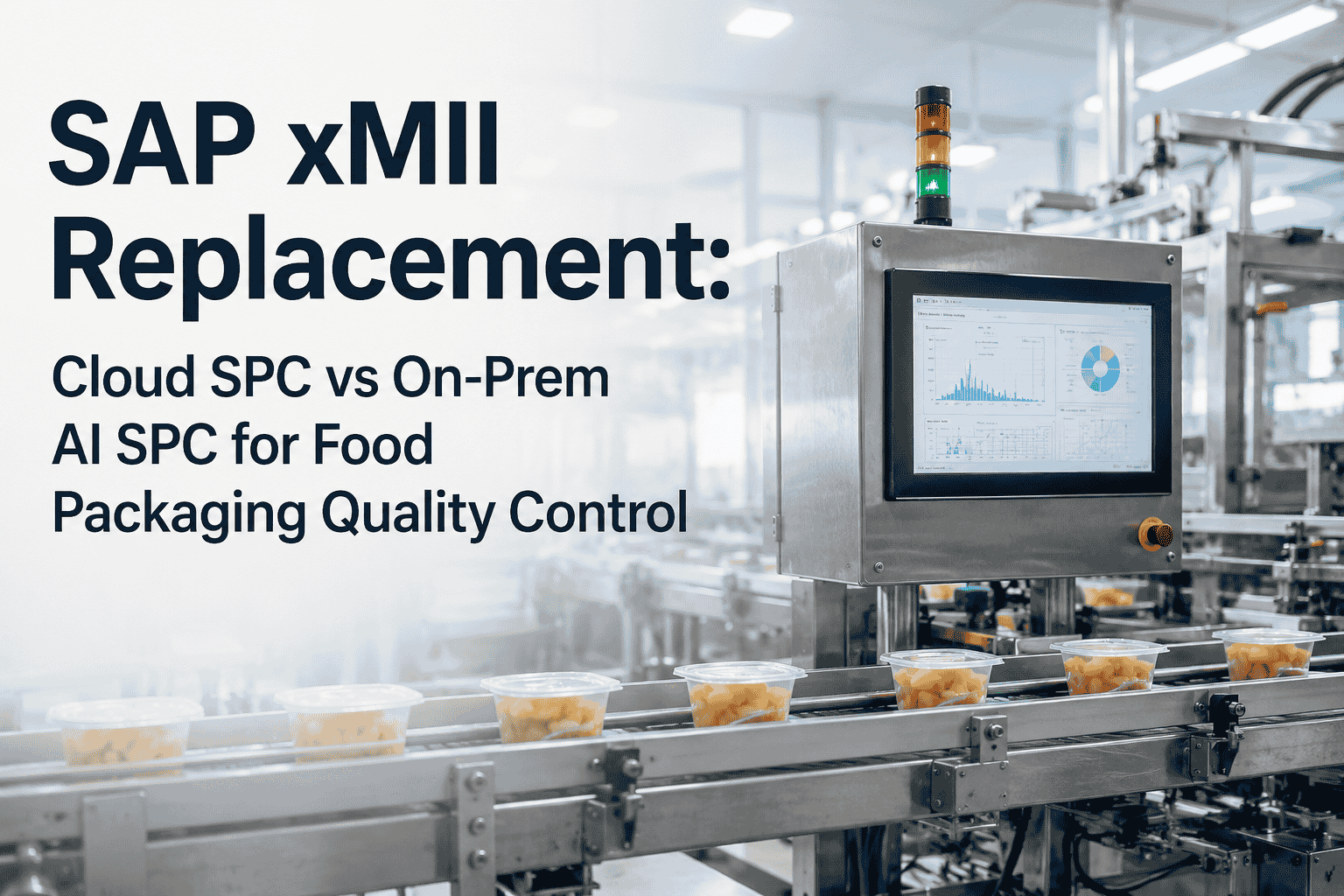
Food & Beverage SAP xMII Migration to AI-Native SPC Quality Platform
By Riley Quinn on May 29, 2026
Manual inspection catches 85% of defects on a typical F&B line; AI vision catches 99% — producing 14× fewer escapes per million units. The gap matters most for defect elimination, where every escape is a potential recall, customer complaint or regulatory finding. Migrating from SAP xMII to an AI-native SPC platform unlocks vision inspection as a real-time sensor that feeds multivariate root cause — not a separate camera system bolted on. Book an AI SPC migration workshop to map vision into your specific line architecture.
The Defect Elimination Journey
From manual sampling to per-unit AI inspection at line speed — three stages, one integrated architecture.
Stage 01 · Detect
99%
Per-unit AI vision catches every defect at line speed
VisionSpectroscopySensors
Stage 02 · Classify
AI-Native SPC + RCA Layer
6 categories · multivariate fusion · sub-100ms
Stage 03 · Eliminate
14×
fewer defect escapes per million units
PLC RejectSAP QMRCA Loop
The Six F&B Defect Categories — What AI Vision Catches
Defect elimination starts with knowing what you’re actually trying to eliminate. F&B defect taxonomies cluster into six categories that AI vision handles dramatically better than manual inspection. The category mix varies by product line, but the structural advantage holds across all six.
Both approaches inspect for defects. The structural differences in coverage, consistency, and traceability are what determine which one can actually deliver defect elimination at modern F&B line speeds.
Legacy
Manual Inspection
Human eyes on a moving line
85% catch rate — 150K escapes per million units
2–5% statistical sampling of units only
55–70% inter-inspector agreement on borderline
15–30% accuracy degradation by end of shift
Batch-level notes — no per-unit traceability
Result:Defect detection, not elimination
vs
Same problem, different architecture
AI-Native
Vision Inspection
Per-unit AI at line speed
99% catch rate — 10K escapes per million units
100% units inspected at 10,000+ per hour
Identical accuracy 24/7 — same model, same verdict
The Vision-to-SPC Integration Flow — What Makes Migration Worthwhile
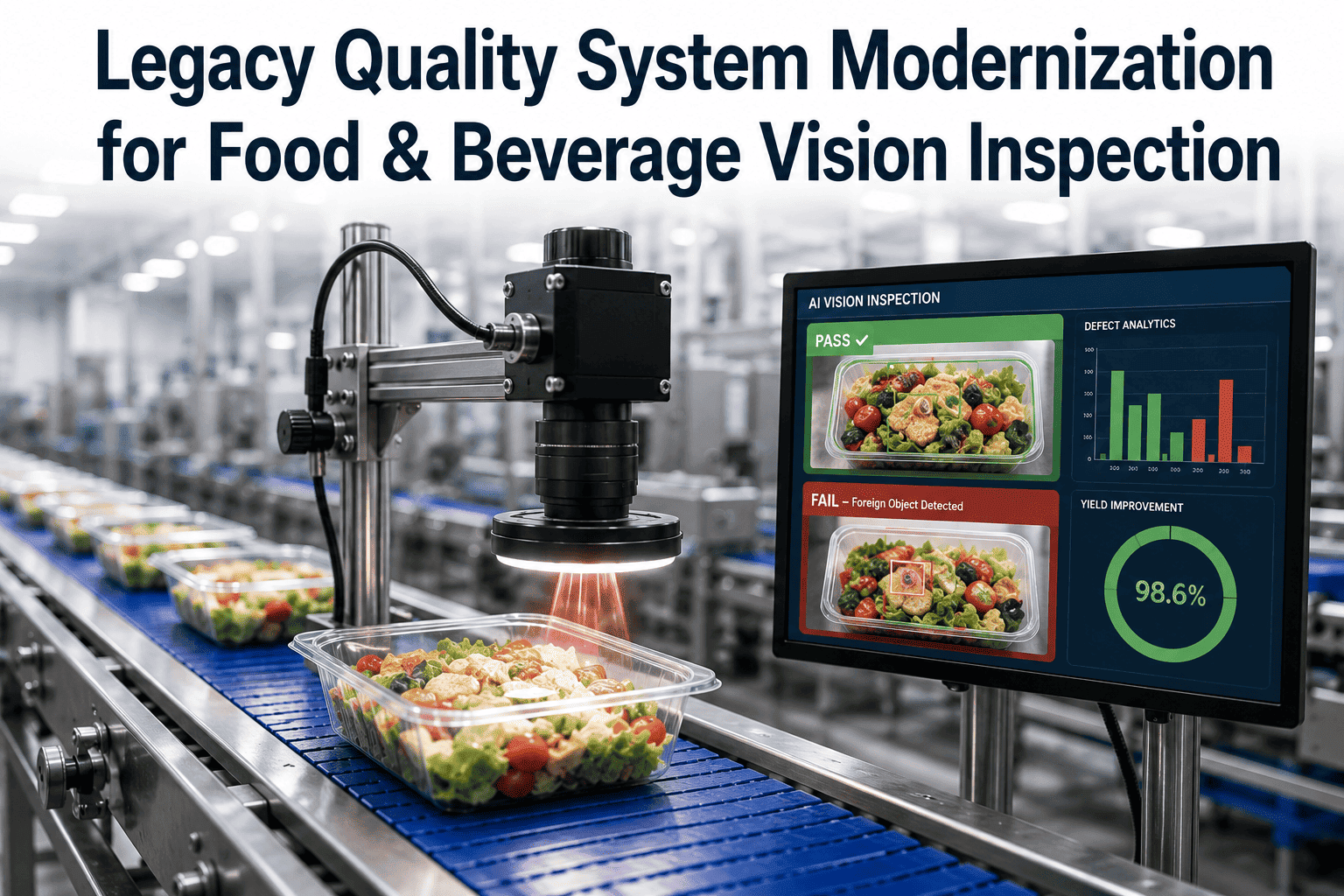
AI vision as a standalone camera system is a productivity tool. AI vision integrated into an AI-native SPC platform is a defect elimination architecture. The difference matters because vision data — per-unit verdicts, defect coordinates, severity scores — needs to feed multivariate SPC to close the root-cause loop.
1
Edge Capture
2–8 IP69K stainless cameras per inspection point with structured LED lighting capture per-unit images at line speed.
<100msedge inference latency on NVIDIA Jetson + H200
2
SPC Fusion
Vision events fuse with PLC, historian, and SAP QM data through LSTM + Nelson + Autoencoder confidence fusion. Defect clusters trigger multivariate RCA.
80+correlated tags analyzed per defect cluster
3
Closed-Loop Action
PLC reject mechanism triggered directly. Quality notification + root cause hypothesis posted to SAP QM. CMMS work order generated if asset health implicated.
100%per-unit traceability for FSMA 204 KDE/CTE
From Defect Detection to Defect Elimination
iFactory ships pre-built AI vision servers integrated with the AI-native SPC platform that migrates your SAP xMII landscape — one project, 8–12 weeks, 7–8 month payback. F&B-specific defect models pre-trained on produce, bakery, protein, beverage. Edge-only data residency.
The vision-integrated SPC architecture isn’t about faster cameras — it’s about closing the loop from defect to root cause to process correction. Four documented benefits define what production-grade vision-integrated platforms deliver versus standalone vision systems or legacy MES SPC.
99%
AI vision catch rate at line speed
vs 85% manual inspection — producing 14× fewer defect escapes per million units across produce, bakery, protein, beverage
37%
Defect rate reduction
Documented average across recent vision deployments — with 85% fewer customer complaints typical within the first quarter post-deployment
374%
Three-year ROI
Average 7–8 month payback period across F&B vision deployments — through defect reduction, recall scope shrinkage, and inspector redeployment
Migration Readiness Checklist — What to Validate Before Week One
Vision-integrated migration succeeds when readiness checks happen before kickoff. Three layers of validation establish whether your plant is positioned for 8–12 week deployment versus the 18-month custom development path most failed migrations take.
Line & Hardware Readiness
Line topology mapped — inspection points identified per SKU
Camera mounting locations and lighting conditions assessed
PLC reject mechanism integration points confirmed
Network bandwidth for edge-to-platform sync verified
"The single biggest mistake F&B plants make in defect elimination is treating AI vision as a standalone camera project rather than as a sensor layer of the broader SPC platform. Vision events that don’t feed multivariate SPC produce defect counts but not defect elimination. The 99% catch rate matters, but the architectural decision — vision integrated with SPC and RCA versus vision running as a parallel system — matters more. Plants that fold vision into the SAP xMII migration as a single project deliver defect elimination within the first quarter post-deployment. Plants that defer vision to a Phase 2 project rebuild the integration architecture 18 months later."
— F&B AI Vision & SPC Practice, 2026 industry insight
99% vs 85%
AI vision vs manual inspection catch rate — 14× fewer escapes
iFactory’s F&B AI vision practice runs a 90-minute workshop applying the defect taxonomy, the vision-to-SPC integration flow, and the xMII migration specifics to your real line topology and defect mix. You leave with a defect elimination projection, the integrated 8–12 week deployment plan, and a vendor scorecard.
Why is the AI vision catch rate 99% while manual is only 85%?
Four structural reasons. First, coverage: AI vision inspects 100% of units while manual inspection relies on statistical sampling (2–5% of units) at modern line speeds of 10,000+ units per hour. Second, consistency: AI vision applies identical detection thresholds 24/7 while human inspectors show 55–70% inter-inspector agreement on borderline defects and 15–30% accuracy degradation by end of shift. Third, sub-millimeter detection: AI vision detects foreign objects at 0.3–0.5 mm while manual inspection floors at roughly 2 mm with optimal lighting. Fourth, multi-angle imaging: 2–8 cameras per inspection point capture defect signatures across multiple angles simultaneously while human inspectors see only what’s in their immediate field of view. The 99% catch rate is documented across multiple recent F&B deployments, not theoretical.
What does "vision integrated with SPC" actually mean architecturally?
Vision events — per-unit verdicts with defect coordinates, severity scores, and confidence levels — flow into the same multivariate SPC engine that monitors PLC tags, historian data, SAP QM notifications, and CMMS records. When a vision cluster appears (e.g., "12 packaging seal failures detected in the last 4 minutes on Line 3"), the SPC engine doesn’t just count the defects — it triggers multivariate root cause analysis against the 80+ correlated process tags upstream of the inspection point. The investigation hypothesis comes back ranked: "85% probability sealing temperature drift, 12% probability film tension variance, 3% probability ambient humidity correlation." This is fundamentally different from standalone vision systems that produce defect counts and dashboards but don’t close the root-cause loop.
Does AI vision deployment require a separate project from the SAP xMII migration?
It shouldn’t. Plants that deploy vision as a separate project rebuild the grounding architecture twice — once for the vision system and once for the SPC platform — and lose the closed-loop integration that delivers actual defect elimination. The right sequence: in the broader 8–12 week xMII migration playbook, vision deployment happens during weeks 4–10 alongside the AI-native SPC layer. Same VMP, same data mapping, same parallel validation. Edge servers ship pre-configured to feed the SPC fabric. Vision models fine-tune on plant data during parallel validation. Cutover happens once, not twice. Cost difference between integrated deployment and separate projects is typically 40–60% across the total migration lifecycle.
What happens to images — do they leave the plant?
No. Raw images stay on the edge device. Each camera inspection point runs inference locally on NVIDIA Jetson or H200 silicon, produces per-unit verdicts and metadata, logs verdicts plus thumbnails for audit, and shares only model weight updates with the central platform via federated learning. Raw images never traverse the network or leave the plant. This matters for three reasons: data residency (proprietary line configurations and product recipes stay in-plant), regulatory compliance (potential PII in operator hands or faces stays controlled), and bandwidth (raw video at line speed would overwhelm any network). The federated learning model means each camera contributes to platform-wide model improvements without exposing the underlying images.
How does FSMA 204 traceability work with per-unit imaging?
FSMA 204 requires Key Data Element (KDE) and Critical Tracking Event (CTE) capture for designated foods to enable rapid recall scope reduction. Per-unit AI vision inspection automatically captures the KDEs each CTE requires: timestamp, lot identifier, line identifier, defect verdict, severity score, and unit-level image reference. When a recall is triggered, the trace works at the unit level rather than the batch level — meaning if defects are confined to a 4-hour production window on a specific line, the recall scope shrinks to that window rather than the full batch. This is the difference between a $10M batch-scope recall and a $400K unit-scope recall. Manual sampling approaches can’t produce per-unit KDE records and force broader recall scopes that multiply cost, waste, and consumer exposure.