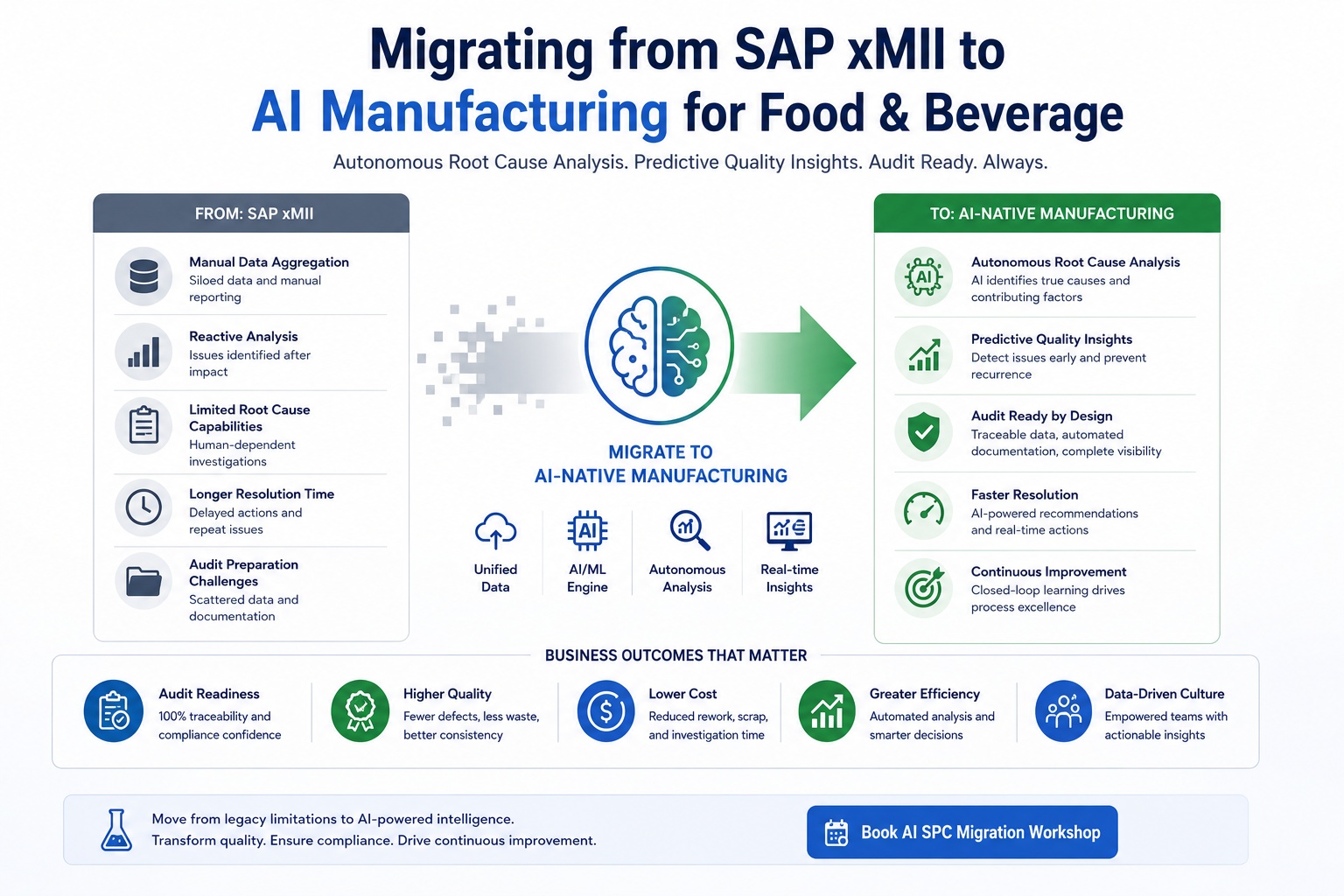
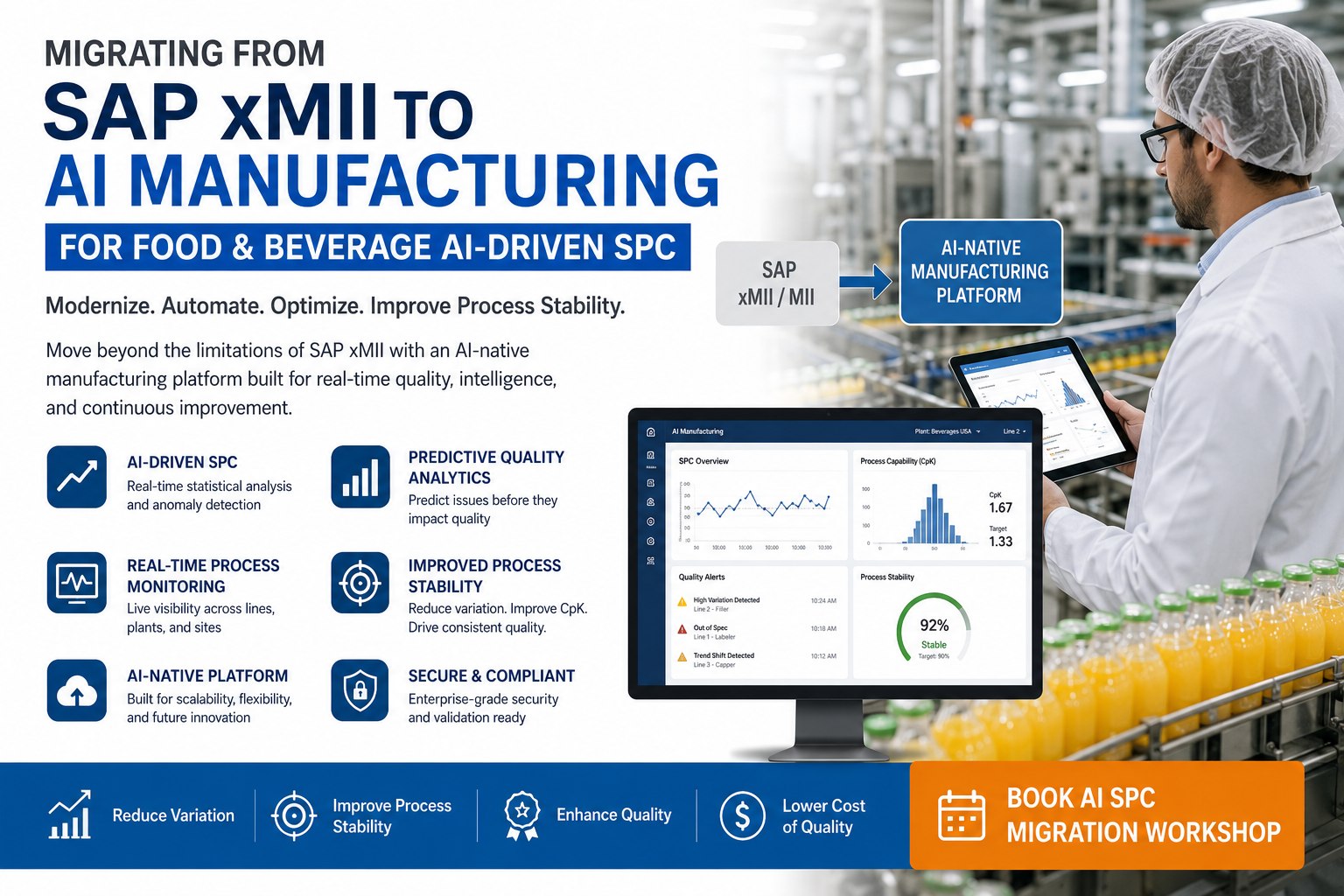
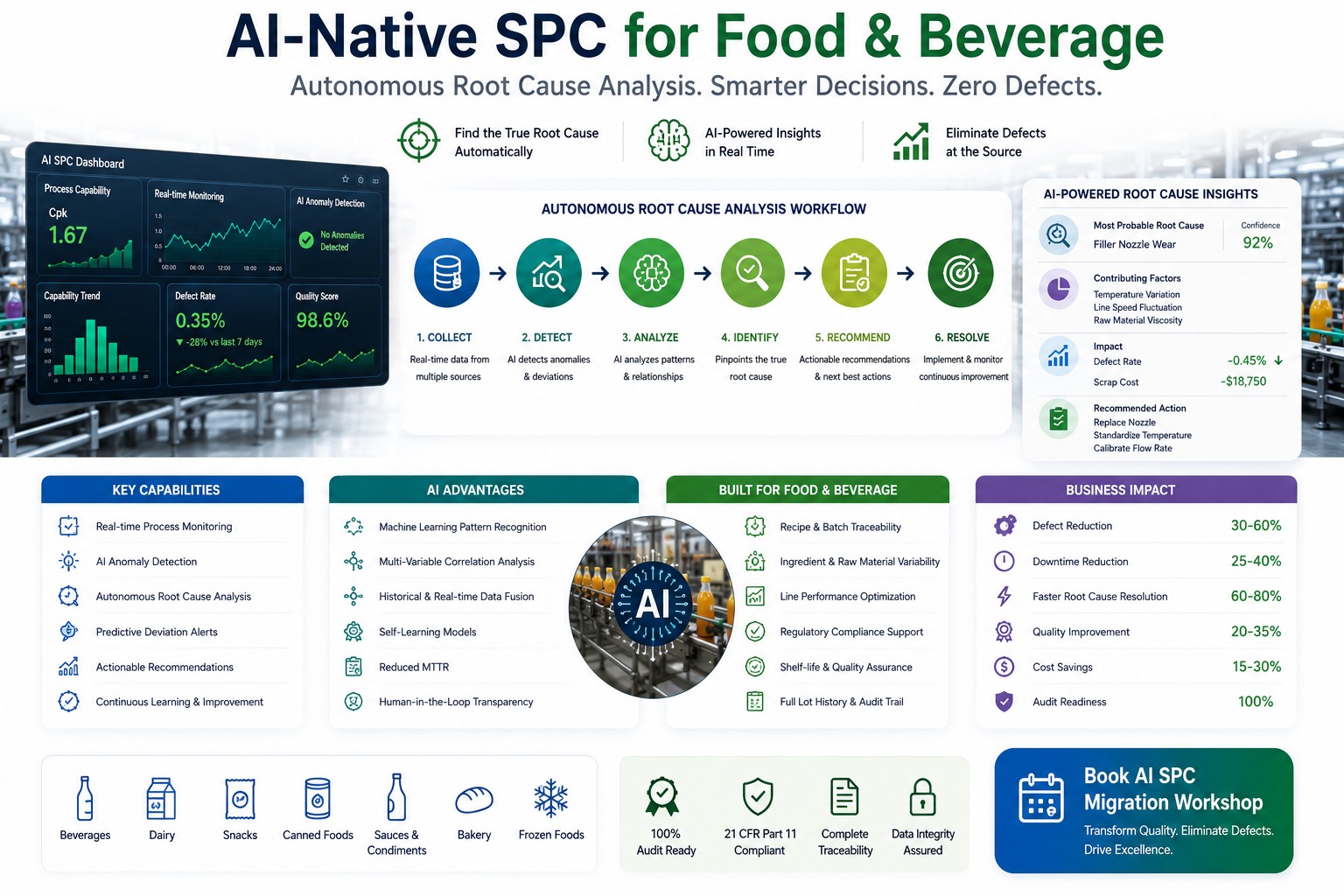
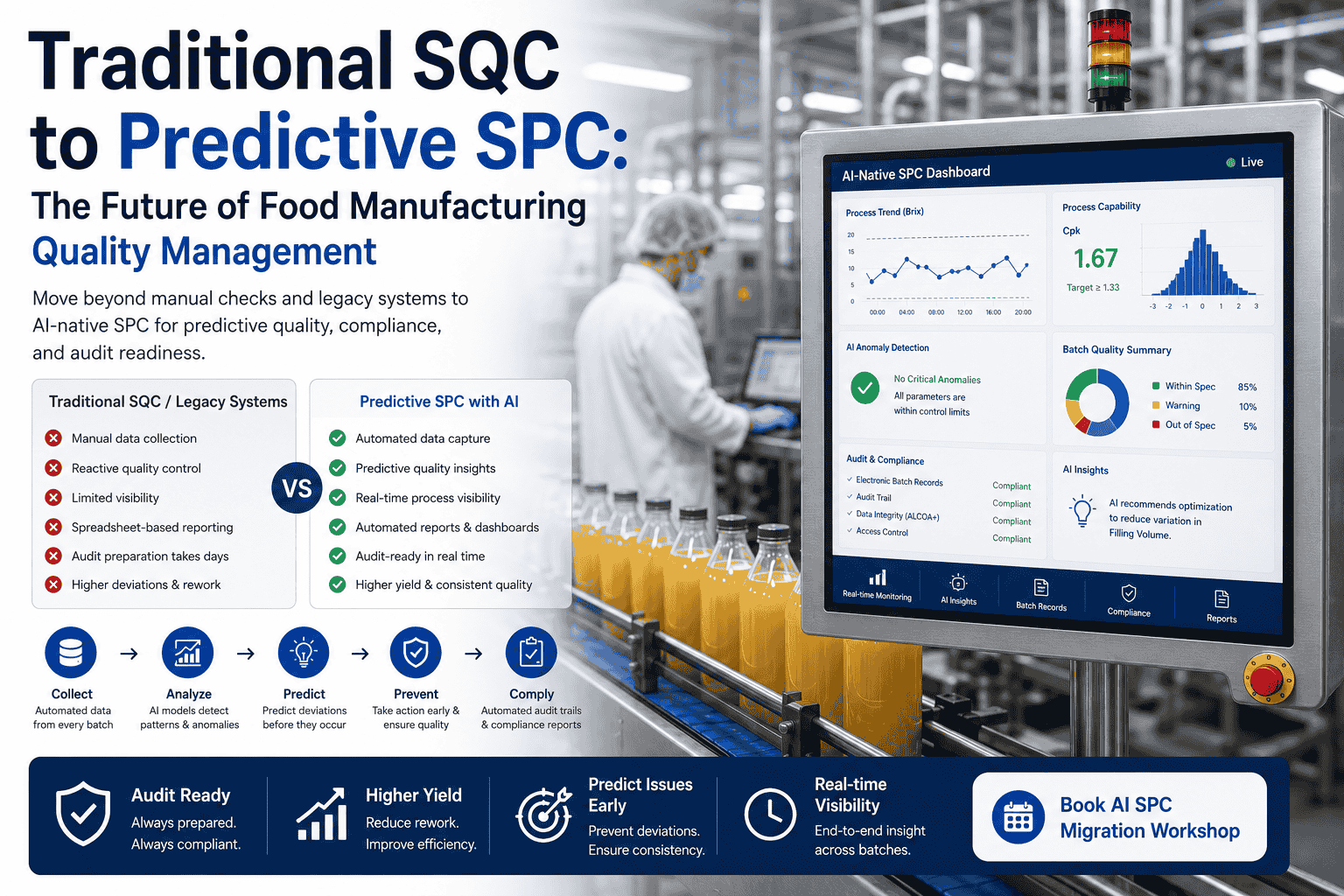
Migrating from SAP xMII to AI Manufacturing for Food & Beverage Autonomous Root Cause Analysis
By Riley Quinn on June 18, 2026
When an FDA inspector arrives unannounced at your facility and asks for corrective action records, HACCP monitoring logs, and root cause documentation for the last 90 days, how long does it take your team to produce them? For facilities still running SAP xMII — where RCA is a manual investigation process and audit records are assembled from shift logs, spreadsheets, and filing cabinets — the honest answer is hours. Sometimes days. Book a demo to see how AI-native autonomous RCA delivers evidence-backed findings in 3 to 5 minutes and keeps your facility continuously audit-ready — not just audit-prepared the week before an inspection.
HERO: RCA time comparison + audit readiness spectrum
SAP xMII to AI-Native Migration — Autonomous RCA & Audit Readiness
From 45-Minute Manual Investigations to 3-Minute AI-Computed Root Cause
SAP xMII Manual RCA
45 to 75 min per event
Reactive
AI Autonomous RCA
3 to 5 min
Pre-computed
015 min30 min45 min60 min75 min
10x
Faster root cause analysis with AI vs. manual investigation
Always
Audit-ready — continuous documentation, not pre-audit compilation
4 to 24 hr
Predictive warning before quality event requires RCA at all
SECTION 1
The RCA Problem SAP xMII Was Never Built to Solve
SAP xMII was designed as a manufacturing integration and dashboard platform, not a quality intelligence engine. Its rule-based SPC fires alerts when process parameters cross fixed control limits — but the investigation that follows is entirely manual. A quality engineer must pull historian data, review shift logs, check equipment maintenance records, interview line operators, and build a causal hypothesis from scratch. Every time. For a food and beverage plant running four to eight production lines with multiple quality events per shift, that manual investigation burden compounds rapidly into a structural drain on your most experienced people.
Step 1
Alert Fires in xMII
0 min
Control limit breach detected. xMII fires alert. No context, no correlated variables, no pre-computed hypothesis — investigation queue starts blank.
Step 2
Historian Data Pull
10 to 20 min
Engineer manually retrieves process data from historian. Searches across time windows, tags, and equipment states to identify what changed before the alert.
Step 3
Shift Log & Equipment Review
15 to 25 min
Review paper shift logs, maintenance records, and operator notes. Cross-reference ingredient lot changes, line changeovers, and CIP cycles manually.
Step 4
Conclusion (Often Inconclusive)
45 to 75 min total
Team reaches a hypothesis — often single-variable, frequently unverified. Documented in CAPA record. Root cause frequently recurs because causal chain was incomplete.
How many engineer-hours does your plant spend on manual RCA each month? Book a demo and RCA burden assessment — we will quantify the investigation time your team spends and show what autonomous RCA delivers instead.
SECTION 2
How Autonomous RCA Works — The AI Approach
Autonomous RCA in an AI-native platform is not a faster version of manual investigation. It is a fundamentally different architecture. Instead of launching an investigation after an alert fires, the AI agent runs a continuous multivariate causal analysis across every process variable, equipment state, ingredient lot record, and operator action — in real time, around the clock. When an anomaly occurs, the root cause explanation is already pre-computed. The operator does not start an investigation. They review a finding.
AI RCA architecture: 3-layer stack
How the AI Builds Root Cause Before You Ask For It
Layer 3
Root Cause Output
Evidence-backed causal explanation surfaces in operator dashboard in 3 to 5 minutes after anomaly is confirmed. Includes ranked contributing variables, correlated process signatures, recommended corrective action, and CAPA record auto-draft.
What Operator Sees
Layer 2
Multivariate Causal Correlation
AI agent correlates equipment state, process parameters, ingredient lot history, CIP cycles, line speed, environmental conditions, and operator actions — simultaneously, continuously, across all production lines.
Runs Continuously
Layer 1
Real-Time Data Ingestion
Every sensor reading, historian tag, lot record, maintenance log, and operator entry — ingested from your existing infrastructure. No new sensors required in most F&B deployments. Data flows in from PLCs, LIMS, ERP, and production historian.
Foundation
SECTION 3
The Audit Readiness Gap: What SAP xMII Leaves Exposed
Audit readiness in food and beverage manufacturing is not a documentation project — it is an operational discipline. Regulatory agencies, GFSI certification bodies, and major retail customer auditors expect documented evidence that is accurate, complete, instantly retrievable, and demonstrably continuous. SAP xMII generates operational data, but the audit-ready documentation layer — corrective action records, root cause evidence trails, CAPA completion verification — is assembled manually, often under pre-audit time pressure. This is where the exposure lives.
Records assembled under pressure before each audit. Paper logs, spreadsheets, filing cabinets. Missing entries create findings. RCA documentation incomplete or inconclusive.
Most xMII-Dependent Plants Today
Level 2
Structured Digital Records
Digital QMS with structured CAPA records. Faster retrieval but still requires manual RCA input. Audit prep reduced to hours rather than days. RCA quality depends on engineer availability and expertise.
Achievable with Legacy Platforms
Level 3
Real-Time Compliance Monitoring
CCP monitoring automated. Deviations flagged immediately. CAPA records opened automatically on alert. Audit package retrievable on demand. Manual RCA still required for causal documentation.
Mid-Range Modernization
Level 4
Continuous Autonomous Audit Readiness
AI-native platform. Root cause pre-computed. CAPA auto-drafted with evidence chain. Every deviation documented with timestamp, correlated variables, corrective action taken, and outcome verification. Audit package generated on demand in minutes — any time, any auditor.
Target State — AI-Native Platform
Where does your plant sit on the audit readiness maturity ladder today? Book a free maturity assessment demo — our F&B compliance team will map your current state and show you what Level 4 looks like for your operation.
CTA 1
See Autonomous RCA and Continuous Audit Readiness in Action
iFactory's AI SPC Migration Workshop demonstrates autonomous RCA and continuous audit readiness on representative F&B scenarios — including a live comparison of what your current xMII-based investigation process looks like vs. AI-pre-computed root cause with CAPA auto-documentation. Half-day session, concrete output.
What Changes in Your CAPA Process When RCA Is Autonomous
The CAPA cycle — Corrective and Preventive Action — is the audit currency of food and beverage manufacturing. Every GFSI scheme, every FDA preventive control framework, and every major retail customer audit expects documented evidence that your CAPA records are complete, that root causes are genuine rather than symptomatic, and that corrective actions are verified for effectiveness. Manual RCA produces incomplete CAPA records because the causal chain is often cut short by time pressure, single-variable analysis, or unavailability of the right engineer at the right moment. Autonomous RCA changes all three.
CAPA comparison: before/after two-column
CAPA with SAP xMII Manual RCA
CAPA with AI Autonomous RCA
Root Cause Identification
Engineer-built hypothesis from manual data pull. Single-variable focus. Often incomplete under time pressure.
Multivariate causal chain pre-computed across all process variables. Evidence-ranked. Completed in 3 to 5 minutes.
CAPA Record Quality
Depends on engineer availability and experience. Inconsistent across shifts. Frequently flagged in audits for incomplete causal documentation.
Auto-drafted with full evidence trail — anomaly signature, correlated variables, ingredient lot, equipment state, and corrective action recommended.
Time to CAPA Closure
Days to weeks. Investigation time plus scheduling corrective action plus verification follow-up — all tracked manually.
AI monitors corrective action effectiveness automatically. CAPA closure verified by process data — not by manual follow-up scheduling.
Recurring Defect Prevention
Recurrence common because single-variable RCA misses upstream systemic causes. Same investigation relaunched next event.
Multivariate root cause identifies systemic contributors. Recurrence rate drops because the causal chain is complete, not truncated.
Audit Evidence Trail
Assembled from shift logs, emails, and CAPA software. Gaps common. Auditor findings frequently cite incomplete corrective action evidence.
Continuous, tamper-evident documentation chain. Every anomaly, RCA, corrective action, and verification linked. Audit package generated on demand.
Unannounced Inspection Readiness
Hours of record compilation. Risk of gaps, missing signatures, or mismatched dates. Creates findings for inadequate recordkeeping even when operations were compliant.
Always ready. Any record retrievable in seconds. Full 90-day CAPA history, monitoring logs, and corrective action evidence instantly available.
SECTION 5
The Compliance Documentation Gap: What F&B Auditors Actually Find
The most common audit findings in food and beverage manufacturing are not process failures — they are documentation failures. FDA Form 483 observations, GFSI non-conformances, and customer audit findings repeatedly cite the same categories: corrective action records that do not document the root cause, monitoring logs with missing entries, and CAPA records that address symptoms rather than causal chains. All of these are direct consequences of manual RCA on SAP xMII or legacy platforms.
Incomplete CAPA Root Cause
Corrective action records exist, but root cause documentation is symptomatic rather than causal. Auditors cite inability to demonstrate that the underlying cause was identified and addressed.
AI fix: Autonomous RCA provides full multivariate causal chain — not just the proximate trigger — automatically documented in every CAPA record.
Missing Monitoring Log Entries
CCP monitoring records show gaps — missed entries, unsigned check-in times, or paper logs that could not be located during the audit. Auditors question whether monitoring actually occurred.
AI fix: Continuous automated CCP monitoring creates a complete, timestamped, tamper-evident log. No manual entry gaps possible.
CAPA Effectiveness Not Verified
Corrective actions were taken, but no documented verification that the action was effective. CAPA records closed without process data showing the root cause was eliminated.
AI fix: AI monitors process behavior after corrective action is implemented. Effectiveness verified automatically against historical process signatures — documented in the CAPA record.
Procedures Not Reflecting Current Operations
SOPs and Food Safety Plans last updated 18 to 36 months ago. Equipment changes, recipe modifications, and new product introductions not reflected in documented procedures.
AI fix: Process change detection surfaces procedure gaps automatically when production signatures deviate from documented SOPs — triggering update workflow before the auditor finds the gap.
Which of these findings does your current xMII deployment leave you exposed to? Talk to our F&B compliance team — we will walk through your specific audit history and documentation architecture before you make any migration commitment.
SECTION 6: Stats + Expert
Expert Perspective: Why Autonomous RCA Changes the Audit Conversation
The most common audit finding in food and beverage manufacturing is not a process failure — it is a documentation failure. Facilities receive Form 483 observations for inadequate recordkeeping when their actual operations were compliant. The problem is that SAP xMII and legacy platforms generate operational data without generating audit-ready documentation. RCA is a manual, after-the-fact exercise, and CAPA records reflect what the engineer had time to document — not necessarily the full causal chain. AI-native platforms reverse this: root cause is pre-computed before the operator asks, CAPA records are auto-drafted with the evidence trail already populated, and every corrective action is monitored for effectiveness automatically. The result is continuous audit readiness — not a pre-audit scramble.
— iFactory AI SPC Migration Research, F&B Compliance Operations 2025 to 2026
3 to 5 min
Autonomous RCA vs. 45 to 75 min manual — per event
$180K
Documented remediation cost from one documentation-gap audit finding
Dec 2027
SAP xMII mainstream support end date — compliance risk accelerates after
Migrate from SAP xMII to Autonomous RCA — Live in 6 to 12 Weeks
iFactory's AI SPC Migration Workshop covers your current xMII RCA burden assessment, a live demonstration of autonomous RCA and continuous audit documentation on F&B scenarios, CAPA workflow walkthrough, three-path migration comparison, and a documented ROI model against your investigation time, audit prep cost, and compliance risk baseline.
What does autonomous root cause analysis mean in practice for F&B manufacturing?
Autonomous RCA means the AI agent runs a continuous multivariate causal analysis across all process variables, equipment states, ingredient lot records, CIP cycles, and operator actions — in real time, before any alert fires. When an anomaly is detected, the root cause explanation is already pre-computed. The operator reviews a ranked, evidence-backed finding in 3 to 5 minutes rather than launching a manual investigation from a blank queue. This eliminates the 45 to 75 minute manual investigation cycle per event that SAP xMII and legacy platforms require.
How does autonomous RCA improve audit readiness for FDA, GFSI, and customer audits?
Every autonomous RCA generates a complete, timestamped evidence trail — anomaly signature, correlated process variables, ingredient lot, equipment state, corrective action taken, and effectiveness verification — automatically documented in the CAPA record. This produces continuous audit-ready documentation rather than pre-audit compilation from shift logs and spreadsheets. When an FDA inspector arrives unannounced requesting 90 days of corrective action records, any record is retrievable in seconds — eliminating the most common audit finding category: documentation gaps, not process failures.
Why does manual RCA in SAP xMII produce recurring defects despite completed CAPA records?
Manual RCA under time pressure typically identifies the proximate trigger of a quality event — the immediate cause — rather than the full multivariate causal chain. Single-variable analysis misses upstream systemic contributors: ingredient lot interactions, CIP cycle completeness, equipment degradation signatures, or shift changeover conditions. Because the true root cause is not identified, corrective actions address symptoms rather than causes, and the same defect signature recurs in the next relevant batch. Autonomous RCA's multivariate correlation identifies the complete causal chain — producing CAPA records that actually prevent recurrence.
Can iFactory's autonomous RCA work alongside SAP ERP and existing LIMS systems?
Yes — iFactory's AI-native platform is designed as an intelligence layer that integrates with your existing SAP ERP, LIMS, historian, and shop floor systems, not a replacement for them. Data flows in from your existing infrastructure — PLCs, historian tags, LIMS records, SAP ERP lot data — without requiring new sensors in most F&B deployments. The platform delivers autonomous RCA and continuous audit documentation on top of the data your current systems already generate, running on a pre-configured NVIDIA appliance on-premise inside your plant. Live in 6 to 12 weeks.
What does the AI SPC Migration Workshop cover for autonomous RCA and audit readiness?
The half-day workshop covers your current xMII RCA burden assessment, a live demonstration of autonomous RCA and continuous CAPA documentation on representative F&B scenarios, CAPA workflow walkthrough with your specific regulatory framework, three-path migration comparison, deployment roadmap, and a documented ROI model against your investigation time, audit prep cost, and compliance risk baseline. Suitable for quality, compliance, plant operations, IT, and finance stakeholders together. Register your team for the AI SPC Migration Workshop here.