Autonomous Root Cause Analysis in Dairy Processing Plants
By Riley Quinn on May 27, 2026
FDA inspection data shows that roughly 4 out of every 10 Form 483 observations in regulated manufacturing sites stem from inadequate deviation investigations and weak CAPA closure quality. The pattern is identical in dairy: inspectors no longer judge plants on whether documentation exists — they judge plants on how effectively process deviations get investigated, how rigorously root causes get identified, and how reliably the same deviation stops recurring. Manual root cause analysis can’t keep up with that bar at modern dairy line speeds. Autonomous RCA can. The question for operations leaders evaluating RCA platforms in 2026 isn’t whether to automate the investigation layer — it’s how to evaluate the vendors making similar claims, where the ROI lands first, and what the cost actually looks like of running another year without it. This guide is for buyers and evaluators of autonomous RCA solutions for dairy processing — the cost-of-inaction math, the evaluation framework, the integration approach, and the questions to ask before signing. Book a demo with us to walk through your line’s deviation history and see autonomous RCA applied to it.
The Hidden Annual Cost
What a Dairy Line Pays Without Autonomous RCA
Five quiet cost categories most plants stopped trying to quantify because manual RCA couldn’t close the loop. Vision shifts when the numbers get visible.
$2.4M
Unplanned downtime
Annual cost of separator and pasteurizer failures that could have been caught 24–72 hours earlier
$800K
Recurring CAPA failures
Same deviation investigated 3+ times annually because RCA never reached the true system root cause
$10M+
Average recall exposure
Single contamination or labeling recall — cost autonomously preventable through earlier deviation detection
$450K
Investigation labor
Quality engineering FTE hours absorbed by deviation paperwork instead of process improvement work
Variable
Audit-week disruption
Form 483 risk plus operational disruption during inspector visits when CAPA closure cannot be demonstrated
A typical $200M-revenue dairy plant carries roughly $3–$4M annually in costs that autonomous RCA addresses directly — before considering recall avoidance.
What Autonomous RCA Catches That Manual RCA Misses
Manual root cause analysis on a dairy line is forensic — the defect happened, the batch is diverted, the operator is reconstructing what occurred from logs, samples, and memory. Autonomous RCA inverts that workflow. Five diagnostic functions run continuously in the background: anomaly detection, causal hypothesis generation, evidence validation, remediation planning, and outcome capture. By the time the alert reaches the HMI, the investigation is already complete — with a ranked root cause, supporting evidence, and a prescriptive action attached. Here’s what each side actually delivers.
Swipe horizontally to compare manual vs autonomous RCA
Capability
Manual RCA
Autonomous RCA
Investigation start
After defect forms · hours to days later
5–15 min before defect · predictive trigger
Time to root cause
30 min–3 days per investigation
Seconds · pre-computed by 5 diagnostic agents
Variables analyzed in parallel
2–5 variables realistically
80+ tags multivariate correlation simultaneously
Knowledge retention
Lives in one operator’s head + paper CAPA log
Self-updating failure-pattern library across shifts
CAPA recurrence rate
Same issue investigated 3+ times annually
Library prevents recurrence structurally
Audit evidence quality
Paper logbook + verbal reconstruction
Tamper-evident audit trail with confidence scores
Coverage
Only investigated events · many minor issues skipped
Every drift event analyzed · no skipped investigations
The Three High-Impact Deviation Categories Autonomous RCA Addresses First
Not every dairy deviation costs the same. Three categories dominate the cost-of-inaction math on most lines, and they’re where autonomous RCA earns its first quarter ROI. Knowing which category drives your specific exposure is how you frame the vendor conversation.
Drift discovered 30–120 minutes after it starts. Investigation forensic. CAPA closure weeks later. Same drift recurs next quarter.
With autonomous RCA
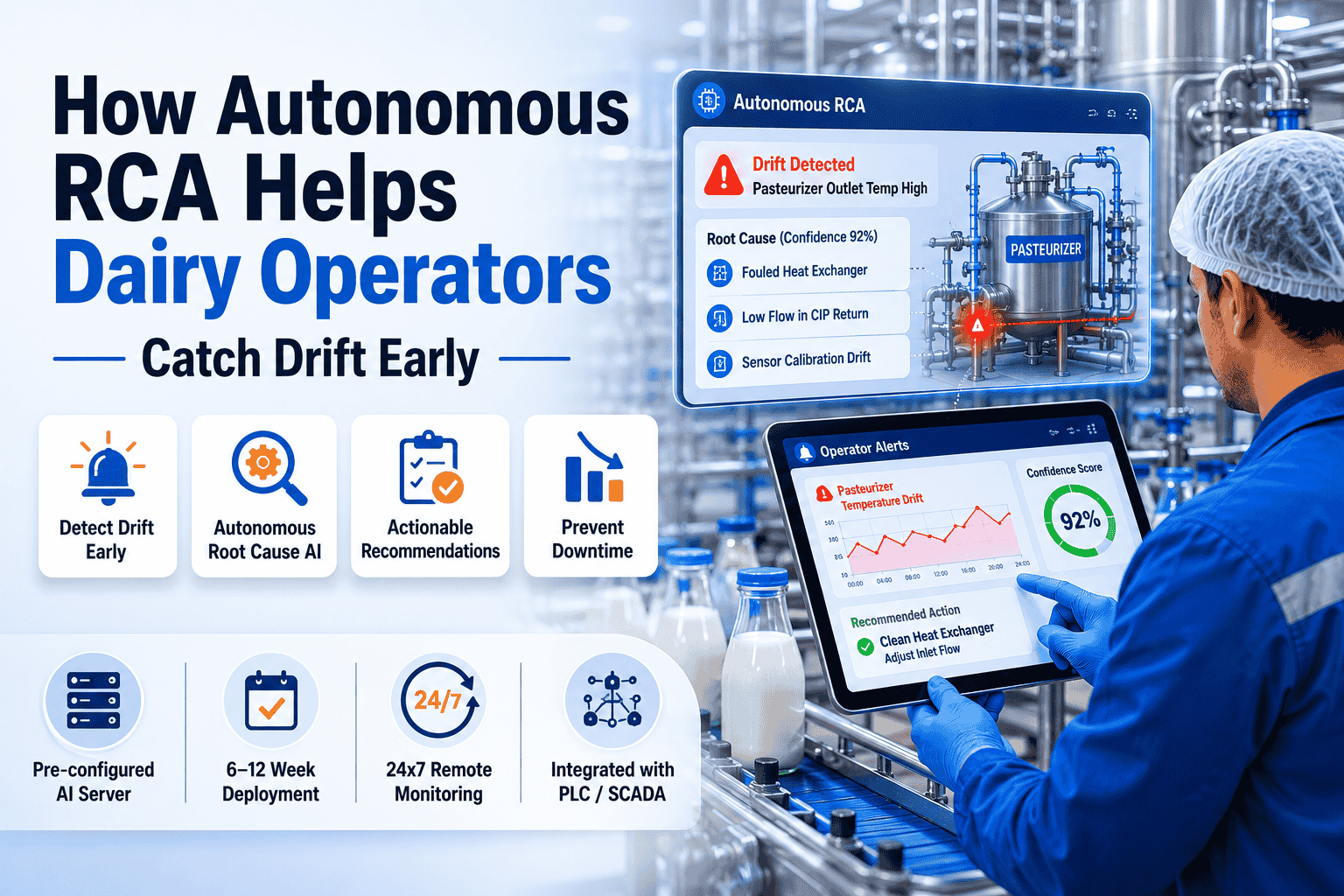
Drift caught 5–15 min before it crosses spec. Root cause pre-ranked. Prescriptive action surfaces on HMI. Recurrence prevented via failure-pattern library.
Category 02
Quality Deviation Events
Examples on dairy lines
Off-spec fat content · SCC or BAC counts trending up · protein standardization variance · texture defects in yogurt · flavor profile drift in cultured products
Without autonomous RCA
Lab confirms deviation after batch produced. Investigation team chases logs to reconstruct upstream cause. CAPA documented for the auditor but rarely effective.
With autonomous RCA
Multivariate correlation surfaces the upstream cause before lab confirms downstream defect. CAPA effectiveness verifiable in days, not quarters.
Category 03
Audit & Compliance Failures
Examples on dairy lines
Form 483 observations · BRCGS findings · SQF non-conformities · orphan deviations with no CAPA · repeat findings indicating CAPA ineffective
Without autonomous RCA
Auditor finds same deviation type appearing repeatedly. CAPA closure quality flagged. Form 483 or Warning Letter risk escalates with each repeat.
With autonomous RCA
Every deviation auto-paired with corrective action. Failure-pattern library demonstrates structural prevention. CAPA effectiveness provable on demand.
Want to see which of the three categories carries the highest cost exposure on your specific line? Book a cost-of-inaction analysis with our dairy RCA specialists.
How to Evaluate an Autonomous RCA Vendor — The Buyer’s Framework
Vendor marketing decks all sound similar. The differences that matter for a dairy deployment are in eight specific evaluation criteria. Plants that walk into vendor conversations with this checklist close the gap between “sales demo” and “production deployment” in 6–12 weeks. Plants that don’t typically spend 18–24 months learning these criteria the hard way.
01
Multi-Agent vs Single-Model Architecture
Ask:
"Do you use a single LLM or a multi-agent diagnostic stack?"
Multi-agent architectures (anomaly detection + causal hypothesis + evidence validation + remediation + outcome capture as separate agents) reduce hallucination and improve interpretability. Single-model approaches are faster to demo, slower to trust on shift.
02
Failure-Pattern Library Persistence
Ask:
"Does the library self-update from operator confirmations?"
A platform that doesn’t learn from your plant’s confirmed root causes will keep flagging the same patterns indefinitely. The library’s ability to retain plant-specific knowledge across shifts is the difference between a tool and a colleague.
03
Multivariate Analysis Depth
Ask:
"How many process tags can be correlated in a single investigation?"
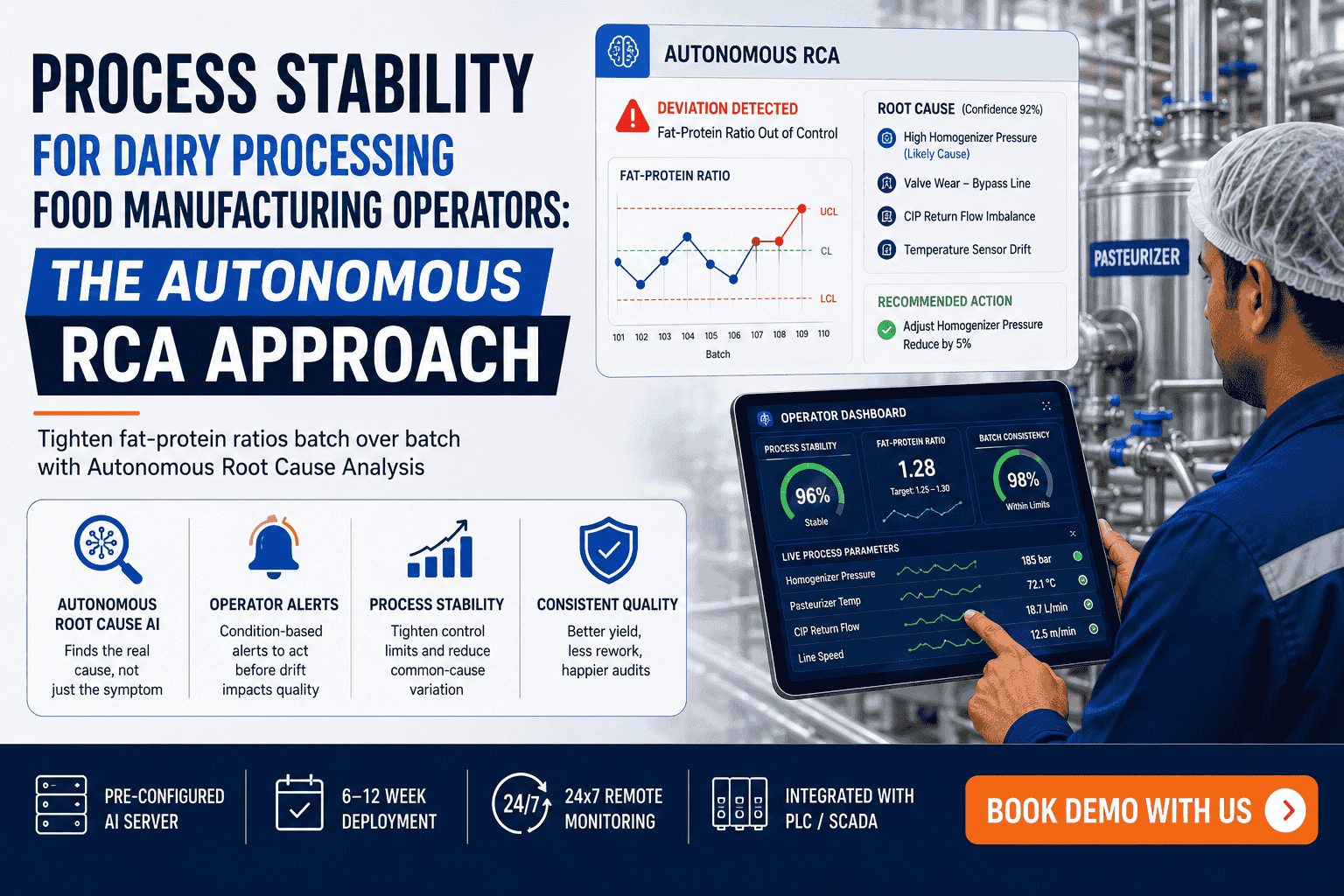
Dairy deviations almost always involve multiple variables. A platform analyzing 5–10 tags will miss most root causes. The threshold for serious dairy RCA is 80+ tags multivariate, with neural-network permutation algorithms computing each variable’s contribution score.
04
PLC and SCADA Native Integration
Ask:
"Which industrial protocols do you support natively?"
OPC UA, Modbus TCP, EtherNet/IP, PROFINET should all be native. Custom-adapter requirements add 2–6 weeks to deployment and create ongoing maintenance burden. Native protocol support is non-negotiable for production-grade dairy deployments.
05
Confidence Scoring & Explainability
Ask:
"Does each alert come with a confidence score and evidence trail?"
Operators won’t trust black-box alerts on shift. Every recommendation must arrive with an explicit confidence percentage and the supporting variable contributions. This is where multi-agent architectures pay off — evidence validation is a discrete agent function.
06
21 CFR Part 11 Audit Trail
Ask:
"Is your evidence trail tamper-evident and GFSI-ready?"
Every prescriptive action and operator confirmation must generate an immutable, time-stamped record satisfying 21 CFR Part 11 electronic records standards. This is what turns autonomous RCA from a productivity tool into a CAPA closure system.
07
Deployment Timeline
Ask:
"How long until first validated alert in production?"
6–12 weeks is the production-grade benchmark. Pre-configured dairy templates accelerate model training on 6–8 weeks of your historical data. Vendors quoting 12+ months are selling custom development, not a deployment.
08
Operator Training Footprint
Ask:
"What training do operators need on day one?"
A platform requiring days of operator training has the wrong abstraction. Production-grade autonomous RCA needs 60–90 minutes plus shift-side support during week one. Operators’ physical workflow doesn’t change — only the quality of HMI information.
A 30-Minute Demo Worth the Calendar Slot
iFactory will walk through every criterion in the evaluation framework against your line’s real specs — PLC stack, current deviation types, FDA inspection history, deployment timeline targets. You leave with a deployment plan, a cost-of-inaction projection, and clarity on the first quarter ROI.
How Autonomous RCA Connects to the Rest of Your Stack
The commercial-investigation question after “does it work” is “does it work with what we already have.” The honest answer for dairy plants in 2026 is yes — integration patterns are mature, predictable, and don’t require ripping out anything you already run. Here’s what the integration topology actually looks like across the four systems autonomous RCA must talk to.
PLC & SCADA
OPC UA · Modbus TCP · EtherNet/IP · PROFINET
Reads tag data continuously from existing PLCs. Pushes prescriptive alerts back to operator HMI. No control loop changes — PLCs continue running safety control logic exactly as today.
Historian & MES
REST API · SQL · MQTT · Kafka
Ingests 6–8 weeks of historical data during deployment for model calibration. Streams deviation events, root causes, and outcomes back for production data joins and analytics.
QMS & LIMS
REST API · HL7 · ODBC
Auto-generates CAPA records from every prescriptive action taken. Pairs deviations with corrective actions in the format your existing quality system expects. No orphan deviations structurally possible.
CMMS & Audit
REST API · Webhooks · 21 CFR Part 11
Triggers maintenance work orders when failure patterns indicate equipment wear. Feeds 21 CFR Part 11 tamper-evident audit trail directly to inspector-ready evidence packages.
The First-Quarter ROI Path — What 12 Weeks Actually Delivers
The commercial conversation about autonomous RCA isn’t complete without a defensible ROI projection. Here’s what a typical dairy plant sees in the first quarter post-deployment — documented across multiple recent implementations and benchmarked against the cost-of-inaction baseline.
Weeks 1–4
Foundation
PLC and SCADA integration complete
Historian ingest of 6–8 weeks plant data
Dairy-specific model templates calibrated
First validated alerts · shadow mode running
Weeks 5–8
Validation
Shadow mode vs manual RCA comparison
Confidence thresholds tuned per asset
Failure-pattern library seeded from history
First prescriptive actions on HMI · live
Weeks 9–12
Production
QMS / LIMS / CMMS integrations live
CAPA auto-pairing with deviations active
Audit trail validated against GFSI scheme
First quarter ROI measurable · cost-of-inaction baseline broken
Want a defensible first-quarter ROI projection built around your plant’s historical deviation data? Book a working session with our dairy RCA team.
Expert Perspective
"The FDA inspection trend is unambiguous: roughly 40% of Form 483 observations in regulated manufacturing now stem from inadequate deviation investigations and weak CAPA closure. Inspectors no longer judge documentation availability — they judge investigation depth, root-cause accuracy, and CAPA effectiveness across the lifecycle. Manual RCA simply cannot deliver that bar at modern dairy line speeds. The plants that move first on autonomous RCA in 2026 aren’t buying productivity software — they’re buying structural risk insurance against the FDA enforcement direction the regulator has telegraphed for three consecutive years. The cost-of-inaction math no longer requires hypothesis: it’s the visible 4-out-of-10 ratio on every inspection summary report."
— Dairy Manufacturing Compliance Practice, 2026 industry insight
40%
FDA 483 observations linked to inadequate deviation investigations
5 agents
multi-agent diagnostic architecture vs single-model approaches
6–12 wk
production-grade deployment with pre-configured dairy templates
Conclusion: The Question Has Shifted from "Whether" to "Which Vendor"
Autonomous RCA has crossed the maturity threshold for dairy processing. The cost-of-inaction math is no longer hypothetical — FDA inspection data quantifies it on every published 483 summary. The technology is no longer experimental — multi-agent diagnostic architectures are production-grade with documented dairy deployments closing 6–12 month ROI windows. The integration is no longer custom — native protocol support for OPC UA, Modbus, EtherNet/IP, and PROFINET is standard, and QMS/LIMS/CMMS connection patterns are mature. The buyer’s question has shifted from whether to deploy autonomous RCA to which vendor delivers the cleanest integration, the deepest multivariate analysis, the most defensible audit trail, and the fastest first-quarter ROI. Operations leaders who run the evaluation framework rigorously make the decision in weeks rather than quarters. Book a demo with us to walk through the framework against your specific dairy line.
Run the Vendor Evaluation Built for Your Dairy Line
iFactory’s dairy RCA practice runs a 30-minute working session through every criterion in the evaluation framework against your line’s real specs. You leave with a defensible deployment plan, a cost-of-inaction projection, and a clear path through the 12-week timeline.
What does autonomous RCA actually cost a dairy plant per year to NOT deploy?
A typical $200M-revenue dairy plant carries roughly $3–$4M annually in costs that autonomous RCA addresses directly. The breakdown: about $2.4M in unplanned downtime from separator and pasteurizer failures that could have been caught 24–72 hours earlier, $800K in recurring CAPA failures where the same deviation gets investigated three or more times because manual RCA never reached the true system root cause, $450K in investigation labor absorbed by quality engineering FTE hours on deviation paperwork, plus variable audit-week disruption costs and Form 483 risk exposure. This excludes recall avoidance, which alone runs $10M+ per incident. The cost-of-inaction math has shifted decisively in the last 24 months as line speeds increased and FDA inspection rigor on CAPA quality intensified.
Why does multi-agent architecture matter when comparing autonomous RCA vendors?
Because single-model AI approaches have documented hallucination and interpretability problems that disqualify them for safety-relevant dairy applications. A multi-agent architecture decomposes the investigation into discrete functions: anomaly detection, causal hypothesis generation, evidence validation against historical patterns, remediation planning with confidence scoring, and outcome capture for the failure-pattern library. Each agent is auditable, each step produces evidence, and the final operator-facing alert arrives with confidence percentage and supporting variable contributions explicit. Single-model approaches optimize for demo speed; multi-agent architectures optimize for shift-floor trust. The difference shows up in week six of deployment when operators decide whether to act on alerts or override them.
How does autonomous RCA reduce FDA Form 483 audit risk specifically?
FDA inspection data shows roughly 40% of Form 483 observations now stem from inadequate deviation investigations and weak CAPA closure quality. Autonomous RCA addresses both root causes structurally. Every deviation gets a multivariate root cause analysis with confidence scoring — not a paper logbook entry. Every prescriptive action auto-pairs with the deviation it resolved, eliminating orphan deviations entirely. The failure-pattern library prevents recurrence of the same deviation, which is the specific pattern inspectors look for as evidence of CAPA ineffectiveness. The 21 CFR Part 11 tamper-evident audit trail demonstrates investigation depth on demand. Plants deploying autonomous RCA typically see Form 483 observation counts fall by half or more within two inspection cycles — not because they game the system, but because the structural deviation pattern is broken.
Does this replace our existing QMS, LIMS, PLC, or SCADA systems?
No. Autonomous RCA sits above your existing controls and quality stack, integrating through standard industrial protocols. Your PLCs continue running safety control logic exactly as today. Your SCADA continues displaying threshold alarms operators are trained on. Your existing QMS continues managing CAPAs, change controls, and supplier qualifications. Your LIMS continues handling lab results and microbiology testing. What changes is that every prescriptive action the AI surfaces auto-generates a CAPA record in your existing QMS, every deviation auto-pairs with its corrective action in the format your quality system expects, and every alert flows to operators on the existing HMI. Deployment runs 6–12 weeks because the platform is additive, not replacement. The systems that already work continue to work; the missing investigation intelligence layer gets added on top.
What separates a production-grade RCA vendor from a marketing claim?
Eight criteria distinguish serious vendors from demo-grade ones: multi-agent diagnostic architecture (not single-model LLM); self-updating failure-pattern library that learns from operator confirmations; multivariate analysis of 80+ tags simultaneously with neural-network permutation algorithms computing each variable’s contribution; native PLC/SCADA integration on OPC UA, Modbus TCP, EtherNet/IP, PROFINET without custom adapters; explicit confidence scoring and evidence trail on every alert (no black boxes); 21 CFR Part 11 tamper-evident audit trail satisfying GFSI scheme requirements; 6–12 week deployment timeline with pre-configured dairy templates; and 60–90 minute operator training footprint with shift-side support during week one. Any vendor unwilling to commit to specific numbers on all eight criteria is selling the demo, not the deployment — and the 18–24 month implementation timelines that follow.