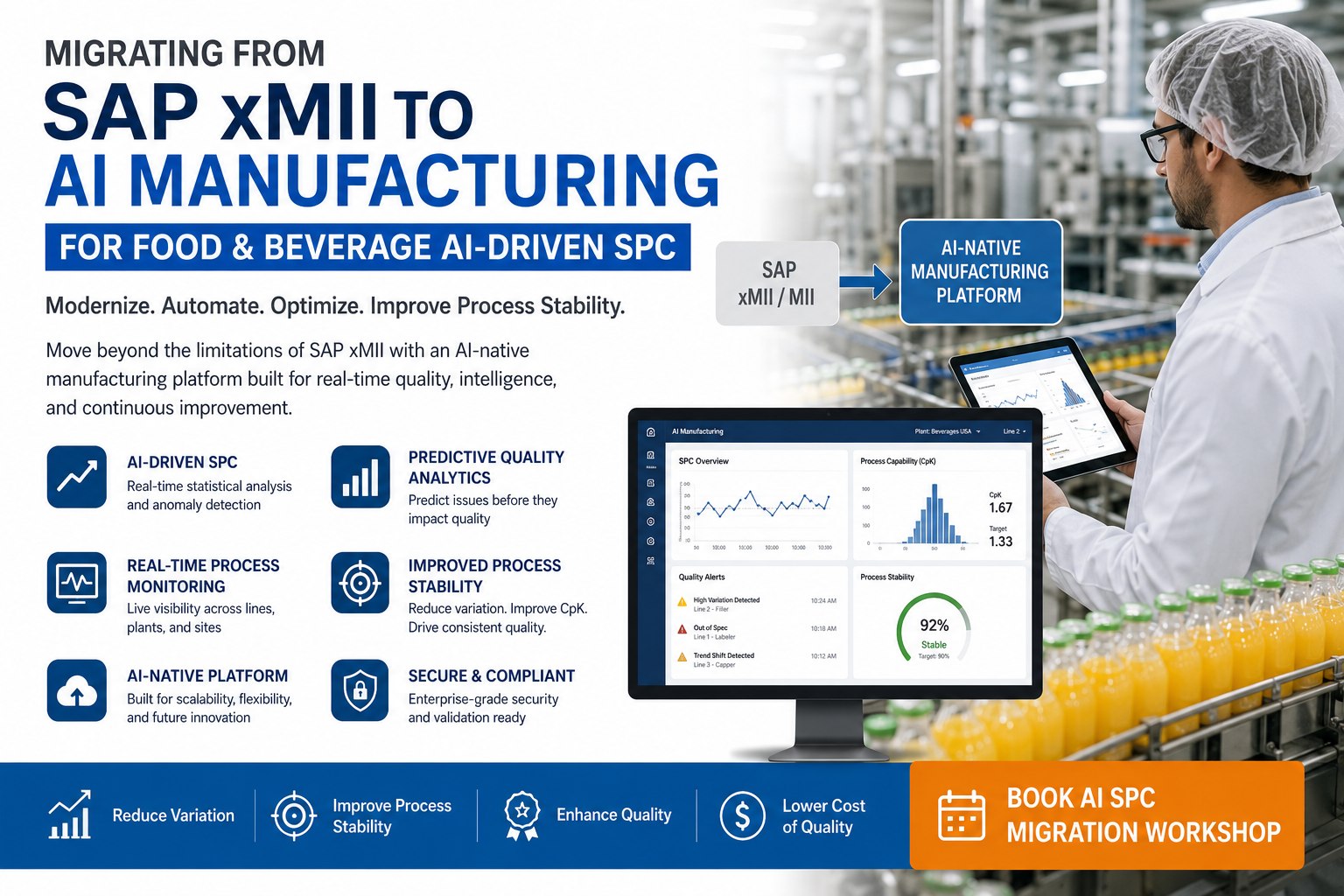
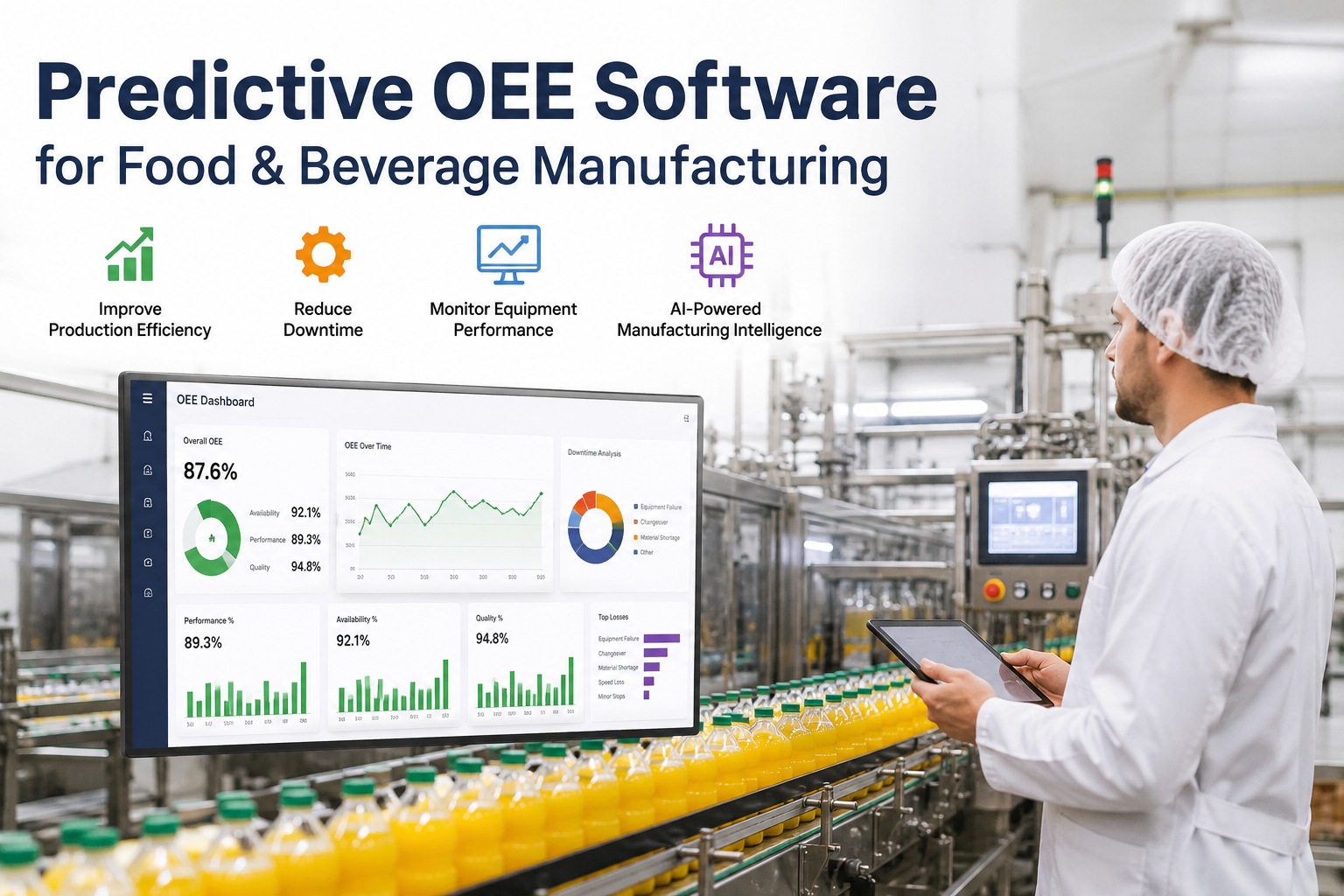
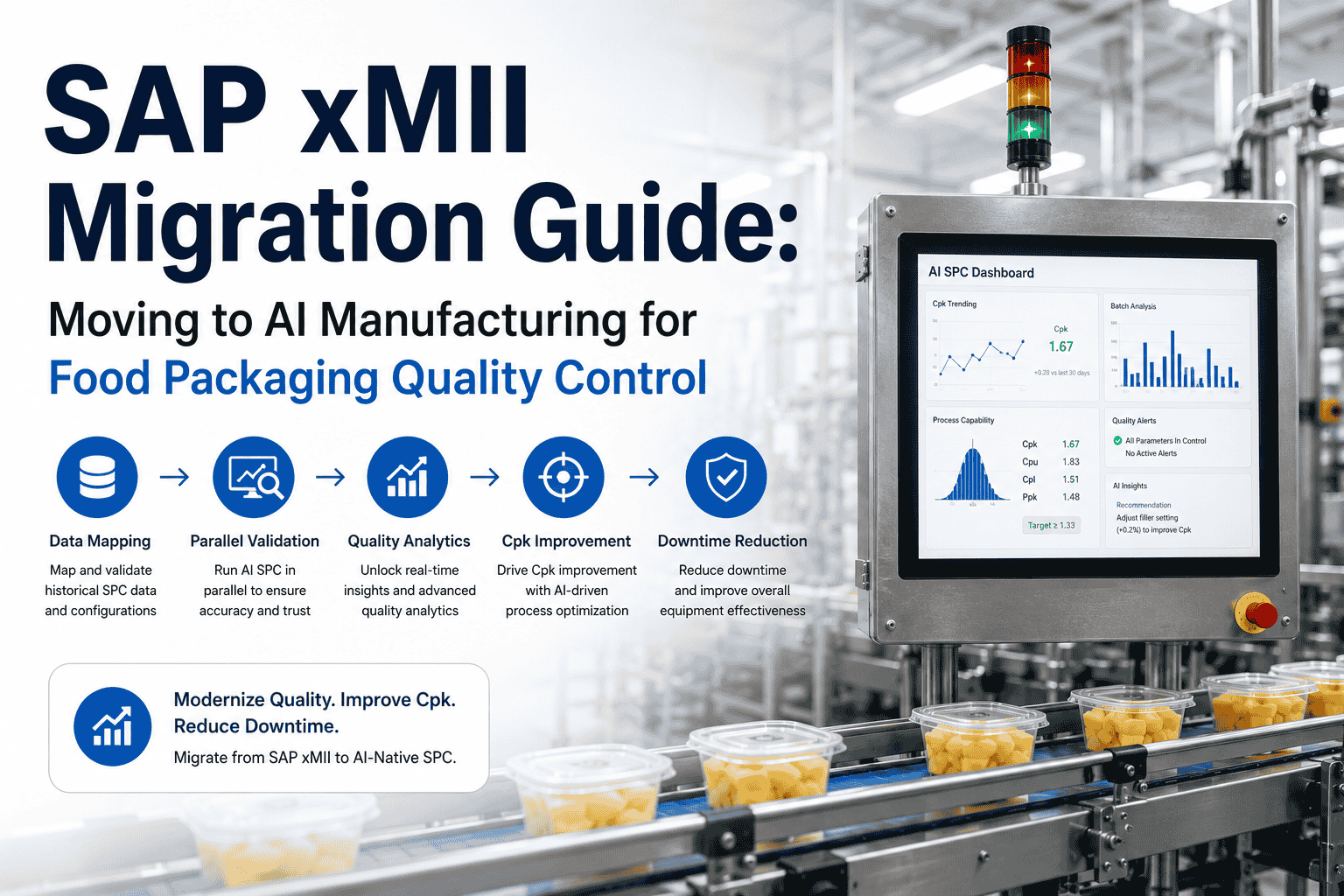
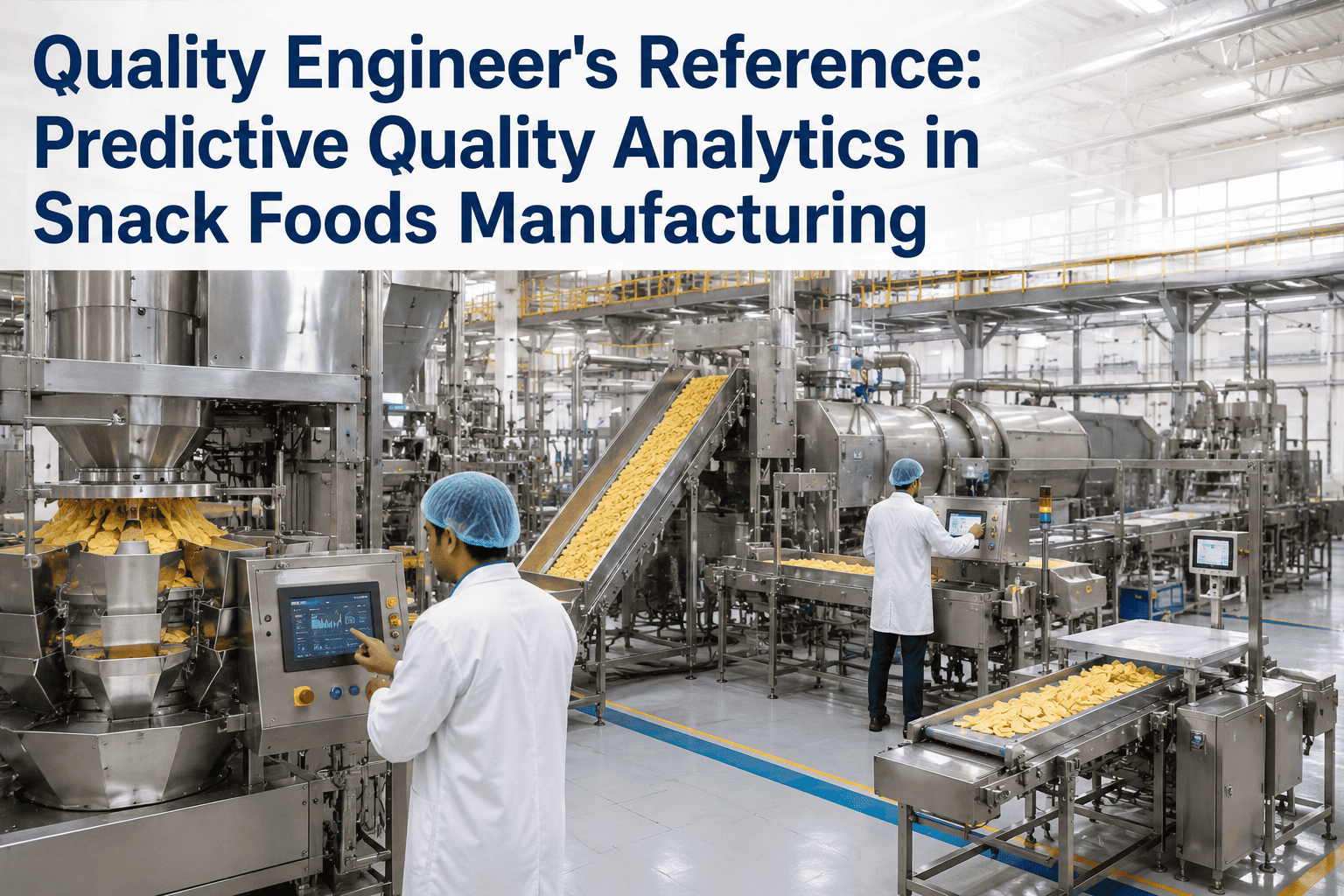
Migrating from SAP xMII to AI Manufacturing for Food & Beverage AI-Driven SPC
By Riley Quinn on June 18, 2026
SAP xMII's mainstream support ends December 2027. For food and beverage manufacturers who built their quality intelligence on xMII — rule-based SPC, BLS transactions, shop floor dashboards — the clock is running. Migration timelines take 12 to 36 months. Teams starting in 2026 finish with time to stabilize. Teams that wait until 2028 execute under pressure. The bigger opportunity: book a demo to see how migrating to an AI-native platform lets you skip traditional SPC entirely and land directly on predictive quality analytics that prevent defects before they fire.
SAP xMII Migration Framework — Food & Beverage
Two Paths. One Deadline. What Happens to Your Process Stability?
Legacy Path
SAP xMII
Rule-Based SPC
Threshold violations detected after the fact
Single-parameter control charts only
Manual RCA takes 45 to 75 minutes per event
No patches or fixes after December 2027
Days of manual effort before each audit
End-of-Life: Dec 2027
AI-Native Path
iFactory AI
Predictive SPC
Defect prediction 4 to 24 hours before they fire
Multivariate AI across all process variables
Autonomous RCA in 3 to 5 minutes
On-premise NVIDIA appliance, live in 6 to 12 weeks
Continuous, always-audit-ready batch records
Live in 6 to 12 Weeks
Why SAP xMII End-of-Life Hits F&B Quality Teams Hardest
SAP MII version 15.5 is the final release — no further versions are planned. After December 2027, SAP issues zero compliance patches, security fixes, or ERP compatibility updates for xMII. For food and beverage manufacturers, this is not a theoretical risk. Quality-critical data running on an unsupported platform creates audit findings in regulated environments. Every SAP ERP upgrade after 2027 becomes a potential break point for BLS transactions and xMII queries, with no SAP patch coming to stabilize them.
SAP xMII End-of-Life Timeline
2005
SAP acquires Lighthammer, launches xMII
2025
Version 15.5 — final release, no further updates planned
Dec 2027
Mainstream support ends — no patches, audit risk begins immediately
2030
Extended support ends — platform fully unsupported
Migration timelines run 12 to 36 months. Starting in 2026 gives you time to complete an orderly migration and stabilize before the 2027 deadline.
Running xMII-based SPC today? Book a free AI SPC Migration Demo to see how an orderly migration looks for your F&B operation — including a mapped timeline and ROI model.
The Three Eras of F&B Quality Control — Where Most Plants Stand
Most food and beverage operations evaluated in 2025 and 2026 are operating in Era 2 — traditional SPC with real-time monitoring against fixed control limits. SAP xMII rule-based SPC is a textbook Era 2 system. It was a major step forward from batch acceptance testing, but its inability to predict and its single-parameter analysis are now operationally limiting for today's F&B margins and retailer scorecards.
01
Largely Superseded
1950s to 1990s
Statistical Quality Control
Batch acceptance sampling. Defects discovered after production — too late to prevent waste. Some F&B plants still carry Era 1 elements alongside traditional SPC.
02
Where Most Plants Are Now
1990s to Present
Traditional SPC
Real-time monitoring against fixed control limits. SAP xMII, AVEVA Wonderware, Excel dashboards. Flags violations as they occur — not before. Scrap is contained, not prevented.
03
Your Target State
2024 Forward
Predictive SPC
AI predicts drift 4 to 24 hours before defects fire. Multivariate analysis across all process variables. Autonomous RCA pre-computed. Continuous audit-ready documentation.
xMII vs. AI-Native: What Actually Changes on the Plant Floor
The shift from SAP xMII to an AI-native platform is not a feature upgrade — it is a quality philosophy change. Traditional SPC monitors against fixed thresholds. AI-native SPC learns what good looks like for the current product, shift, ingredient lot, and equipment state — and refines that model continuously as conditions change.
Dimension
SAP xMII — Rule-Based SPC
AI-Native Predictive SPC
Defect Detection
After threshold breach — damage already done
4 to 24 hours before defects fire
Root Cause Analysis
Manual investigation: 45 to 75 min per event
Autonomous, pre-computed: 3 to 5 minutes
Variable Coverage
Single-parameter control charts only
Multivariate AI across all process variables simultaneously
Ingredient Lot Variability
Not modeled — fixed thresholds only
Correlated with lot history in real time
Audit Readiness
Days of team effort before each audit
Continuous — always audit-ready
Scrap Rate Impact
Reactive — scrap reported, not prevented
5 to 10 percentage point yield improvement typical
Platform Longevity
Support ends December 2027
Ongoing AI model updates, no sunset date
Ready to see what predictive SPC looks like on your lines? Book a personalized demo and we will model the gap between your current xMII baseline and what Era 3 SPC delivers.
Three Migration Paths from SAP xMII — What Each Costs You
When F&B manufacturers evaluate xMII migration options, three routes emerge. The right path depends on your customization depth, IT preferences, and how fast you need process stability gains. Understanding the tradeoffs upfront prevents the 18-month surprises that derail migration programs.
01
SAP Digital Manufacturing
Stay in SAP Ecosystem
Timeline18 to 36 months
Key constraintBLS transactions and xMII queries must be redesigned — cannot be reused
SPC outcomeStill rule-based SPC — no predictive leap
High effort, no quality philosophy change
02
Cloud MES Platform
Cloud-First Migration
Timeline12 to 24 months
Key constraintCloud latency and connectivity risks for real-time F&B process monitoring
SPC outcomeVaries by vendor — often still threshold-based
Cloud lock-in risk for OT-critical environments
Recommended for F&B
03
AI-Native On-Premise Platform
iFactory Approach
Timeline6 to 12 weeks to live
Key advantagePre-configured NVIDIA appliance — no cloud dependency, no large IT buildout
iFactory's AI SPC Migration Workshop covers your current xMII assessment, three-path cost and timeline comparison, and a documented ROI model against your F&B baseline. Half-day session — concrete output your finance team can act on.
The ROI Four-Pack: Numbers Finance and Quality Both Understand
Process stability improvements from AI-native SPC appear across four measurable categories within 12 to 18 months. For a mid-size F&B plant running four to eight production lines, these figures are typically enough to get quality and finance leadership aligned on migration priority before a single budget cycle is missed.
5 to 10 pts
Yield Improvement
From predictive prevention of drift-driven scrap before it compounds into waste
3 to 5 min
Root Cause Analysis
Down from 45 to 75 minutes of manual investigation per quality event on xMII
40 to 65%
Cost of Quality Reduction
From prevented scrap and faster RCA cycles across all lines in year one
30 to 50%
Audit Duration Reduction
Continuous documentation replaces days of manual audit prep that xMII requires
Case Reference — Snack Bar Manufacturer, 4 Lines, 18 SKUs
Before Migration
6.8% average scrap rate. SAP MII captured operational data but could not pre-compute root cause or predict scrap signatures ahead of time. Manual RCA averaged 45 to 75 minutes per event.
After AI-Native Migration
Scrap rate dropped from 6.8% to 1.6% in year one. RCA time fell to 3 to 5 minutes. Year-one savings: $4.2M against a $1.3M total program cost. Customer scorecards moved from yellow to green at two major retail accounts.
These results come from operations that complete a structured migration assessment. Book a demo and migration ROI session to model the numbers against your specific plant baseline, line count, and compliance requirements.
Expert Perspective: Why F&B Is the Right Fit for This Migration
F&B operations moving from traditional SPC on SAP xMII to predictive SPC can skip Era 2 rebuilds entirely and deploy Era 3 capability directly. The specific ROI depends on baseline yield, scrap cost, audit frequency, and compliance complexity. Plants that complete the readiness assessment walk away with a documented ROI model, not a vendor pitch deck. The move is not a platform migration so much as a quality philosophy upgrade — and the on-premise appliance timeline makes it the most practical path for F&B environments that cannot afford cloud latency.
— iFactory AI SPC Migration Research, F&B Operations 2025 to 2026
12 to 22%
OEE gain typical within 12 months of migration
6 to 12 wk
Time to live on on-premise AI appliance
Dec 2027
SAP xMII mainstream support end date
Migration Readiness: What to Assess Before You Commit
The most important input before choosing a migration path is an honest inventory of your current xMII deployment. Industry experience shows 40 to 70% of MII Workbench artifacts in long-running deployments are either unused, redundant, or replaceable by configuration in a modern platform. A full lift-and-rebuild is almost always the wrong economic decision.
Current State Inventory
Catalog all active BLS transactions and xMII queries
Identify which reports and KPIs are actively used vs. legacy
Map all ERP, LIMS, and shop floor integration points
Document quality-critical data flows and batch record paths
SPC Capability Assessment
Identify which SPC rules are actively enforced vs. just configured
Assess CCP recording frequency and audit burden
Quantify current manual RCA hours per month across all lines
Baseline current scrap rate and cost of quality
Infrastructure Readiness
Confirm OT network connectivity and historian access
Evaluate cloud vs. on-premise deployment preference
Identify 12 to 18 months of historical production data for AI training
Align quality, IT, and operations leadership on migration priority
Not sure how deep your xMII customization runs? Talk to our F&B migration team — we walk through the readiness checklist before any commitment is made.
Start Your SAP xMII to AI-Native SPC Migration
iFactory's half-day workshop delivers a current-state xMII assessment, predictive SPC demonstration on your representative F&B scenarios, three-path migration comparison, deployment roadmap, and a documented ROI model for your plant. Quality, operations, IT, and finance — all in one session.
When does SAP xMII support actually end and what happens to our quality data?
Mainstream support ends December 2027. Extended support runs to 2030 at premium cost, after which xMII is fully unsupported. After 2027 SAP issues no compliance patches, security fixes, or ERP compatibility updates. For F&B manufacturers, quality-critical data on an unsupported platform creates audit findings in regulated environments — and every SAP ERP upgrade after 2027 becomes a potential break point for BLS transactions and xMII queries with no patch coming to fix it.
Can our existing xMII SPC rules and control charts be reused in a new platform?
Existing BLS transactions, xMII queries, and SSCE pages cannot be directly reused — they must be redesigned. For AI-native platforms the approach is different: rather than recreating rule-based charts, the AI learns process patterns from your historical data. Industry experience shows 40 to 70% of MII Workbench artifacts in long-running deployments are either unused or replaceable by configuration, so rationalization typically reduces migration scope considerably.
How long does migrating from SAP xMII to an AI-native platform take?
Migration timelines range from 6 weeks to 36 months depending on the path and complexity. An AI-native on-premise appliance like iFactory's pre-configured NVIDIA setup goes live in 6 to 12 weeks for a typical F&B operation. SAP Digital Manufacturing migrations run 18 to 36 months because BLS transactions must be redesigned from scratch. Teams starting in 2026 complete orderly migrations with time to stabilize before the 2027 mainstream support deadline.
What historical data does the AI need to build predictive SPC models for our lines?
AI-native SPC platforms typically train on 12 to 24 months of historical production data including process parameters, equipment state, ingredient lot records, and quality event logs. More history improves model accuracy, particularly for seasonal products and ingredient lot variability patterns common in F&B. iFactory's AI agents run multivariate correlations across the same data your xMII historian has been collecting — now used to predict rather than just report.
What does the AI SPC Migration Workshop cover and who should attend?
The half-day workshop covers your current xMII deployment assessment, cloud vs. on-premise deployment failure mode analysis, a predictive SPC demonstration on representative F&B scenarios, three migration path comparison with cost and timeline projections, and a documented ROI model against your scrap and quality baseline. Suitable for quality, plant operations, IT, and finance stakeholders together. Register for your AI SPC Migration Workshop session here.