SAP xMII to AI Manufacturing Migration for Food & Beverage
By Riley Quinn on June 1, 2026
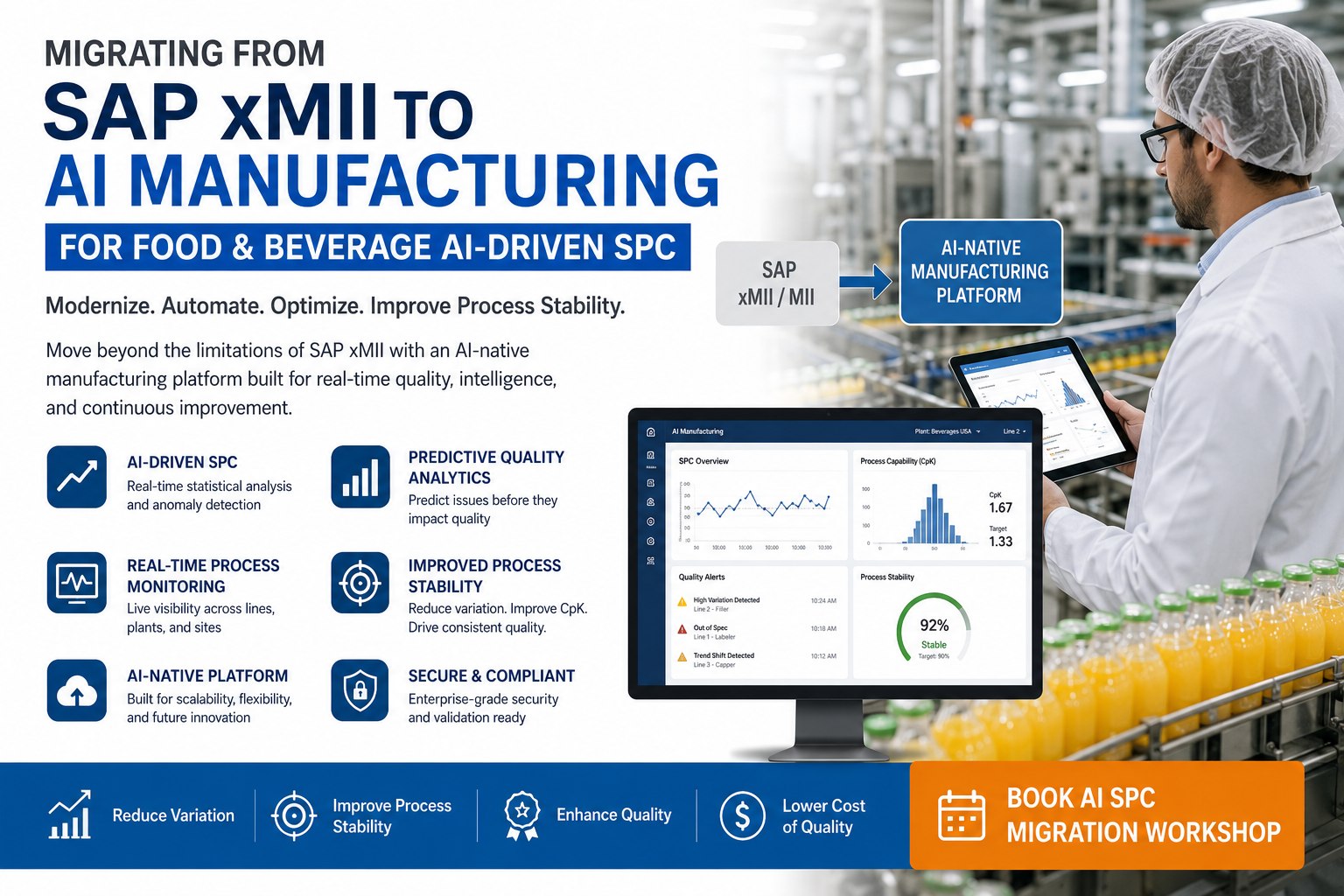
Same recipe, same equipment, different day, different batch — that’s the batch consistency problem F&B quality engineers fight every shift. Raw material variation, supplier lot drift, ambient conditions, operator decisions, equipment wear all collide to produce coefficient of variation that legacy SAP xMII can’t correlate or compensate for. Migration to a self-learning AI-native SPC platform shrinks batch-to-batch CV by 50–75% across the first six months — not because the recipes change, but because the system learns which conditions produce consistent batches and which produce drift. Book an AI SPC migration workshop to baseline your current CV and project the post-migration target.
Batch Consistency Migration
The Batch-to-Batch Variance Collapse
Coefficient of variation across batches before and after the SAP xMII to AI-native SPC migration — same recipes, same equipment, same operators. The system learns the conditions that produce consistent batches.
50–75%
CV reduction across batches within the first 6 months
Before
Legacy xMII SPC
CV: 8.2%
First-pass: 72%
After
AI-Native Self-Learning
CV: 2.1%
First-pass: 96%
Why Batch Consistency Is the Hardest F&B Problem to Solve with Legacy SPC
Batch consistency in F&B operations isn’t a single-variable problem — it’s the cumulative interaction of supplier lot variation, ambient conditions, equipment wear, operator decisions, and recipe execution drift. Legacy SAP xMII handles each variable independently and produces univariate alerts that miss the interaction patterns producing batch-to-batch drift. Three structural reasons explain why xMII hits its consistency ceiling on batch processes.
01
Raw Material Heterogeneity
Every supplier lot varies in moisture, particle size, fat content, protein percentage, sugar concentration. A new lot shouldn’t mean a bad batch — but with univariate SPC, it usually does.
Effect on batch CV:
+30–50% variance
02
Process Drift Accumulation
Heat exchanger fouling, mixer blade wear, depositor nozzle erosion, valve seat creep — gradual drifts that Shewhart charts catch only at 3-sigma, long after batch consistency has degraded.
Effect on batch CV:
+20–35% variance
03
Shift & Operator Variation
Same recipe, different shift, different operator habits. Setpoint interpretation, adjustment timing, intervention thresholds all vary. The platform doesn’t standardize these into reproducible signatures.
Effect on batch CV:
+15–25% variance
The Five-Phase Batch Consistency Migration Playbook
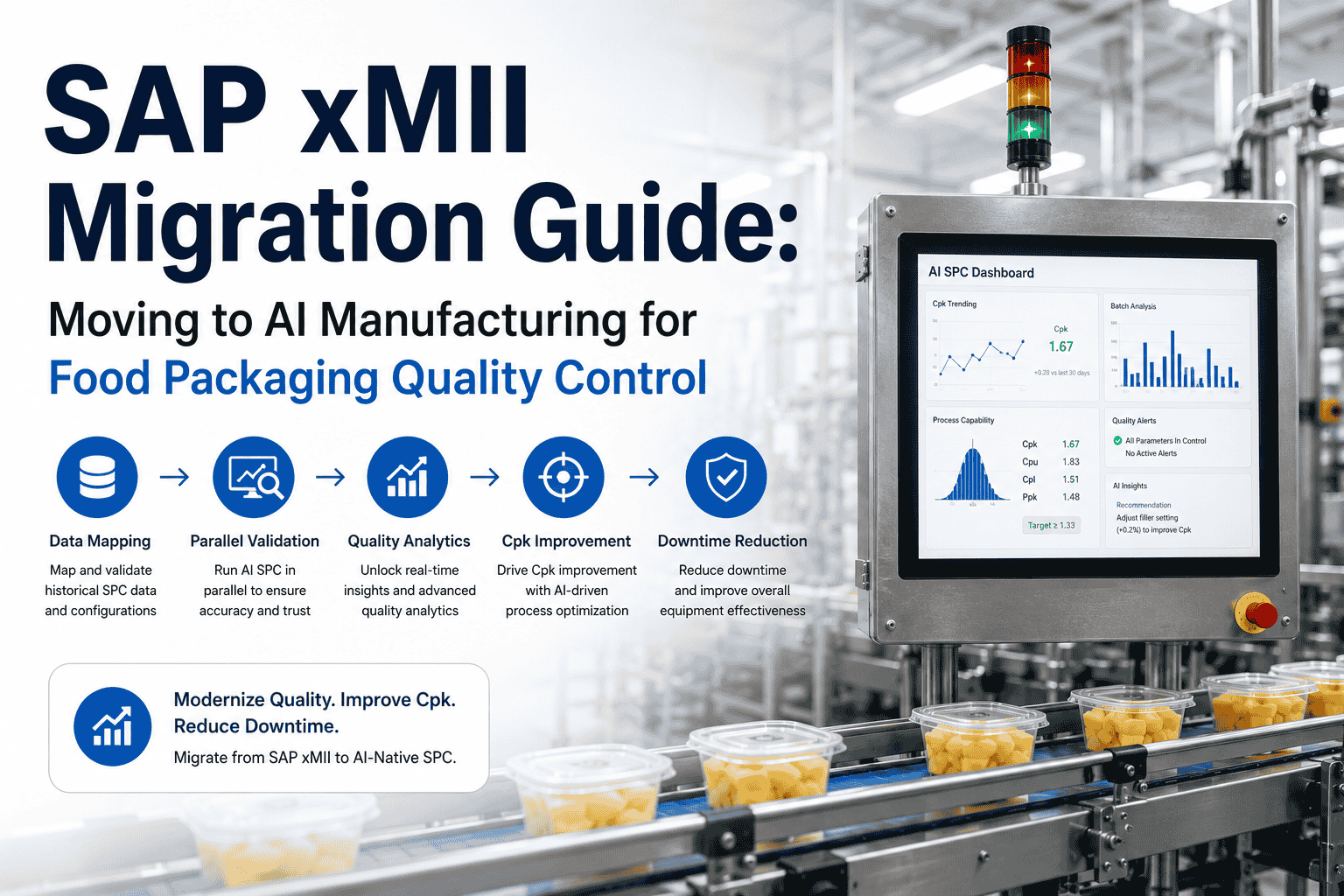
The batch consistency migration is fundamentally different from a compliance migration. Where compliance migration focuses on validation evidence and audit traceability, batch consistency migration focuses on operational outcomes: shrinking the gap between best-batch and worst-batch, raising first-pass acceptance rate, and tightening the coefficient of variation across the full SKU portfolio. Five phases sequenced across 12–16 weeks deliver measurable consistency improvement at every checkpoint.
01
Weeks 1–2
Baseline Variance Assessment
Measure where you are before you change anything
Pull 6–12 months of batch history from SAP QM, historian, and xMII display templates
Compute coefficient of variation for each critical quality attribute by SKU
Identify top 5 worst-CV SKUs and their dominant variance contributors
Map current first-pass batch acceptance rate as the migration baseline
Phase deliverable
Variance assessment report with SKU-level CV baselines, target improvement projections, and self-learning bootstrap data preparation
02
Weeks 3–5
Recipe & Setpoint Topology Mapping
Codify the batch parameter structure with tolerance bands
Migrate recipe master data from SAP PI sheets and xMII transactions
Document setpoint targets, tolerance bands, and critical-to-quality parameters per SKU
Map PLC tag structure to recipe parameters with semantic naming conventions
Configure CCP definitions with HACCP-aligned monitoring rules
Phase deliverable
Recipe parameter dictionary with tolerance bands and PLC tag mapping ready for AI-native SPC ingestion
03
Weeks 4–9
Self-Learning Model Bootstrap
Let the AI learn your plant’s batch consistency signatures
Feed historical batch data (6–12 months minimum) into the AI-native SPC engine
LSTM models learn good-batch vs problem-batch multivariate signatures per SKU
Failure pattern library codifies every prior deviation incident as future prevention signal
Phase deliverable
Plant-specific batch consistency models tuned to your SKU portfolio, ready for parallel validation
04
Weeks 8–12
Parallel Batch Validation
Prove consistency improvement before cutover
Run xMII and AI-native SPC in parallel against the same live batches (4–6 weeks)
Compare alert quality: false positive rate, lead time, root cause accuracy
Measure CV trajectory for batches where AI alerts triggered operator intervention
Quality engineers validate AI hypotheses against their domain expertise
Phase deliverable
Validation report with documented CV reduction, alert accuracy benchmarks, and quality engineer sign-off
05
Weeks 12–16+
Cutover & Continuous Learning Loop
Production deployment with self-improvement enabled
Cutover AI-native SPC as the primary intelligence layer feeding SAP QM
xMII display templates retired or migrated to AI dashboards
Operator confirmations and rejections feed back to refine model thresholds
Every new batch contributes to the self-learning loop — consistency improves monthly
Phase deliverable
Production deployment with measurable CV reduction, monthly improvement cadence, and quality engineer dashboards
Need this playbook applied to your specific SKU portfolio and xMII landscape? Book an AI SPC migration workshop — the phase-by-phase plan is the most valuable single deliverable for the migration kickoff.
How Self-Learning Quality Systems Actually Get Smarter
"Self-learning" gets used loosely in vendor pitches. The honest meaning: each batch contributes new training data, operator confirmations refine model thresholds, and the failure pattern library codifies signatures so the same drift gets prevented next time. Four mechanisms make the learning genuinely cumulative rather than static.
Mechanism 01
Historical Signature Extraction
LSTM models trained on 6–12 months of batch history learn what good-batch and problem-batch multivariate signatures look like for your specific SKUs and equipment.
Mechanism 02
Operator Confirmation Feedback
Each alert gets confirmed or rejected by operators. Confirmed alerts strengthen the signature; rejections refine the false-positive threshold. Models improve weekly.
Mechanism 03
Failure Pattern Library
Every deviation incident codifies as a signature. Next time similar conditions appear, the platform prevents the same drift rather than detecting it. Recurrence drops 3–4×.
Mechanism 04
Federated Cross-Plant Learning
Pattern signatures from one plant’s deployment improve models for the next plant's deployment — without raw data ever leaving the originating plant. Models compound across the fleet.
From 8% Batch CV to 2% Batch CV in Six Months
iFactory’s AI-native SPC platform layers above SAP QM and xMII to deliver self-learning batch consistency. LSTM signature extraction, operator confirmation feedback, failure pattern library, federated cross-plant learning. SAP QM stays as system of record; xMII intelligence layer migrates to AI-native engine. Deployment runs 12–16 weeks with first measurable CV reduction visible within 30 days.
The Batch Consistency Math — Concrete Per-Phase Improvement
The consistency improvement isn’t a single jump at cutover — it’s a curve that compounds across phases. Each phase delivers measurable CV reduction with self-learning maturity. Plants tracking the math at each checkpoint defend the business case to the CFO without vendor sales-deck percentages.
Swipe horizontally to compare phase-by-phase metrics
Migration phase
Batch CV
First-pass acceptance
Cumulative improvement
Pre-migration baseline
7–9%
70–78%
Baseline
Phase 02: Recipe mapping live
6–8%
75–82%
+5–10% acceptance
Phase 03: Self-learning bootstrap complete
5–6%
82–88%
~30% CV reduction
Phase 04: Parallel validation done
4–5%
88–92%
~45% CV reduction
Phase 05: 3 months post-cutover
3–4%
92–95%
~55% CV reduction
6 months post-cutover (full maturity)
2–3%
95–97%
50–75% CV reduction
The Quality Engineer’s Migration Checklist
Quality engineers own the technical evaluation of the migration. Eight criteria specifically test whether the platform delivers genuine batch consistency improvement or just faster legacy SPC. The diagnostic questions surface vendor capabilities that matter for batch operations — not generic AI claims.
01
SKU-level CV tracking
Ask:
"Does the platform compute and trend coefficient of variation per SKU, per critical quality attribute, in real time?"
Batch consistency is measured per SKU, not at plant level. Platforms that aggregate CV across SKUs hide the worst performers. Production-grade platforms expose SKU-level CV trending as a first-class dashboard with month-over-month delta visibility.
02
Self-learning evidence
Ask:
"How does the platform demonstrate that models improve over time — not just deploy and freeze?"
Production-grade platforms show monthly model accuracy improvement as a reportable metric. Failure pattern library growth, false-positive rate reduction, operator confirmation feedback rates are all observable. Vendors who can’t demonstrate learning over time deliver static models that degrade.
03
Recipe parameter migration tooling
Ask:
"What automated tooling does the platform provide for migrating recipes from SAP PI sheets and xMII transactions?"
Manual recipe migration adds 4–8 weeks per SKU portfolio. Production-grade platforms ship recipe import tooling that handles SAP PI sheet structure, xMII display templates, and BLS transaction parameters with semantic mapping to AI-native parameter dictionary.
04
Parallel validation methodology
Ask:
"How does the platform support 4–6 week parallel validation against live xMII before cutover?"
Parallel validation is non-negotiable for batch operations. Production-grade platforms run both engines simultaneously, compare alert quality, measure CV trajectory on intervention batches, and document quality engineer sign-off before cutover. Vendors requiring big-bang cutover create unacceptable batch risk.
05
Raw material variability compensation
Ask:
"Does the platform learn how new supplier lots affect downstream batch outcomes and recommend setpoint adjustments?"
Raw material variability is the #1 cause of batch inconsistency in F&B. Platforms that ingest supplier CoA data, correlate it to batch outcomes, and recommend recipe compensation prevent the “new lot, bad batch” failure mode. Generic vendors don’t close this loop.
06
SAP QM coexistence
Ask:
"Does the platform write batch quality records back to SAP QM or maintain a parallel record system?"
The right answer: write back to SAP QM. Quality notifications, defect codes, root cause hypotheses, batch certificates, CAPA workflows continue flowing through SAP. AI-native SPC feeds these workflows with better intelligence — not a parallel record system that creates audit-trail discrepancies.
07
CCP integration with HACCP plan
Ask:
"Does the platform respect the existing HACCP CCP definitions and tolerance bands, or require redefinition?"
HACCP plans are validated documents. Re-defining CCPs requires re-validation that adds quarters to the migration. Production-grade platforms ingest existing CCP definitions and tolerance bands directly, applying AI intelligence on top of validated HACCP structure.
08
Deployment timeline commitment
Ask:
"When does first measurable CV reduction appear in production batches?"
30 days post-cutover is the production-grade benchmark for first visible CV reduction. 12–16 weeks total deployment. 6 months for full maturity. Vendors quoting 6+ months for first measurable improvement are doing custom development, not deploying a product.
Expert Perspective
"The most underestimated benefit of the SAP xMII to AI-native SPC migration is what happens to batch consistency after cutover. Most quality engineers expect modernization to deliver faster alerts and better dashboards — both of which are true but minor. The major benefit is that batch-to-batch coefficient of variation drops 50–75% across the first six months without changing the recipes, the equipment, or the operators. The mechanism is simple: the self-learning system identifies which combinations of raw material properties, ambient conditions, and process parameters produce consistent batches versus problem batches. Operators get prescriptive alerts before the batch enters the problem zone — not reactive alerts after the lab flags it. The math compounds because every new batch contributes to the failure pattern library. Plants that follow the five-phase playbook honestly land 95%+ first-pass batch acceptance within 6 months. Plants that skip the parallel validation phase or rush the self-learning bootstrap end up with consistency improvements that plateau at 20%. The phase sequencing matters."
— F&B Batch Consistency Practice, 2026 industry insight
50–75%
batch-to-batch CV reduction across the first 6 months post-cutover
12–16 wk
total migration timeline through all five phases
95%+
first-pass batch acceptance rate at full maturity
Conclusion: Batch Consistency Is the Most Defensible Migration Outcome
Quality engineers evaluating SAP xMII to AI-native SPC migration get pulled in multiple directions — compliance, audit readiness, defect elimination, yield improvement, operator productivity. The most defensible outcome to track, the one with the clearest pre/post measurement and the most direct CFO conversation, is batch consistency: coefficient of variation per SKU, first-pass batch acceptance rate, and recurrence of the same drift signatures across batches. The five-phase migration playbook — baseline assessment, recipe mapping, self-learning bootstrap, parallel validation, cutover with continuous learning — delivers measurable CV reduction at every phase checkpoint. 50–75% CV reduction across the first six months. 95%+ first-pass batch acceptance at full maturity. No recipe changes. No equipment changes. No operator headcount changes. The system learns which conditions produce consistent batches and which produce drift, then prevents drift before it manifests. SAP QM stays as system of record; xMII intelligence migrates to the AI-native engine. Book an AI SPC migration workshop to baseline your current CV and map the five-phase playbook against your specific SKU portfolio.
Run the Batch Consistency Migration Workshop
iFactory’s F&B batch consistency practice runs a 90-minute workshop applying the five-phase migration playbook, the self-learning architecture, and the per-phase consistency math to your real SKU portfolio. You leave with a baseline CV assessment, a phase-by-phase deployment plan, and a CFO-defensible consistency improvement projection.
What does "batch consistency" actually mean in measurable terms?
Batch consistency is measured through three concrete metrics. First, coefficient of variation (CV) across batches: the standard deviation of critical quality attributes divided by the mean, expressed as a percentage. Lower CV means tighter batch-to-batch consistency. Typical F&B baselines run 7–9% pre-modernization; well-tuned operations land 2–3% post-migration. Second, first-pass batch acceptance rate: the percentage of batches that meet all specifications without rework or rejection. Pre-modernization baselines run 70–78%; post-migration maturity lands 95%+. Third, recurrence rate of the same drift signatures: how often the same root cause produces another out-of-spec batch within 30 days. Pre-modernization runs 60–75% (same drift keeps happening); post-migration drops to 15–25% (failure pattern library prevents recurrence). All three metrics are SKU-specific — plant-level averages hide the worst performers, so production-grade evaluation tracks each SKU independently.
How is this different from the SAP xMII compliance migration playbook?
Compliance migration focuses on validation evidence: VMP (Validation Master Plan), data mapping for 21 CFR Part 11 records, parallel validation for audit traceability, CSV deliverables (Computer System Validation). The deliverable is regulatory defensibility. Batch consistency migration focuses on operational outcomes: variance reduction per SKU, first-pass acceptance rate, drift recurrence reduction. The deliverable is measurable CV improvement. Both migrations share infrastructure work (PLC tag mapping, historian federation, SAP QM coexistence) but optimize for different outcomes at the validation stage. Plants that pursue compliance migration alone often miss the consistency optimization opportunity; plants that pursue consistency migration alone may underinvest in compliance evidence. The right approach: run both as one integrated 12–16 week program where compliance evidence is captured automatically as a byproduct of the consistency-focused phases.
How does the self-learning system actually improve over time — not just deploy and freeze?
Four cumulative mechanisms make the learning genuinely continuous. First, historical signature extraction: LSTM models trained on 6–12 months of batch data learn the multivariate signatures distinguishing good batches from problem batches. Second, operator confirmation feedback: every alert gets confirmed or rejected. Confirmed alerts strengthen the signature; rejections refine the false-positive threshold. Weekly model refinement is measurable. Third, failure pattern library: every deviation incident codifies as a reusable signature so the same drift gets prevented next time rather than detected. This drops drift recurrence from 60–75% to 15–25%. Fourth, federated cross-plant learning: pattern signatures from one plant’s deployment improve models for the next plant’s deployment without raw data ever leaving the originating plant (privacy-preserving federated learning). Production-grade platforms expose all four mechanisms as observable metrics. Vendors who can’t demonstrate monthly model accuracy improvement or pattern library growth deliver static models that degrade over time as conditions drift.
Why does the self-learning bootstrap need 6–12 months of historical batch data?
Three reasons. First, supplier lot variation cycles: most F&B raw materials cycle through 8–15 supplier lots over 6 months, creating natural variation the model needs to learn how to compensate for. Less data means the model overfits to recent lots. Second, seasonal variation: ambient humidity, temperature, raw material moisture content vary by season. Models trained on a single quarter don’t generalize. Third, SKU coverage: a typical F&B plant runs 30–120 SKUs through batch operations. 6 months captures enough production runs per SKU to learn signature-level patterns. Less than 6 months produces unreliable models on long-tail SKUs. Plants with shorter history available can start the bootstrap on top 5 SKUs by volume and expand as the model matures, but the full portfolio benefit lands at the 6–12 month historical data threshold. Plants migrating from paper-based SPC may need to digitize 3–6 months before the bootstrap can run — which makes phase 1 (baseline assessment) longer for those plants.
Does this require replacing SAP QM, or does it layer above?
Layer above, never replace. SAP QM’s quality notifications, batch certificates, CAPA workflows, batch genealogy, and integration with the broader SAP ecosystem are among the strongest capabilities in the SAP product family. There’s no business case to replace them — doing so adds 12–18 months to migration and breaks downstream integrations with finance, procurement, sales, and compliance. What changes is the intelligence layer feeding SAP QM. xMII Business Logic Services (BLS) transactions running rule-based univariate SPC migrate to AI-native model invocations running LSTM signature fusion with autoencoder anomaly detection across 80+ correlated tags. AI-native SPC writes batch quality records, defect codes, root cause hypotheses, and confidence scores back to SAP QM via OData/REST APIs. The downstream workflows you’ve built in SAP QM continue working exactly as today — they just receive higher-quality, earlier, more accurate input from the AI-native SPC layer. This is the right architecture for both ECC and S/4HANA — the integration approach works across the migration boundary.