-system-validation-and-analytics-checklist.png)
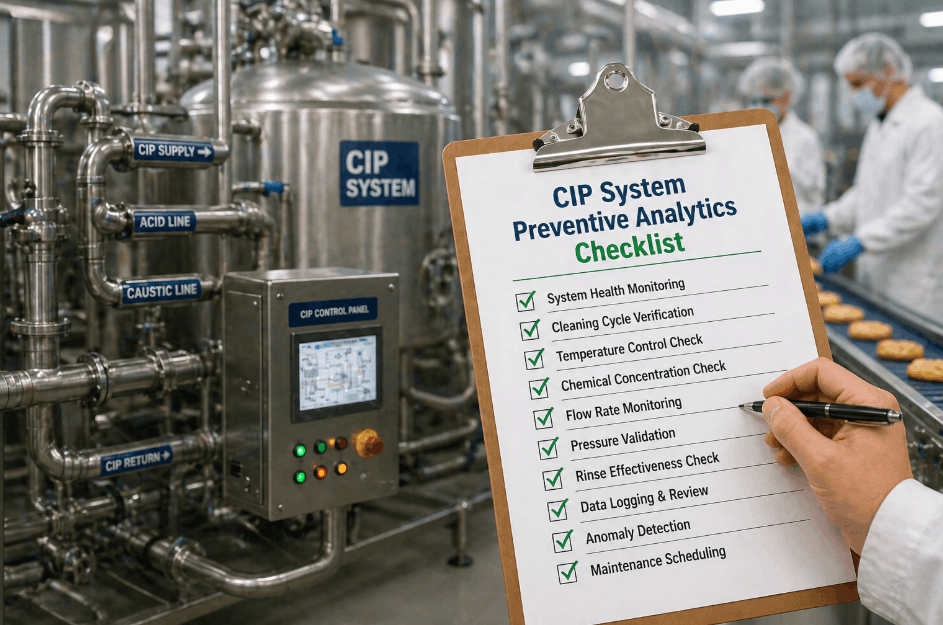
A Clean-in-Place (CIP) system is the backbone of sanitation compliance in food, beverage, and dairy manufacturing. When CIP cycles fail validation — whether due to incorrect chemical concentration, inadequate temperature, or insufficient contact time — the consequences range from product contamination to regulatory shutdown. A structured validation and analytics checklist ensures every CIP cycle is documented, traceable, and audit-ready. If your facility is still relying on manual logbooks, book a demo to see how automated CIP compliance tracking eliminates recordkeeping gaps and missed validations across every circuit and shift.
1. Pre-CIP Circuit Setup & System Readiness Verification
Before initiating any CIP cycle, the circuit must be correctly configured, valves positioned, and system parameters confirmed. An improperly set up circuit allows process residues to bypass cleaning zones or allows cleaning chemicals to enter unprepared equipment — both create compliance failures. For plants running multiple CIP circuits simultaneously, book a demo to see how digital circuit-by-circuit scheduling prevents setup errors at scale.
2. Chemical Concentration Verification & Dosing Accuracy
Cleaning chemical concentration is the most critical variable in CIP validation. Too low, and the cycle fails microbial reduction targets. Too high, and residue carryover into the product stream becomes a food safety risk. Every caustic, acid, and sanitizer solution must be analytically confirmed — not assumed from dosing pump settings. Facilities managing multiple chemical circuits can schedule a demo to automate inline concentration monitoring and deviation alerts.
3. Temperature Monitoring & Thermal Profile Validation
Temperature directly controls cleaning efficacy — particularly for fat and protein soils that require sustained heat to saponify and disperse. CIP cycle temperature must be maintained throughout the cleaning phase, not just at the supply point. Monitoring temperature at return line and critical dead-leg points is essential for full circuit validation. For continuous temperature data logging across multiple CIP circuits, book a demo to explore automated thermal profile capture and deviation flagging.
4. Flow Rate, Velocity & Turbulence Adequacy Verification
CIP cleaning of pipe circuits depends on turbulent flow — not simply solution contact. Reynolds numbers above 10,000 are required for effective mechanical scrubbing of soil from pipe walls. Flow rate and velocity must be confirmed at multiple points in the circuit, not just at the pump discharge. Facilities managing complex multi-branch CIP circuits can book a demo to configure automated flow verification and turbulence modeling in their CIP analytics dashboard.
5. Contact Time Compliance & Phase Duration Documentation
Each CIP phase — pre-rinse, caustic, intermediate rinse, acid, final rinse, and sanitize — has a minimum validated contact time that must be met at target temperature and concentration simultaneously. Contact time logged by the control system must reflect actual conditions, not just elapsed cycle time. Any phase where temperature or concentration dropped below setpoint during the timed window must be flagged as a deviation.
6. Rinse Verification & Post-CIP Residue Testing
Final rinse verification is the last validation gate before equipment is returned to production. Residual cleaning chemicals in a food or beverage line create adulteration risk — caustic, acid, or sanitizer carryover can alter product pH, taste, and safety profile. Post-rinse analytical testing and conductivity return-to-baseline checks must be completed and documented before any production restart authorization.
7. CIP Analytics, Cycle Data Logging & Deviation Management
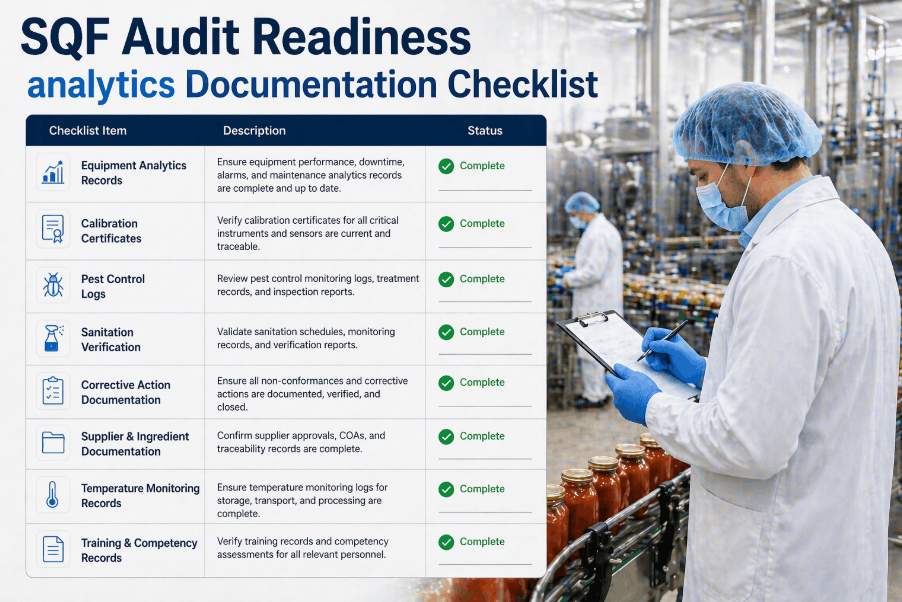
CIP validation is only as strong as its documentation. Every cycle parameter — chemical concentration, temperature, flow rate, phase duration, and post-rinse results — must be captured in a retrievable, tamper-evident record. Analytics trending of CIP cycle data enables facilities to detect performance drift before a cycle fails, identify seasonal cleaning load variations, and demonstrate continuous compliance during FDA, FSMA, or SQF audits. Facilities transitioning from paper CIP logs to digital analytics can schedule a demo to explore automated cycle data capture and real-time deviation alerts.

-system-analytics-best-practices-for-food-and-beverage.png)