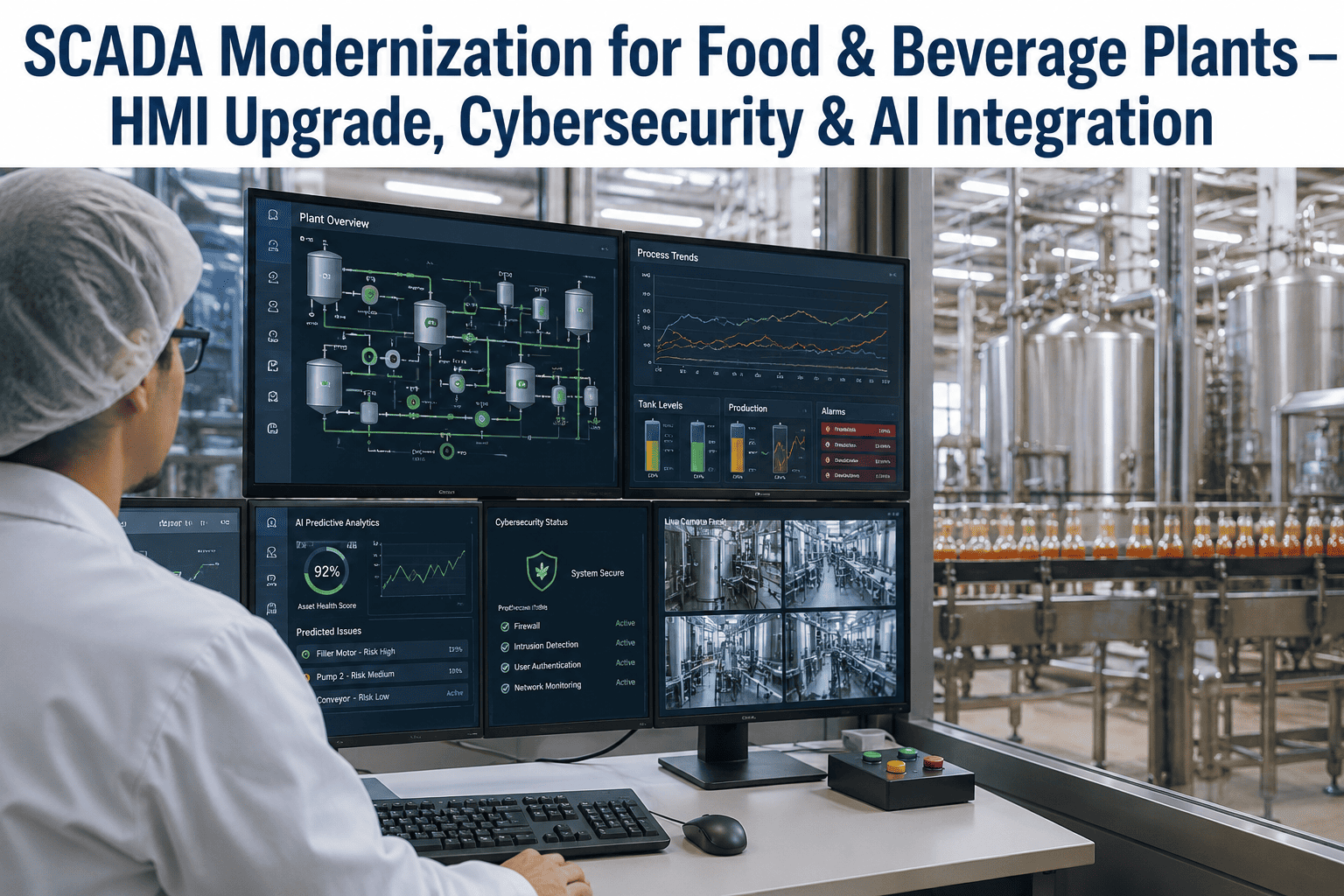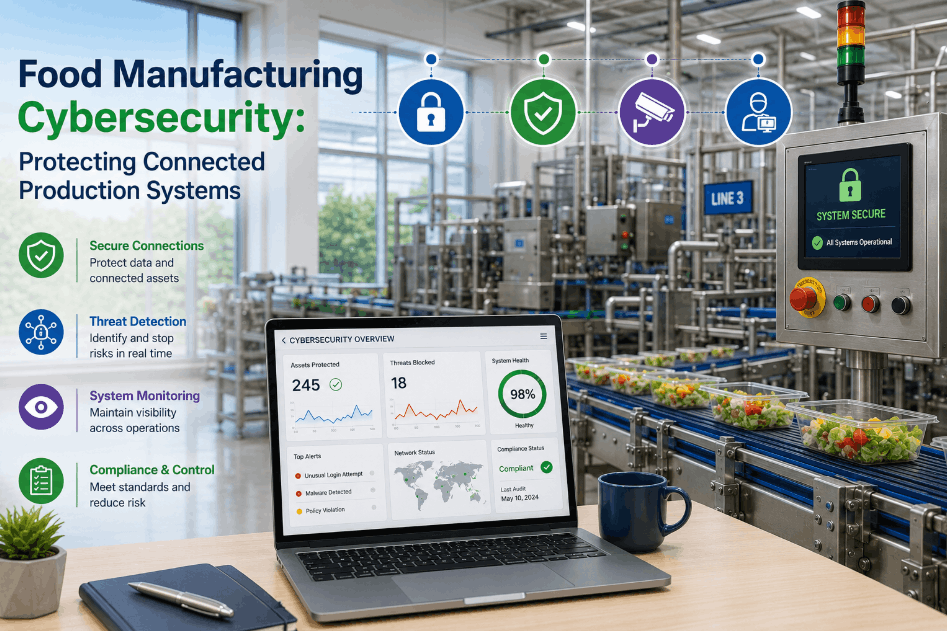
Cybersecurity risks in smart food manufacturing plants are escalating at a pace that traditional IT security frameworks were never designed to handle. As food processors integrate industrial IoT sensors, SCADA systems, and cloud-connected analytics platforms across production lines — from raw ingredient intake through pasteurization, filling, and cold chain management — the attack surface expands with every new connected endpoint. Industrial control system security failures in food plants are no longer theoretical: ransomware attacks on OT networks have halted production across dairy, beverage, and packaged food facilities, triggering recalls, compliance breaches, and multimillion-dollar recovery costs. Book a Demo to see how AI-powered OT security analytics monitor cyber risk across every connected system in your food manufacturing plant.
AI-Powered Cybersecurity for Smart Food Manufacturing
iFactory delivers real-time OT security monitoring, industrial IoT threat detection, and SCADA security analytics built specifically for food and beverage manufacturers operating under FSMA, GFSI, and SQF compliance requirements.
Why Smart Food Plants Face Unique Industrial Cybersecurity Threats
The convergence of IT and OT networks in modern food manufacturing plants creates a fundamentally different cybersecurity threat landscape than enterprise IT environments. Legacy PLCs controlling CIP systems, batch mixing lines, and filling equipment were engineered for reliability and uptime — not network security. When these devices are connected to plant historians, MES platforms, and cloud analytics systems without proper network segmentation, adversaries gain lateral movement paths from corporate email networks directly to production control systems. Manufacturing cybersecurity strategies that treat OT and IT as a unified threat surface — while preserving the operational isolation required for food safety — are the only architectures that consistently reduce cyber risk in connected food plants.
The Five Most Critical OT Security Vulnerabilities in Food Processing Operations
Understanding where cybersecurity risk concentrates in smart food manufacturing plants is the prerequisite for building an effective industrial control system security program. The vulnerabilities that threat actors consistently exploit in food and beverage OT environments share a common pattern: they exist at the intersection of operational convenience and inadequate security controls. Food plant engineers who Book a Demo with iFactory can map these vulnerabilities against live sensor and network data to identify which risks are active in their facility right now.
Flat Network Architecture Enabling Lateral Movement
Food plants without proper IT/OT network segmentation allow attackers who compromise a single endpoint — an HMI terminal, an engineer's laptop, or a vendor remote access session — to traverse the network laterally and reach critical SCADA systems, batch controllers, and process historians with no technical barriers.
Unpatched Industrial IoT Devices and Legacy PLCs
The majority of industrial IoT sensors and PLCs deployed in food processing environments run firmware that has not been updated in years — often because patches require production downtime that plant managers cannot justify under existing maintenance windows. These devices represent persistent, known vulnerabilities that threat intelligence feeds actively track.
Insecure Remote Access for Vendor Maintenance
Third-party equipment vendors frequently require remote access to food plant OT systems for diagnostics and firmware updates. When this access is managed through shared credentials, persistent VPN tunnels, or unmonitored remote desktop sessions, it creates uncontrolled entry points that bypass perimeter security controls entirely.
Default Credentials on SCADA and HMI Systems
SCADA interfaces and HMI terminals in food plants are routinely deployed with manufacturer default usernames and passwords that operators never change. Publicly available default credential databases make these systems trivially accessible to any attacker who achieves network access, enabling immediate control over production processes.
Insufficient OT Activity Monitoring and Anomaly Detection
Most food manufacturing plants have no continuous monitoring capability for OT network traffic, PLC command sequences, or historian data access patterns. Without behavioral baselines and anomaly detection, attackers can maintain persistent access for weeks or months before detection — long enough to map production systems, exfiltrate formulation data, or pre-position ransomware payloads across the OT environment.
Supply Chain and Third-Party Software Risks
Analytics platforms, MES software, and ERP integrations introduce third-party code into food plant OT environments. Supply chain attacks that compromise software update mechanisms or vendor portals can deliver malicious payloads directly into production systems through trusted channels, bypassing all perimeter security controls that assume third-party software is safe.
SCADA Security and Industrial Control System Protection Strategies
SCADA security in food manufacturing requires a defense-in-depth architecture that accounts for the operational constraints of continuous food production. Unlike IT security environments where systems can be taken offline for patching or incident response, food plant SCADA and DCS systems often control batch processes, cold chain temperature maintenance, and CIP cycle execution that cannot be interrupted without product loss or food safety violations. Effective industrial control system security strategies for food plants layer passive network monitoring, behavioral analytics, and compensating controls that protect critical systems without requiring production downtime. Plant engineers who want to assess their current SCADA security posture can Book a Demo to see live OT network visibility dashboards identifying unauthorized devices and anomalous command sequences in real time.
OT Network Segmentation and Purdue Model Implementation
Implementing the Purdue Enterprise Reference Architecture in food plant OT environments creates security zones that limit lateral movement between the enterprise network, plant historian, supervisory control layer, and field device level — ensuring that a compromised email account cannot reach a PLC controlling a pasteurizer or filling line.
Passive OT Traffic Analysis and Behavioral Anomaly Detection
Passive network monitoring solutions capture and analyze OT network traffic — including Modbus, EtherNet/IP, and PROFINET protocols — without injecting packets that could disrupt sensitive industrial control systems. Machine learning models trained on baseline PLC command sequences detect deviations that indicate unauthorized access or pre-attack reconnaissance activity.
Privileged Access Management for OT Systems and Vendor Sessions
Just-in-time privileged access management for SCADA systems ensures that vendor remote access sessions are time-limited, fully logged, and automatically terminated on session expiration. Role-based access controls prevent operators from accessing systems outside their production area and create audit trails required for FSMA and GFSI compliance documentation.
Industrial Endpoint Security for HMI Terminals and Engineering Workstations
Endpoint security solutions designed for industrial environments provide application whitelisting, USB port control, and removable media restrictions on HMI terminals and engineering workstations without degrading the real-time performance required for production control. These compensating controls address the patch management gap that exists for legacy OT systems that cannot run conventional antivirus software.
Industrial IoT Security: Protecting Connected Sensors Across the Food Production Floor
Industrial IoT security in food manufacturing encompasses every IP-addressable device on the production floor — from temperature sensors on pasteurizers and moisture analyzers on dryers to vision inspection cameras on packaging lines and RFID readers in cold storage. Each connected device represents a potential entry point for adversaries, and the diversity of communication protocols, firmware versions, and vendor security postures across a typical food plant's IoT estate makes comprehensive asset visibility the first requirement of any effective industrial IoT security program. Continuous device discovery, automated vulnerability assessment, and network traffic analysis for IoT protocols are the foundational capabilities that convert an invisible IoT attack surface into a manageable, monitored risk environment.
Cybersecurity Compliance in Food Manufacturing: FSMA, NIST, and IEC 62443
Cybersecurity compliance frameworks relevant to smart food manufacturing plants span both food safety regulation and industrial security standards. FSMA Section 204 supply chain traceability requirements create data integrity obligations that implicitly demand OT cybersecurity — falsified or corrupted traceability records resulting from a cyber attack expose food manufacturers to the same regulatory consequences as intentional adulteration. The NIST Cybersecurity Framework provides the identify-protect-detect-respond-recover structure most food plant security programs use as their organizational backbone, while IEC 62443 delivers the technical security level requirements for industrial control systems that regulators and insurance underwriters increasingly reference in food manufacturing audits. Food manufacturers seeking to assess their compliance posture can Book a Demo to review iFactory's cybersecurity compliance documentation capabilities against their current audit requirements.
Cybersecurity Risk Management vs. Reactive Incident Response: A Comparison for Food Plant Engineers
| Security Domain | Reactive Incident Response | Proactive Cyber Risk Management | Operational Outcome |
|---|---|---|---|
| OT Network Visibility | Asset inventory compiled after breach discovery | Continuous automated device discovery and profiling | Eliminates unknown-asset attack surface blind spots |
| SCADA Threat Detection | Incident detected after production disruption | Behavioral anomaly detection flags suspicious PLC commands in real time | Reduces mean time to detect from days to minutes |
| Vendor Remote Access | Shared credentials reviewed after security audit finding | Just-in-time PAM with session recording and automatic termination | Eliminates persistent vendor access as attack vector |
| Industrial IoT Security | Firmware vulnerabilities addressed after CVE publication | Continuous vulnerability scanning with compensating controls for unpatchable devices | Manages risk across legacy OT devices that cannot be patched offline |
| Compliance Documentation | Manual records compiled for scheduled audits | Automated security event logs and compliance reports generated continuously | Always audit-ready without manual data collection effort |
| Ransomware Response | Unplanned production halt, manual recovery from last backup | Network segmentation limits blast radius; clean backups enable rapid OT restoration | Reduces recovery time from weeks to hours for OT environments |
| Supply Chain Risk | Third-party software reviewed after security incident | Software bill of materials monitoring with change detection alerts | Detects malicious software updates before execution in production environment |
Ransomware Threats in Food Manufacturing OT Environments
Ransomware attacks targeting food manufacturing OT environments have accelerated significantly, with threat actors specifically seeking to encrypt production control systems, historian databases, and MES platforms to maximize operational impact and extortion leverage. The food and beverage sector is particularly vulnerable because production uptime pressure — driven by perishable raw materials, retailer delivery commitments, and seasonal demand peaks — creates intense motivation to pay ransoms rather than endure extended recovery timelines. Effective ransomware defense in food plant OT environments requires network segmentation that prevents ransomware propagation from IT to OT networks, immutable OT system backups stored in offline or air-gapped environments, and incident response playbooks specifically designed for food production recovery scenarios. Analytics platforms that maintain continuous network traffic baselines can detect ransomware staging behavior — such as mass file enumeration, shadow copy deletion, and lateral movement spikes — before encryption begins.
Threat Detection Software and Digital Risk Protection for Connected Food Plants
Modern threat detection software for food manufacturing OT environments integrates passive network monitoring, asset vulnerability management, and threat intelligence feeds into a unified security operations capability that plant engineers and IT security teams can operate without deep industrial protocol expertise. Digital risk protection platforms extend this visibility beyond the plant perimeter — monitoring dark web forums for leaked OT credentials, tracking threat actor campaigns targeting food sector manufacturers, and correlating external intelligence with internal network anomalies to prioritize response actions based on actual threat actor intent rather than generic vulnerability scores. For food plant security teams managing the convergence of IT and OT risk with limited security operations capacity, AI-driven threat detection that surfaces only high-confidence, actionable alerts prevents alert fatigue while maintaining the detection coverage required for meaningful risk reduction. Operational teams can Book a Demo to explore how iFactory's threat detection dashboards correlate OT anomalies with food safety compliance metrics across production environments.
Complete OT Asset Inventory and Network Visibility
You cannot protect what you cannot see. Building a complete, continuously updated inventory of every IP-addressable device in your food plant OT environment — with hardware model, firmware version, communication protocol, and network connection data — is the non-negotiable first step in any industrial cybersecurity program. Automated asset discovery tools that passively monitor industrial protocols deliver this visibility without requiring production interruptions or manual surveys that become obsolete the moment they are completed.
Network Segmentation and Zero-Trust OT Access Architecture
Implementing network segmentation between IT and OT environments — with secure data diodes or unidirectional gateways at the boundary — limits ransomware propagation, prevents lateral movement from compromised enterprise endpoints, and creates the network architecture foundation that all subsequent security controls depend on. Zero-trust principles applied to OT access management eliminate the implicit trust assumptions that make shared vendor credentials and persistent remote access sessions such persistent vulnerabilities in food manufacturing environments.
Continuous OT Monitoring, Behavioral Analytics, and Incident Response
Continuous behavioral monitoring of OT network traffic, PLC command sequences, and historian access patterns — combined with a food manufacturing-specific incident response plan that includes production recovery procedures — converts cybersecurity from a periodic audit exercise into an operational capability that reduces both the probability and the impact of OT security incidents. Integration with food safety management systems ensures that cybersecurity events triggering production deviations generate the regulatory documentation required by FSMA and GFSI audit schemes.
Frequently Asked Questions: Cybersecurity in Smart Food Manufacturing Plants
What makes OT security different from standard IT cybersecurity in food plants?
OT security in food manufacturing must prioritize production availability and food safety above all else. Unlike IT environments, OT systems often cannot be patched, rebooted, or taken offline without impacting product quality, regulatory compliance, or perishable inventory. Security controls must be non-disruptive — passive monitoring, compensating controls, and network segmentation — rather than the active scanning and patching approaches standard in IT security.
How does ransomware spread from IT to OT networks in food manufacturing plants?
Ransomware spreads from IT to OT networks through flat network architectures with no segmentation, shared engineering workstations that connect to both environments, and vendor remote access sessions that bridge the IT/OT boundary. Once ransomware reaches the OT network, it targets SCADA servers, historians, and HMI workstations running Windows operating systems that have not been patched due to production uptime constraints.
Does FSMA require food manufacturers to implement cybersecurity controls?
FSMA does not explicitly mandate cybersecurity controls, but the data integrity requirements embedded in FSMA Section 204 traceability rules and hazard analysis requirements effectively demand that food manufacturers protect the systems producing this data from tampering and unauthorized modification. Cybersecurity incidents that corrupt traceability records or process data can result in the same regulatory consequences as food safety violations.
What is the first step in building an OT cybersecurity program for a food plant?
Complete OT asset discovery and network visibility is always the first step. Without a comprehensive, accurate inventory of every connected device in the food plant OT environment — including firmware versions, communication protocols, and network connections — it is impossible to prioritize vulnerabilities, plan segmentation architecture, or establish behavioral baselines for anomaly detection.
How long does it take to see ROI from an industrial cybersecurity investment in food manufacturing?
Most food manufacturers see measurable ROI within 12 to 18 months, primarily through avoided ransomware recovery costs, reduced cyber insurance premiums following documented security improvements, and compliance audit efficiency gains from automated security documentation. Plants that have experienced prior OT security incidents typically see the fastest payback through insurance and recovery cost reduction.
Secure Your Smart Food Manufacturing Plant Against OT Cyber Threats
iFactory's AI-powered industrial cybersecurity platform delivers continuous OT network monitoring, SCADA threat detection, industrial IoT security, and FSMA-aligned compliance documentation built specifically for food and beverage manufacturers — protecting every connected system from sensor to supervisory control layer.