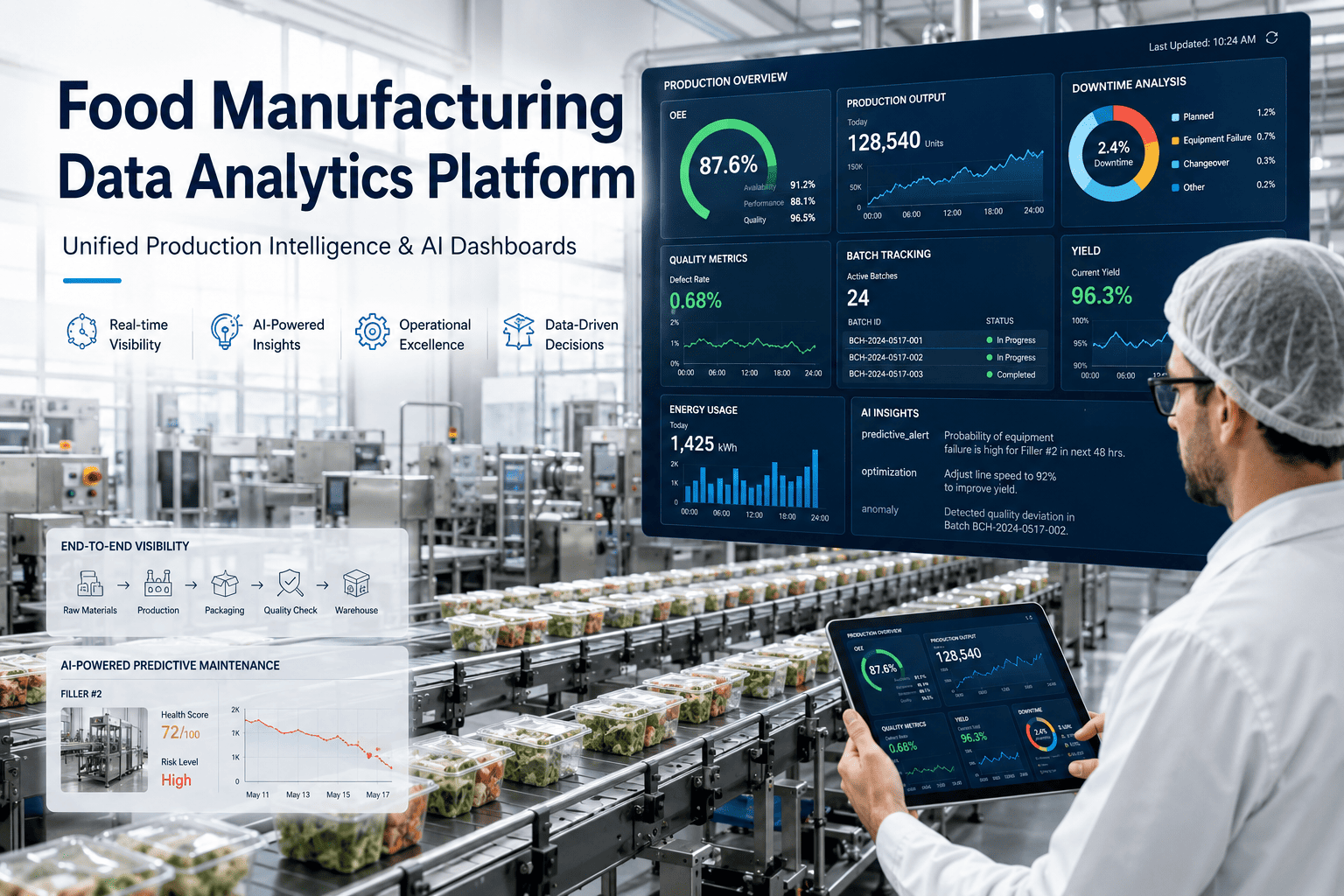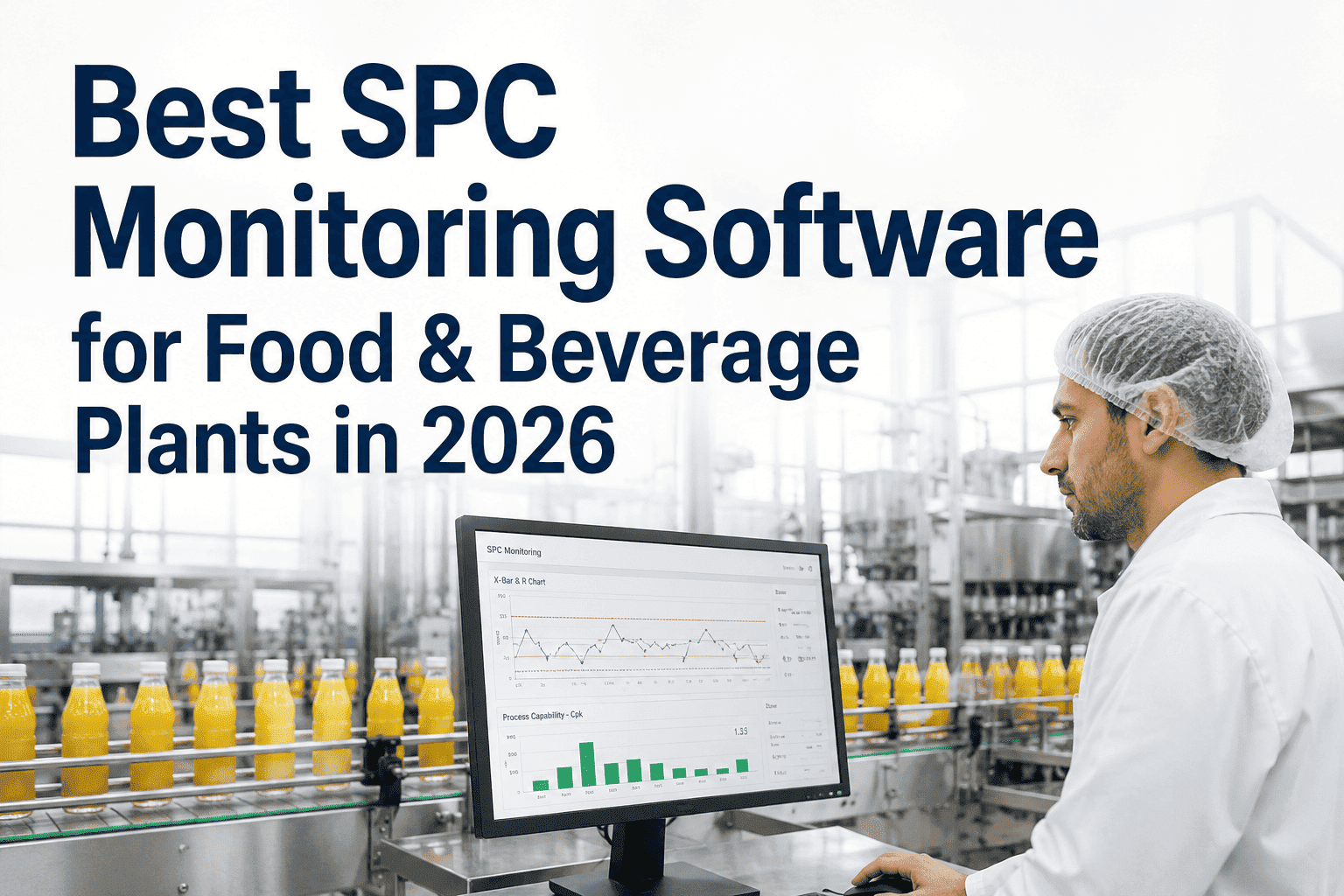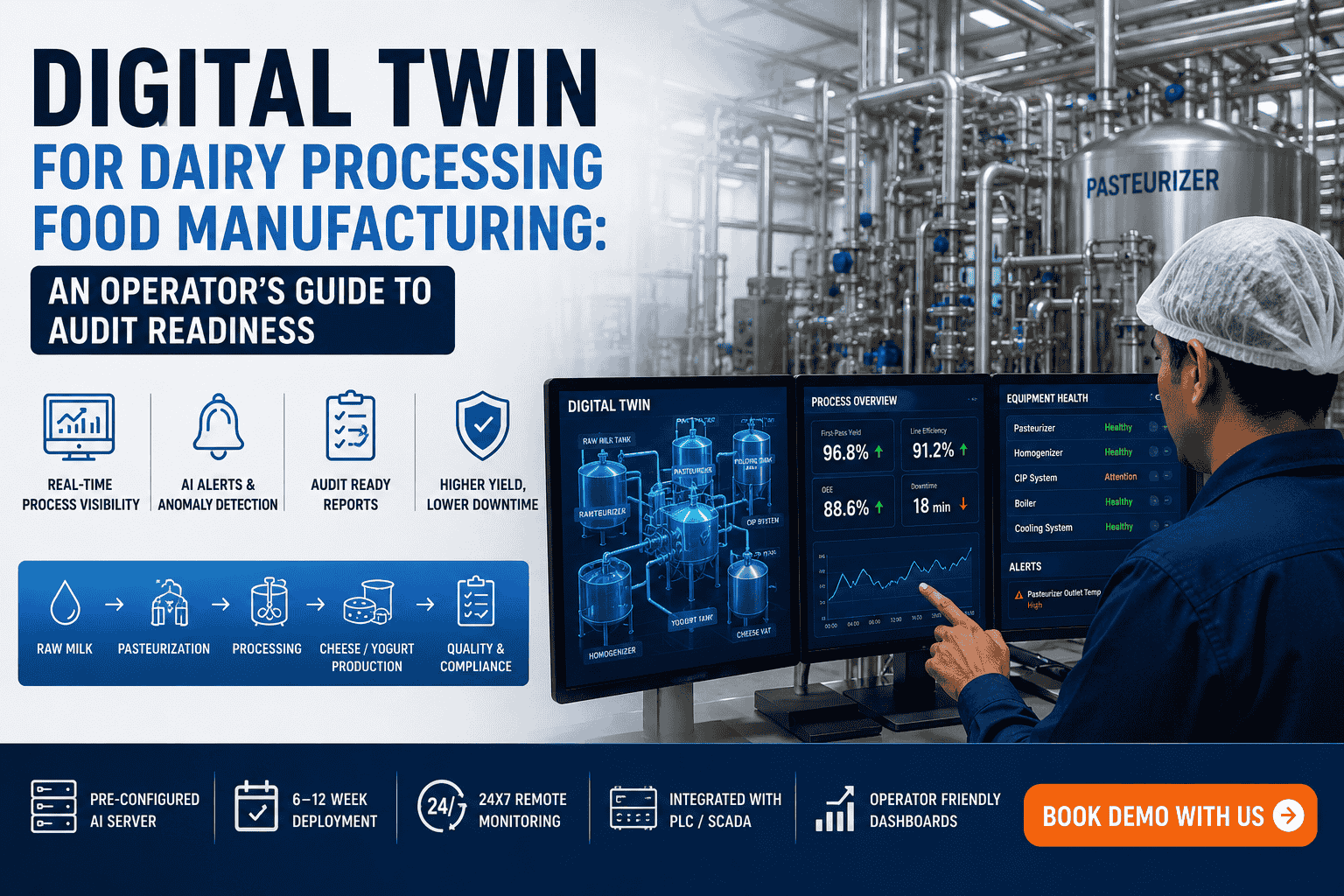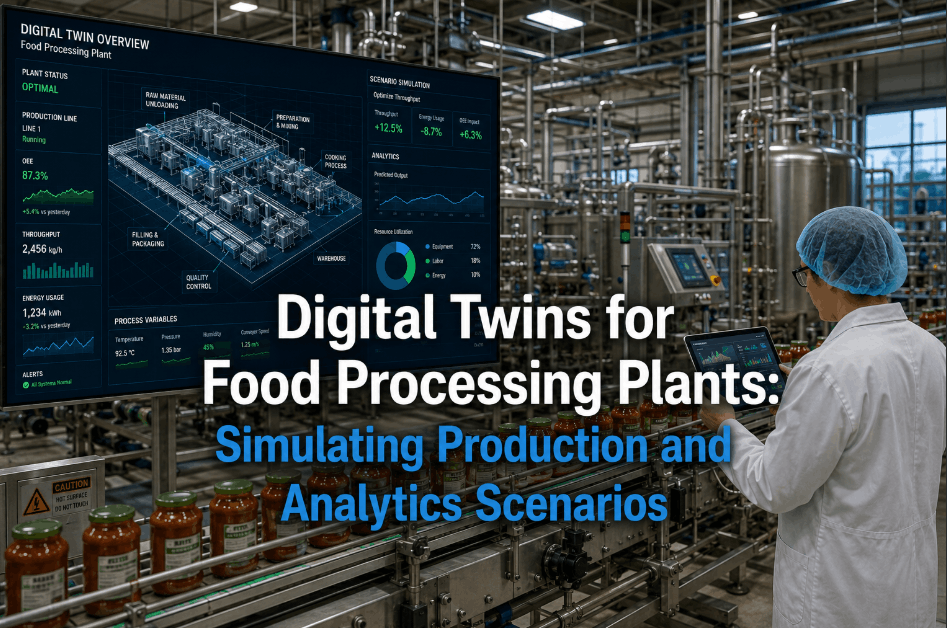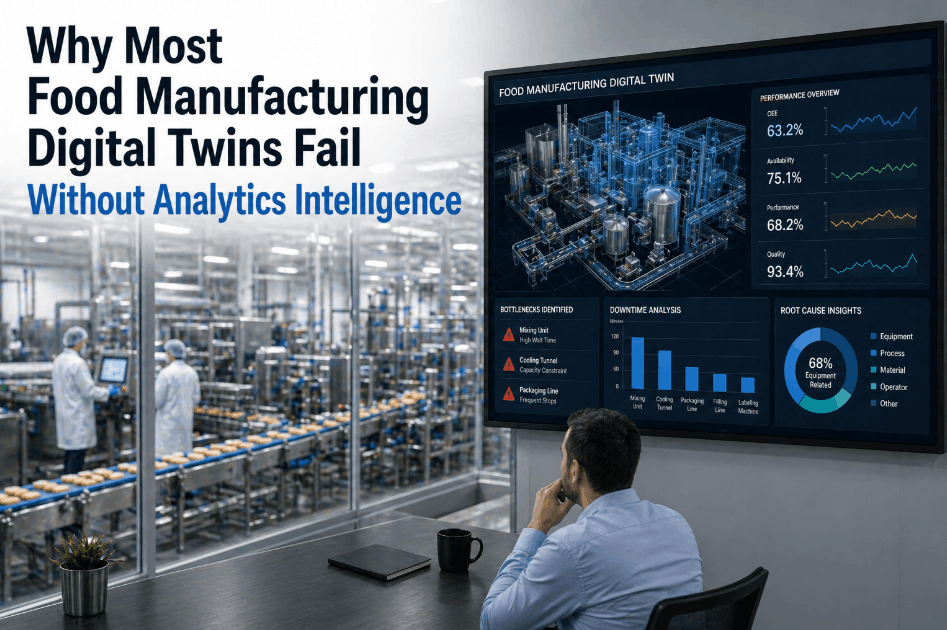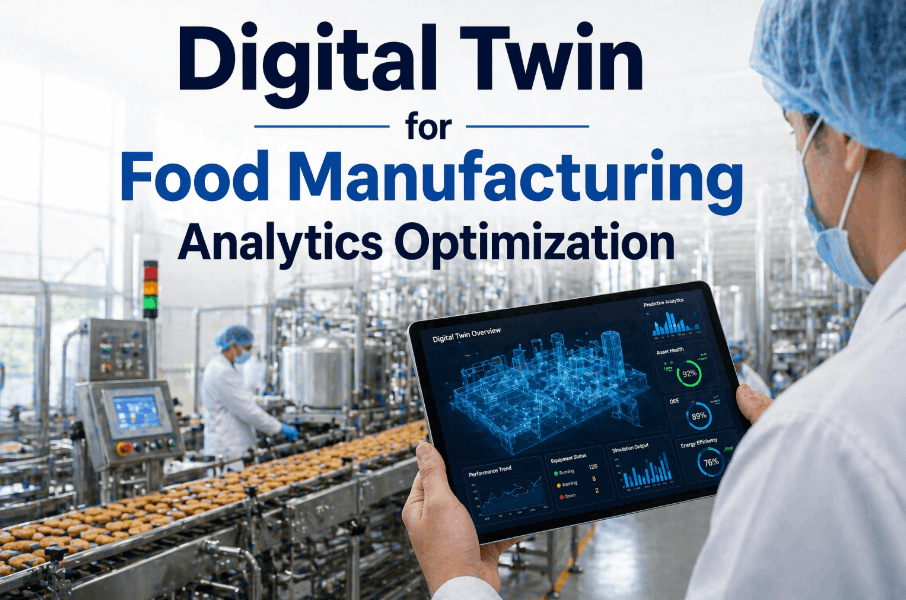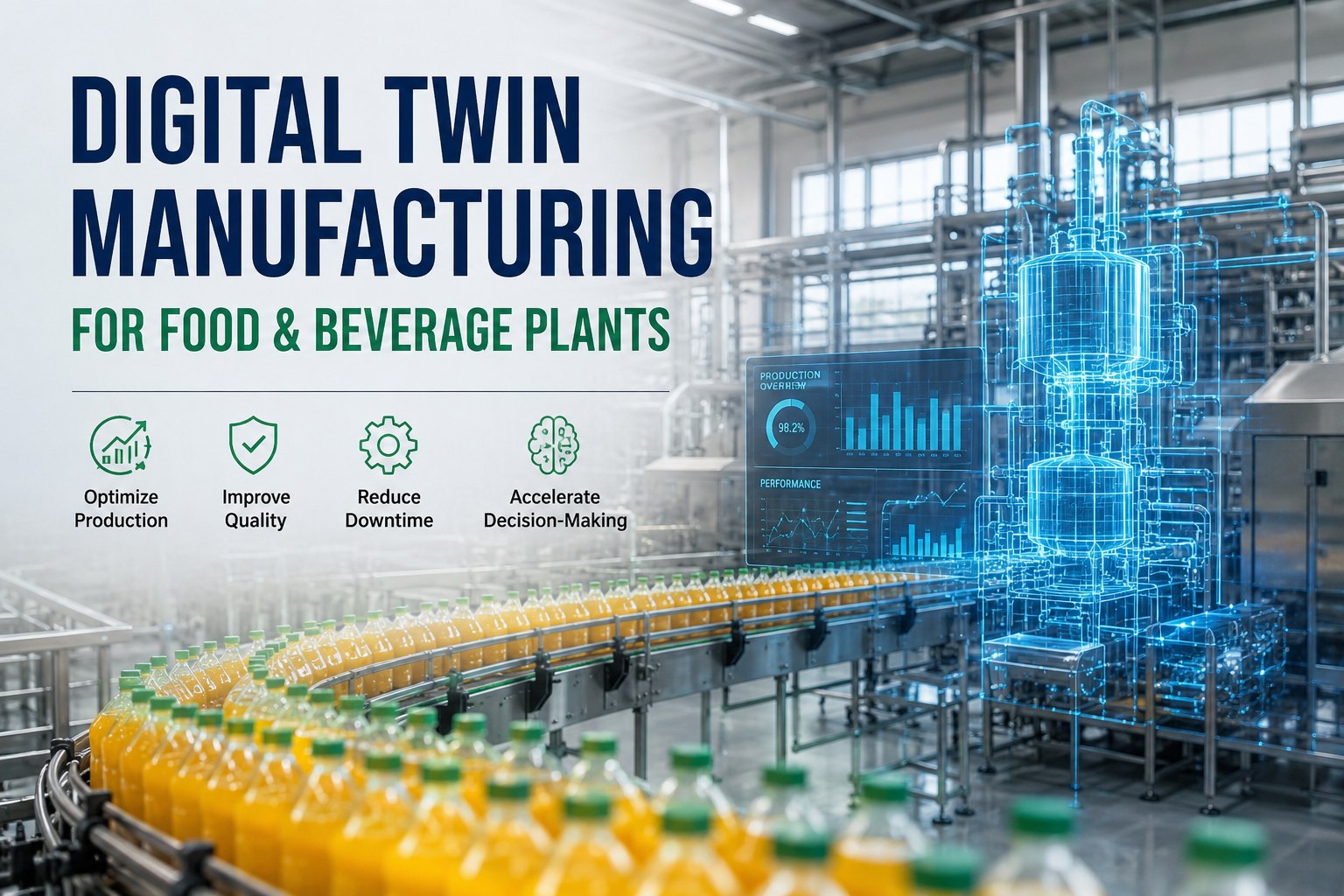
Imagine running a production changeover, a line-speed increase, or a new CIP schedule — and seeing exactly what happens before you touch a single machine on the real floor. That's the promise a digital twin delivers to food and beverage plants in 2026: a continuously updated, physics-accurate virtual replica of your plant, synchronized with live sensor data, that lets you simulate future states and stress-test decisions before any physical intervention. It isn't theoretical. One Georgia beverage manufacturer built a digital twin of its filling line, cut CIP cycle times 23%, and prevented $1.2 million in annual product losses — by predicting exactly when heat exchangers would foul and cleaning on actual residue rather than a fixed calendar. This guide explains how digital twin manufacturing works for food and beverage, the five domains where it pays, how it differs from old-school simulation, and how iFactory runs it on-premise as a modern SAP MII alternative.
Digital Twin Manufacturing for Food & Beverage Plants
A live, physics-accurate virtual replica of your plant — synced to real-time sensor data — so you can simulate changeovers, line-speed increases, and CIP windows before they cost time, material, or output on the real floor. Predict failures, optimize throughput, and test decisions virtually. On-premise so your plant data stays in the plant. A modern SAP MII alternative, live in 6–10 weeks.
Digital Twin vs Simulation — Not the Same Thing
This is the distinction that decides whether the investment pays off. Most people use the terms interchangeably; confusing them is one of the most expensive mistakes in manufacturing technology. A traditional simulation is a static model built from historical data to answer one design question, then it's done. A digital twin is a continuously updated virtual replica connected to live sensor data — it evolves with your actual equipment, learning your specific wear patterns, product mix, and failure history.
- Static — built once from historical data
- Answers a single design question
- Based on assumptions and averages
- Goes stale the moment the plant changes
- Lives in engineering, not operations
- Live — synced to real-time sensor data
- Continuously answers "what happens if…?"
- Reflects your actual equipment behavior
- Evolves as the plant evolves
- Drives daily operational decisions
How a Food & Beverage Digital Twin Works
The twin is built from data you already have — no plant shutdown, no hardware rip-out. Sensors feed a calibrated virtual model that mirrors reality in motion; AI models trained on your plant's signature run scenarios against it; and the best solutions flow back to the physical floor. It's a closed loop between the real plant and its virtual mirror.
Want to see a calibrated twin built from your own plant data? Book a 30-minute demo — iFactory builds the twin from your existing sensors, historian, and ERP without a shutdown, and runs a live what-if scenario on your process. Sessions available this week.
Five Places a Digital Twin Pays Off in Food & Beverage
The value isn't one big thing — it's five distinct operational domains where leading food, beverage, and FMCG manufacturers are deploying twins today.
Throughput optimization
Lines often run below their ceiling because no one's sure how machines react to speed increases. The twin simulates line acceleration and pinpoints the exact speed beyond which a downstream machine becomes the bottleneck.
CIP & cleaning optimization
Model fouling on heat exchangers and clean on actual residue accumulation, not a fixed calendar — avoiding both over-cleaning (wasted time and chemicals) and under-cleaning (contamination risk).
Predictive maintenance
Physics simulation plus ML trained on your equipment signature predicts failures and remaining useful life above 90% accuracy — scheduling repairs into planned windows before a breakdown.
Virtual commissioning
Test new equipment configurations and operating parameters in the twin before physical installation — cutting commissioning ramp-up 30–40% and avoiding expensive production trials.
Continuous quality & batch
The twin monitors every batch against optimal parameters in real time, flagging deviations the moment they appear rather than discovering them at end-of-line inspection.
Which fits your plant?
Most plants start with the highest-pain domain and expand. Ask iFactory Support which domain delivers fastest ROI for your operation.
The What-If Engine — Test Before You Touch the Floor
The single feature that makes plant managers lean in during a demo is causal what-if simulation. Before a conveyor is adjusted, a filling sequence is changed, or a changeover is executed, the twin runs the entire scenario virtually and shows exactly what would happen downstream. AI agents can even run an iterative optimization loop — testing speed, temperature, and control logic, analyzing results, and converging on the best configuration autonomously before anything touches the real line.
Curious what your highest-value what-if would reveal? Schedule a demo and iFactory will run a causal simulation on a real question from your plant — a speed change, a changeover, or a CIP adjustment — and show the downstream outcome live. Slots open this week.
How iFactory Builds Your Twin — and the Timeline
iFactory's virtual food-plant platform is built for the complexity of food and beverage, not adapted from a generic IoT tool. It integrates with the sensors, historian, and ERP you already have, calibrating the twin from existing data — no shutdown, no hardware replacement, no extended commissioning.
On-Premise or Cloud — and Why It Replaces SAP MII
Many food and beverage plants run production intelligence through SAP MII, which moves and displays data but can't model a physics-accurate twin or run what-if scenarios. iFactory connects to the same sensors, historian, and ERP directly, adds the digital-twin and AI layer SAP never had, and syncs results back — so you modernize without an enterprise-wide rip-and-replace. On-premise is the default for food, keeping plant and recipe data in the plant.
iFactory On-Premise Appliance The food default — plant data stays in the plant
- Pre-configured NVIDIA AI server — racked, loaded, ready.
- Real-time twin at 1-sec fidelity — synced to the live floor.
- Air-gap capable — recipe and plant data never leave.
- Runs through WAN outages — the twin stays live.
iFactory Cloud For multi-plant and enterprise networks
- Fully managed — no on-site hardware to maintain.
- Same twin engine — physics simulation, what-if, prediction.
- Cross-plant modeling — compare and optimize site to site.
- Fastest start — first plant live in weeks.
Test every decision in the twin before it costs you on the floor.
A digital twin turns "let's try it and see" into "we already know what happens." Simulate changeovers, line-speed increases, and CIP windows virtually; predict failures before they hit; and push proven optimizations back to the real line. iFactory builds it from your existing data on a pre-configured on-premise appliance replacing SAP MII — live in 6–10 weeks, ROI proven on one line first.
Frequently Asked Questions
What's the difference between a digital twin and a simulation?
A simulation is a static model built once from historical data to answer a specific design question. A digital twin is a continuously updated virtual replica connected to live sensor data — it evolves with your actual equipment, learning your specific wear patterns, product mix, and failure history. The twin drives daily operational decisions; a simulation answers a one-time question and then goes stale.
Do we need to shut down or replace hardware to build one?
No. iFactory builds a calibrated twin from the sensors, historian, and ERP you already have — connecting via MQTT, OPC-UA, Modbus, and REST at 1-second resolution. There's no plant shutdown, no hardware replacement, and no extended commissioning period. The twin reflects your actual plant, with its specific equipment wear and supplier variability, not a theoretical average.
What's the most valuable thing a twin does day to day?
Causal what-if simulation. Before adjusting a conveyor, changing a filling sequence, or running a changeover, the twin simulates the entire scenario and shows the downstream outcome — so you find the optimal setting virtually instead of by trial and error on the live line. One beverage plant used this to cut CIP cycle times 23% and prevent $1.2M in annual losses.
How accurate is the failure prediction?
iFactory's models are trained on your plant's specific equipment signature, product mix, and failure history — not generic industry averages — which delivers failure-prediction accuracy above 90%. Combined with physics-based remaining-useful-life modeling, that lets maintenance schedule into planned windows before a breakdown rather than reacting to one.
Is this a replacement for SAP MII?
It replaces the production-intelligence layer while connecting directly to your existing equipment. SAP MII moves and displays data; iFactory connects to the same sensors, historian, and ERP, adds a physics-accurate digital twin and AI what-if engine SAP never had, and syncs results back to SAP or MES — no enterprise-wide rip-and-replace. A demo is the fastest way to see it; schedule one here.
How fast can a twin go live, and what does it cost?
The model-commissioning phase typically runs 6–10 weeks, calibrating against your historical and live production data. The recommended path is to start with one line or the highest-pain domain, prove ROI there, then expand. For a sized timeline and investment estimate for your plant, contact iFactory Support with your line list and main objective — typically a response within 3 business days.
Your plant, mirrored in motion — and one step ahead.
The 2026 food and beverage advantage is a live digital twin: simulate before you act, predict before it breaks, and optimize without disrupting a single run — replacing SAP MII without touching your equipment. Built from your existing data, live in 6–10 weeks, ROI proven on one line first. The next step is a 30-minute demo with a causal what-if on your own process. Sessions available this week.