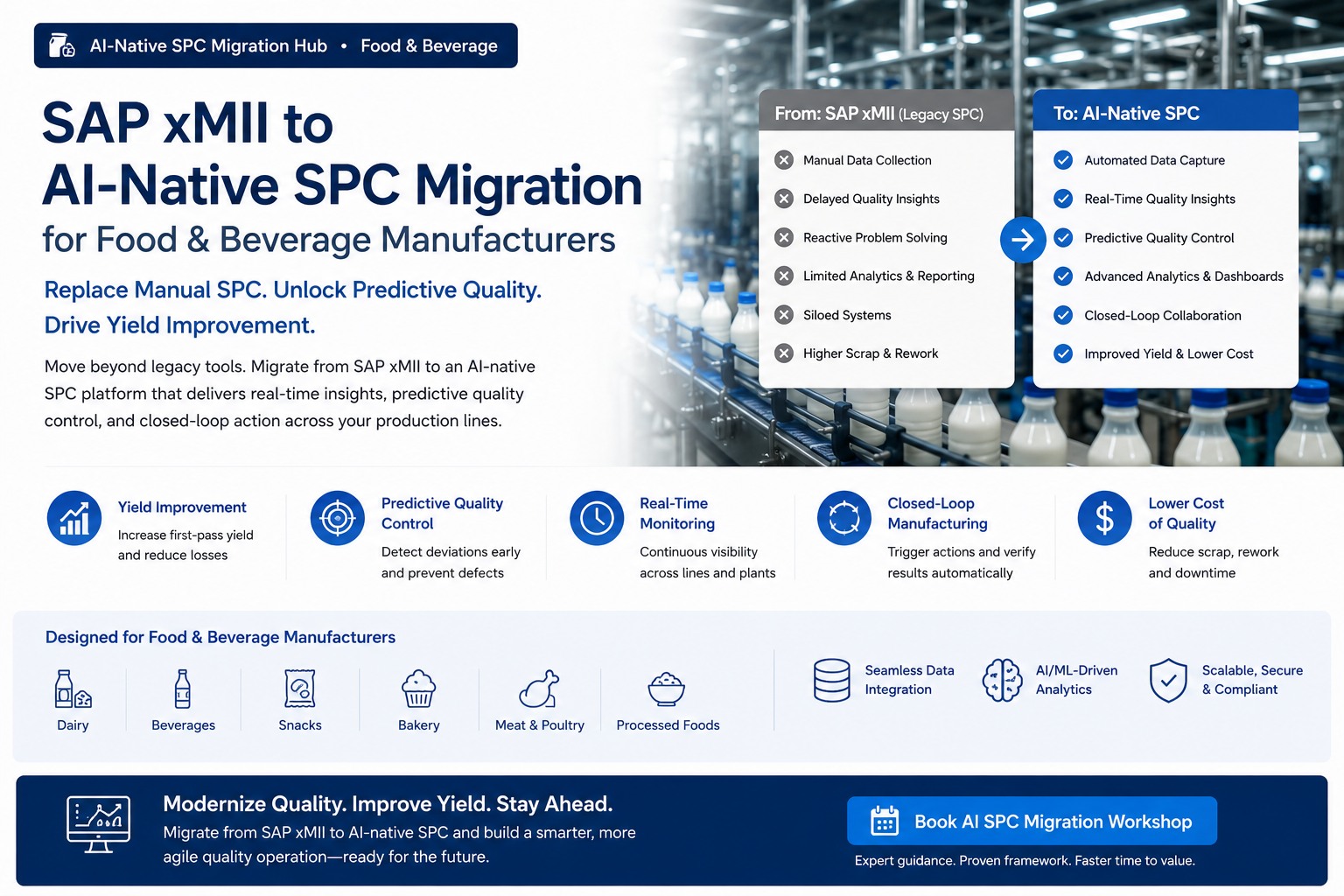
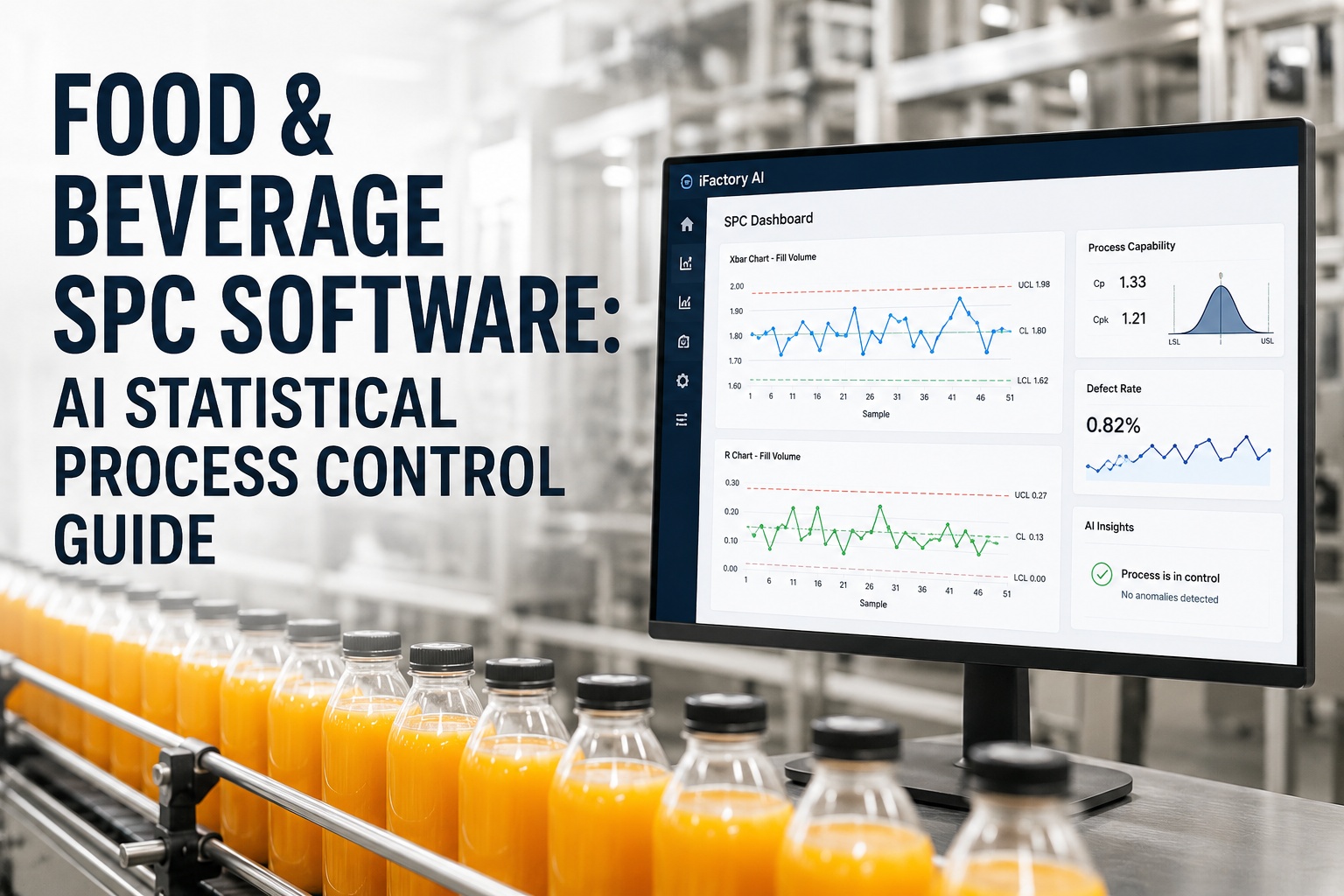
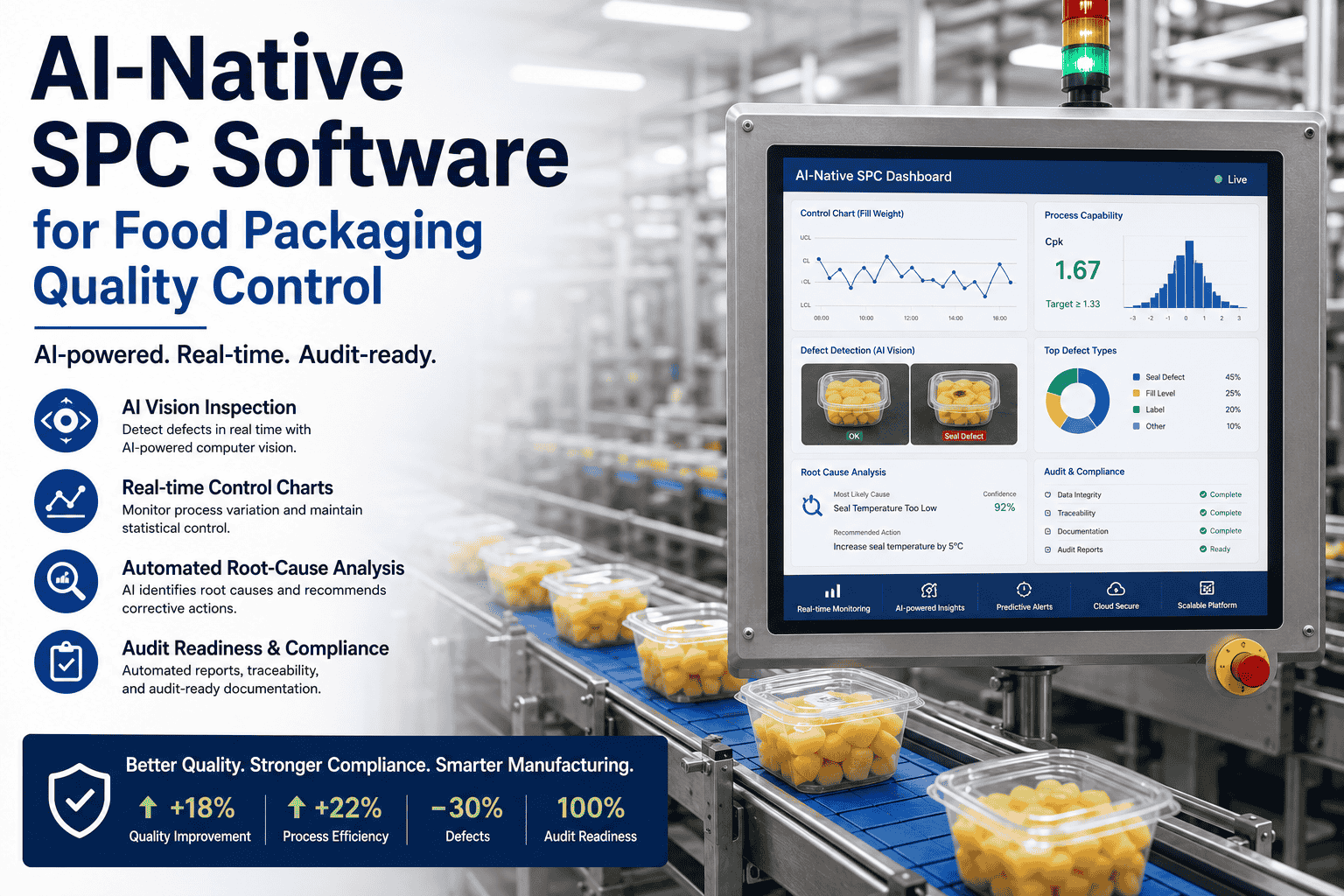
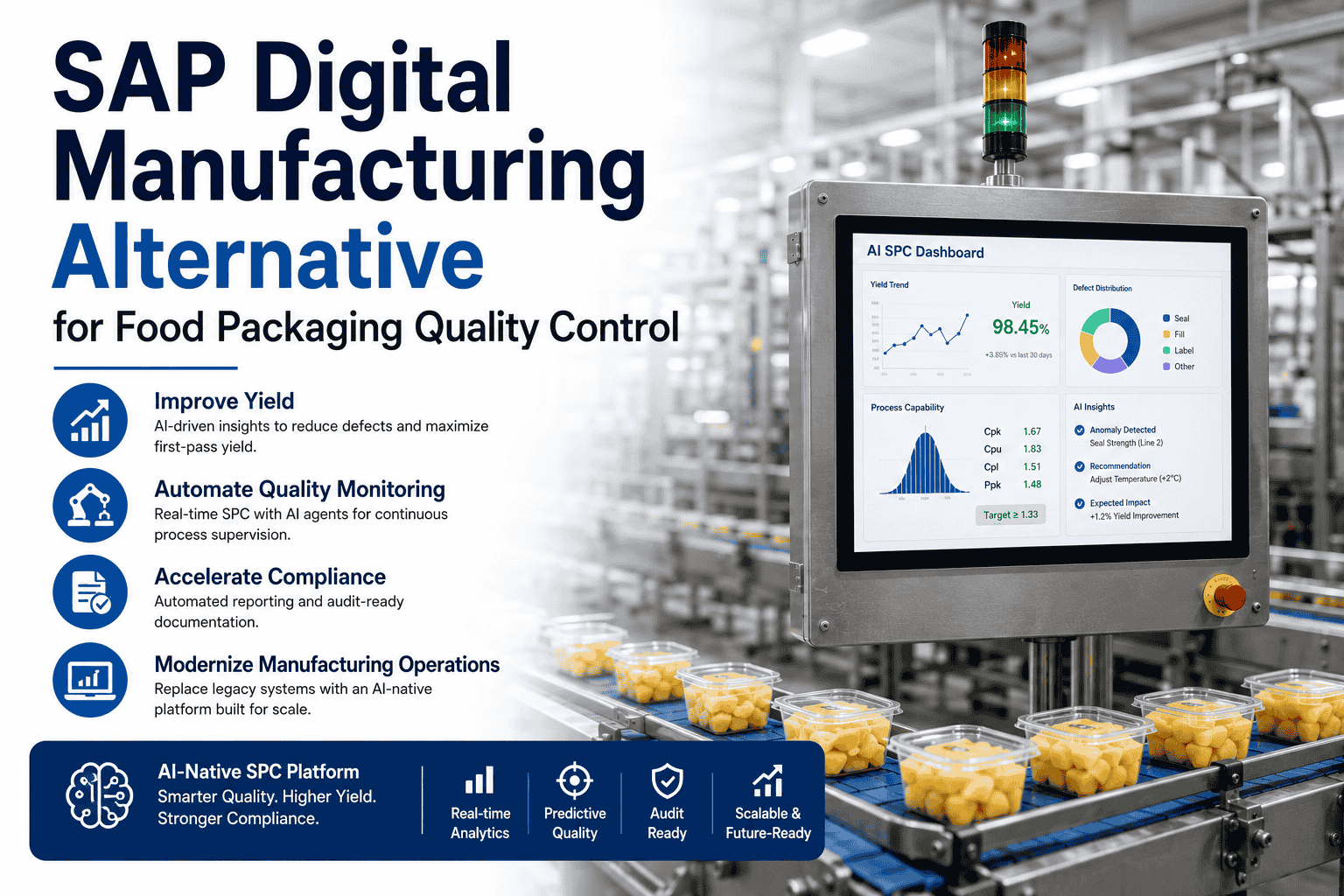
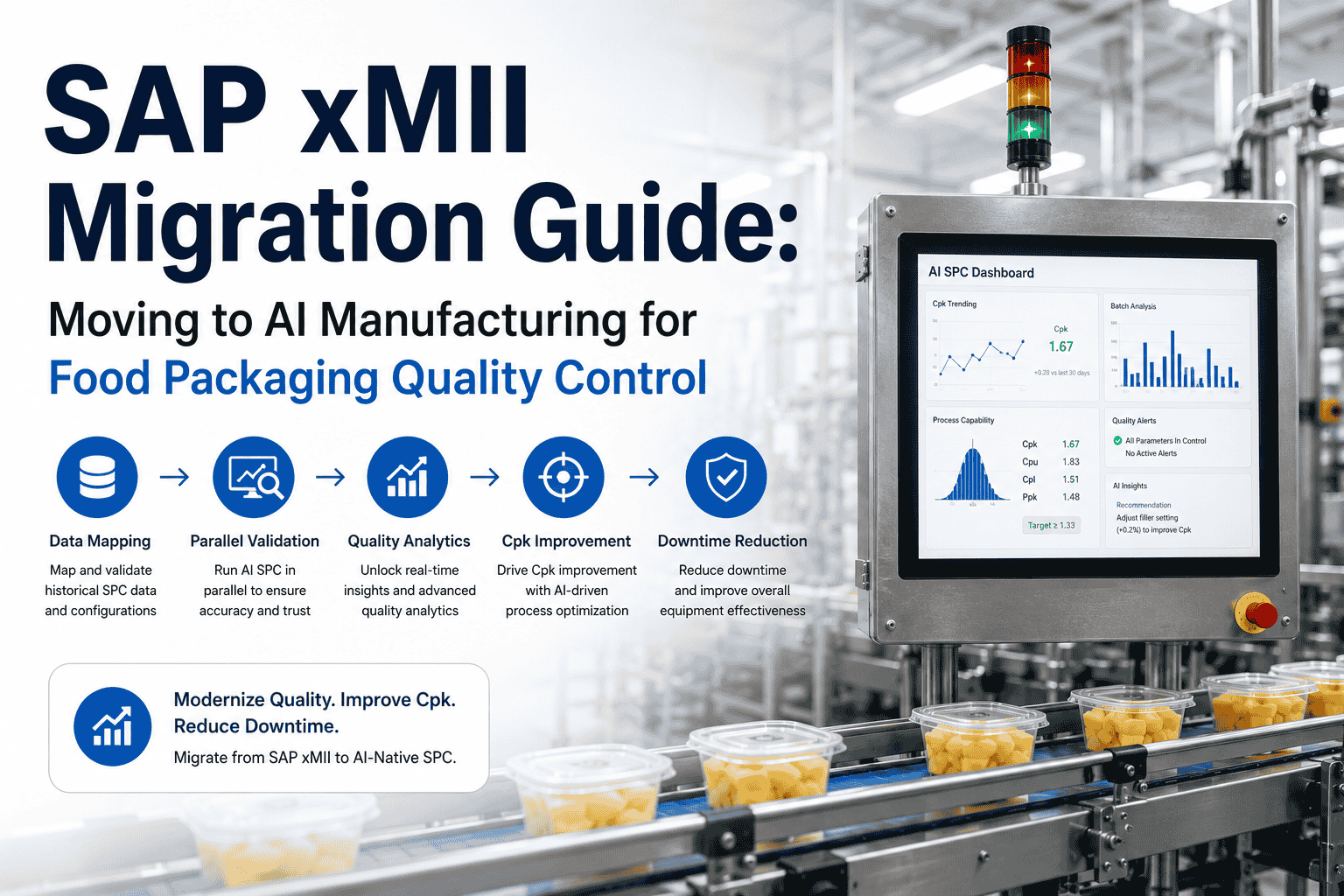
Every F&B plant running SAP xMII for SPC is leaking yield it cannot see — and cannot fix. xMII reports deviations after the fact and waits for an operator to react, costing the typical F&B line 5 to 12% cumulative yield across cooking, dosing, filling, drying, and packaging. AI-native SPC closes the loop: senses deviation in seconds and dispatches corrective setpoints to the PLC autonomously. Plants migrating from xMII to closed-loop AI SPC consistently recover 60 to 80% of that hidden yield loss. Book an AI SPC migration workshop to model your yield recovery before migration begins.
SAP xMII to AI-Native SPC Migration — F&B Closed Loop Yield 2026
Where SAP xMII Leaks Yield — and Where AI-Native Closed Loop Recovers It
Cooking / Thermal
xMII reports temperature deviation after batch · AI holds tighter setpoint, recovers 70–80%
Dosing / Standardisation
xMII reactive only · AI adjusts ratio batch-by-batch · 80–90% recovery
Filling & Packaging
Fill weight giveaway tracked by xMII · AI reduces target headroom 80%
Drying / Concentration
Moisture spec margin built in for xMII lag · AI eliminates overhead
Rework / Off-Spec
xMII detects after batch fails · AI prevents defect propagation
xMII Open Loop
90.0%
−10% cumulative yield loss
AI Closed Loop
98.1%
+8.1 pts yield recovery
5–12%Hidden yield loss in typical xMII open-loop F&B operations
60–80%Of that loss recoverable through AI closed-loop migration
secondsAI-to-PLC dispatch latency vs. minutes for xMII alerts
8–14 wkTypical xMII-to-AI migration timeline per production line
Why SAP xMII Architecture Locks In Yield Loss — By Design
SAP xMII was built as a reporting and integration layer between SAP ERP and the shop floor — not as a closed-loop control system. The architecture decisions made in 2008 still drive the yield ceiling today. Four structural limits.
01
Polling-Based Data Acquisition
xMII queries OPC and historian tags at intervals — typically 5 to 60 seconds. Fast deviations resolve before the next poll. AI-native SPC ingests streaming sensor data and detects drift in single-digit seconds.
Yield impact: Misses transient deviations entirely
02
Operator-in-the-Loop by Default
xMII surfaces alerts on the HMI and waits for an operator response. Human reaction time, shift handover gaps, and competing tasks compound to 5 to 30 minute delays before corrective action.
Yield impact: Two to four batches drift before correction
03
Rule-Based Control Charts
xMII Western Electric rules detect known patterns (8 above mean, 7 trending up). They miss multivariable drift where individual variables stay in range but their combination signals failure.
Yield impact: 40 to 60% of defects show no single-variable trigger
04
No Direct PLC Writeback
xMII reads from PLCs through OPC but does not write setpoints back. Any corrective action requires operator-mediated HMI change. Closed-loop autonomous correction is architecturally impossible in xMII.
Yield impact: Open-loop limit on Cpk capability
What Changes With AI-Native Closed Loop: The Architecture Shift
The migration from xMII to AI-native SPC is not a feature upgrade — it's an architectural inversion. xMII is reporting layer with bolt-on rules. AI-native is closed-loop control with reporting as a byproduct. Five capabilities define the shift.
Δ1
Streaming Data Ingest
Edge layer ingests sensor data continuously via OPC-UA, MQTT, or direct PLC tags. Sub-second detection vs. 5-60 second polling.
Δ2
Multivariable AI Models
ML models detect drift across 20+ correlated variables simultaneously. Catches failure patterns Western Electric rules cannot see.
Δ3
Recipe-Aware Baseline
Each recipe has its own learned baseline — not a single global control chart. Tighter limits per SKU without false positives.
Δ4
Autonomous PLC Writeback
Corrective setpoints dispatched directly to PLCs under governance rules. Operator confirms exceptions, not routine adjustments.
Δ5
Continuous Self-Improvement
Every batch outcome retrains the model. Day 90 yield is better than day 30. Day 365 is better still.
Want to model your specific yield recovery against your xMII deviation history? Book an AI SPC migration workshop — we will run the analysis on your data before commitment.
The xMII to AI-Native SPC Migration Roadmap: 8–14 Weeks Per Line
Migration is not a rip-and-replace. xMII continues running ERP integration and historical reporting while AI-native SPC takes over the closed-loop control layer. The 5-phase roadmap below is what disciplined F&B plants follow.
Wk 1–2
Baseline & Audit
Extract 6–12 months of xMII deviation data. Map current control charts, alerts, and operator response patterns. Identify highest-yield-loss zones.
Wk 3–5
Edge Layer Install
Deploy edge gateways at PLCs. Establish streaming data pipeline via OPC-UA or MQTT. xMII continues running in parallel — no production disruption.
Wk 6–8
Model Training
Train recipe-specific AI models on historical batches. Validate against known good and known bad runs. Establish per-recipe baselines.
Wk 9–11
Advisory Mode
AI runs in recommendation-only mode. Operators see AI-suggested setpoints alongside xMII alerts. Build trust before autonomous dispatch.
Wk 12–14
Closed Loop Live
Governance rules approved. AI dispatches corrective setpoints to PLCs autonomously within defined bands. Operator handles exceptions and recipe decisions.
Stop Reporting Yield Loss on xMII Dashboards — Start Recovering It With Closed Loop AI
iFactory's AI SPC migration workshop models your yield recovery against actual xMII deviation history, identifies the highest-impact lines (cooking, dosing, filling, drying, packaging), and designs the 8–14 week migration that preserves SAP ERP integration while shifting closed-loop control to AI-native architecture.
What Stays in SAP — What Moves to AI-Native SPC
Migration is not removal of SAP. ERP, financial reporting, master data, and audit trail remain in SAP. What moves is the closed-loop control layer that xMII was never designed for.
Stays in SAP
SAP ERP — finance, procurement, planning
SAP QM — quality master data and audit records
Material master, BOMs, recipes (source of truth)
Batch genealogy and traceability records
Regulatory reporting (FDA, FSMA, HACCP)
Historical xMII data for compliance retention
Moves to AI-Native SPC
Real-time process monitoring and SPC charts
Multivariable anomaly detection
Recipe-specific control baselines
Autonomous setpoint adjustment to PLCs
Predictive yield and defect forecasting
Continuous self-learning per batch outcome
Expert Perspective: Why xMII Plants See Yield Improvement Within 90 Days of Migration
The yield improvement most F&B plants see in the first 90 days of closed-loop AI SPC operation isn't because the AI is doing anything exotic. It's because the plant is finally responding to drift in seconds instead of minutes, on every variable at once instead of one at a time, with every recipe having its own learned baseline instead of a single global chart. xMII was a good architecture for its decade — reporting to ERP, integrating shop floor data, surfacing dashboards. It was never an architecture for closed-loop control. Plants that recognise that distinction migrate the closed-loop layer to AI-native SPC and keep xMII running for ERP integration. They recover 60 to 80% of the yield xMII was structurally unable to protect, while preserving every SAP investment that actually delivers value.
— iFactory F&B SPC Migration Practice, Closed Loop Architecture 2025 to 2026
90 days
Typical time to measurable yield improvement post-migration
6–14 mo
Typical payback on AI SPC migration investment
0
SAP ERP / QM / batch genealogy modules replaced
Ready to migrate the closed-loop layer while preserving every SAP investment that delivers? Talk to our F&B migration team — we will design the 8–14 week migration plan for your plant.
Recover the 5–12% Yield xMII Was Never Architected to Protect
iFactory's AI SPC migration workshop maps your xMII deviation history to recoverable yield by stage, designs the closed-loop architecture across cooking, dosing, filling, drying, and packaging zones, and produces the 8–14 week phased migration plan that runs xMII in parallel through cutover — delivered before any system change.
Frequently Asked Questions
Does migration to AI-native SPC mean removing SAP xMII entirely?
No. xMII continues running ERP integration, historical data retention for compliance, and existing dashboards. What migrates is the closed-loop control layer that xMII was never architected to deliver. SAP ERP, QM, batch genealogy, recipe master data, and regulatory reporting all stay in SAP. AI-native SPC takes over real-time monitoring, multivariable detection, and autonomous setpoint dispatch to PLCs.
How much yield improvement is realistic from xMII to closed-loop AI migration?
Typical F&B plants running xMII open-loop SPC carry 5 to 12% cumulative yield loss across cooking, dosing, filling, drying, and packaging stages. Migration to AI-native closed-loop SPC consistently recovers 60 to 80% of that loss within 90 days. Total payback typically lands between 6 and 14 months depending on production volume and product margin.
How long does the migration actually take per production line?
A typical line migrates in 8 to 14 weeks across 5 phases: baseline and audit (weeks 1-2), edge layer install with streaming pipeline (weeks 3-5), recipe-specific model training (weeks 6-8), advisory-mode validation (weeks 9-11), and full closed-loop go-live (weeks 12-14). xMII runs in parallel throughout — there is no production downtime during cutover. Multiple lines can migrate in parallel after the first reference line proves the architecture.
Will operators accept autonomous PLC writeback after years of xMII operator-in-the-loop?
The migration includes a deliberate Advisory Mode phase (weeks 9-11) where AI runs as recommendation-only — operators see suggested setpoints alongside xMII alerts and choose to accept or override. This builds trust before autonomous dispatch. Governance rules then define which adjustments run autonomously (routine drift within tight bands) and which require operator confirmation (recipe changes, out-of-band corrections). Operators typically embrace the change once they see the AI catching deviations they were missing.
How does iFactory's AI SPC migration workshop work?
iFactory's workshop ingests 6 to 12 months of your xMII deviation data, maps yield loss by production stage, identifies highest-impact lines for first migration, designs the AI-native closed-loop architecture with edge layer specification, produces the 8 to 14 week phased migration roadmap, and models yield recovery projections against your actual deviation history. All delivered before any system change.
Book your migration workshop here.