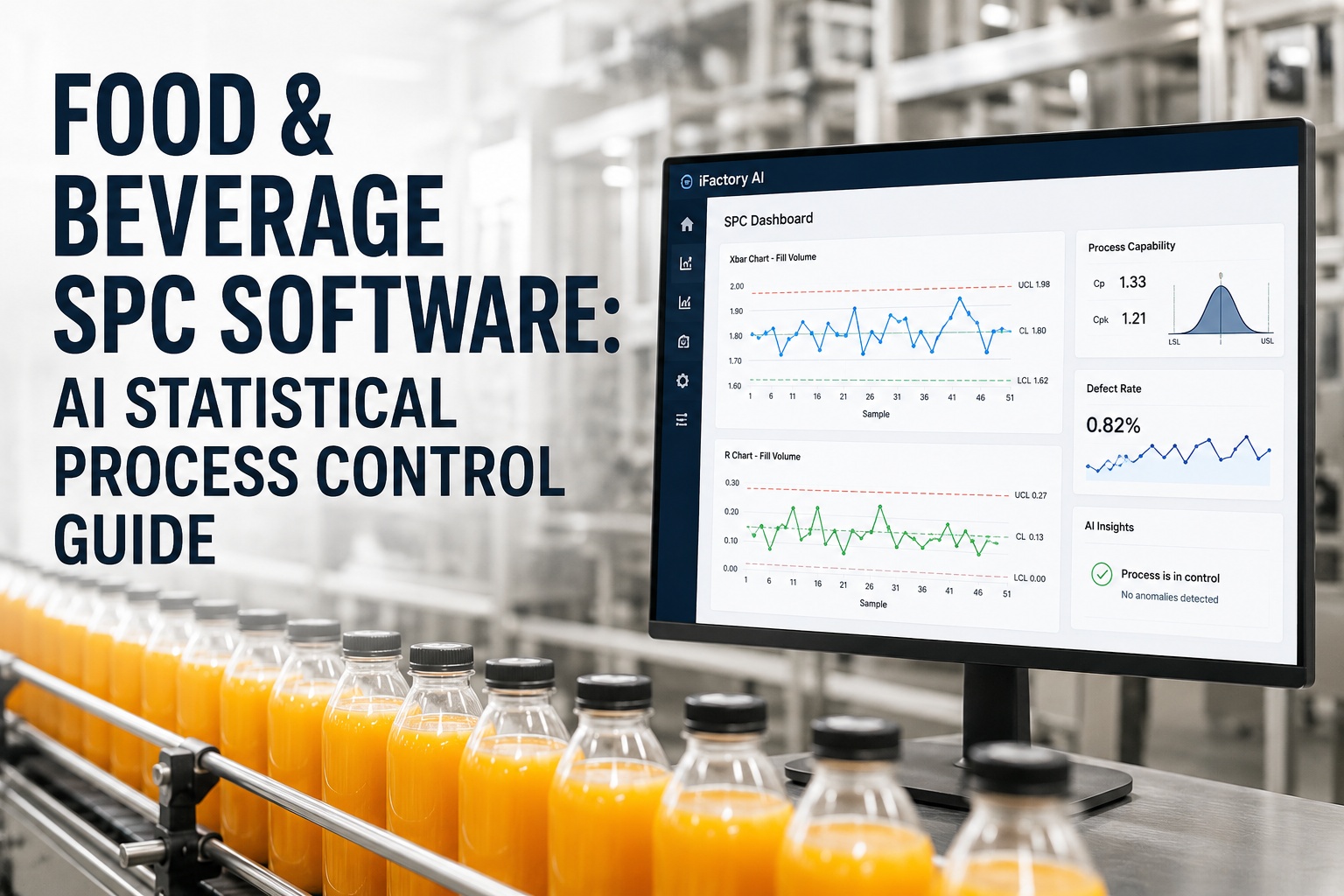
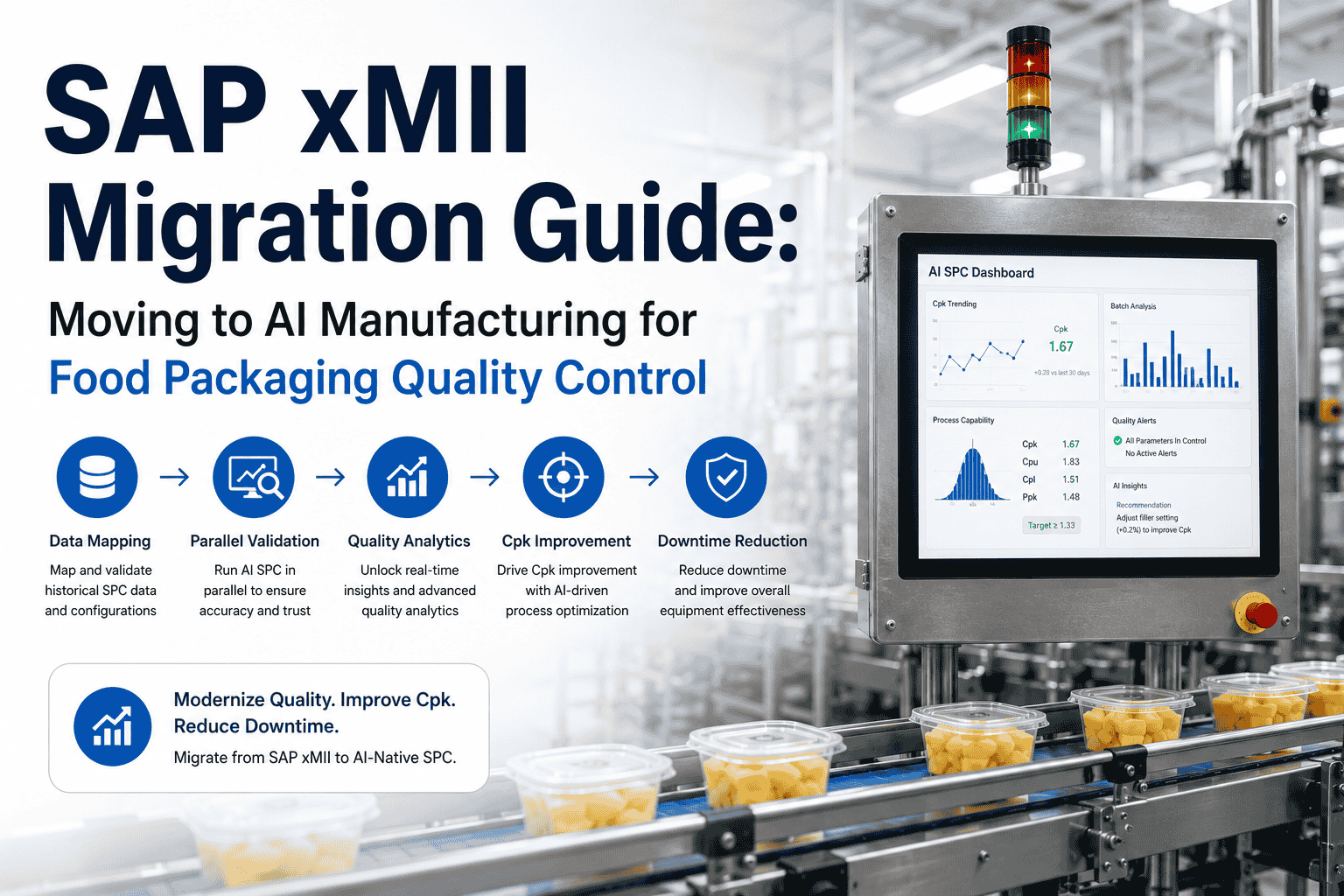
Searching for a SAP MII alternative lands you in five different software categories — SAP’s own Digital Manufacturing Cloud, traditional on-prem MES platforms, cloud-native MES, F&B-specific platforms, and AI-native intelligence layers. The categories solve different problems, and most F&B manufacturers eventually need pieces from more than one. iFactory AI sits in the AI-native intelligence layer — it doesn’t replace your MES choice, it adds on-prem AI models that deliver adaptive SPC monitoring, CIP optimization, and shop-floor AI intelligence on top of whichever MES you select. The on-prem NVIDIA deployment is the wedge for F&B: data stays in the plant, latency stays low, and food safety/IP sovereignty stays intact. Schedule an AI manufacturing transformation workshop to map iFactory AI against your alternative shortlist.
Beyond SAP MII and xMII
The AI Intelligence Layer Your MII Alternative Needs
iFactory AI is the on-prem AI manufacturing intelligence platform F&B plants run on top of SAP DMC, Plex, AVEVA, Proficy, or whichever MES alternative they choose. Adaptive SPC monitoring, CIP optimization, allergen-aware quality control — with NVIDIA on-premise deployment for food safety data sovereignty.
On-premNVIDIA AI appliance, no cloud dependency
6–12 wkper-line deployment, not 12–36 mo
Any MESSAP DMC, Plex, AVEVA, Proficy, more
Where iFactory AI Fits
ERP / Business Backbone
SAP S/4HANA · Oracle · Infor
MES / Shop Floor Visibility
SAP DMC · Plex · AVEVA · Proficy
AI Intelligence Layer
iFactory AI · On-Prem NVIDIA
This is where iFactory AI lives
Plant Floor / Automation
PLCs · SCADA · HMIs · Sensors
Why “SAP MII Alternative” Search Lands in 5 Different Categories
The reason “SAP MII alternative” is hard to evaluate is that MII itself sat in an ambiguous category. It wasn’t purely MES, wasn’t purely SPC, wasn’t purely analytics — it was an integration-plus-intelligence platform that bridged SAP and the shop floor. Replacing MII means picking pieces from multiple software categories. Most F&B manufacturers end up with two pieces: a primary MES (SAP DMC, Plex, AVEVA, Proficy, or another) plus an AI intelligence layer (iFactory AI). The MES handles production execution and ERP integration; the AI layer handles adaptive SPC, CIP optimization, and shop floor intelligence.
Category 01
SAP’s Own Path
SAP Digital Manufacturing Cloud (DMC)
SAP’s official MII/ME replacement. Cloud-only deployment. Native S/4HANA integration. Retains static SPC paradigm. 12–36 month migration typical.
F&B fit: Strong for SAP-committed enterprises, weaker for plants wanting on-prem control or adaptive SPC.
Category 02
Traditional On-Prem MES
AVEVA, GE Proficy, MPDV Hydra X, Rockwell FactoryTalk
Mature MES platforms with deep F&B vertical features. On-prem deployment available. Significant infrastructure investment. Mature partner ecosystem.
F&B fit: Strong for large multi-plant operations with existing on-prem infrastructure. Proficy and Plex (Rockwell) widely deployed.
Category 03
Cloud-Native MES
Plex (Rockwell), Tulip, SYMESTIC, MachineMetrics, 42Q
Modern SaaS MES platforms with rapid deployment. Predictable subscription pricing. Cloud-only architecture. Strong for greenfield or modernization scenarios.
F&B fit: Plex strong for WIP and quality compliance. Tulip strong for frontline operator apps. Cloud architecture limits data sovereignty.
Category 04
F&B-Specific Platforms
Aptean, Infor M3, ParityFactory, Deacom, FactoryTalk CPGSuite
Industry-specialized MES with built-in F&B regulatory frameworks (FSMA, PMO, allergen controls). Faster deployment for F&B-specific workflows.
F&B fit: Strong for plants needing pre-built F&B compliance. ParityFactory specifically focused on F&B processors.
Category 05
AI-Native Intelligence Layer
iFactory AI, Falkonry, Braincube, Harmony AI
Sits above your MES choice. Adds adaptive SPC, predictive maintenance, AI-driven recommendations. iFactory AI uniquely runs on-prem on NVIDIA appliances for F&B data sovereignty.
F&B fit: Strong for plants with existing MES who want AI capabilities without MES replacement. iFactory AI specifically optimized for F&B (dairy, beverage, bakery, processed foods).
Trying to figure out which categories you actually need? Schedule a transformation workshop — we’ll map your specific MII implementation against the 5 categories and identify whether you need one or two pieces of the replacement stack.
Why On-Prem AI Models Win for F&B Specifically
The AI value proposition that matters most for F&B manufacturers is on-premise AI deployment. Cloud-native alternatives have predictable pricing and faster initial deployment, but they push production data outside the plant network — which creates real problems for F&B specifically. Food safety records, PMO compliance documentation, allergen tracking, and IP-sensitive recipe data have data sovereignty requirements that cloud architectures struggle with. iFactory AI’s NVIDIA on-prem appliance solves this directly: data stays in the plant, processing happens at the edge, and audit responses are simpler because data flow doesn’t cross jurisdictional boundaries.
01
Food Safety Data Sovereignty
F&B production data — CIP records, allergen tracking, PMO compliance, batch genealogy — stays within the plant network. No cloud round-trip. Regulatory inspections (FDA, USDA, FSMA) can be answered with documented data flow that doesn’t cross jurisdictional boundaries.
Real-Time Edge Inference
02
Adaptive SPC requires sub-second inference on streaming process data. Cloud round-trips add 100–500ms latency that degrades the detection window operators need. NVIDIA on-prem appliance processes at the edge with millisecond latency.
03
Recipe & IP Protection
F&B recipes, formulations, and process parameters are competitive IP. Cloud deployment requires trusting another vendor’s security model with your most sensitive operational data. On-prem deployment keeps IP within your perimeter.
No Cloud Outage Exposure
04
Plant operations continue during internet outages. Cloud-native MES alternatives stop functioning when the WAN drops. On-prem AI continues monitoring SPC, CIP, and predictive maintenance during connectivity loss.
05
Predictable Total Cost
Cloud SaaS pricing escalates with data volume and user count. On-prem appliance has a fixed deployment cost with predictable annual support. F&B plants with high-volume continuous production avoid the SaaS scaling cost curve.
Audit Posture Simplicity
06
FSMA 21 CFR 117 Subpart C preventive controls auditors increasingly ask where SPC data is processed and stored. On-prem deployment with documented data flow simplifies audit responses compared to cloud-hosted SPC where data crosses jurisdictional boundaries.
iFactory AI — What You Get on Top of Your MES Choice
iFactory AI layers on top of whichever MES you select. It connects via standard OPC-UA, Modbus, and MQTT to your PLC/SCADA. It integrates via REST APIs to your MES and ERP. It doesn’t require ripping out existing automation, doesn’t require new operator HMIs, and doesn’t conflict with your MES vendor’s data ownership. What it adds is the AI intelligence layer that turns existing data into adaptive SPC, predictive recommendations, and shop-floor AI workflows.
01
Adaptive SPC Monitoring
Control limits adapt to current product, shift, line, and incoming material variability. Western Electric and Nelson rules automated across every chart, every second. Pattern detection catches drift hours before static limits would alarm.
CIP Optimization
02
Condition-based CIP cycle termination using turbidity, conductivity, temperature, and flow signals. ATP-pass probability prediction before swab. Re-clean prevention through pattern detection. Chemical right-sizing across hundreds of cycles per quarter.
03
Allergen-Aware Quality Control
Adaptive limits adjust per product changeover. Cross-contact risk flagged before next batch begins. CIP cycle integrated with allergen control records. FSMA 21 CFR 117 Subpart C preventive control documentation generated automatically.
Beverage Line Monitoring
04
Filler giveaway optimization. Brix and pH control loop tuning. Carbonation level stability. Changeover stabilization. Multi-head filler per-head performance tracking. Bottle/can integrity monitoring integrated with checkweigher.
05
Pump seal health, heat exchanger fouling, valve seat wear, filler head wear, conveyor bearing condition. Predictive intervention windows of 1–4 weeks. Integration with existing CMMS workflows.
Predictive Maintenance
Shop Floor AI Recommendations
06
Plain-language alerts that name the equipment, describe the pattern, and recommend specific operator action. Continuous learning from operator feedback. Shift handoff digests preserving context across crew changes.
Layer iFactory AI on Your Existing or New MES
A transformation workshop walks through your current MES (or MES candidates if you’re still selecting) and maps how iFactory AI’s AI intelligence layer integrates. The deployment plan addresses both scenarios: layering on existing MII while you migrate, or co-deploying with a new MES choice.
How to Evaluate SAP MII Alternatives — Selection Framework
Vendor selection for F&B manufacturing intelligence breaks down into eight evaluation dimensions. Most RFPs cover all eight but weight them differently based on whether the manufacturer is primarily concerned with regulatory compliance, operational efficiency, capital cost minimization, or technology modernization. The framework below covers the dimensions iFactory AI scores strongest on and where category alternatives differ.
Dimension 01
Deployment model
On-premise vs cloud vs hybrid. F&B manufacturers with food safety data sovereignty requirements weight on-premise highly. Cloud-native alternatives weight on rapid deployment and predictable pricing.
iFactory AI fit: Strongest in this dimension — on-prem NVIDIA appliance is the wedge.
Dimension 02
SPC paradigm
Static vs adaptive control limits. Static limits work for stable single-product lines. Adaptive limits matter for multi-SKU, allergen-changeover, CIP-frequent F&B operations.
iFactory AI fit: Adaptive limits are core platform capability, not add-on.
Dimension 03
Integration scope
Standard PLC/SCADA protocols (OPC-UA, Modbus, MQTT), ERP integration (S/4HANA, Oracle, Infor), QMS integration (SAP QM, ETQ, Rockwell PharmaSuite).
iFactory AI fit: Standard integration, no proprietary protocols required, layers on existing stack.
Dimension 04
Deployment timeline
Time from contract to production value. Full MES migrations run 12–36 months. AI intelligence layer deployments run 6–12 weeks per line. Faster timelines fit better with 2027 SAP MII end-of-life pressure.
iFactory AI fit: 6–12 week per-line deployment, phased across plant lines.
Dimension 05
F&B vertical depth
Pre-built support for HTST pasteurization, CIP cycles, allergen control, filler line giveaway, fermentation monitoring, batch tracking. Generic MES platforms require extensive F&B-specific configuration.
iFactory AI fit: Pre-configured for dairy, beverage, bakery, processed foods CCPs.
Dimension 06
AI capability
Pattern detection, predictive recommendations, continuous learning. AI-native platforms have AI as core capability. AI-bolted-on platforms have AI as marketing layer.
iFactory AI fit: AI-native platform, models trained on F&B production patterns, continuous learning from operator feedback.
Dimension 07
Support model
24×7 coverage during deployment and operation. Training scope (operators, supervisors, engineers). Tuning frequency. Continuous improvement engagement.
iFactory AI fit: 24×7 support, training included, quarterly tuning reviews, continuous learning automation.
Dimension 08
Total cost of ownership
3-year TCO including license, deployment, infrastructure, training, support, and ongoing tuning. Cloud SaaS pricing escalates with data volume. On-prem deployment has predictable annual cost.
iFactory AI fit: Predictable on-prem TCO, no per-user/per-volume scaling fees.
iFactory AI vs Other AI Intelligence Layer Options
Within the AI intelligence layer category specifically, iFactory AI competes with Falkonry, Braincube, Harmony AI, and other AI-native manufacturing platforms. The comparison below covers the dimensions F&B manufacturers evaluate when choosing among AI intelligence layer vendors. The key differentiator: on-prem NVIDIA deployment combined with F&B vertical depth (dairy, beverage, bakery pre-configuration).
← Swipe to see all columns →
Need this comparison applied to your specific MII replacement shortlist? Schedule a transformation workshop — we’ll walk through your candidate vendors and identify where iFactory AI’s on-prem NVIDIA differentiation matters most for your environment.
Deployment Path — From MII to iFactory AI + MES
The deployment runs in two parallel tracks. Track A: iFactory AI deploys on existing MII infrastructure first (6–12 weeks per line), demonstrating value before MES migration completes. Track B: MES selection and migration proceeds on its own 12–36 month timeline. Track A delivers value during the MES migration window, not after — which means F&B manufacturers don’t wait 12–36 months to see AI-native SPC benefits.
Track A · Fast
iFactory AI Layer Deployment
Week 1–2: NVIDIA appliance installed, PLC/SCADA tag mapping, baseline data ingestion
Week 3–6: Shadow mode alongside MII, adaptive limits tune to your products and lines
Week 7–12: Operators transition to AI-native primary view, CIP and filler optimization live
Week 13+: Continuous learning, quarterly tuning reviews, expanding to additional lines
Outcome: Live AI-native SPC value within 90 days
Track B · Strategic
MES Selection & Migration
Months 1–3: RFP and vendor selection across MES candidates (SAP DMC, Plex, AVEVA, Proficy, etc.)
Months 4–9: Pilot deployment of selected MES on first plant or first lines
Months 10–24: Multi-plant or multi-line rollout, MII data migration, integration testing
Months 25–36: Sunset MII, complete cutover, finalize integrations including with iFactory AI
Outcome: Modern MES platform on schedule with 2027 deadline
Expert Perspective
"The F&B manufacturers handling the SAP MII transition best in 2026 are the ones who recognize that the ‘MII replacement’ question has two answers, not one. The MES question is what platform handles production execution and ERP integration — that’s SAP DMC, Plex, AVEVA, Proficy, or a category-specific F&B platform. The AI question is what platform handles adaptive SPC, predictive recommendations, and shop-floor AI intelligence — that’s iFactory AI or another AI intelligence layer. Treating these as one decision forces compromise; treating them as two separate decisions optimizes each. For F&B specifically, the on-premise data sovereignty requirement is the strongest argument for the AI intelligence layer being a separate, plant-resident system rather than a feature of the cloud MES. Food safety records, allergen tracking, and recipe IP have data residency requirements that get cleaner with on-prem AI than with cloud-hosted MES SPC modules. The 2027 deadline forces the MES decision; the AI intelligence layer decision is independent and can deliver value while the MES decision is still being made."
— F&B Manufacturing Architecture Practice, 2026 industry perspective
5 categories
of SAP MII alternative software exist
On-prem
NVIDIA deployment for F&B data sovereignty
6–12 wk
iFactory AI per-line deployment
Schedule Your AI Manufacturing Transformation Workshop
90 minutes with your supervisor and operations manager team produces a documented evaluation: where iFactory AI fits in your specific MII replacement stack, which MES options to evaluate in parallel, and a per-line deployment plan aligned to your 2027 deadline. No engagement commitment required to participate.
Frequently Asked Questions
Is iFactory AI an MES replacement or something else?
Something else — iFactory AI is an AI intelligence layer that runs on top of your MES, not as your MES. It doesn’t handle production order management, work-in-process tracking, or ERP integration the way an MES does. It handles adaptive SPC, CIP optimization, allergen-aware quality control, predictive maintenance, and shop-floor AI recommendations. For F&B manufacturers replacing SAP MII, the typical stack becomes: SAP DMC (or Plex/AVEVA/Proficy/other) as the MES + iFactory AI as the AI intelligence layer. The two systems integrate through standard APIs and work together rather than competing.
Why not just use the AI features built into the new MES?
Three reasons. First, depth: MES platforms typically have AI bolted on as a marketing layer rather than built as core capability. AI-native platforms like iFactory AI have AI as the foundation, with deeper models and continuous learning. Second, deployment model: most MES platforms are cloud-only or cloud-first, which conflicts with F&B data sovereignty requirements. iFactory AI’s on-prem NVIDIA deployment addresses this directly. Third, F&B vertical depth: iFactory AI is pre-configured for dairy, beverage, bakery, and processed foods CCPs (HTST pasteurization, CIP cycles, allergen control, filler optimization). Generic MES AI features require extensive F&B configuration to reach equivalent capability.
Can we deploy iFactory AI before we’ve picked our MES replacement?
Yes — this is actually the recommended path for F&B manufacturers facing the 2027 MII deadline. iFactory AI deploys on top of existing MII infrastructure in 6–12 weeks per line, delivering adaptive SPC and CIP optimization value during the MES selection window (months 1–3 of a typical MES RFP). When the new MES is selected and deployed (months 4–36), iFactory AI continues operating with no disruption — the integration shifts from MII APIs to the new MES APIs. This means F&B manufacturers don’t wait 12–36 months for AI-native SPC benefits; they get value within the first quarter while the strategic MES decision proceeds on its own timeline.
How does this work with cloud-native MES platforms like Plex or Tulip?
Cleanly. iFactory AI’s on-prem deployment is complementary to cloud-native MES, not conflicting. Production data flows from PLCs/SCADA into both systems in parallel — the MES gets the production execution data it needs (orders, WIP, quality records), and iFactory AI gets the time-series process data it needs for AI-native SPC. The two systems integrate through standard REST APIs. The combination addresses the cloud-native MES gap on F&B data sovereignty: critical SPC and CIP data stays on-prem in iFactory AI’s NVIDIA appliance while the MES handles its cloud-native functions. F&B manufacturers get the rapid deployment and predictable pricing of cloud MES with the data sovereignty of on-prem AI.
What about the cost compared to an all-in-one MES?
The all-in-one MES total cost typically exceeds the MES + iFactory AI combination for F&B specifically. Reason: F&B-specific MES customization (CIP cycle integration, allergen controls, HTST pasteurization, filler optimization) drives significant configuration costs in generic MES platforms. iFactory AI comes pre-configured for these F&B CCPs, reducing the customization burden on the MES side. A typical F&B plant with 4–8 lines sees the MES + iFactory AI combination delivering equivalent capability at 70–85% of the cost of a fully-customized generic MES. Cost comparisons are project-specific; the workshop session includes a directional TCO comparison for your specific environment before any deployment commitment.
How quickly can we see ROI?
Most F&B plants see measurable ROI within the first two quarters of iFactory AI operation. The 3–6% yield recovery (across CIP optimization, filler giveaway, predictive maintenance, and process drift) translates to documented bottom-line impact within 90 days of go-live. For a mid-sized F&B plant with $100M annual production value, 3% yield recovery represents $3M annual impact — significantly higher than typical iFactory AI deployment cost. Larger plants see proportionally larger ROI. Customer complaint reduction (40–60%) delivers additional brand-protection value that’s harder to quantify but increasingly important under FSMA 21 CFR 117 Subpart C preventive controls scrutiny.