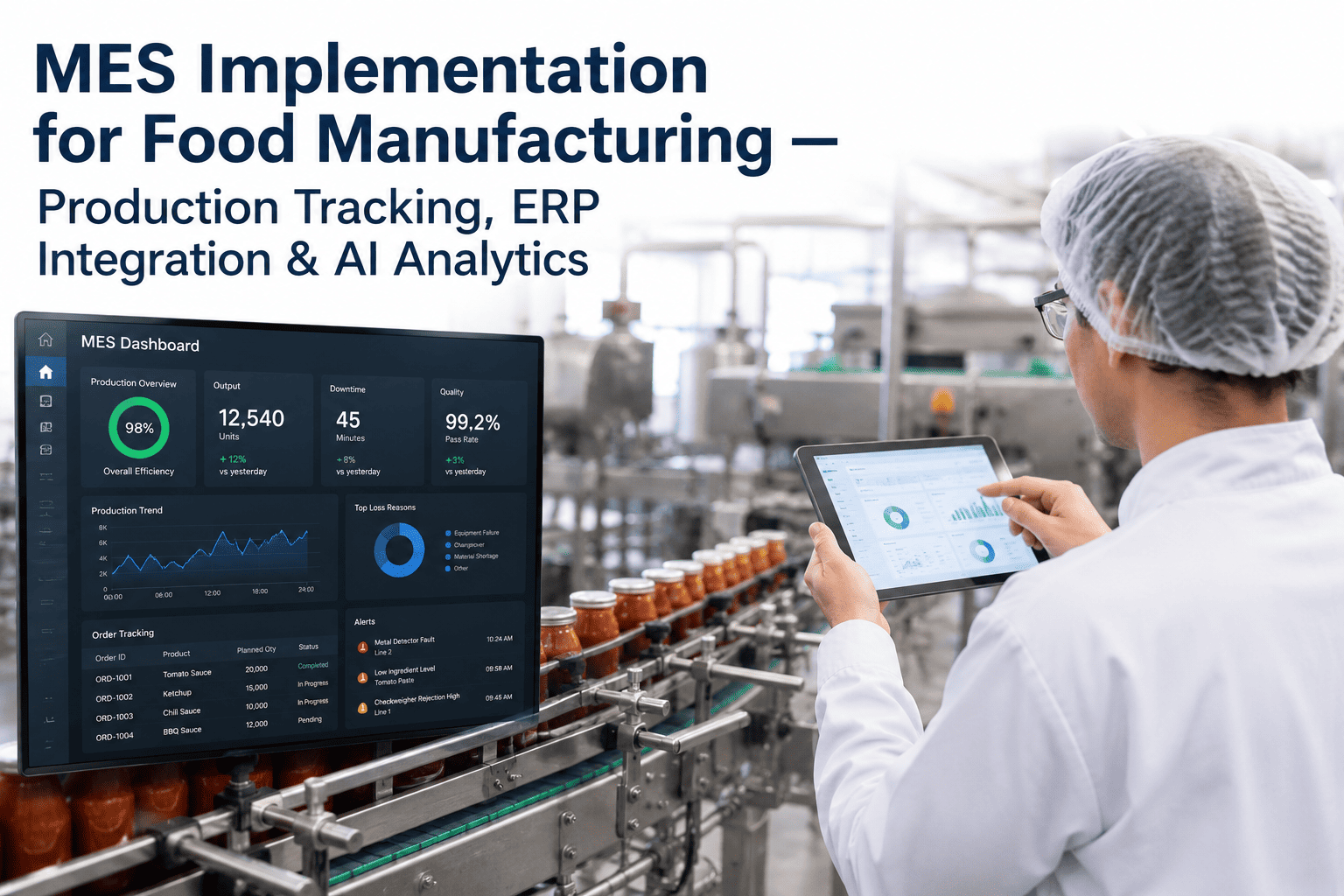
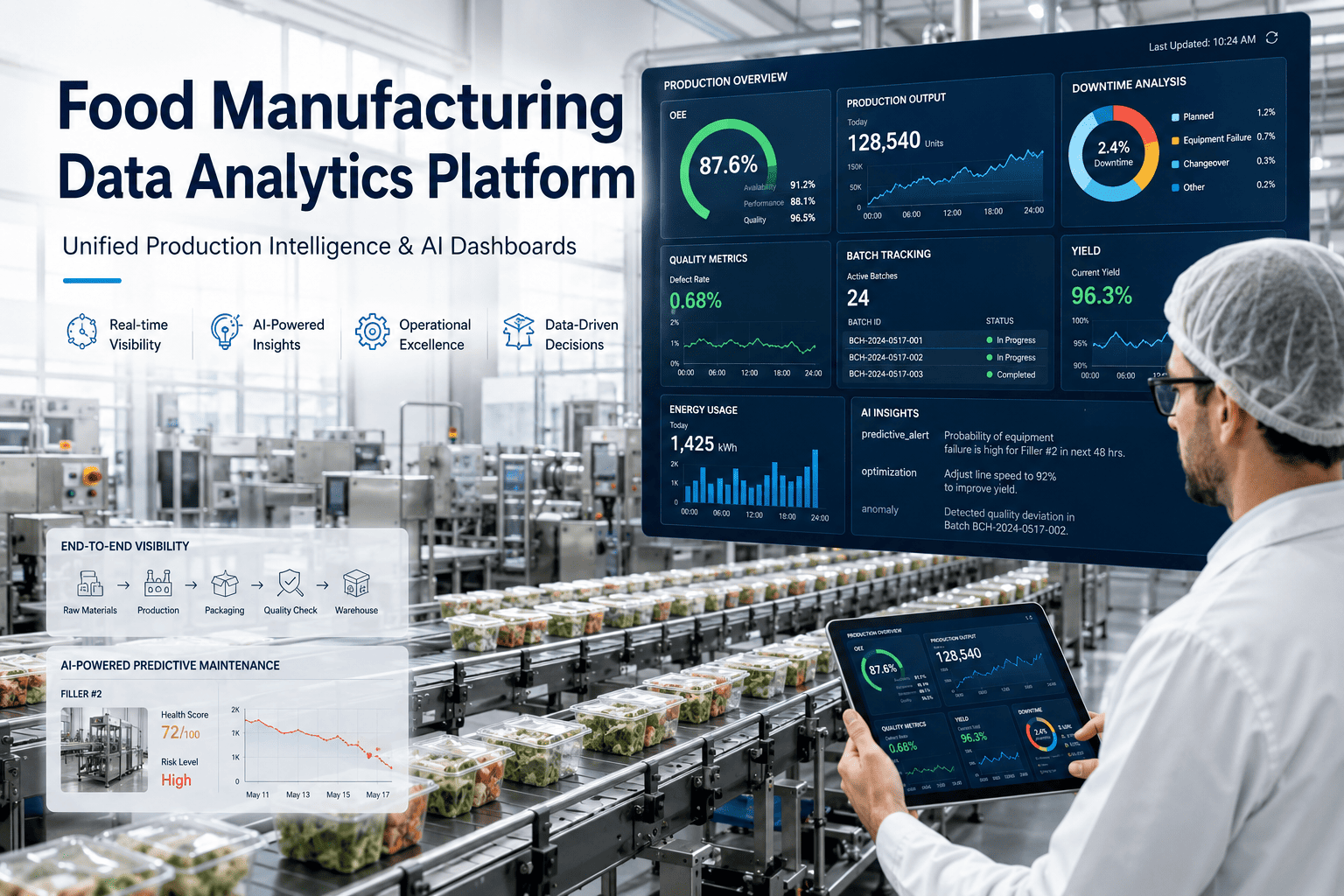
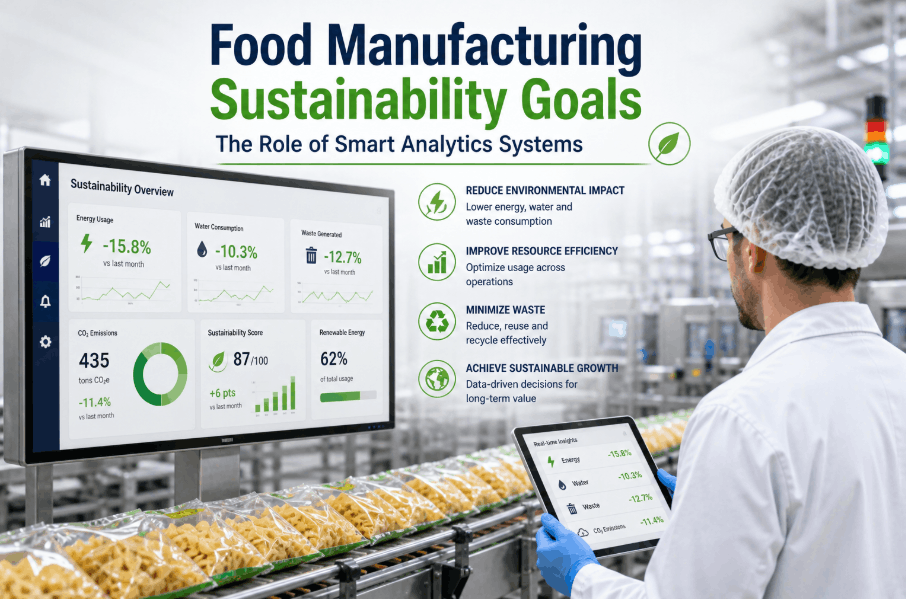
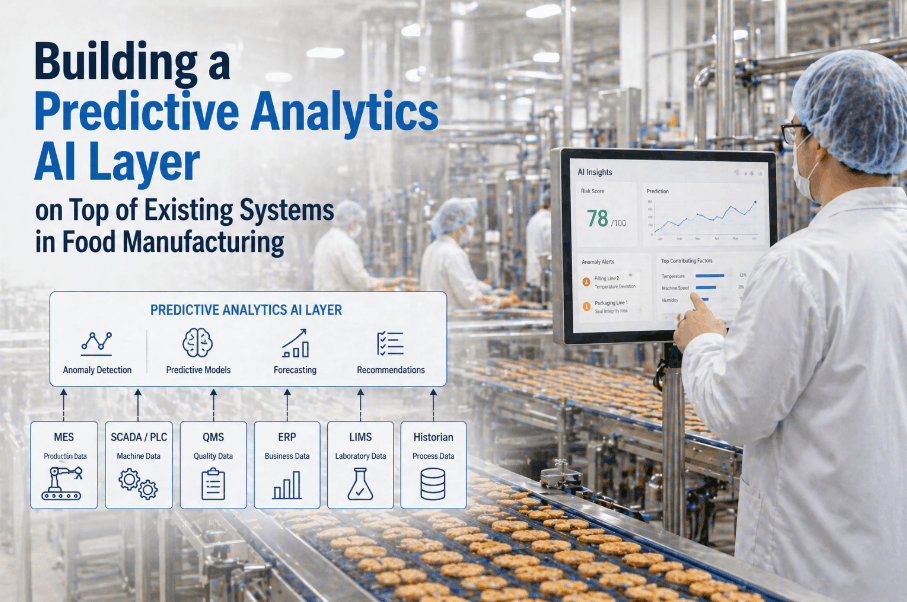
Food manufacturers running separate systems for production orders, material genealogy, quality holds and machine performance lose real-time visibility the moment a batch leaves the ERP screen and reaches the plant floor. A recall investigation that should take hours instead consumes 3-5 days chasing paper lot logs, spreadsheet records and disconnected line historians across multiple shifts. Manufacturing Execution Systems solve this by connecting production order release, genealogy tracking, quality checkpoints and real-time line performance into one continuous digital record spanning ERP to sensor. Most MES rollouts stall for 6-9 months mapping legacy PLCs, HMIs and paper-based logs into a usable data model before a single dashboard goes live. iFactory's AI-powered MES layer connects directly to existing ERP systems, historians and shop-floor controllers, delivering production order visibility from release to pallet within weeks rather than quarters. Book a demo to see order tracking mapped to your ERP inside two weeks.
Production Order Tracking Built for Food Plants
Connect Your ERP to the Shop Floor Without Replacing Either
iFactory sits between your ERP and your existing PLCs, HMIs and scales, turning production orders into live, traceable output with AI-driven exception alerts the moment a line drifts from plan.
ERP System
Production orders, BOMs, master data, sales demand
Bi-directional sync, no custom middleware
iFactory MES
Order execution, genealogy, exception alerts, AI analytics
Continuous data feed, sub-minute latency
Shop Floor
PLCs, HMIs, scales, scanners, line historians
Order visibility, release to pallet
Under 48 hrs
Recall investigation time reduction
70-85%
OEE improvement within 6 months
12-18%
Manual data entry hours removed weekly
30-45 hrs
Paper Logs and Spreadsheets Slow Down Every Recall and Every Audit
iFactory MES captures every production order, lot genealogy record and quality hold automatically as product moves through your line, so a recall query that once took days now takes minutes.
How iFactory MES Turns Production Orders Into Live, Traceable Output
Traditional MES rollouts in food manufacturing fail for a simple reason: they demand a rip-and-replace of SCADA, historians and ERP integration points that took a decade to stabilize. iFactory instead reads existing tag structures and order data as they already exist, applying an AI mapping layer that reconciles ERP order fields with shop-floor sensor tags without new PLC programming. See how the mapping layer connects to your specific ERP and PLC combination.
Order Execution
Real-Time Production Order Tracking
Every order released from the ERP appears on the floor as a live execution record showing planned versus actual output, downtime reasons and quality holds updated every 60 seconds. Operators see exactly which order is running on which line without walking to a terminal, while planners see true completion percentage instead of end-of-shift estimates.
Genealogy
Full forward and backward material genealogy links every raw material lot, intermediate batch and finished pallet automatically, cutting recall scope investigation from days to minutes.
ERP Sync
Completed quantities, scrap, downtime codes and quality dispositions post back to the ERP automatically, eliminating end-of-shift manual reconciliation and closing orders same-day.
Exception Alerts
AI flags orders trending toward missed completion, unexpected scrap rates or quality parameter drift 2-4 hours before shift end, giving supervisors time to intervene rather than explain a miss.
Performance Analytics
Line-Level OEE Without Manual Data Collection
Availability, performance and quality components of OEE calculate automatically from the same execution data used for order tracking, removing the manual OEE spreadsheets most plants maintain in parallel and giving every shift a consistent, audit-ready number.
Digital Batch Records
Batch records assemble automatically from process parameters, operator entries and quality checks, replacing paper batch sheets and cutting record review time ahead of audits and customer inspections.
MES vs. Paper-Based and Spreadsheet Production Tracking
Most food plants run a hybrid of ERP order data, paper traveler sheets, whiteboard schedules and end-of-shift spreadsheet reconciliation. This works until a recall, an audit or a customer complaint requires exact genealogy, at which point the gaps become expensive. Compare your current tracking method against iFactory MES directly.
| Capability |
Paper & Spreadsheet Tracking |
iFactory MES |
| Order Visibility |
Updated at shift change from paper travelers; planners see yesterday's status, not current progress. |
Live order execution status updated every 60 seconds, visible from ERP order screen to shop floor. |
| Material Genealogy |
Reconstructed manually from paper logs and lot sheets; recall scoping takes 3-5 days per incident. |
Automatic forward and backward genealogy from raw material to finished pallet; recall scoping in minutes. |
| OEE Calculation |
Manual spreadsheet tallies compiled weekly; inconsistent between shifts and supervisors. |
Automatic OEE from live execution data, consistent across every shift and line. |
| ERP Reconciliation |
End-of-shift manual entry of completions, scrap and downtime codes; frequent transcription errors. |
Automatic bi-directional sync closes orders same-day with no manual re-entry. |
| Audit Readiness |
Batch records assembled manually from paper sheets ahead of every audit; 20-40 hours per audit cycle. |
Digital batch records assemble automatically; audit prep time reduced 60-75%. |
| Deployment Effort |
No system change required, but manual workload compounds every quarter. |
Fixed-scope deployment using existing PLCs, HMIs and ERP; no rip-and-replace. |
iFactory MES Deployment Path, Step by Step
Deployment follows a fixed six-stage path designed around food plant realities: existing PLCs stay in place, ERP integration uses standard connectors, and the first live order-tracking dashboard goes live inside the first three weeks.
1
ERP & Tag Discovery
Order fields, BOM structure and existing PLC/HMI tag lists are catalogued without touching production configuration.
2
Mapping Layer Build
AI mapping reconciles ERP order fields against shop-floor tags, resolving naming inconsistencies across lines automatically.
3
Pilot Line Go-Live
One line runs live order tracking and genealogy capture, validated against the existing paper process in parallel.
4
ERP Sync Activation
Bi-directional sync opens, closing completed orders automatically and removing manual end-of-shift entry on the pilot line.
5
Analytics & Alerting
OEE dashboards and AI exception alerts activate, giving supervisors advance warning of orders at risk of missing plan.
6
Full Plant Rollout
Remaining lines onboard using the validated mapping template, with paper travelers retired line by line.
Deployment Timeline and Where ROI Shows Up
iFactory MES deployments for food plants run on a structured multi-week schedule, with the pilot line proving genealogy and OEE accuracy well before the full plant goes live. Request the full deployment schedule sized to your plant's line count.
Weeks 1-2
Discovery & Mapping
ERP order fields and BOM structure catalogued alongside existing PLC and HMI tag lists across all lines.
AI mapping layer built and validated against a sample of historical orders and genealogy records.
Week 3
Pilot Line Live
First line runs live order execution tracking and genealogy capture in parallel with existing paper process.
Accuracy validated against paper records before ERP sync opens.
Weeks 4-5
ERP Sync & Analytics
Bi-directional ERP sync activated on the pilot line, closing orders automatically without manual entry.
OEE dashboards and AI exception alerting go live for supervisors and plant managers.
Weeks 6-8
Full Plant Rollout
Remaining lines onboard using the validated mapping template, with paper travelers retired progressively.
Recall scoping, audit prep and OEE reporting run entirely from live MES data plant-wide.
MEASURABLE IMPACT FROM THE PILOT LINE
Food plants completing pilot deployment typically see recall scoping drop from days to minutes and OEE visibility become consistent across every shift before the second line even onboards.
48 hrs
Order visibility, release to pallet
70-85%
Recall investigation time cut
12-18%
OEE improvement within 6 months
Live Order Tracking on Your First Line Inside Three Weeks
No PLC replacement, no ERP migration. iFactory maps your existing systems and proves genealogy and OEE accuracy on a single pilot line before touching the rest of the plant.
Results From Food Plants Running iFactory MES
These outcomes reflect six-month post-deployment performance across three food manufacturing segments currently running iFactory MES. Request the case study closest to your product category and line configuration.
Bakery & Snack Production
Recall Scoping Cut From 4 Days to 20 Minutes
A multi-line bakery producing packaged snack products relied on paper travelers and shift-end spreadsheets to track lot genealogy across six production lines. A single ingredient recall previously required 3-4 days of manual cross-referencing between paper logs and warehouse records. After deploying iFactory MES, genealogy queries that once took days returned results in under 20 minutes, and OEE visibility became consistent across all three shifts for the first time.
20 min
Recall scoping time, down from 4 days
15%
OEE improvement across all lines
32 hrs
Weekly manual reconciliation hours removed
Dairy Processing
Same-Day ERP Order Closure Across Four Plants
A regional dairy processor closed production orders in the ERP 2-3 days after completion due to manual data entry backlogs across four plants. iFactory's automatic bi-directional ERP sync eliminated the manual entry step entirely, closing orders same-day and giving finance accurate cost-of-goods data without waiting on shift-end paperwork. Quality holds now trigger automatically from live process parameters rather than manual inspection sign-off delays.
Same-day
Order closure, down from 2-3 days
40 hrs
Monthly reconciliation hours eliminated
98%
Genealogy record completeness achieved
Ready Meal & Prepared Foods
Audit Prep Time Cut by Two-Thirds
A prepared foods manufacturer preparing for third-party customer audits spent 30-40 hours per audit cycle assembling batch records from paper sheets and spreadsheets. Digital batch records generated automatically by iFactory MES reduced audit prep time by roughly two-thirds, while AI exception alerts caught two orders trending toward missed completion in time for supervisors to adjust staffing before shift end.
65%
Audit preparation time reduction
4-6 hrs
Advance warning on at-risk orders
3 weeks
Time to first live pilot line
What Plant Managers Say About iFactory MES
The following comments are from operations and quality leaders currently running iFactory MES at their food manufacturing plants.
Our recall process used to mean pulling three people off the floor for four days to reconstruct genealogy from paper logs. Now it takes one person twenty minutes. That alone justified the whole project.
Quality Director
Bakery & Snack Manufacturer, Midwest US
Finance used to wait days for accurate order costs because completions sat in a spreadsheet until someone typed them into the ERP. Same-day closure changed how we run month-end entirely.
Plant Controller
Dairy Processing Facility, Wisconsin
The pilot line went live in under three weeks with zero PLC changes. Seeing genealogy and OEE numbers we could actually trust from day one made the rest of the rollout an easy decision.
Operations Manager
Ready Meal Producer, Ontario
Audit prep used to eat a full week of my team's time every quarter. Digital batch records assembling themselves in the background gave that week back, and auditors trust the data more than our old paper sheets.
Compliance Manager
Prepared Foods Manufacturer, Texas
Frequently Asked Questions
Do we need to replace our existing PLCs or SCADA system to implement MES?
No. iFactory connects to existing PLCs, HMIs and historians through standard protocols, reading tag data as it already exists rather than requiring new controller programming. The AI mapping layer reconciles differences in naming conventions across lines automatically, which is typically the step that adds months to traditional MES projects. Deployment uses your current shop-floor hardware from day one of the pilot line.
How long does it take before we see a live order tracking dashboard?
The pilot line typically runs live order execution tracking and genealogy capture within three weeks of project start, running in parallel with your existing paper process so accuracy can be validated before anything is retired. Full ERP sync activation follows in weeks four and five, with remaining lines onboarding through week eight using the validated mapping template from the pilot.
Which ERP systems does iFactory MES integrate with?
iFactory integrates with major ERP platforms used across food manufacturing through standard connector interfaces, synchronizing production orders, BOMs, completions and quality dispositions bi-directionally. Integration typically completes during weeks four and five of deployment once the shop-floor mapping layer has been validated on the pilot line, and does not require ERP customization or a parallel migration project.
How does material genealogy tracking actually reduce recall investigation time?
Every raw material lot, intermediate batch and finished pallet is linked automatically as product moves through production, replacing manual cross-referencing of paper travelers and warehouse logs. When a recall query comes in, the full forward and backward genealogy chain returns in minutes instead of the 3-5 days typical of paper-based reconstruction, narrowing recall scope precisely instead of over-recalling out of caution.
Book a demo to see genealogy tracing on a sample product run.
Can iFactory MES support multiple plants and product lines on one platform?
Yes. iFactory deploys across multiple plants and production lines within a single platform, with each line's mapping template reused during rollout to shorten onboarding time for subsequent facilities. Bakery, dairy and prepared foods deployments referenced above all run on the same underlying platform with segment-specific genealogy and quality parameter configurations tailored during the discovery phase.
Stop Reconstructing Genealogy From Paper. Go Live on Your First Line in Three Weeks.
iFactory MES connects your existing ERP, PLCs and historians into one live production record, cutting recall scoping to minutes and closing orders same-day without a system replacement project.
Live order tracking on a pilot line within three weeks
Recall genealogy scoping cut from days to minutes
Same-day ERP order closure with zero manual entry
12-18% OEE improvement within six months