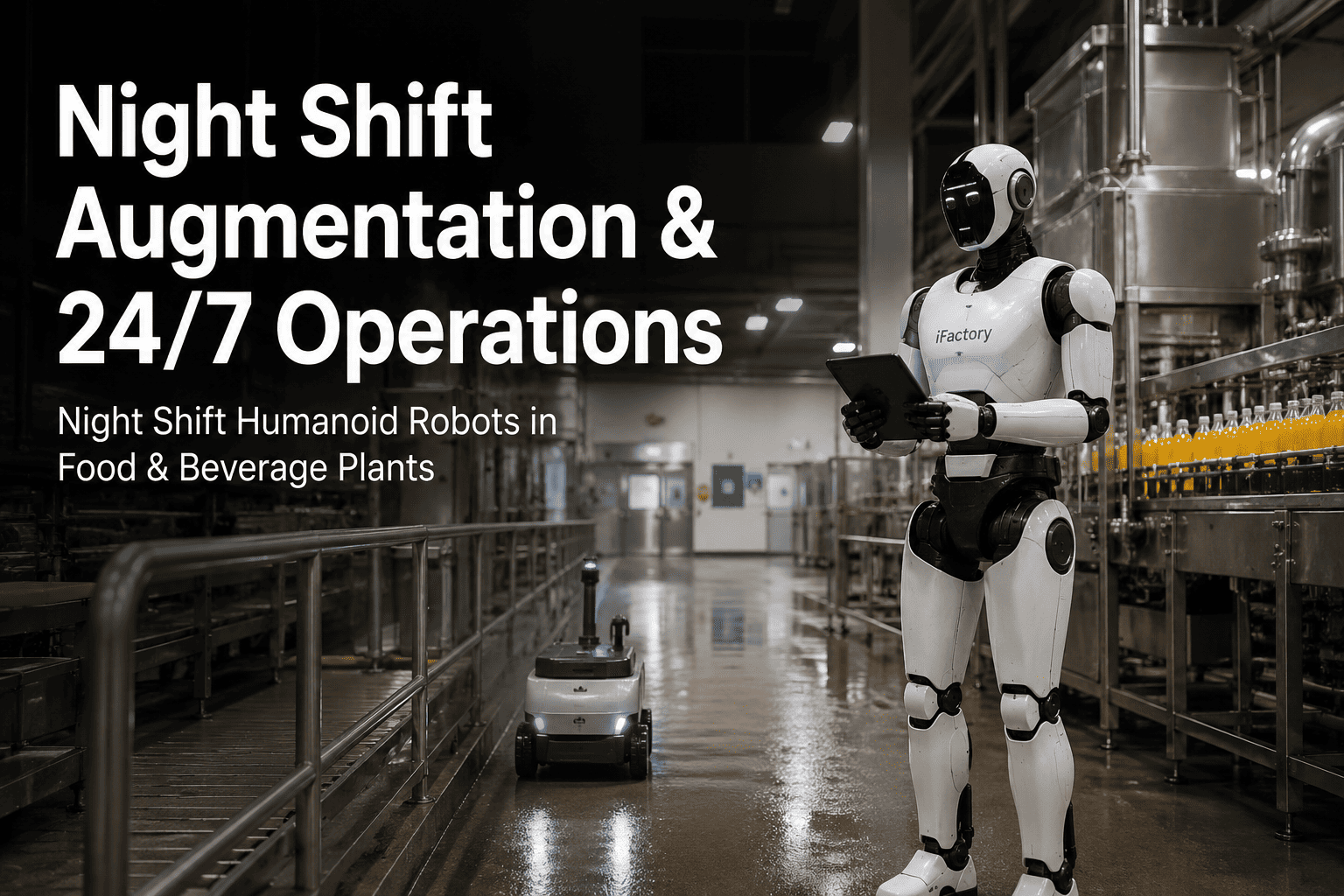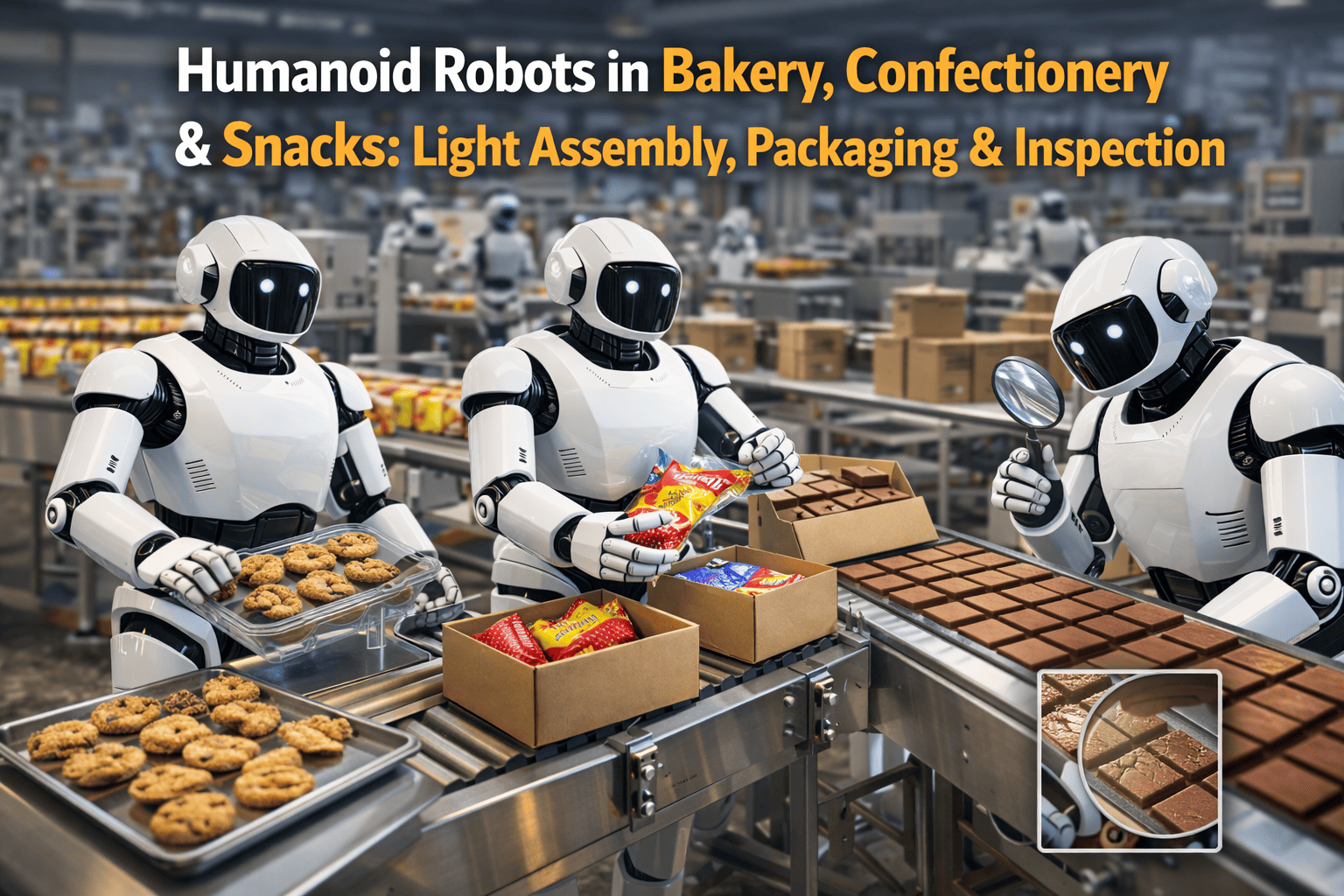
Bakery, confectionery, and snack manufacturing present some of the most demanding handling challenges in food production — fragile biscuits, irregular confectionery shapes, multi-SKU packaging runs, and strict hygiene zones that limit conventional automation. Humanoid robots are entering this space in 2026 not to replace purpose-built machinery, but to fill the flexible light assembly, packaging support, and quality inspection gaps that fixed automation cannot address. For plant engineers evaluating where humanoid platforms fit, the operational question is not whether the robot can hold a product — it is whether the surrounding production intelligence can coordinate the robot, track its work orders, log its inspection outputs, and keep the whole line compliant. That is where iFactory connects. See how iFactory supports humanoid-integrated bakery lines — Book a Demo.
How humanoid platforms handle gentle product handling, flexible packaging support, and quality inspection in high-mix bakery and snack environments — and what production intelligence they need to operate effectively.
Why Bakery and Snack Lines Are a Natural Fit for Humanoid Robots
Fixed industrial robots are engineered for high-volume, low-variety production. A rotary filler or a dedicated case packer performs one task exceptionally well — but cannot adapt when a SKU changes, a tray format shifts, or a packaging line needs to switch from retail singles to club-pack bundles mid-shift. Bakery, confectionery, and snack manufacturing is defined by exactly this kind of variability.
Humanoid platforms bring a different capability set: generalist dexterity, teachable task sequences, and the ability to work in production zones designed for human operators without layout modification. In 2026 deployments, bakery and snack plants are evaluating humanoids specifically for tasks where product fragility, format variability, and hygiene zone access make fixed automation impractical rather than expensive.
Where Humanoid Robots Are Being Evaluated in Bakery and Snack Plants
The use cases emerging in 2026 pilot deployments are specific and bounded. Humanoid robots are not replacing bakery lines wholesale — they are filling defined flexibility gaps that fixed automation cannot address economically.
Placing biscuits, chocolates, or snack packs into trays, gift boxes, or mixed-SKU kits requires gentle variable-configuration handling. Fixed robots require format-specific tooling changes; humanoids can be retaught for a new configuration within a shift.
Case erecting, inner pack loading, and retail display unit assembly are labour-intensive with high variability across formats. Humanoid robots alongside human packers take on repetitive secondary packing steps without dedicated fixed-automation investment for each product variant.
Humanoid platforms equipped with vision systems assist with product appearance checks — identifying broken biscuits, misshapen confectionery, or incorrect pack fills. The robot augments inspection consistency at high-throughput checkpoints without replacing the quality process.
Allergen changeovers demand verified cleaning sequences and documented sign-off. Humanoid robots can follow structured changeover protocols — removing tooling, transporting items to sanitation, completing digital checklist steps — without relying solely on operator execution.
Where pallet patterns change by order or mixed-case pallets are required for retail customers, humanoid platforms offer an alternative to fixed palletisers. Current humanoid palletising speed suits lower-throughput or promotional packaging runs rather than full production rate.
Chocolate gifting, seasonal assortment tins, and confectionery hampers involve manual light assembly difficult to automate with fixed equipment due to low volumes and frequent format changes. Humanoids handle product placement and outer packaging assembly with operator-equivalent dexterity.
The Production Intelligence Gap Humanoid Robots Create
Humanoid robots introduce a new category of production asset that most existing CMMS and MES platforms were not designed to manage. Unlike a fixed conveyor or filler that reports fault codes to a PLC, a humanoid robot performs variable tasks, accumulates wear patterns unique to its task sequence, and generates inspection and compliance data that must enter the plant's quality and audit records.
Without a connected CMMS layer, bakery plants deploying humanoid robots face three specific operational gaps that accumulate quickly into compliance and reliability risk. See how iFactory closes each gap in a live production environment — Book a Demo.
A humanoid robot is an asset with servicing requirements — joint calibration, actuator wear, sensor cleaning, and firmware schedules — that need to sit alongside all other line assets in a unified work order system. Plants managing the robot separately create a blind spot where scheduled maintenance is missed under production pressure. iFactory's work order management and preventive maintenance scheduling covers robot assets on the same platform as conveyors, ovens, and packaging machines.
When a humanoid robot performs a visual quality check, that inspection result must enter the plant's quality log — not stay in the robot's local system. Manual transcription introduces lag and error. iFactory's inspection management and digital HACCP log capabilities capture outputs from connected systems in real time, creating immutable records with timestamps that satisfy FDA 21 CFR Part 11 and SQF audit requirements without manual data entry.
Understanding whether a humanoid robot is improving or constraining line OEE requires real-time availability, performance, and quality data from the entire line, not just the robot's task completion rate. iFactory's OEE analytics module connects PLC and sensor data from all line assets — including robot feeds — into a unified dashboard that shows where the humanoid is contributing throughput and where it is introducing bottlenecks.
How iFactory Connects to Humanoid-Integrated Bakery Lines
iFactory does not manufacture or supply humanoid robots. It provides the production intelligence layer that makes humanoid deployments manageable, auditable, and integrated with the rest of the plant's operations. The platform connects via open API to existing PLCs, SCADA systems, SAP, Oracle, and production line sensors without replacing existing infrastructure.
Humanoid robot assets added to iFactory's CMMS with AI-driven maintenance scheduling, fault logging, and 48-hour failure prediction from connected sensor data — same as any other line asset.
Work orders for robot servicing, line changeovers, CIP cycles, and allergen verifications generated and dispatched automatically with complete digital audit trails and sign-off records.
Real-time OEE visibility across every asset — including humanoid stations — with loss analysis, shift benchmarking, and downtime pareto to identify where the robot is helping and where it needs adjustment.
Inspection outputs from robot vision systems captured into immutable digital HACCP logs with timestamps. FDA 21 CFR Part 11 compliant records generated without manual transcription from robot systems.
Mandatory digital allergen changeover checklists enforced before line restart. Photo evidence capture, step-by-step SOPs, and verified sign-off — whether performed by a human operator, a humanoid robot, or both.
Full offline functionality in wet areas and production zones. Technicians complete work orders, log robot faults, capture photos, and submit inspection results without WiFi — auto-sync on reconnect with zero data loss.
What iFactory Delivers on Humanoid-Integrated Lines
iFactory is an AI-powered CMMS deployed across food and beverage plants. The platform does not manufacture robots — it manages the production intelligence layer those robots operate within.
Predictive maintenance on all line assets including robot platforms reduces emergency stoppages across the production line.
Automated HACCP logs, inspection records, and compliance documentation from live data satisfy FDA, SQF, and BRC requirements.
AI models detect anomalies on connected assets 48 hours or more before failure, converting emergency interventions to planned maintenance.
Pre-built food and beverage templates — HACCP plans, allergen protocols, sanitation checklists — get iFactory live fast, not in months.
Handling Challenges Humanoid Robots Must Overcome in Food Environments
Evaluating humanoid robots honestly requires acknowledging the constraints bakery and snack environments impose. These are not reasons to avoid the technology — they are the engineering requirements any humanoid deployment must satisfy before it is production-ready.
| Challenge | Food Environment Requirement | Current Humanoid Status | iFactory Support |
|---|---|---|---|
| Product fragility | Gentle, controlled grip force for biscuits, chocolates, and snacks | Emerging — soft gripper end-effectors in pilot evaluation | Inspection logging, rejection rate tracking via OEE analytics |
| Sanitation compliance | IP-rated enclosure or exclusion from wet cleaning zones | Current platforms require zone management in wash-down areas | Work order scheduling, CIP tracking, zone clearance documentation |
| Allergen cross-contact | Dedicated tooling or verified cleaning between allergen runs | Requires defined changeover protocol enforcement | Digital allergen changeover checklists with mandatory sign-off |
| Speed vs. throughput | Line-rate packing demands current humanoids cannot match | Suitable for lower-throughput, high-mix tasks only in 2026 | OEE loss analysis identifies where humanoid is the bottleneck |
| Audit traceability | Every inspection and task must be timestamped and logged | Robot logs need to connect to plant quality records | Immutable HACCP logs, FDA 21 CFR Part 11 compliant records |
| Maintenance visibility | Robot servicing must be integrated with line maintenance | Most humanoid vendors provide separate service portals | iFactory work order system covers robot assets alongside all line assets |
Frequently Asked Questions
iFactory connects to bakery and snack production lines through existing PLCs and SCADA. 1 to 2 week deployment. Pre-built food safety templates. No system replacement required.