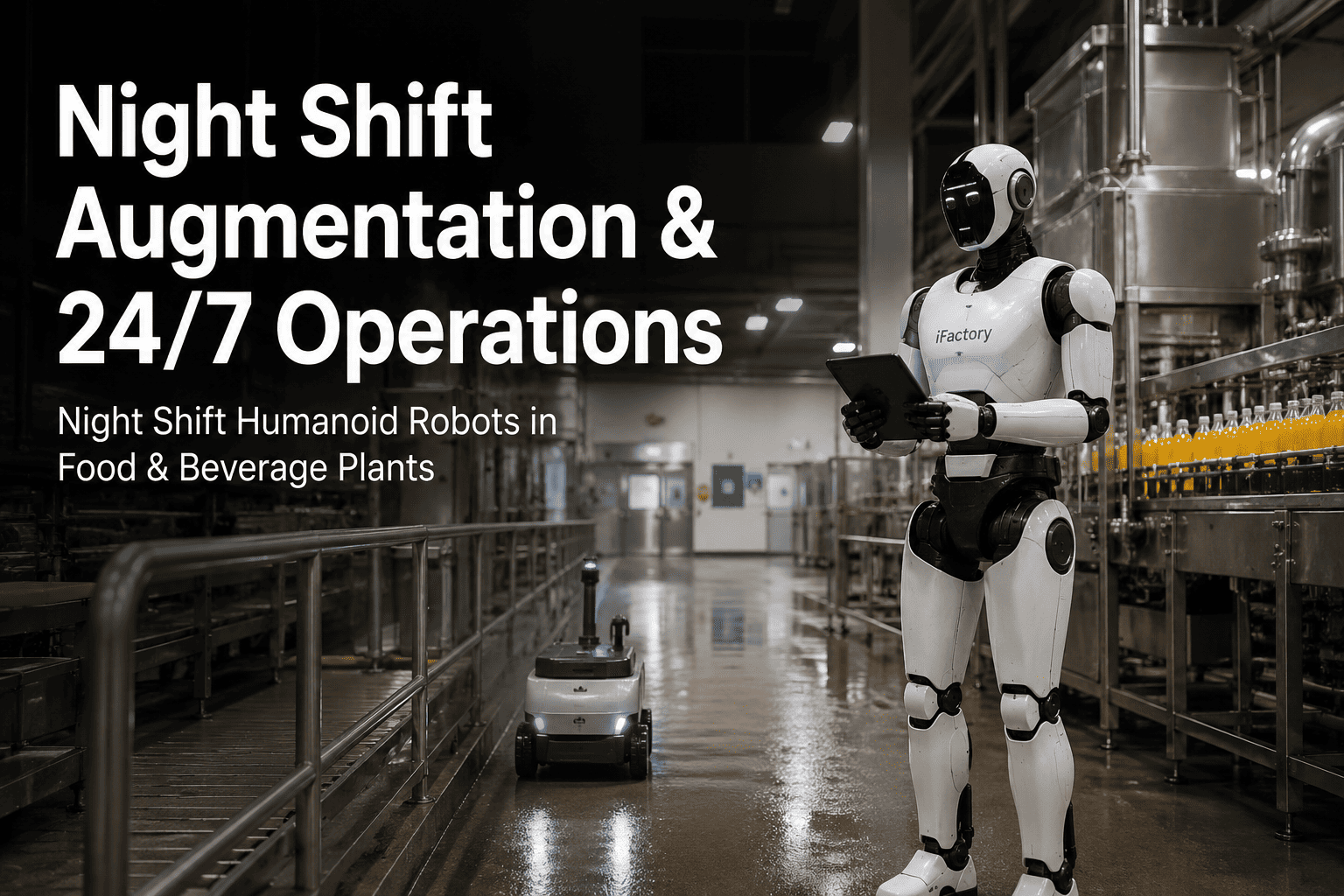
Food and beverage manufacturing is one of the most demanding environments any humanoid robot will ever enter. Caustic CIP chemicals, high-pressure washdowns, temperature swings from blast freezer to pasteurizer, allergen contamination risk, and FDA audit requirements do not forgive hardware that was designed for a warehouse floor or an automotive assembly line. The platforms entering the market in 2026 — Figure 02, Agility Digit, Unitree H1, and others — differ significantly in their suitability for food plant deployment. IP ratings, material compatibility, payload capacity, cleanroom certifications, and software integration depth all determine whether a humanoid robot becomes a documented asset in your HACCP and FSMA program or an expensive proof-of-concept that generates no compliance value. This guide compares the leading platforms against food manufacturing requirements so procurement and operations teams can make informed deployment decisions. See how iFactory orchestrates humanoid robot data into HACCP, CIP, and FSMA compliance records — Book a Demo.
What Food Plants Actually Need from a Humanoid Robot
Before comparing platforms, the requirements framework matters. Food manufacturing imposes constraints that most industrial robot evaluations do not address. A robot that performs well in a logistics warehouse or an automotive press shop may be entirely unsuitable for a dairy processing line or a beverage filling room. The evaluation criteria below define what actually matters in food plant deployments.
The Four Major Humanoid Platforms: Food Plant Assessment
The information below is based on publicly available platform specifications and documented deployments as of 2026. Food plant suitability ratings reflect published hardware specifications against the requirements framework above. Actual deployment readiness should be verified directly with each manufacturer, as food-specific certifications and software integrations are actively evolving across all platforms.
Figure 02 is among the most capable humanoid platforms in 2026 for complex task execution. Its limiting factor for immediate food plant wet zone deployment is IP rating — IP54 does not satisfy the IP67 minimum for direct CIP and washdown exposure. Suitable for dry processing zones, warehouse operations, and ambient temperature inspection tasks. BMW manufacturing deployment demonstrates industrial maturity without food-specific certification.
Agility Digit is the most commercially proven humanoid platform in 2026 based on Amazon deployment scale. Its strength is bipedal navigation and payload handling in structured logistics environments. For food manufacturing applications, it is best evaluated for finished goods warehouse, dry ingredient handling, and ambient temperature case-moving tasks. Wet zone or processing area deployment is not supported by current published specifications.
Unitree H1 is the preferred platform for food manufacturers running pilot programs to develop and test CMMS integration before committing to higher-cost platforms. The open ROS2 SDK enables custom API development connecting robot sensor output to iFactory compliance records. Food-specific waterproofing and material certifications require additional hardware modification for wet zone applications.
Tesla Optimus Gen 2 is included as a benchmark reference because its capability specifications are frequently cited in comparisons and it shapes buyer expectations. It is not currently available for external purchase and has no documented food manufacturing deployment or food-safety CMMS integration. F&B procurement teams should not include Optimus in near-term deployment planning as of 2026.
Head-to-Head Comparison: Food Plant Deployment Criteria
The table below compares all four platforms across the criteria that determine food manufacturing deployment suitability. Specifications are based on publicly available data. Verify current certifications directly with manufacturers before procurement decisions.
| Criteria | Figure 02 | Agility Digit | Unitree H1 | Tesla Optimus G2 |
|---|---|---|---|---|
| IP Rating (Published) | IP54 | Not rated IP67 | IP54 standard | Not disclosed |
| Wet Zone / CIP Suitability | Requires upgrade | Not suitable | Requires upgrade | Unknown |
| Food-Grade Materials | In development | Not certified | Not certified | Not applicable |
| Payload Capacity | 20 kg / hand | 16 kg total | 30 kg whole-body | ~20 kg (estimated) |
| Hand Dexterity | High (multi-finger) | Limited (end-effector) | Moderate | Very high (11 DOF) |
| Temperature Range | 0-40°C typical | 0-40°C typical | -10 to 45°C | Not disclosed |
| Open SDK / API | Moderate | Moderate | Open ROS2 | Proprietary only |
| CMMS Integration Path | API available | Limited | ROS2 bridge | Not available |
| Commercial Availability | Available | Available | Available | Internal only |
| Proven Industrial Deployment | BMW manufacturing | Amazon fulfillment | Research / pilot | Tesla internal |
| Relative Cost Position | Premium | Mid-premium | Most accessible | Not for sale |
| Best F&B Application | Dry zones, inspection | Finished goods warehouse | Pilot programs, dry zones | Benchmark only |
Food Plant Deployment Use Cases by Robot Platform
Each platform is best suited for specific food manufacturing applications based on current hardware capabilities. Matching the robot to the right task type avoids deploying hardware in conditions that exceed its certification or produce data that cannot satisfy compliance requirements.
- Packaging line visual inspection and label verification in ambient temperature zones
- Environmental monitoring swab collection in dry ingredient storage and warehouse areas
- Allergen changeover verification in areas not requiring high-pressure washdown
- Equipment patrol in electrical rooms, compressed air systems, and dry utility spaces
- Finished goods tote and case handling in ambient finished goods warehouses
- Pallet building and SKU movement in distribution staging areas
- Dry ingredient bag and container repositioning in ambient storage
- Not recommended for processing zones, wet areas, or CIP-exposed environments
- Ideal first platform for teams building HACCP CMMS integration via ROS2 bridge
- Predictive maintenance sensor patrol in dry production equipment areas
- Cold storage temperature monitoring in freezer areas with appropriate cold-rated enclosures
- Lower acquisition cost allows multi-unit pilot without full-scale capital commitment
- CIP zone post-wash verification in dairy, beverage, and RTE processing facilities
- Direct surface sanitation tasks in high-pressure washdown environments
- Cold storage and blast freezer patrol with full condensation and temperature resistance
- No current platform has published IP69K certification — this remains a 2026-2027 development horizon
The CMMS Layer: Why Robot Data Needs iFactory to Have Compliance Value
Every humanoid robot deployment in a food plant generates data. The question that procurement and QA teams must ask before deployment is: where does this data go, and what compliance record does it create? A robot that completes an allergen changeover verification and stores the result as a proprietary sensor file has produced zero HACCP compliance documentation. The same robot integrated with iFactory produces a mandatory checklist completion record with photo evidence, electronic signature, timestamp, and a direct link to the FALCPA documentation chain. See how iFactory converts robot inspection data into FDA 21 CFR Part 11 audit records — Book a Demo.
Robot completes patrol, generates thermal images and sensor readings stored in proprietary format. QA team exports files manually. Data is not linked to HACCP CCPs, does not trigger corrective action workflows, cannot be retrieved as a compliant audit record, and does not satisfy FDA 21 CFR Part 11 immutability requirements. The robot produced data. It produced no compliance documentation.
Robot completes patrol, sensor data posted to iFactory via API. iFactory auto-populates HACCP CCP log with timestamp and immutable record. Temperature deviation triggers instant CCP alert and corrective action workflow. CIP verification result updates the CIP record with chemical concentration, temperature, and contact time. Any record is retrievable in seconds for FDA inspection response. The robot produced data. iFactory produced compliance documentation.
iFactory Platform: What the CMMS Delivers for Robot-Integrated Food Plants
iFactory is the AI-powered CMMS purpose-built for food and beverage manufacturing — the software layer that gives robot-collected data compliance value. Deployed in 1-2 weeks with pre-built food safety templates. Book a Demo to see iFactory's food CMMS running against your compliance requirements.
| iFactory Capability | What it delivers for robot-integrated food plants |
|---|---|
| HACCP Automation | Robot CCP readings auto-populate immutable HACCP logs; deviations trigger instant corrective actions |
| CIP Tracking | Robot CIP verification feeds complete records with chem concentration, temp, and contact time |
| FSMA 204 Traceability | KDE captured at every CTE; one-click trace report for FDA 24-hour request |
| Allergen Management | Mandatory changeover checklists with robot verification image and electronic sign-off |
| EMP CAPA | Robot swab positives auto-launch CAPA with timestamped corrective action workflow |
| Predictive Maintenance | Robot vibration and thermal data scored by ML models; 48hr+ advance work orders generated |
| Audit Readiness | Any record retrieved in seconds; audit prep 2 days vs 3 weeks; FDA 21 CFR Part 11 compliant |
| Deployment Time | 1-2 weeks with pre-built F&B templates; no legacy system replacement required |