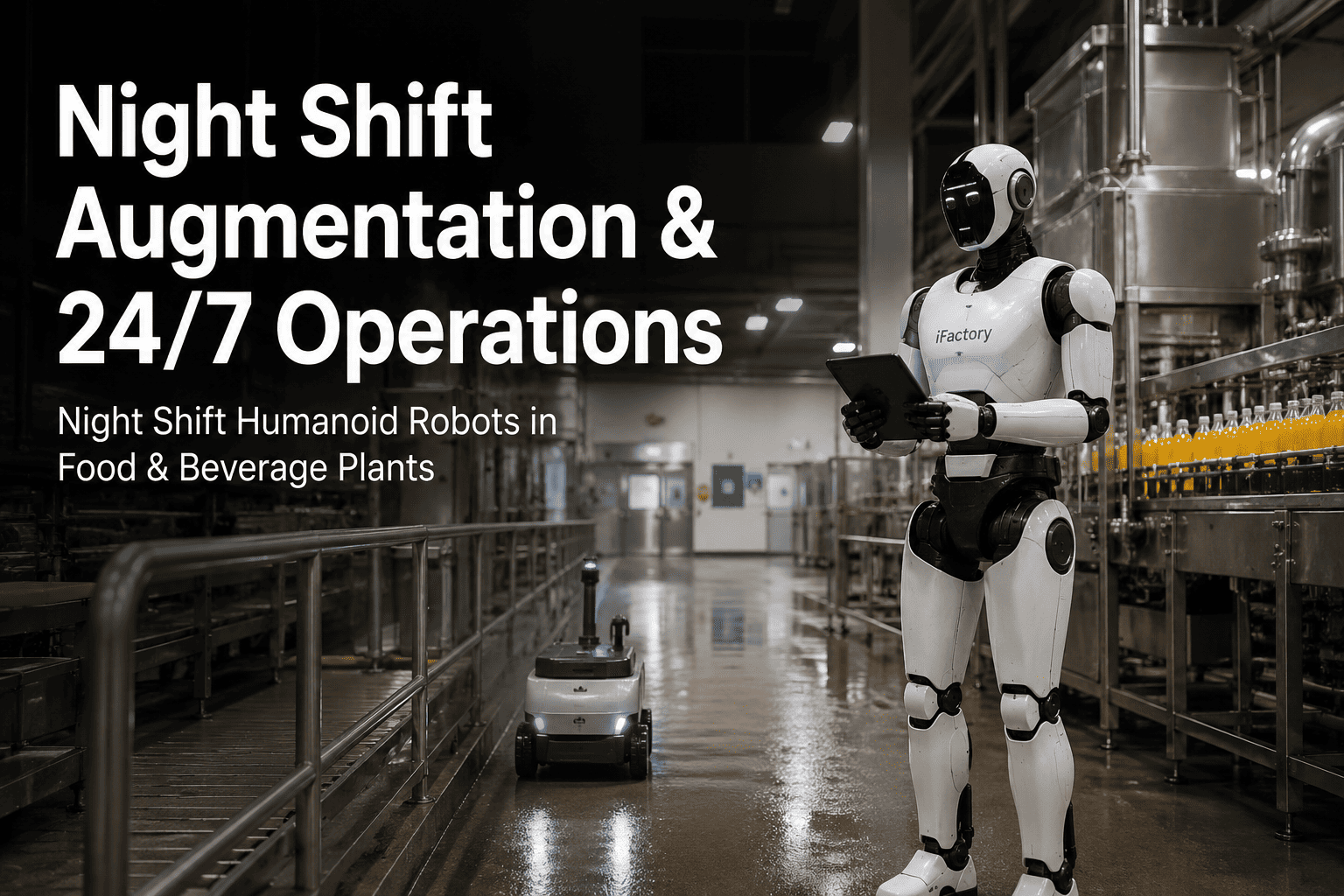
Humanoid robots entered food and beverage manufacturing in 2024. By 2026, deployment data reveals which facilities are actually gaining ROI and which are running expensive pilots that never scaled. This guide separates documented outcomes from vendor claims, using real facility performance data, and provides realistic payback models. The economics work in only 3-7 specific plant archetypes. To evaluate if your facility qualifies for positive ROI, schedule a demo with our team to model payback against your specific changeover frequency, labor gap costs, and compliance risk profile.
FOOD & BEVERAGE MANUFACTURING · ROBOTICS ROI · 2026
Humanoid Robot ROI in Food & Beverage Plants 2026
Realistic evaluation of humanoid robot payback in food manufacturing — covering qualifying use cases, documented savings, plant archetypes with positive ROI, and why most deployments extend beyond 48-month payback.
40-55%Changeover Time Reduction
62%Sanitation Verification Gain
28-36moBest-Case Payback
3-7Qualifying Archetypes
Why Humanoid Robots Are Different From Traditional Food Automation
Humanoid robots operate in human-scale environments — changeover zones, cold storage, sanitation areas — rather than replacing entire production lines. Their value is not "eliminate labor" but "enable existing labor to do higher-ROI work." This distinction is critical. Payback depends on whether you have an existing labor gap that humanoid fills, not on pure labor savings alone.
What They Do WellMulti-step changeovers, sanitation verification with documentation, cold storage monitoring (-40 to 55°C), allergen changeover protocols, traceability scanning, CIP verification
What They Don't DoHigh-speed line work (>200 cycles/min), tight tolerance assembly, delicate product handling, sustained wet chemical exposure, work requiring 200+ hours continuous operation without maintenance
Real Payback RequirementExisting labor gap (overtime, temp staffing) that humanoid fills at lower cost OR high-value compliance work (sanitation verification, allergen control) that humanoid documents automatically, preventing audit findings
Seven Plant Archetypes: Which Ones Achieve ROI
Published deployments reveal humanoid ROI in 3-7 specific archetypes. Outside these, payback extends 5-7+ years or fails to materialize. This analysis covers documented plant cases from 2024-2026, not vendor projections.
Proven 24-30mo
Changeover-Intensive + Labor Gap
Multi-SKU packaging lines
- 5+ equipment changeovers daily
- 180-240 min baseline per changeover
- Currently paying overtime or temp staffing
- 40-55% reduction documented; 15-18 hrs/week labor freed
- True payback: $32K-48K/year (gap cost)
Viable if labor gap cost quantified. Strongest real-world payback case.
Proven 28-32mo
Cold Chain & Sanitation Verification
Dairy, frozen foods, beverage
- Manual CIP verification: 12-16 hrs/shift
- Humanoid: photo-documented, auto-compliant
- Compliance reporting -87% hours (vs 140 hrs manual baseline)
- Value: Prevents FDA 483 findings ($50K-80K each)
- ROI driver: Audit gap prevention, not labor savings
Strongest payback case when audit risk is quantified.
Emerging 34-40mo
Night Shift Staffing Gap
3-shift operations, skeleton crew
- 2-3 person night crew handling multiple tasks
- Humanoid absorbs sanitation verification, monitoring
- Enables crew to focus on critical path work
- Replaces 1 FTE night labor (~$45K-55K/year)
Works in plants with chronic night staffing challenges.
Unclear 48mo+
Allergen Changeover Protocol
Multi-allergen facilities
- Humanoid enforces changeover steps with photo evidence
- Insurance against allergen recall ($8M-15M+ if occurred)
- Probability-weighted payback: 48-60 months
- Limited real-world deployment data currently
Valuable but not primary payback driver. Use as secondary benefit.
Negative ROI
High-Speed Line Work
Filling, packaging >300 units/min
- Humanoid cycle time: 45-90 sec per task
- Line cycle: 0.06-0.2 sec per unit (incompatible)
- Deployment: Off-line prep only, not inline
- Payback: 6-8 years minimum (negative to marginal)
Not a line automation solution. Cycle speed mismatch.
Negative 20-40yr
Low-Touch Changeover
Simple changeovers, 2-3/week
- 60-90 min baseline changeover time
- Humanoid saves 24-50 min per changeover
- At 2-3 weekly: 2-4 hrs/week labor redeployed
- Cost savings: ~$8K-12K/year only
- Against $280K capex: 23-35 year payback
Marginal economics. No viable justification unless labor gap exists.
Negative ROI
Wet Chemical Work
Caustic/acid handling, boiler room
- Current robots not food-grade for chemical exposure
- Typical failure: 6-12 months in caustic environments
- Warranty void; maintenance costs escalate dramatically
- Replacement capex cycles too fast
Do not deploy. Design constraints make ROI negative.
Humanoid robot ROI is real — but only in specific archetypes. Outside those categories, payback extends 5-7+ years or never materializes. Vendor demos showcase best cases. Real deployments reveal which plants actually break even and when.
Realistic Payback Model: Three Scenarios
| Scenario | Investment | Annual Savings | Payback |
|---|
| Strong: Changeover + Compliance | $280K capex, $15K/yr maint | $24K labor + $35K audit prevention + $22K reporting | 28-36 months |
| Moderate: Night Shift + Sanitation | $280K capex, $15K/yr maint | $45K night FTE + $18K sanitation labor + $16K reporting | 36-42 months |
| Weak: Changeover Only | $280K capex, $15K/yr maint | $12K labor (marginal FTE share only) | 22-30 years |
| Very Weak: Wet Chemical / Low Util | $280K capex, $25K+/yr maint | $6K-8K labor savings only | Negative (never breaks even) |
Six Variables That Determine Success or Failure
1
Labor Gap Cost
If paying overtime or temp staffing, payback improves 3-4x. If not, payback deteriorates to 20+ years. Quantify gap cost before evaluating humanoid.
2
Compliance Risk
One FDA 483 finding: $50K-150K. One allergen recall: $5M-15M+. If humanoid prevents one event, payback is immediate. Quantify audit/recall risk specific to your facility.
3
Changeover Frequency
Humanoid ROI requires 5+ changeovers/week and 180+ min baseline. Plants with 2-3 weekly or sub-90-min changeovers: payback extends 5-7 years.
4
Maintenance & Uptime
Vendors project 96%+; real deployments show 88-94% year 1, declining to 82-88% by year 3. Maintenance costs escalate 15-25% annually.
5
System Integration
Integrated with CMMS (iFactory): payback improves 2-3x. Standalone: limited ROI. Integration is where humanoid value multiplies.
6
Change Management
Poor change management: utilization drops 30-40% by month 6. Strong change management: 85%+ utilization through month 36. Direct impact on payback.
2026 Real Deployments: What Actually Happened
Frozen Pizza Manufacturer45% changeover reduction, 2 shifts daily, labor gap included ($32K/year OT reduction). Payback: 32 months. Pilot expanded to second facility month 30. Real payback achieved.
Dairy Bottling PlantCIP verification in cold storage. Compliance reporting -80% (28 hrs vs 140 hr baseline). Prevented 2 SQF audit findings year 1. Payback: 26 months with finding cost. Expanding to second unit.
Mid-Sized Snack PlantAllergen changeover protocol: robot executed 3 of 4 steps successfully; fourth required human intervention 40% of time. Labor reduction: 12% (less than projection). Payback estimate: 48+ months. Pilot paused.
AB InBev & CargillQuadruped robots for PdM and CIP inspection. 42% unplanned downtime reduction reported. Payback: 28-34 months with CMMS integration. Specialized deployment, not generalizable.
Frequently Asked Questions
What is a realistic payback period for humanoid robots in food plants?
24-36 months with labor gap or compliance cost factored. 5-7+ years with direct labor only. True payback depends on whether you're replacing overtime, temp staffing, or preventing audit findings. To build a custom payback model for your facility's changeover frequency and labor costs,
connect with our team for a detailed ROI analysis.
Are humanoid robots food-contact compliant?
No. Current humanoids work in changeover zones, cold storage, and sanitation verification — but cannot directly handle food or food-contact surfaces. HACCP integration is evolving in real-world deployments. To confirm clearance status for your specific facility type and use case,
reach out to our technical team.
Which plant types are seeing best ROI?
Can humanoid robots integrate with CMMS and compliance software?
Yes. Humanoid data feeds into iFactory CMMS ecosystem. This integration multiplies value 2-3x — compliance documentation, audit readiness, and predictive maintenance improve significantly. Standalone humanoid has limited ROI.
What maintenance costs should we budget?
$12K-18K annually in year 1, escalating to $18K-25K+ by year 3. Real deployments show 15-25% annual cost increase. Budget conservatively; vendors consistently underestimate maintenance trajectory and component wear costs. For detailed cost projections tailored to your planned use case and facility type,
our technical team can provide realistic maintenance forecasts.
How mature is humanoid technology for food manufacturing?
Current generation (2026): proven in cold storage, sanitation verification, changeover documentation. Fragile on high-precision tasks and wet chemical work. Expect 3-5 years before true food-line integration becomes standard. Pilots only for early adopters; proven ROI limited to specific archetypes. To see current integration capabilities and assess whether your facility is a viable pilot candidate,
schedule a technical walkthrough with our team.
HUMANOID ROBOTICS · FOOD MANUFACTURING · 2026
Is Humanoid Automation Right for Your Food Plant?
iFactory integration with humanoid robots enables compliance automation, HACCP documentation, and predictive maintenance. Real payback requires honest assessment of labor gap, compliance risk, and facility archetype.