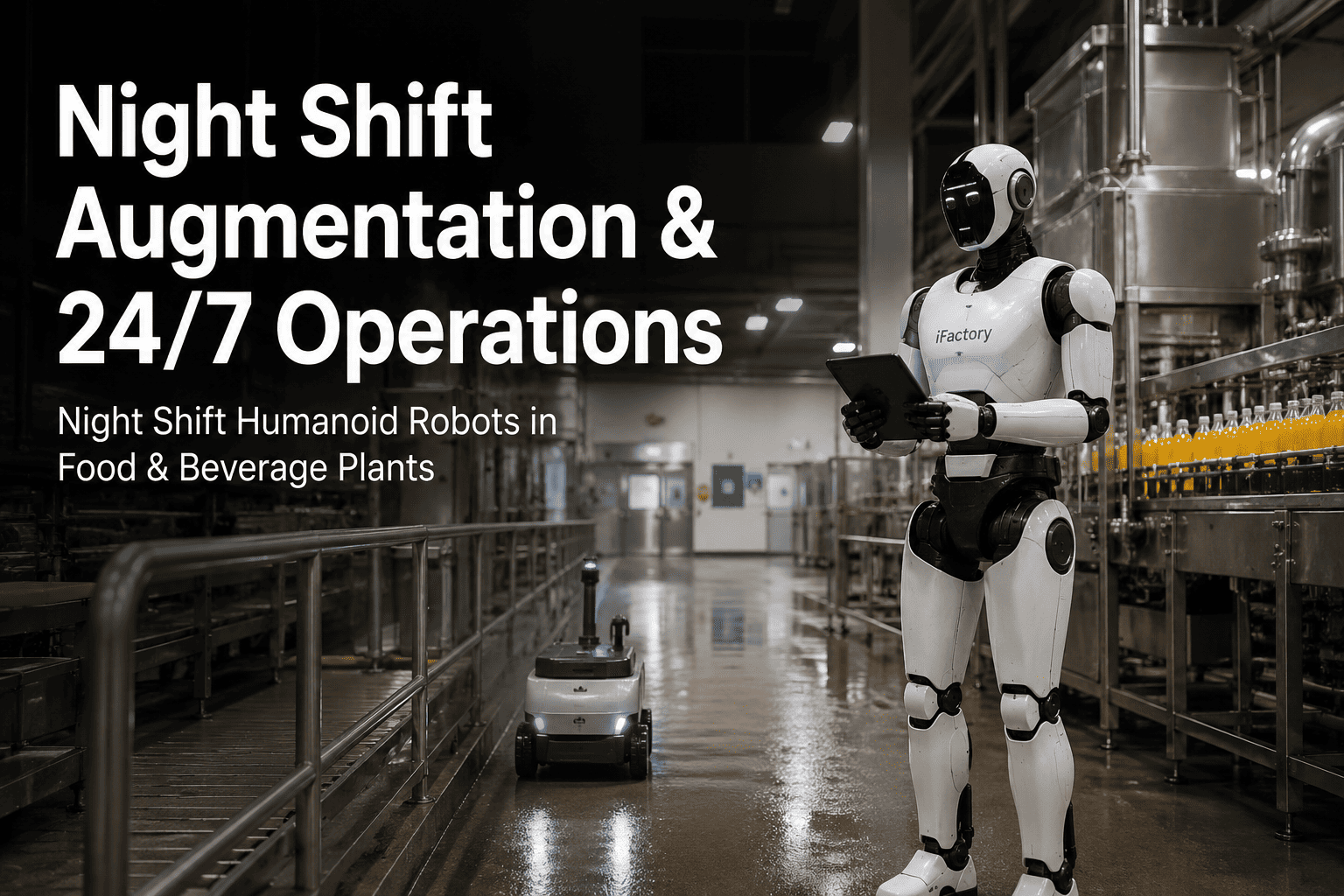
Humanoid and quadruped robots are entering food and beverage manufacturing plants in 2026 — not as science fiction, but as operational tools deployed by AB InBev, Cargill, and large dairy processors to handle sanitation inspections, equipment patrols, and CIP verification in environments too hazardous or inaccessible for routine human entry. The hardware is generating sensor data, images, and inspection records that have real compliance value under FSMA 204, SQF, and FDA audit requirements. But the robots themselves do not manage that data, schedule the follow-up work orders, or connect findings to your HACCP log. That gap is where a food-grade CMMS becomes the operational layer that makes robot deployment yield documented compliance outcomes rather than interesting sensor readings. See how iFactory connects robot inspection data to your HACCP, CIP, and FSMA workflows — Book a Demo.
What Quadruped and Humanoid Robots Are Actually Doing in F&B Plants
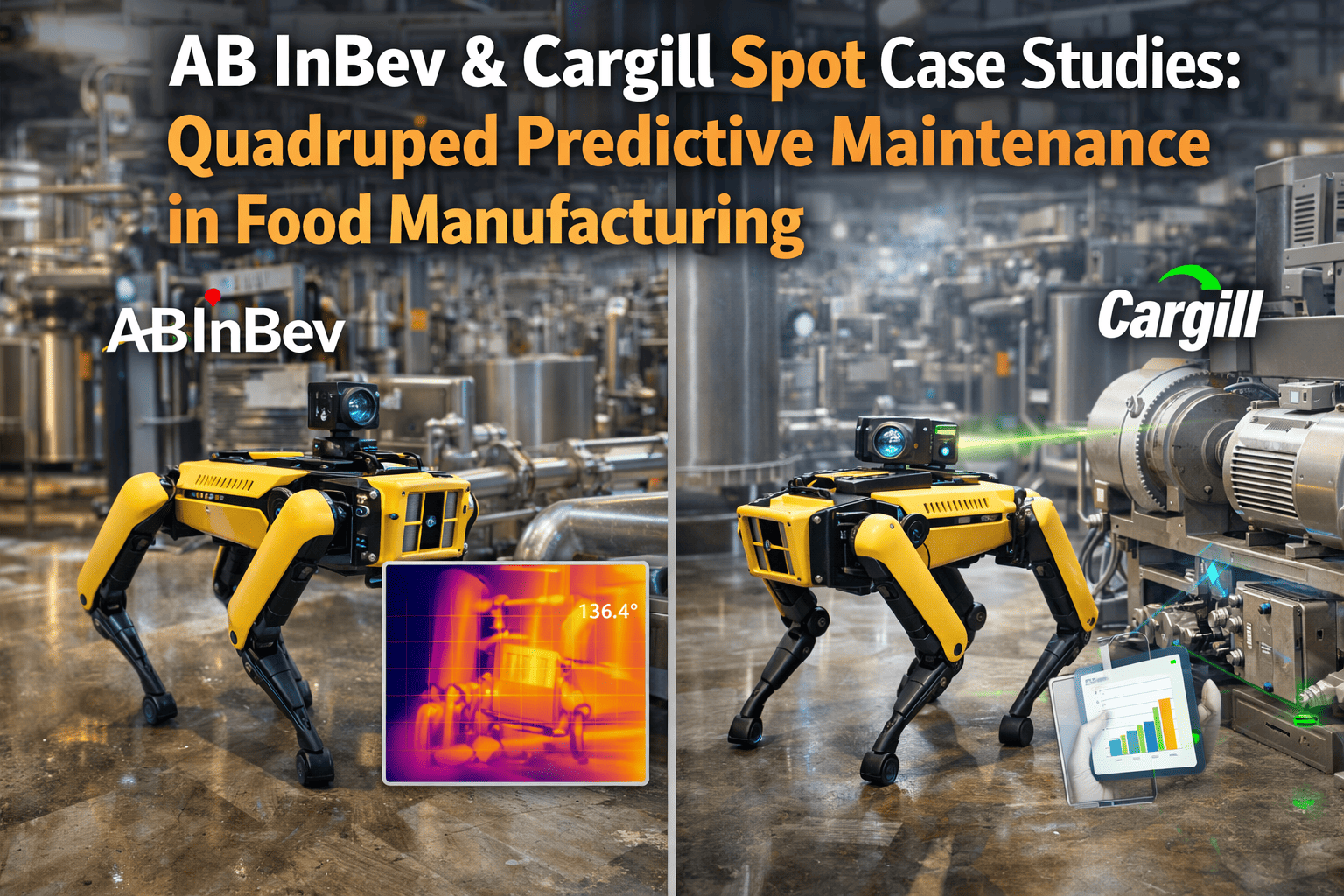
The deployment of quadruped robots like Boston Dynamics Spot at AB InBev breweries and Cargill processing facilities is well documented. These robots perform patrol inspections of areas that present ergonomic risk or access challenges — high-heat zones near pasteurizers, below-grade conveyors, cold storage facilities where repeated human entry is impractical, and CIP equipment rooms where chemical exposure during wash cycles creates safety risk.
Humanoid robots, emerging in pilot deployments at select large-scale processors, extend this to tasks requiring dexterity — surface swab collection for environmental monitoring, visual label verification, and equipment cleaning verification in zones with high sanitation frequency requirements. Neither platform operates independently of software. Every image, sensor reading, and anomaly flag the robot generates requires a system that can receive it, create a work order, update a HACCP log, and produce an audit trail that satisfies FDA 21 CFR Part 11. See how iFactory creates compliant records from robot inspection data — Book a Demo.
The Six F&B Robot Use Cases and Their Compliance Implications
Each robot deployment in a food plant generates a specific type of data with a specific compliance obligation. Understanding what the robot produces and what the compliance framework requires is the foundation of a deployment that delivers audit value rather than sensor noise.
FSMA, SQF, and FDA Compliance: What Robot Data Must Become
The compliance value of robot deployment in food manufacturing is entirely determined by what happens to the data after the robot collects it. The regulatory frameworks that govern food manufacturing do not recognize sensor readings as compliance records — they recognize documented, timestamped, immutable records with electronic signatures and traceable corrective action histories. See how iFactory converts robot sensor data into FDA 21 CFR Part 11 compliant audit records — Book a Demo.
- Robot inspection data received and stored as tamper-proof immutable records
- Electronic signatures applied to all robot-generated inspection completions
- Full audit trail from robot sensor reading to corrective action closure
- Any record retrievable in seconds — not weeks — for FDA inspection response
- Robot CCP readings auto-populate digital HACCP logs with zero manual entry
- Temperature deviations detected by robot patrols trigger instant CCP alerts
- Corrective action workflows launch automatically on any CCP breach
- Every shift's HACCP log complete and audit-ready without manual data entry
- Robot data at receiving, processing, and packaging CTEs captured as KDEs
- Lot-level traceability from raw materials through finished goods automatically maintained
- One-click trace report generation for FDA 24-hour electronic record request
- Full CTE-to-CTE chain documented without manual data entry at any stage
- Robot vibration and thermal data scored against ML failure probability models
- Work orders auto-generated when robot readings indicate impending failure
- Food-grade equipment models trained on mixers, fillers, pasteurizers, and freezers
- 48+ hour advance warning on equipment failures before contamination risk develops
- Robot CIP verification data formatted for SQF Level 2 and Level 3 audit packages
- Environmental monitoring results from robot patrols connected to BRC CAPA workflows
- One-click audit pack generation for any date range without manual record assembly
- Audit prep time reduced from 3 weeks to 2 days across all GFSI-recognized schemes
- Allergen changeover verifications from robot inspections captured in mandatory checklists
- EMP swab results from robot collection trigger auto-CAPA on positive pathogen results
- 9 major allergen tracking with FALCPA and sesame labeling compliance documentation
- Zone 1-4 surface mapping updated automatically from robot patrol routes and findings
Real Deployments: What AB InBev, Cargill, and Dairy Processors Are Actually Doing
The following documents what is publicly reported about quadruped and humanoid robot deployments at major F&B manufacturers. iFactory does not claim partnerships with these companies — this is industry context, not customer endorsement.
AB InBev has publicly documented deploying Boston Dynamics Spot robots across multiple brewery facilities for equipment inspection patrols. The robots navigate around brewing vessels, conditioning tanks, and packaging lines, capturing thermal and visual data in areas where human inspection frequency is limited by access constraints or safety requirements. The documented application is reducing inspection gaps on large-format brewing equipment without increasing headcount.
Cargill has reported using quadruped robots for predictive maintenance data collection at processing facilities. The robots carry sensor payloads that collect vibration, thermal, and audio data from production equipment, feeding readings into maintenance analysis workflows. This mirrors the core use case for iFactory's predictive maintenance module — the distinction being that Cargill's robot is the data collection platform, not the maintenance management system that converts readings into work orders and tracks them to resolution.
Multiple dairy processors have piloted quadruped robots for cold storage temperature patrol and CIP zone verification — two applications where human entry frequency is constrained by physical environment. Cold storage patrols replacing manual temperature logs at multiple points per zone is the most compliance-relevant application, as HACCP requires continuous cold chain documentation that fixed sensors alone cannot always satisfy in large walk-in storage facilities.
Humanoid robot deployments in food manufacturing remain early-stage as of 2026. Reported pilot applications include surface cleaning verification, label inspection, and environmental swab collection in high-sanitation zones. Commercial-scale deployment with fully documented FSMA and HACCP compliance integration is not yet standard practice. The compliance infrastructure — connecting humanoid robot data to food safety management systems — is the active development frontier.
iFactory CMMS: What the Software Layer Delivers for Robot-Integrated Food Plants
iFactory is not a robot platform. It is the AI-powered CMMS that converts robot sensor data, inspection findings, and environmental monitoring results into the HACCP records, work orders, CIP documentation, and FSMA traceability that food safety law requires. See iFactory's food-grade CMMS in a live demo against your compliance requirements — Book a Demo.
| Compliance Requirement | Without CMMS Integration | With iFactory CMMS |
|---|---|---|
| HACCP CCP documentation | Robot reads data, records not created | Auto-populated HACCP log, immutable timestamp |
| CIP verification records | Robot images stored, no compliance record | CIP record complete with chem, temp, contact time |
| FSMA 204 traceability | Robot captures KDE data, no system to store it | KDE auto-captured at every CTE, one-click trace report |
| EMP positive result CAPA | Robot flags positive, no CAPA triggered | Auto-CAPA launched with timestamped corrective action |
| Allergen changeover proof | Robot verifies, no checklist or sign-off | Mandatory checklist completed, photo evidence captured |
| FDA inspection response | Raw sensor files, not audit-ready | Any record retrieved in seconds, FDA 21 CFR Part 11 compliant |
| SQF / BRC audit package | Data exists but cannot be assembled fast | One-click audit pack, 2-day prep vs 3-week manual |
| Predictive work orders | Robot flags anomaly, no work order created | Work order auto-generated, technician dispatched |