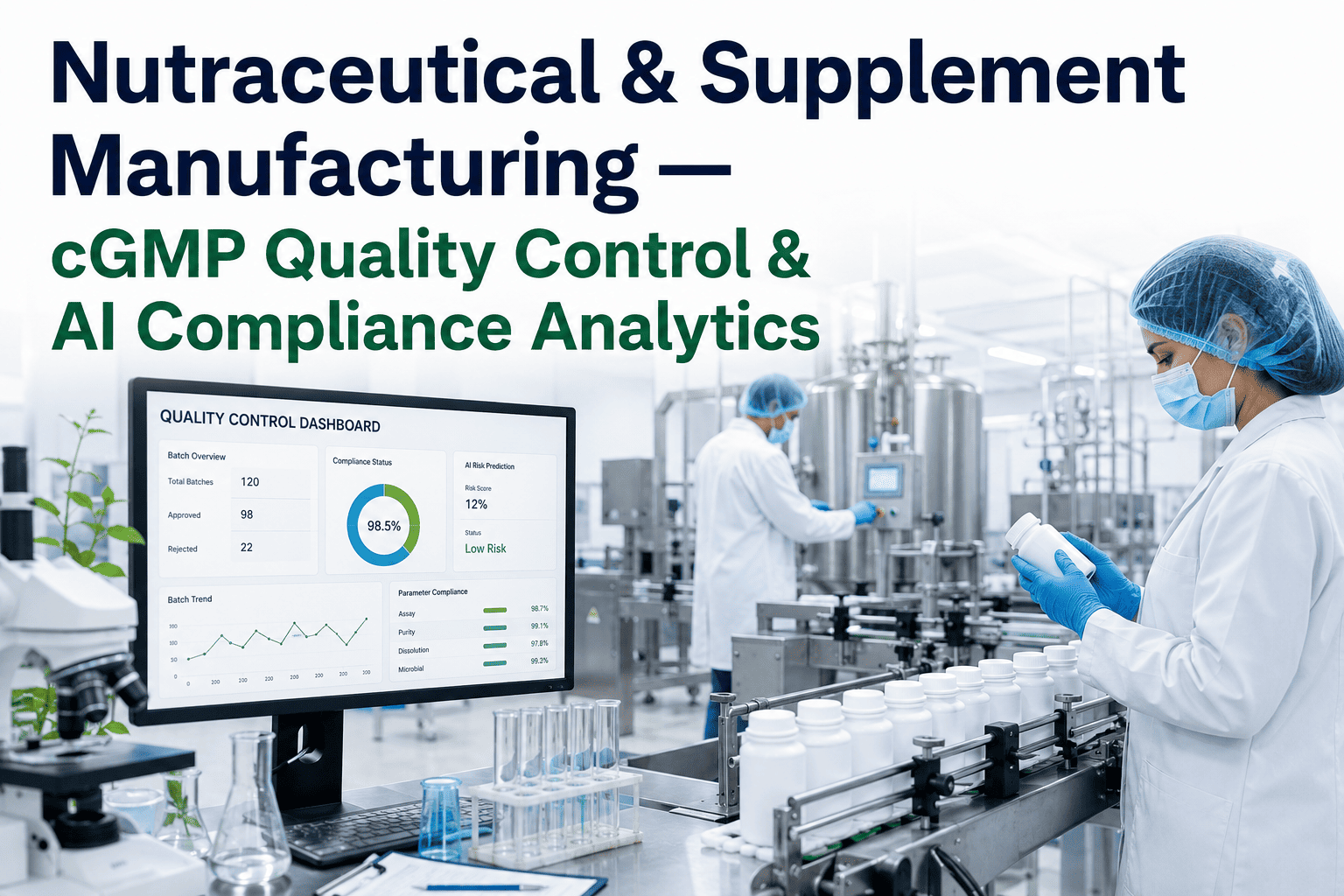
In the rapidly evolving nutraceutical landscape, maintaining rigorous quality control is not just a regulatory requirement but a competitive differentiator. With the global dietary supplement market projected to exceed $300 billion by 2028, manufacturers face mounting pressure to ensure every batch meets strict cGMP standards under 21 CFR 111. From raw material identity testing through high-performance liquid chromatography to final product dissolution profiles, each step demands precision. Yet many facilities still rely on manual documentation and fragmented systems, risking costly deviations and recalls. This comprehensive guide explores how artificial intelligence and advanced analytics are transforming supplement manufacturing quality. We delve into identity verification, potency testing, stability studies, and batch record automation, providing a roadmap for quality managers to achieve compliance excellence. Discover how AI-driven platforms like iFactory app can unify your quality workflows, reduce human error, and deliver real-time insights. Learn more about iFactory's AI compliance solutions to elevate your nutraceutical production.
Ready to Transform Your Quality Control?
Achieve seamless cGMP compliance with AI-powered analytics. Book a demo or get support today.
Identity Testing
Ensure raw materials match specifications using NIR spectroscopy and AI pattern recognition. Our platform reduces false positives by 40%.
Potency Verification
Validate active ingredient concentrations with HPLC data integrated directly into batch records. Achieve 99.5% compliance.
Dissolution Testing
Monitor release profiles in real-time with automated USP apparatus. AI flags anomalies within seconds, preventing batch failure.
Stability Studies
Automate chamber monitoring and trend analysis. Reduce out-of-specification events by 60% with predictive alerts.
AI-Driven Quality Workflow
Raw Material Intake
Scan supplier certificates with AI OCR. System cross-references against approved vendor list and auto-generates identity test requests.
In-Process Sampling
Robotic samplers collect blend uniformity checks. Data streams to cloud dashboard for real-time potency analysis.
Final Product Testing
Automated dissolution baths run USP methods. AI compares results to specification limits and initiates release if passed.
Batch Record Closure
All test data, deviations, and approvals compiled into a single digital batch record. Ready for FDA inspection with one click.
Elevate Your Compliance Today
Integrate AI into your quality management system. Reduce risk and accelerate time-to-market.
Traditional vs AI-Enhanced Quality Control
| Parameter | Traditional | AI-Enhanced |
|---|---|---|
| Identity Testing | Manual wet chemistry (2-3 days) | NIR + AI (minutes) |
| Potency Verification | HPLC with manual data entry | Automated HPLC + cloud LIMS |
| Dissolution Testing | Periodic manual sampling | Real-time automated sampling |
| Batch Records | Paper-based, error-prone | Digital, auto-populated |
| Deviation Handling | Reactive, after batch | Predictive, during process |
| Audit Preparation | Weeks of manual compilation | Instant report generation |
Real-Time Analytics Dashboard
Monitor OEE, yield, and quality KPIs across all lines. Custom widgets for moisture content, hardness, and disintegration time.
Automated Deviation Management
AI detects out-of-trend results and initiates CAPA workflows automatically. Reduce investigation time by 70%.
Supplier Quality Scorecards
Score suppliers based on defect rates, on-time delivery, and audit results. Data-driven procurement decisions.
Stability Chamber Integration
IoT sensors feed temperature and humidity data. AI predicts stability failures before they occur.
Frequently Asked Questions
How does AI improve identity testing for dietary supplements under 21 CFR 111?
AI enhances identity testing by using near-infrared spectroscopy combined with machine learning models trained on thousands of authentic botanical and chemical spectra. This approach, integrated into platforms like iFactory app, allows for non-destructive, real-time verification of raw materials. The system automatically flags any material that deviates from the expected spectral fingerprint, reducing the risk of adulteration or substitution. Unlike traditional wet chemistry methods that require hours of sample preparation, AI-driven identity testing delivers results in under 60 seconds, directly linking to your electronic batch records. This ensures full traceability and compliance with 21 CFR 111.75, which mandates that each component be tested for identity. By automating this critical step, quality managers can reallocate skilled labor to more complex analytical tasks, improving overall lab efficiency.
What role does AI play in potency testing and dissolution testing for nutraceuticals?
AI transforms potency and dissolution testing by automating data acquisition and analysis from HPLC and USP dissolution apparatus. For potency, AI algorithms integrate with chromatographic software to validate that active ingredient concentrations fall within 90-110% of label claim, as required by cGMP. The system automatically calculates potency, flags out-of-specification results, and triggers retesting or deviation workflows. In dissolution testing, AI monitors the release profile of tablets or capsules in real-time, comparing each time point to predefined acceptance criteria. For example, if a multivitamin tablet fails to release 75% of its vitamin C within 45 minutes, the AI instantly alerts the operator. This capability, available through solutions like iFactory app, eliminates the need for manual calculations and reduces the chance of transcription errors. Moreover, AI can predict dissolution outcomes based on raw material properties and process parameters, enabling proactive adjustments to formulation or compression force. This leads to higher first-pass yield and reduced batch failures, directly impacting the bottom line.
How can AI automate batch record creation for supplement manufacturing?
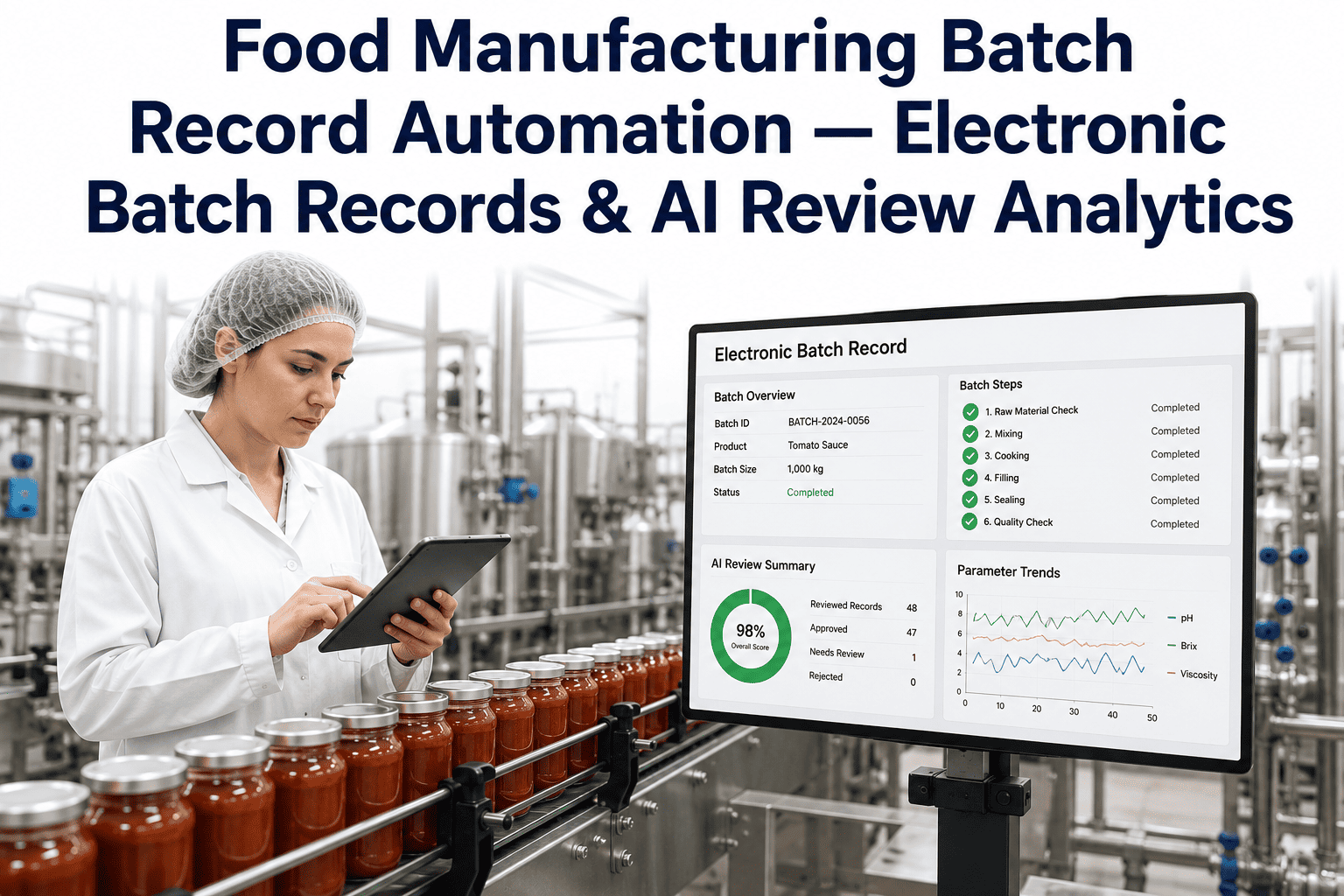
AI automates batch record creation by pulling data from multiple sources including weigh scales, analytical instruments, environmental monitors, and operator inputs. The system uses natural language processing to interpret unstructured data such as operator comments or deviation descriptions, and maps them to the correct fields in the batch record template. For instance, when a blender speed is recorded, the AI checks it against the master batch record range and automatically populates the actual value, highlighting any deviation. This eliminates manual double entry and reduces errors. According to a 2023 FDA warning letter analysis, 35% of citations were related to incomplete or inaccurate batch records. With AI-driven automation, as implemented in iFactory app, batch records are completed in real-time, 100% compliant, and ready for audit review. The system also performs logic checks, such as verifying that all required tests (identity, potency, dissolution, microbial) are completed and passed before batch release. This ensures that no batch is shipped without full quality clearance, protecting both consumer safety and brand reputation.
What are the key benefits of AI-driven stability studies for nutraceutical products?
AI-driven stability studies offer significant advantages over traditional methods by continuously monitoring environmental conditions (temperature, humidity, light) in stability chambers and correlating them with product degradation patterns. Machine learning models can predict shelf life more accurately by analyzing historical stability data from similar formulations. For example, if a probiotic capsule shows a 10% loss in viability after six months at 25C/60%RH, the AI can extrapolate the degradation curve to determine the exact expiration date. This allows manufacturers to set realistic shelf lives and avoid over- or under-committing to consumers. Additionally, AI can detect early signs of instability, such as a sudden increase in moisture content, and send alerts to quality managers. This proactive approach, supported by platforms like iFactory app, reduces the risk of market withdrawals and ensures that only products meeting specifications reach the shelf. The system also automates the generation of stability summary reports for regulatory submissions, saving weeks of manual data compilation. Ultimately, AI transforms stability testing from a reactive compliance burden into a strategic tool for product quality optimization.
How does iFactory app integrate with existing LIMS and ERP systems in a nutraceutical facility?
iFactory app is designed with open APIs and standard data exchange protocols (REST, OPC UA, ODBC) to seamlessly integrate with leading LIMS (e.g., LabWare, STARLIMS) and ERP (e.g., SAP, Microsoft Dynamics) systems. The integration works by establishing a bidirectional data flow: quality test results from the lab are automatically pushed to the ERP for inventory status updates, while master data such as material specifications and batch numbers are pulled from the ERP into the quality module. For example, when a sample of vitamin D3 raw material is logged in the LIMS, iFactory app triggers the appropriate identity and potency tests, and upon completion, sends the pass/fail status back to the ERP to update the material's quarantine status. This eliminates manual data entry and ensures data consistency across systems. The integration also supports real-time dashboards that display quality metrics alongside production KPIs, giving quality managers a holistic view of plant performance. For facilities with legacy systems, iFactory app provides middleware adapters that translate data formats without requiring changes to existing software. This flexibility, detailed on iFactory app, allows nutraceutical manufacturers to adopt AI-driven quality control without disrupting their current operations, ensuring a smooth transition to Industry 4.0 compliance.
Start Your AI Compliance Journey
Join leading supplement manufacturers who trust iFactory app for cGMP quality. Get expert support and a personalized demo.