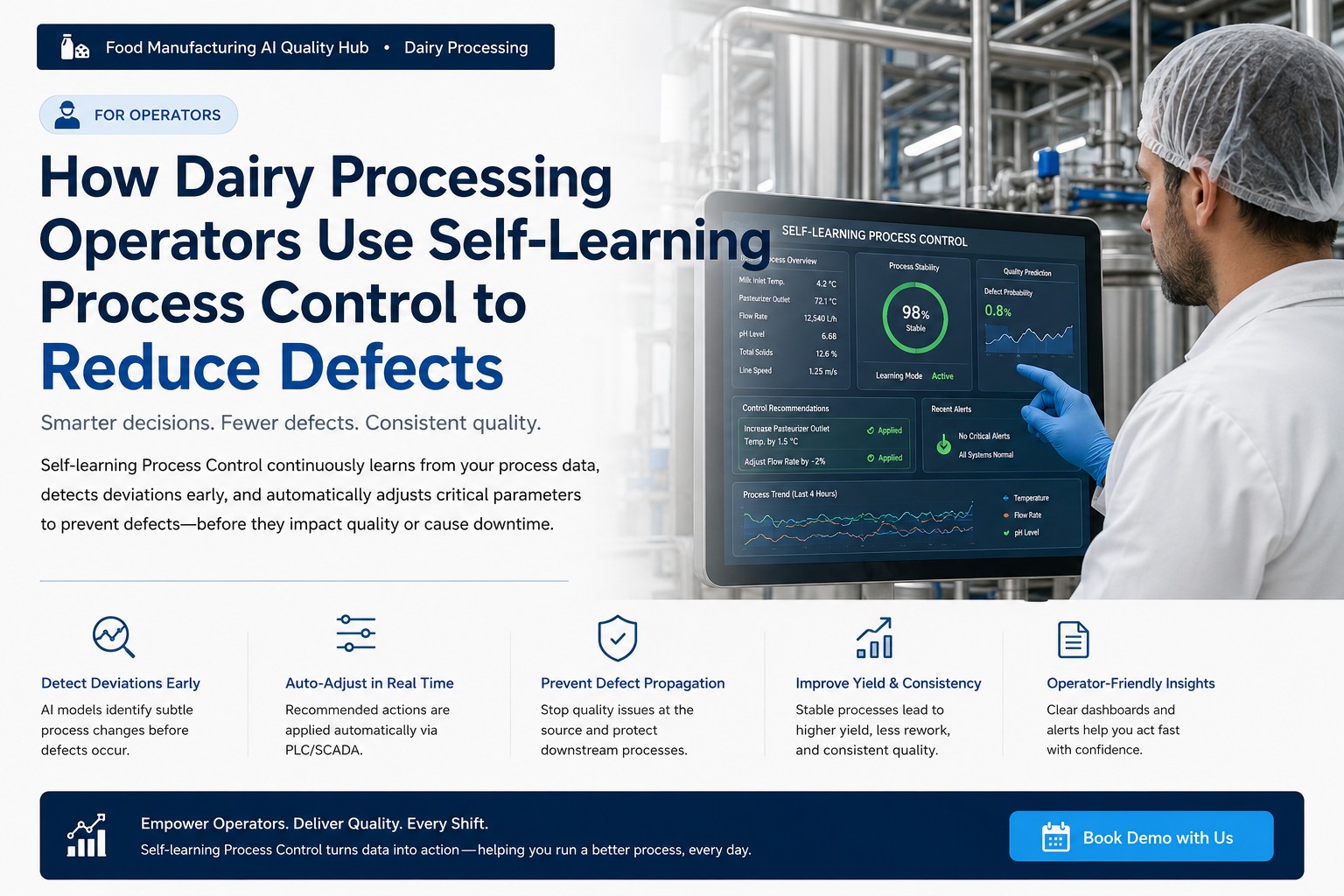
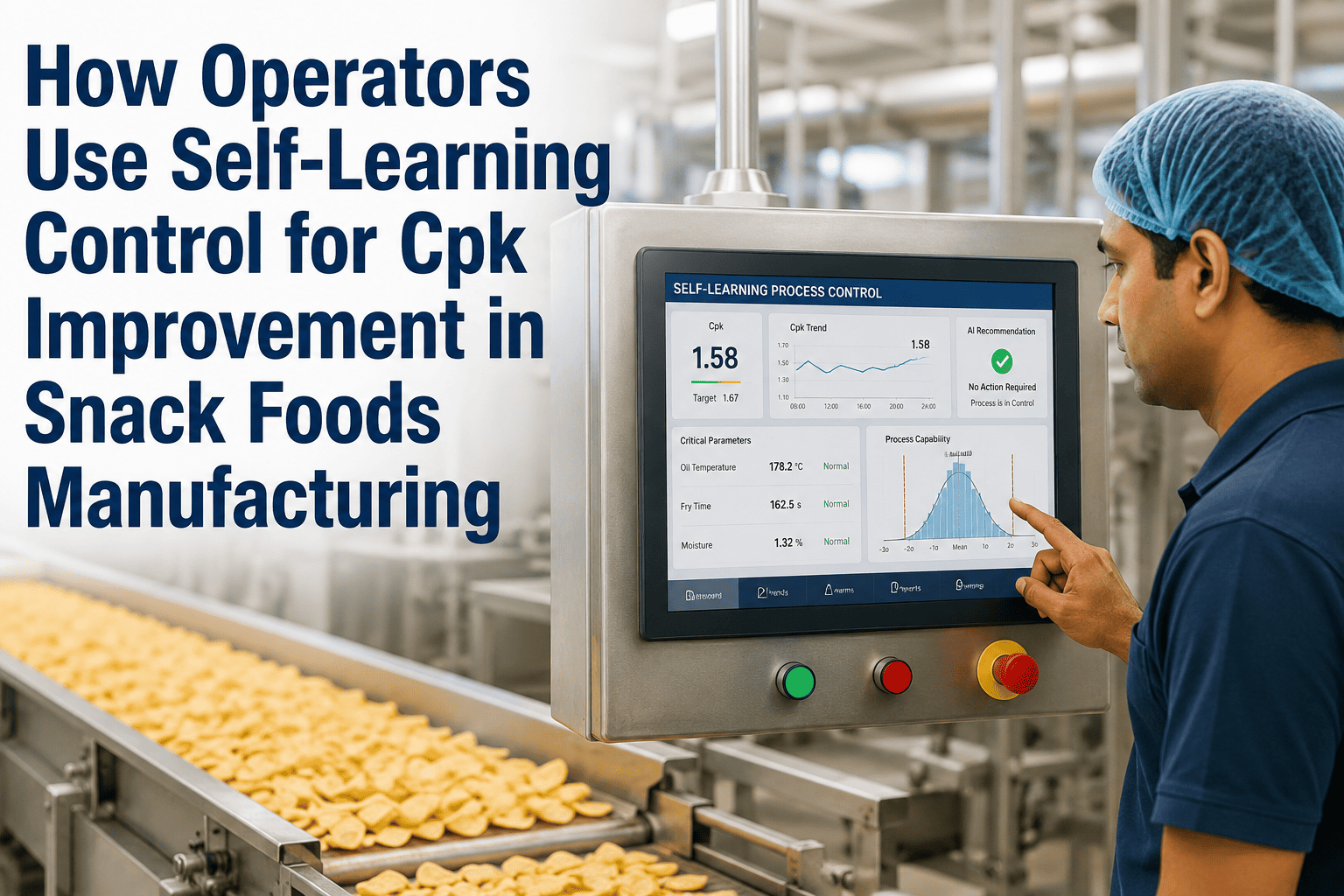
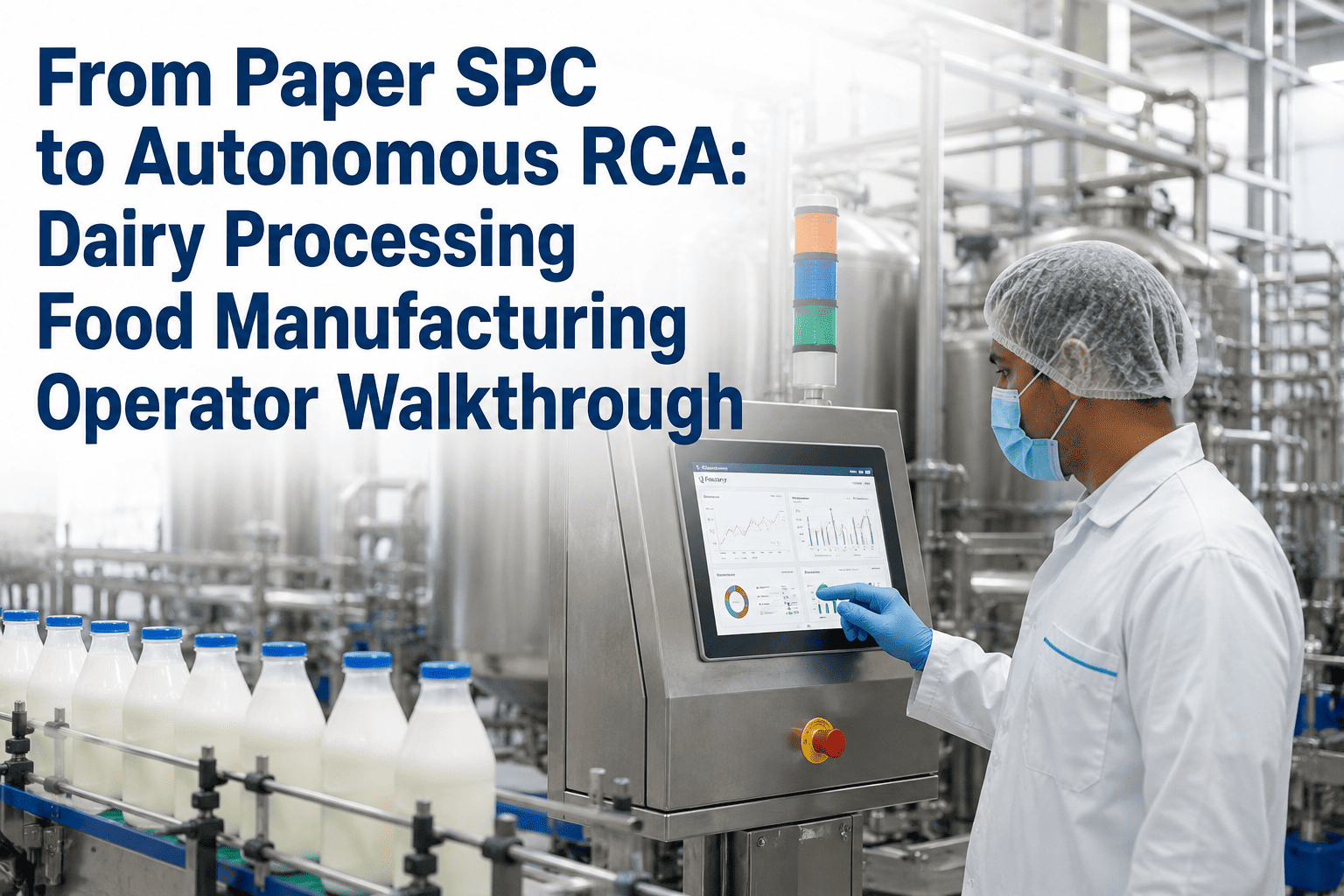
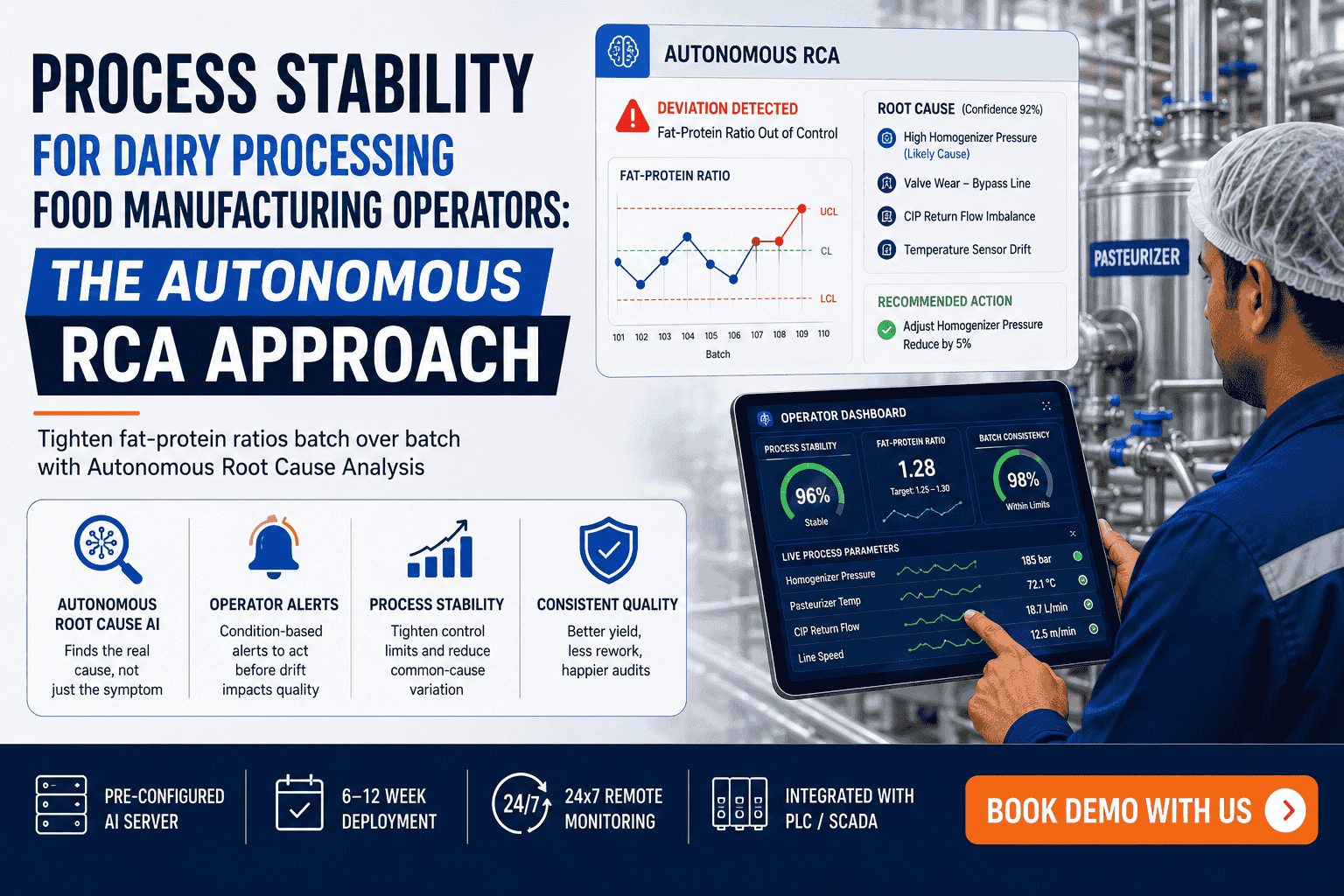
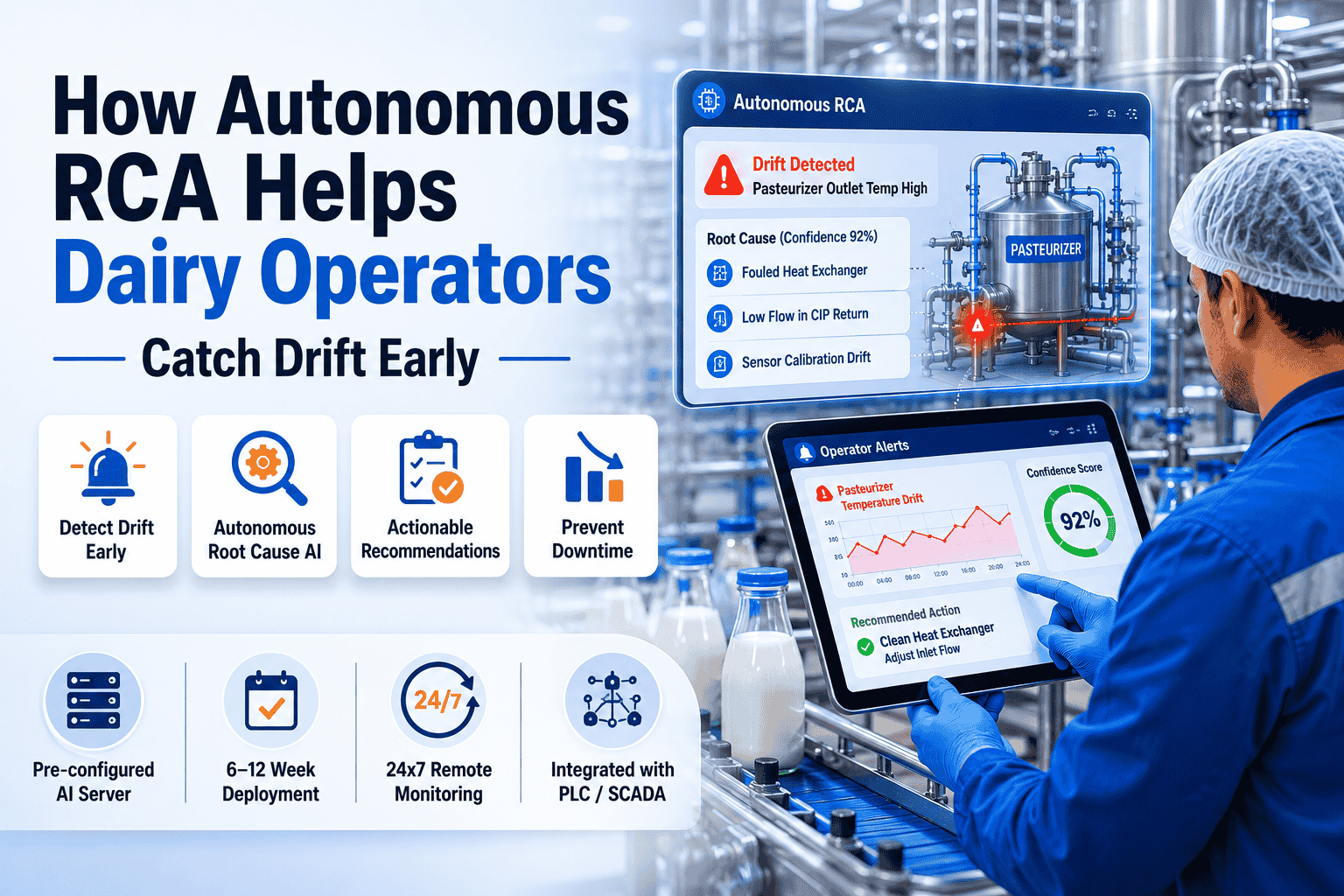
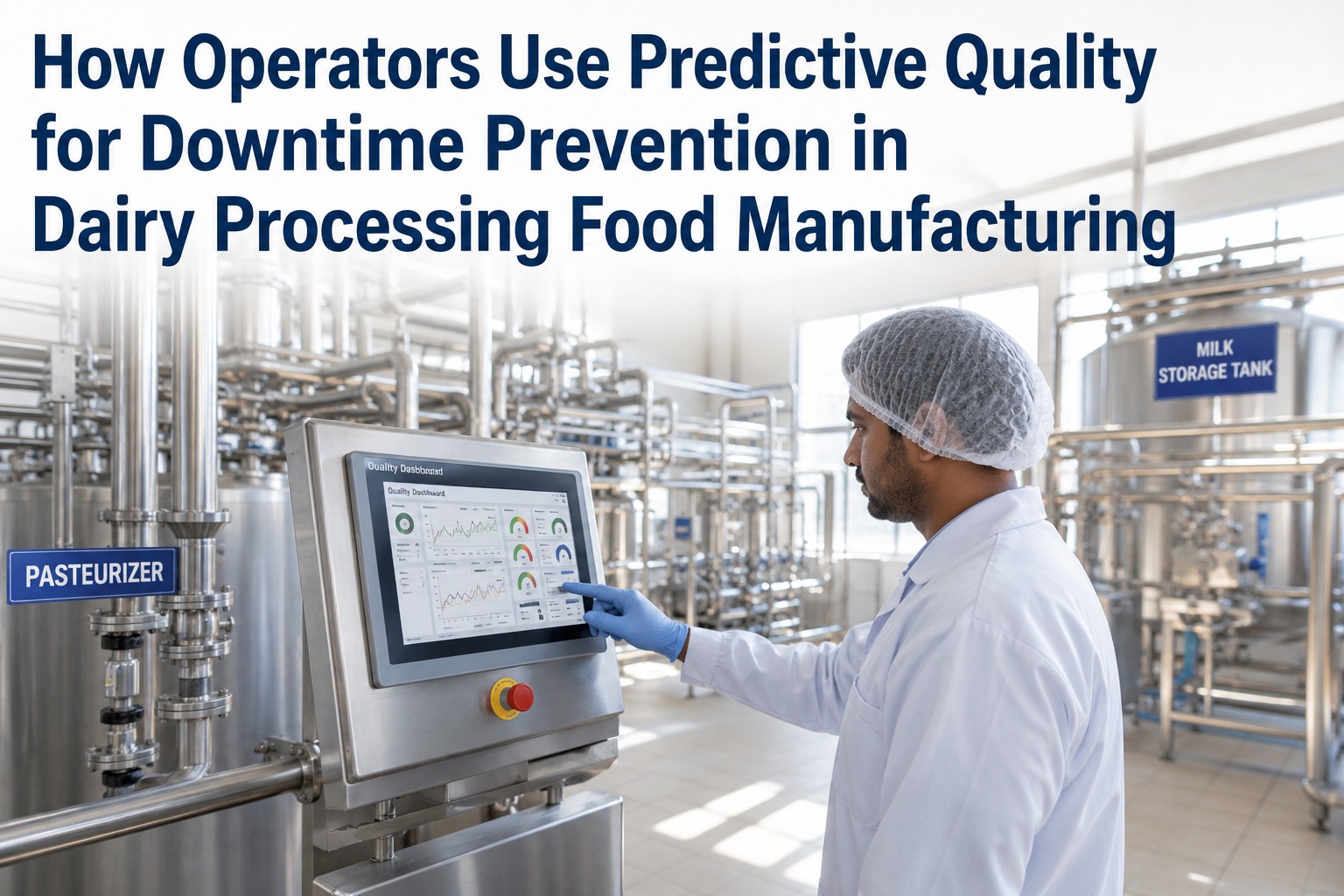
A dairy line operator on paper SPC sees the deviation after 4 samples confirm a trend — typically 30 to 60 minutes after the process drifted. By then, two pasteurization batches are off-spec and a CIP cycle is queued. Self-learning process control sees the same drift in 30 seconds, calculates the corrective setpoint, posts it to the operator's HMI, and either prompts confirmation or adjusts autonomously through the PLC. The operator's role shifts from chart-watcher to decision-maker. Book an AI SPC migration workshop to see the operator workflow shift live in your dairy environment.
How Dairy Operators Use Self-Learning Process Control — Migration from Paper SPC
From 30–60 Minute Defect Discovery to 30-Second Autonomous Correction
Paper SPC — Today
30–60 min
From process drift to operator response
1Sample taken at fixed interval
2Lab test or manual measurement
3Result plotted on control chart
44 samples needed to confirm drift
5Operator phones supervisor
6Setpoint adjusted manually
2 batches typically off-spec before correction
Self-Learning AI — Future
30 sec
From process drift to corrective setpoint
1Inline sensor reads continuously from PLC
2AI detects drift in seconds
3Recipe-aware model calculates correction
4Setpoint pushed to operator HMI
5Operator confirms or AI auto-adjusts
6PLC executes correction immediately
Zero batches off-spec — corrected before defect propagates
60–120×Faster defect detection vs. paper SPC sampling cycles
15–30%Yield improvement on cheese vat fat recovery
66–72°CPasteurization target — AI holds tighter than manual control
0Off-spec batches when AI corrects before defect propagates
Where Self-Learning Process Control Helps on the Dairy Line
Self-learning AI isn't a single tool bolted on top of SCADA — it's integrated control loops running at every critical dairy process. Six zones where dairy operators see immediate impact.
Pasteurization
Holds 66–72°C through milk flow variation
Tighter temp control · No under-processed milk · Energy reduction 8–12%
Separation & Standardisation
Real-time fat/protein content adjustment
Less giveaway on cream and skim · 1–3% material savings
Cheese Vat (Cheddaring)
Whey fat loss predicted per vat, recipe adapts
15–30% yield improvement · Adapts cheese recipe automatically
Fermentation (Yogurt & Cultured)
Texture prediction (Danone-style ML loop)
Texture consistency · Reduced batch rejection rate
CIP (Clean-in-Place)
Adapts chemical, time, temperature to soil level
25–40% chemical and water savings per cycle
Packaging Line
Fill weight + label inspection in real time
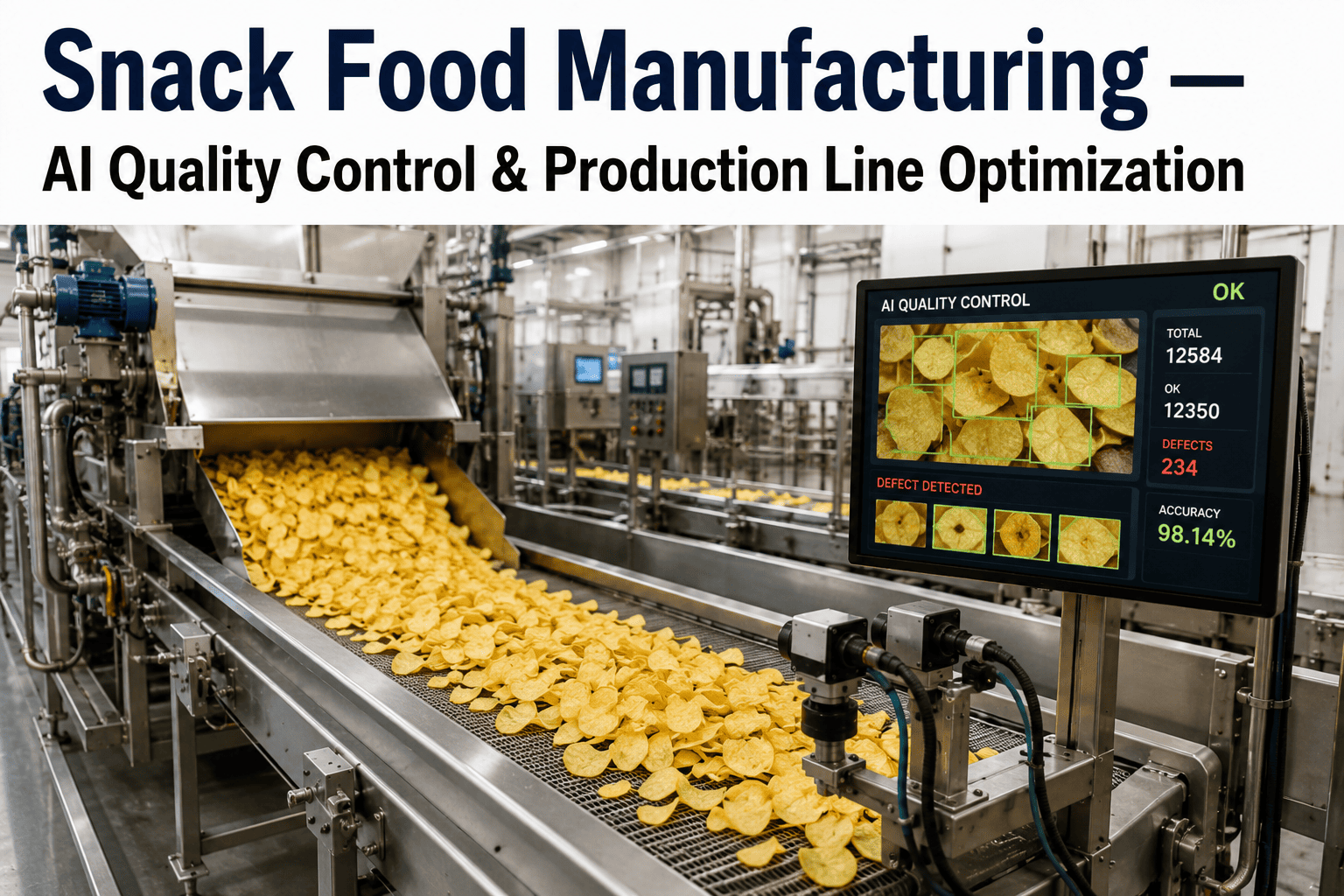
Eliminates 0.5–2% product giveaway · Auto-rejects defects
The Self-Learning Loop: How AI Actually Improves the Process
"Self-learning" isn't marketing — it's a closed-loop architecture where each batch's outcome trains the next batch's parameters. The loop runs continuously between sensor data, the AI model, the operator, and the PLC.
1
Sense
Inline sensors — temperature, flow, pH, fat, conductivity — stream data from PLC every second to the AI layer.
2
Detect
AI compares live data to recipe-specific baseline. Detects deviation in seconds — faster than any human chart-watcher could.
3
Decide
Model calculates the corrective action — adjust temp, flow, recipe ratio. References historical batches with similar drift signatures.
4
Act
Setpoint posted to operator HMI for confirmation, or pushed directly to PLC for autonomous adjustment based on governance rules.
5
Learn
Outcome of every correction feeds back into the model. Next batch starts with better baseline — the system gets smarter every shift.
Want to see the self-learning loop running on your pasteurizer, cheese vat, or CIP system? Book an AI SPC migration workshop — we will demo the loop on your dairy data.
What Changes for the Dairy Operator: The New Day-in-the-Life
Self-learning process control doesn't eliminate the dairy operator — it elevates the role. The shift is from chart-watcher to decision-maker, from sample-taker to system supervisor. The 5 task changes below are what operators actually experience.
Before
Check chart every 30 minutes, log values manually
→
After
Monitor dashboard for AI alerts and trend insights
Before
Pull samples on fixed cadence regardless of state
→
After
Sample only when AI flags drift requiring verification
Before
Call supervisor when deviation confirmed
→
After
Confirm AI-recommended correction on HMI in 1 click
Before
Manually adjust setpoint and watch impact
→
After
AI executes correction · Operator validates outcome
Before
Reconcile shift logs to ERP at end of shift
→
After
Auto-logged batch records · 100% traceability built in
Stop Operators Chasing Drift After It's Too Late — Migrate to Self-Learning Process Control
iFactory's AI SPC migration workshop maps your current dairy line workflow, identifies the highest-impact zones (pasteurization, cheese vat, CIP, packaging), and demos the self-learning loop running on your actual process data — delivered as a phased migration plan.
Expert Perspective: Why the Smartest Dairy Operators Are Embracing AI — Not Resisting It
The first reaction we hear from dairy operators is concern that AI will replace them. Six months into a deployment, the conversation has flipped — the same operators now ask why anyone would run the line on paper SPC again. The reason is simple. Paper SPC asks the operator to spot patterns in chart data while also running the line, taking samples, and doing CIP transitions. Self-learning AI spots the pattern faster, more reliably, with no fatigue effect — and frees the operator to make the higher-value decisions about recipe adjustments, batch quality grading, and process improvements that AI cannot make alone. The dairy industry is moving rapidly here. Danone uses ML for yogurt texture prediction. Nestlé uses AI for sensory and shelf-life monitoring. Amul uses RFID for tanker tracking. The operators who learn the new tools become more valuable, not less.
— iFactory F&B SPC Migration Practice, Dairy & Cultured Products 2025 to 2026
15–30%
Cheese yield improvement from self-learning whey fat correction
25–40%
CIP utility reduction with adaptive cycle parameters
60–120×
Defect detection speedup vs. paper sampling cycles
Ready to migrate your dairy line from paper SPC to self-learning process control? Talk to our F&B process control team — we will design the migration plan around your existing PLC and SCADA.
Free Your Operators From Chart-Watching — Give Them AI-Augmented Decision Power
iFactory's AI SPC migration workshop covers pasteurization, separation, cheese vat, fermentation, CIP, and packaging lines — mapping each control loop, demoing the self-learning architecture on your data, and producing a phased migration plan that works with your existing PLC and SCADA investment.
Frequently Asked Questions
Does self-learning process control replace dairy operators?
No — it elevates the operator role from chart-watching to decision-making. AI handles continuous monitoring, pattern detection, and routine setpoint adjustments. Operators focus on recipe judgment, batch quality grading, exception handling, and process improvement decisions that require human judgment. Plants deploying AI SPC consistently report increased operator engagement and reduced turnover, not workforce reduction.
How does self-learning AI integrate with existing dairy PLC and SCADA?
AI sits as an integration layer between SCADA and PLC, reading sensor data through standard OPC-UA or MQTT protocols and writing setpoint recommendations back to the operator HMI or directly to the PLC under governance rules. Existing Allen-Bradley, Siemens, or other PLC investments are preserved — the AI layer augments rather than replaces. Typical deployment time is 8 to 14 weeks per major process zone.
Can self-learning AI run autonomously, or does the operator always confirm corrections?
Governance rules define which corrections run autonomously and which require operator confirmation. Routine adjustments within tight bands (small temperature drift, minor flow variation) typically run autonomously. Recipe changes, quality grade decisions, and corrections outside normal bands require operator confirmation. Every action is logged for full audit trail compliance with FDA, FSMA, and HACCP requirements.
What yield improvements are realistic for a dairy line moving from paper SPC to AI?
Cheese vat operations typically see 15 to 30% yield improvement from adaptive whey fat recovery loops. Pasteurization energy drops 8 to 12% through tighter temperature control. CIP cycles save 25 to 40% on chemicals and water through soil-adaptive parameters. Packaging fill optimization eliminates 0.5 to 2% product giveaway. Total operational improvement compounds to typical 6 to 14 month payback on AI SPC migration.
How does iFactory's AI SPC migration workshop work?
iFactory's workshop maps your current dairy line workflow, identifies highest-impact control zones (pasteurization, separation, cheese vat, fermentation, CIP, packaging), demos the self-learning loop running on your actual process data, designs the integration architecture with your existing PLC and SCADA, and produces a phased migration plan with operator training schedule. All delivered before any system changes.
Book your workshop here.