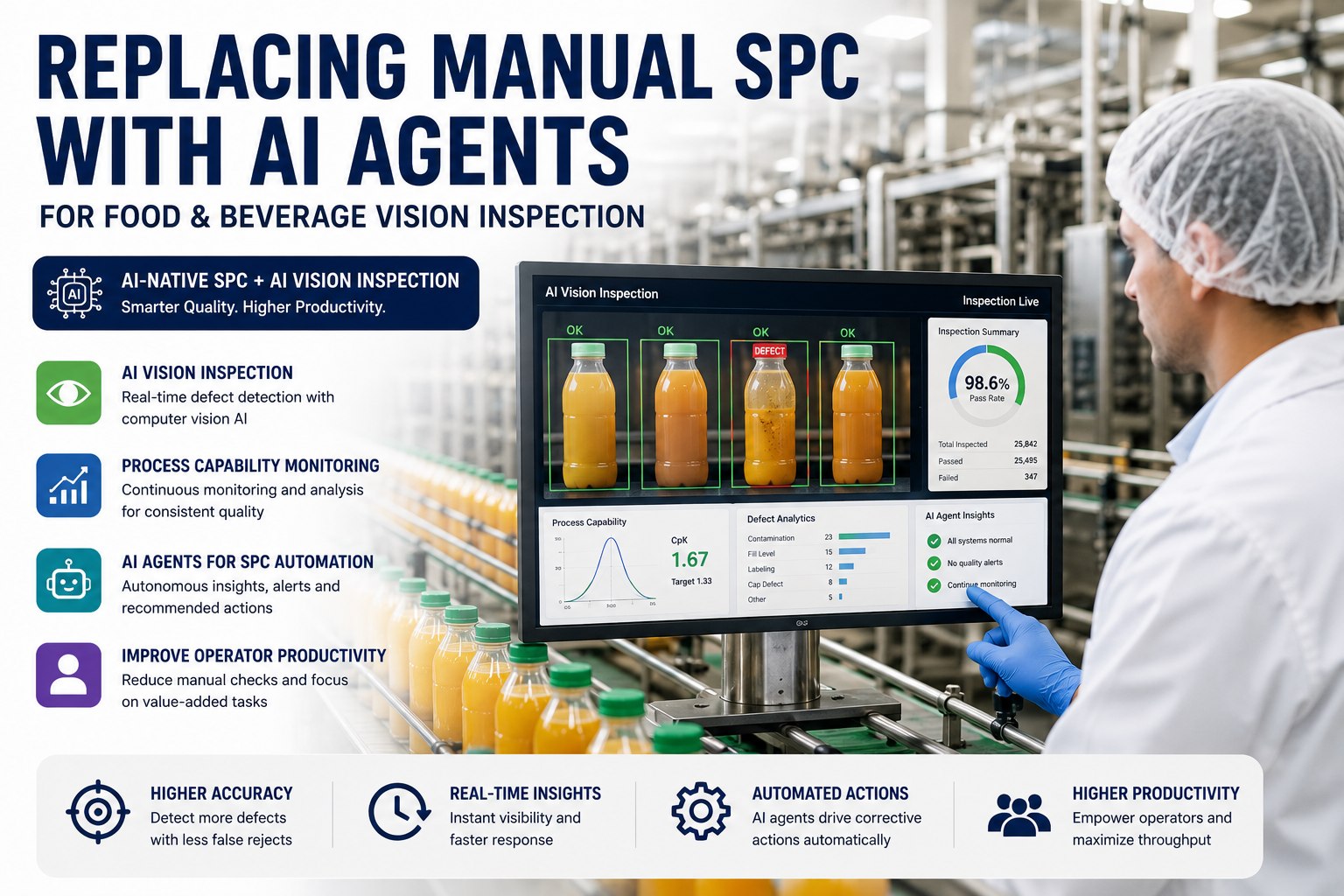
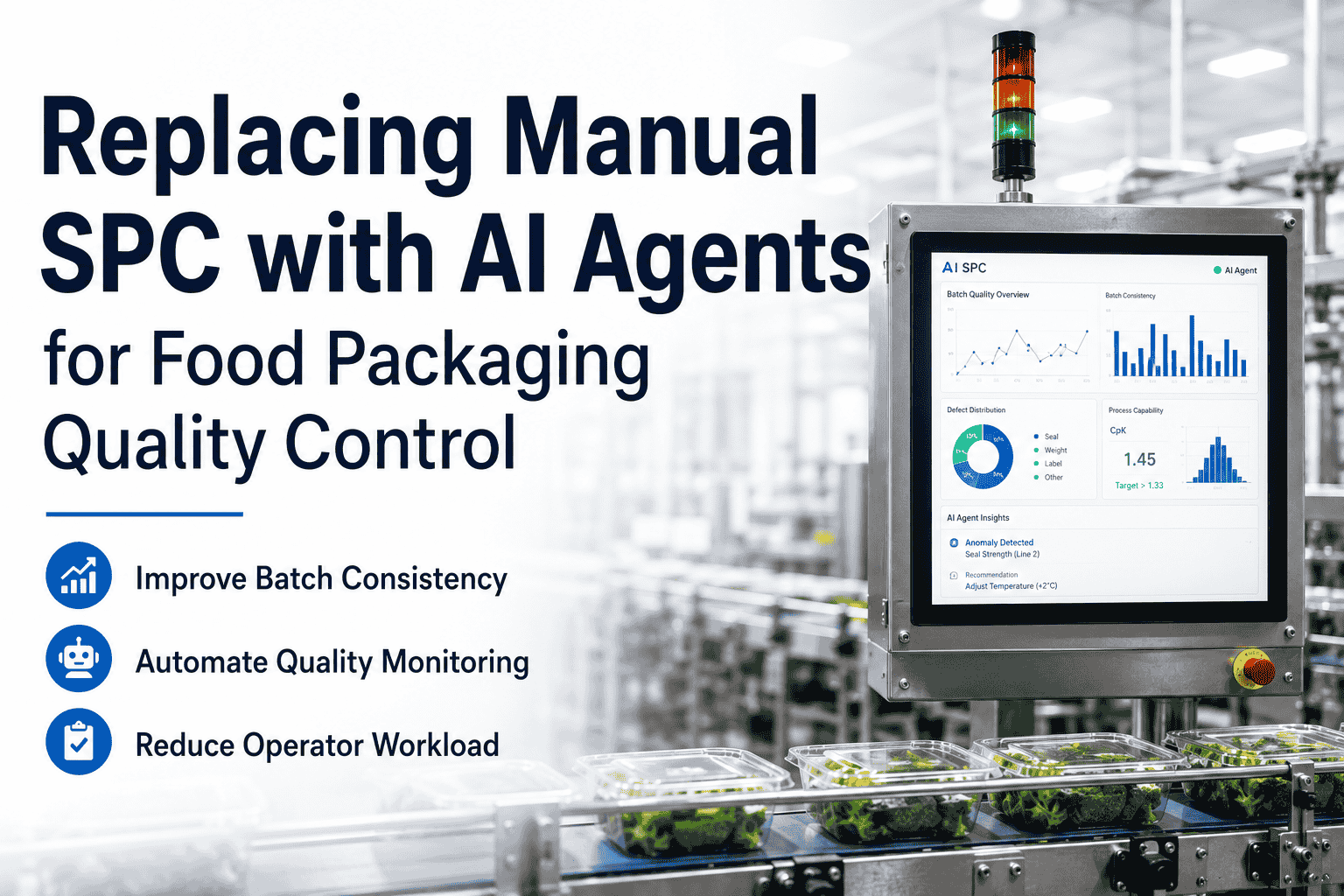
Replacing Manual SPC with AI Agents for Food & Beverage Vision Inspection
By Riley Quinn on June 18, 2026
Human inspectors miss 15 to 25% of defects under sustained production conditions — a figure that compounds with shift fatigue, lighting variability, and line speeds that no human visual system can match consistently. At 400 to 600 units per minute on a beverage or packaged food line, asking operators to catch every fill deviation, seal failure, label misprint, and foreign object is a task physics and biology make impossible at scale. Book a demo to see AI vision inspection running on representative F&B line scenarios — 99%+ detection accuracy, every unit, every shift, at full line speed.
AI Vision Inspection — Food & Beverage Manufacturing
The Inspection Accuracy Gap That Manual Methods Cannot Close
Manual Visual Inspection
Detection Accuracy
Under sustained production conditions
15 to 25% defects missed
Accuracy drops per shift
Speed-limited by human visual processing
Inter-inspector agreement: 55 to 70%
VS
AI Vision Inspection
Detection Accuracy
24/7 — zero fatigue, zero shift variation
100% of units inspected — no sampling
Sub-50ms decision per unit at full line speed
Identical standards every shift, every day
Defects as small as 0.5mm detected
374%
3-year ROI documented
8 to 14 mo
Average payback period
85%
Fewer customer complaints
37%
Defect reduction in first quarter
Why Manual Inspection Fails F&B Lines — The Physics Problem
Manual visual inspection was designed for slower, lower-volume production environments where a trained human eye could realistically evaluate every unit. Modern food and beverage lines operate at 400 to 600 units per minute on beverage and packaged food lines — a rate that leaves approximately 100 to 150 milliseconds per unit for a human inspector to detect, classify, and signal a reject. Under those conditions, consistency is impossible. Identical defects get different outcomes depending on the inspector, the shift, the lighting angle, and how many hours into the shift the evaluation happens.
Speed Ceiling
100 ms
Per-unit evaluation window at 600 units per minute. Human visual processing cannot reliably classify defects at this speed without a significant miss rate.
Inspector Disagreement
55 to 70%
Inter-inspector agreement on defect severity. Identical products receive different quality verdicts depending on which inspector and which shift makes the call.
Fatigue Degradation
Up to 25%
Defect miss rate under sustained production conditions — a figure that worsens progressively as the shift continues, peaking in the final two hours before handover.
Recall Cost Exposure
$10M+
Average cost of a food safety recall triggered by a labelling error missed during manual inspection — not an edge case, but the predictable consequence of inspection at scale.
See exactly what your current manual inspection is missing. Book a demo with an F&B vision inspection specialist — we will walk through the specific defect categories your line speed and product type generate.
What AI Vision Inspection Detects in F&B — Full Defect Coverage
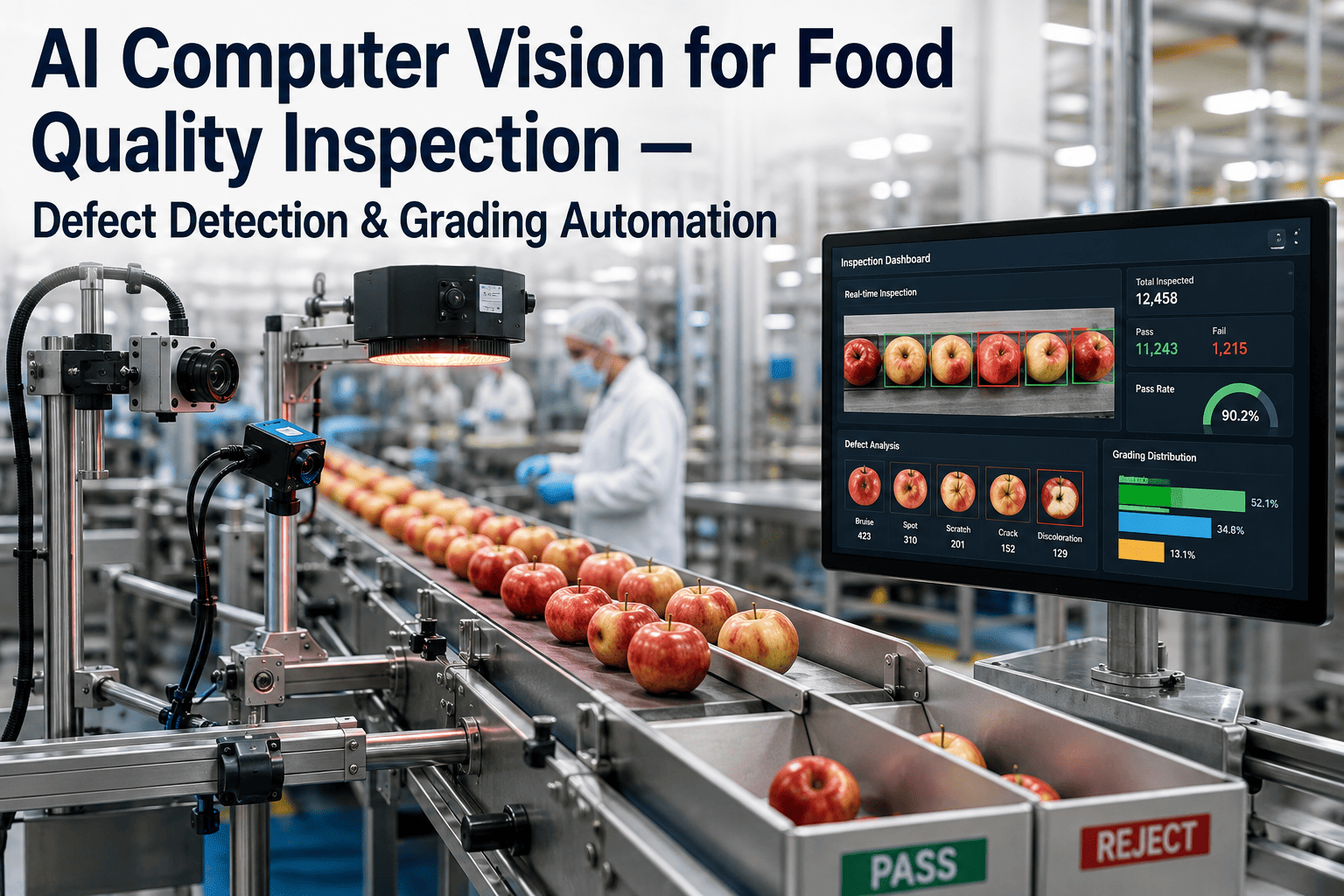
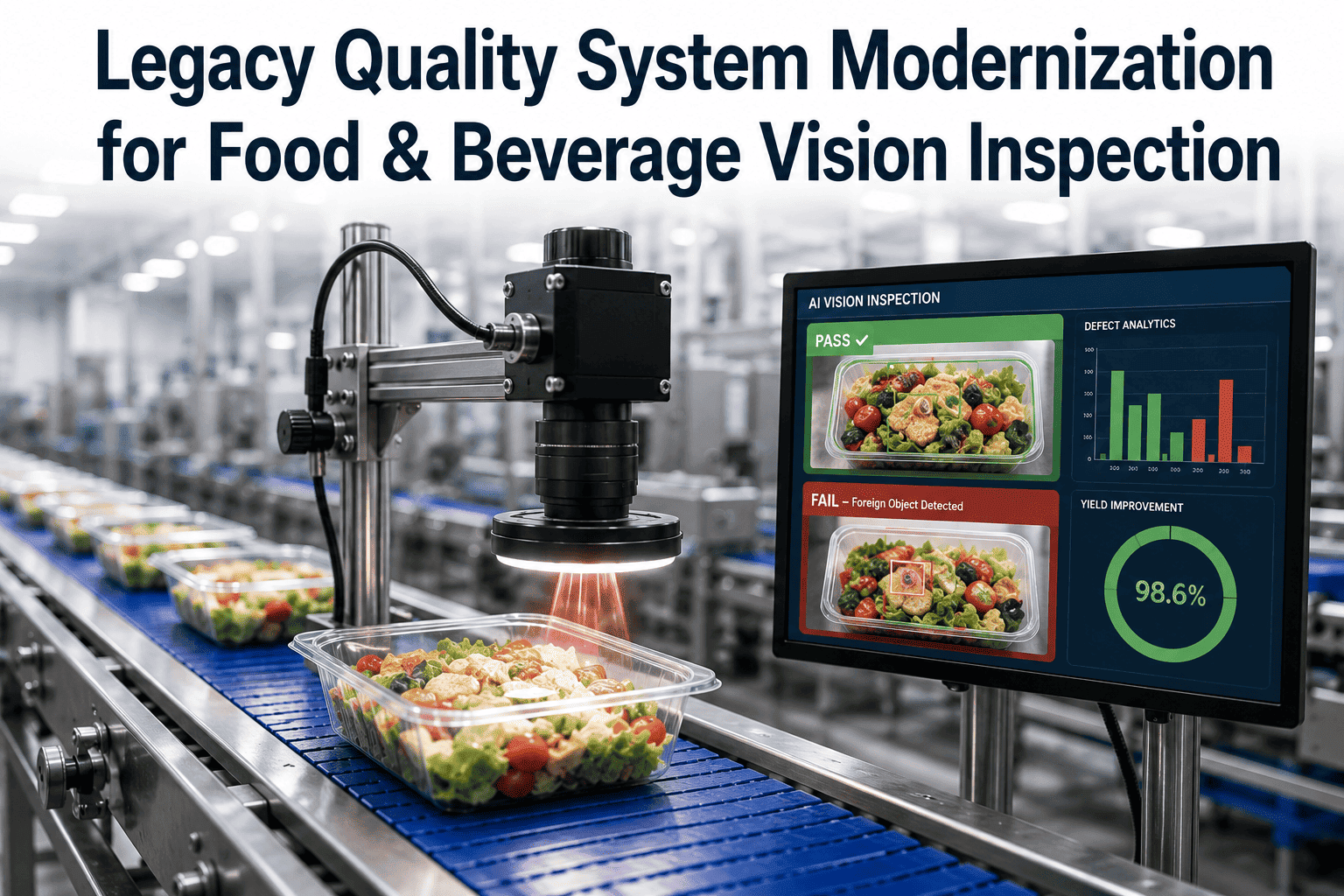
AI vision inspection systems in food and beverage manufacturing are not single-purpose tools. A single deployment covers the full defect library for a production line — from packaging integrity and fill level deviation to label accuracy, foreign object detection, and allergen declaration completeness — all in a single inspection pass at full line speed.
Packaging Integrity
Seal contaminationPartial sealsUnsealed packagesDents and tearsDeformationsVacuum seal failures
Fill Level and Weight
Under-fill detectionOver-fill flaggingPer-bottle visual confirmPouch fill deviationNet weight complianceSKU fill spec matching
Label and Date Code
Date code legibilityLabel position toleranceSKU-run match verifyAllergen declaration checkLot number traceabilityFSMA 204 compliance
Foreign Object and Surface
Foreign particle detectionContamination in sealsMicro-crack detectionSurface color anomaliesMold and bruisingSub-0.5mm defects
AI Vision vs. Manual Inspection vs. Rule-Based Machine Vision — What Each Can Do
Not all vision inspection approaches are equivalent. Rule-based machine vision systems use fixed algorithms and predetermined feature thresholds — they work well for highly consistent products but struggle with the natural variability that defines food and beverage manufacturing. AI-native vision systems learn from annotated defect images and adapt to variation that would overwhelm rule-based logic. Here is how all three approaches compare across the dimensions that matter most in F&B quality.
Capability
Manual Inspection
Rule-Based Machine Vision
AI Vision Inspection
Detection Accuracy
80 to 85% — degrades with fatigue
85 to 92% on consistent products
99 to 99.4% — consistent across all shifts
Natural Product Variability
Humans adapt — but inconsistently
High false-positive rate — misclassifies acceptable variation
Learns and adapts to variability per SKU and ingredient lot
Line Speed
Bottleneck — 100 to 150ms max per unit
High speed but miss rate rises with variation
Sub-50ms — full speed inspection on every unit
New Defect Types
Relies on operator experience and training
Requires rule reprogramming — weeks of engineering
Model retrained on new annotated images — days
SPC Integration
Manual logging — data lags behind production
Structured output — but limited analytics
Real-time defect data feeds AI-native SPC — Cpk, trends, RCA
Audit Trail
Paper logs — incomplete, manual, error-prone
Structured records — limited traceability depth
Every decision logged with timestamp, ID, classification, confidence score
Lowest — fixed-cost asset, 374% documented 3-yr ROI
Want to see the comparison applied to your specific F&B line? Book a product demo and we will show you AI vision inspection running on defect categories specific to your product type and line speed.
See AI Vision Inspection Running on Your F&B Defect Library
iFactory's AI SPC Migration Workshop includes a live demonstration of AI vision inspection on representative food and beverage defect scenarios — packaging integrity, fill level, label accuracy, and foreign object detection — paired with real-time SPC integration showing how every inspection event feeds Cpk monitoring and autonomous RCA.
How AI Vision Integrates with SPC — The Quality Intelligence Loop
The real productivity gain from AI vision inspection is not just catching more defects — it is what happens with that defect data in real time. Every inspection decision is logged with a timestamp, product identifier, defect classification, and confidence score. That continuous data stream feeds directly into AI-native SPC: Cpk is recalculated on every unit inspected, drift patterns are detected before control limits breach, and root causes are pre-computed when anomaly signatures emerge. Manual inspection breaks this loop entirely — data lags, records are incomplete, and the connection between a defect and its process cause is severed.
01
AI Vision Inspection
Every unit inspected at full line speed. Defect classified, logged with timestamp, product ID, confidence score. Reject signal fired in under 50ms.
100% unit coverage
02
Real-Time SPC Feed
Inspection data streams into AI-native SPC platform. Cpk and Cp recalculated on every incoming point. Defect rate trends tracked per SKU and per shift.
Continuous Cpk monitoring
03
Predictive Drift Alert
AI agent detects defect rate drift pattern before control limits breach. Alert fired with evidence — which defect type, which line position, which process variable correlates.
4 to 24 hr early warning
04
Autonomous RCA + Action
Root cause pre-computed. Operator sees evidence-backed explanation in 3 to 5 minutes. Corrective action taken before scrap compounds. Audit record continuous.
3 to 5 min root cause
Operator Productivity: What Changes When Vision Is AI-Driven
The productivity impact of AI vision inspection extends well beyond replacing headcount at the inspection station. When AI handles 100% unit inspection at line speed, operators are redirected from monotonous visual scanning to genuine quality engineering work — investigating pre-computed root causes, optimizing process parameters, and acting on AI-surfaced improvement recommendations rather than building analyses from scratch.
Without AI Vision
2 to 4 inspectors per line scanning units at high speed — accuracy degrades, fatigue sets in, defects escape. Inspectors cannot also maintain data records accurately.
With AI Vision
Zero inspectors required for routine scanning. Operators focus on AI-escalated findings only — high-value intervention, not repetitive scanning.
Without AI Vision
Quality records hand-written or manually entered. Gaps, errors, and missing data create audit exposure. Pre-audit compilation takes days of team effort.
With AI Vision
Every inspection decision automatically logged — timestamp, unit ID, defect class, confidence score. Audit package generated on demand in minutes.
Without AI Vision
Defect rates tracked manually on shift logs. Root cause investigation starts from zero after each event. Average RCA time: 45 to 75 minutes per incident.
With AI Vision
Defect data feeds SPC continuously. When an anomaly fires, root cause is pre-computed. Operator reviews and validates in 3 to 5 minutes — not 75.
Expert Perspective: Why F&B Is the Ideal Industry for AI Vision Deployment
Food and beverage is the industry where manual inspection failure has the highest consequence — a labelling error that escapes human inspection can trigger a recall averaging $10 million in direct costs, plus brand damage that compounds over years. At the same time, F&B is the industry where natural product variability makes rule-based machine vision least reliable. AI vision inspection is precisely the solution the industry needs: a system that learns to distinguish genuine defects from acceptable natural variation, improves continuously as it processes more production data, and integrates directly with SPC to close the loop between defect detection and process root cause. Manufacturers using AI-powered food quality inspection report payback periods of 8 to 14 months, with ongoing savings compounding as the AI model improves.
— iFactory AI Vision Inspection Research, F&B Operations 2025 to 2026
99%+
Detection accuracy across all shifts — vs. 80 to 85% manual
<50ms
Per-unit inspection decision at full F&B line speed
6 to 12 mo
Typical payback period including full SPC integration
Ready to size the ROI for your operation? Book a demo and ROI assessment — our F&B vision team will estimate payback period, defect escape reduction, and SPC integration gains for your specific line configuration.
Replace Manual Inspection with AI Vision — Starting in Weeks
iFactory's AI SPC Migration Workshop covers your current inspection burden assessment, a live demonstration of AI vision defect detection on representative F&B scenarios, real-time SPC integration walkthrough, deployment roadmap, and a documented ROI model against your baseline defect escape rate, inspection labor cost, and audit burden.
How accurate is AI vision inspection compared to human inspectors in food and beverage?
AI vision inspection achieves 99 to 99.4% detection accuracy consistently across all shifts — versus 80 to 85% for manual inspection under sustained production conditions. Human accuracy degrades with fatigue, lighting variation, and line speed. Inter-inspector agreement on defect severity is only 55 to 70%, meaning identical products receive different quality verdicts depending on shift and inspector. AI systems maintain identical standards 24 hours a day, 7 days a week, with every decision logged automatically.
Can AI vision inspection handle natural product variability in food manufacturing?
Yes — this is precisely where AI vision outperforms rule-based machine vision. Rule-based systems use fixed algorithms that misclassify natural variation as defects, generating high false-positive rates on food products like fresh produce, proteins, and baked goods. AI vision systems learn from annotated defect images and develop an understanding of what constitutes a genuine defect versus acceptable natural variation for each specific SKU and ingredient lot. The model continuously refines this distinction as more production data accumulates.
How does AI vision inspection connect to SPC and process capability monitoring?
Every AI inspection decision is logged with a timestamp, unit identifier, defect classification, and confidence score. This continuous data stream feeds directly into AI-native SPC — Cpk is recalculated in real time, defect rate trends are tracked per SKU and shift, and the AI detects drift patterns before control limits are breached. When an anomaly is detected, root cause is pre-computed from the correlated process data. The result is a closed quality intelligence loop that manual inspection fundamentally cannot provide.
What is the typical ROI and payback period for AI vision inspection in F&B?
Food and beverage manufacturers using AI vision inspection report payback periods of 8 to 14 months, with documented 3-year ROI reaching 374% in best-performing deployments. Primary ROI drivers include labor cost reduction from replacing manual inspector headcount ($100,000 to $300,000 annually per line), 15 to 20% scrap cost reduction from earlier defect detection, throughput gains from eliminating the inspection bottleneck, and recall avoidance — the biggest single risk item, with a labelling-error recall averaging over $10 million in direct costs.
How do we get started evaluating AI vision inspection for our F&B plant?
The most effective starting point is iFactory's AI SPC Migration Workshop — a half-day session covering your current inspection burden assessment, a live demonstration of AI vision on representative F&B defect scenarios for your product types, real-time SPC integration walkthrough, deployment roadmap, and a documented ROI model against your specific defect escape rate, inspection labor cost, and audit compliance burden. Register your team for the AI SPC Migration Workshop here.