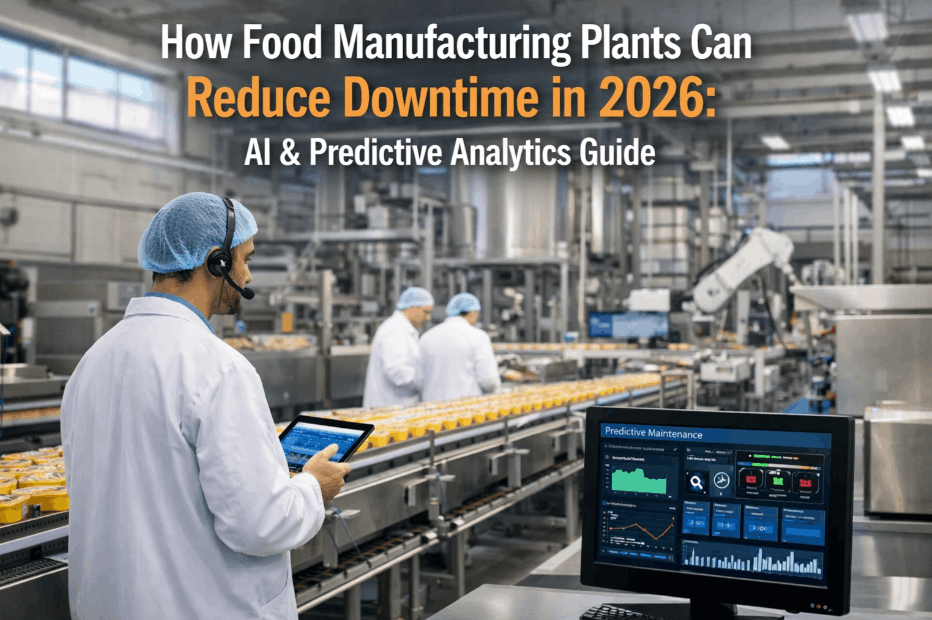
Predictive Maintenance for Food Manufacturing: Preventing Downtime with iFactory AI
By Alice Walker on March 7, 2026
In food manufacturing, one hour of unplanned downtime costs an average of $39,000—and when perishable ingredients are on the line, the real losses extend far beyond repair bills. Spoiled product, missed retail delivery windows, and FDA compliance gaps compound into a financial hit that reactive maintenance programs cannot absorb. Predictive maintenance powered by AI changes the equation entirely: continuous equipment monitoring detects failures weeks before they happen, protecting both throughput and food safety. Sign up free to connect your plant's critical assets and see where hidden downtime risk is costing you the most.
iFactory's AI-powered CMMS connects to your mixers, conveyors, refrigeration, and packaging lines—detecting equipment degradation before it becomes a shutdown, a spoilage event, or an audit finding.
Average cost per hour of unplanned downtime in food plants
42%
Of food plant downtime traced to equipment failures detectable in advance
30%
Average maintenance cost reduction within 12 months of AI deployment
7 mo
Typical payback period for food-industry predictive maintenance platforms
Why Food Manufacturing Is Uniquely Vulnerable
The Stakes Are Higher When Product Is Perishable
Food plants operate under constraints that most industrial facilities never face. Equipment failures do not just stop production—they destroy inventory, trigger food safety holds, and create audit documentation gaps that can result in FDA warning letters. The combination of temperature-sensitive processes, strict sanitation requirements, and tight retail delivery schedules means that even short unplanned stops cascade into disproportionately expensive outcomes.
Spoilage Multiplication
A refrigeration compressor failure during overnight production can destroy $200K+ of perishable inventory before morning shift discovers the problem. AI thermal monitoring catches compressor degradation 30–60 days early.
Compliance Documentation Gaps
FDA's FSMA requires documented proof that critical equipment (CCP monitors, pasteurizers, metal detectors) was operational and calibrated at all times. An untracked equipment failure can invalidate an entire production lot.
Retail Delivery Windows
Major grocery and food service customers enforce delivery windows with penalty clauses. A 6-hour downtime event on a packaging line can result in $50K–$150K in chargebacks and jeopardize contract renewals.
Sanitation Cycle Disruption
When equipment fails mid-production, CIP (Clean-in-Place) schedules are disrupted. Restarting requires a full sanitation cycle—adding 4–8 hours to the downtime window and consuming additional chemical and water resources.
Why This Matters Now
Food manufacturers that implement predictive maintenance report an average 30% drop in total maintenance spend and a 45% reduction in unplanned downtime events within the first year. The savings come from three sources: eliminating over-maintenance of healthy assets, preventing spoilage-related product losses, and reducing emergency parts procurement at premium pricing. For a mid-size food plant spending $2M annually on maintenance, that is $600,000 returned to the bottom line—while simultaneously strengthening food safety compliance documentation.
Cold chain integrity depends entirely on compressor health. AI monitors suction/discharge pressure ratios, motor current draw, and vibration signatures to detect bearing wear, refrigerant leaks, and valve degradation 30–60 days before failure—preventing catastrophic spoilage events.
Failure cost: $50K–$300K per event
Conveyor Drive Systems
Conveyor failures halt entire production lines. Vibration analysis on gearboxes and motor bearings detects misalignment, belt wear, and chain stretch before jamming or breakage occurs—converting emergency line stops into planned 30-minute belt replacements during scheduled downtime.
Failure cost: $15K–$80K per event
Mixers and Blenders
High-torque mixing equipment experiences seal failures, gearbox degradation, and shaft bearing wear under heavy viscous loads. Acoustic emission sensors and current monitoring detect early-stage faults that manual inspection cannot identify until product quality has already been compromised.
Failure cost: $20K–$120K per event
Pasteurization and Heat Exchangers
Fouling, gasket degradation, and pump cavitation in pasteurization systems create both food safety risks and efficiency losses. AI tracks thermal differential trends and flow rates to predict when cleaning or gasket replacement is needed—before temperature compliance is breached.
Failure cost: $30K–$200K per event
Packaging Line Equipment
Packaging is the final bottleneck before shipment. Seal bar wear, servo motor degradation, and film tension irregularities cause micro-stops that accumulate into hours of lost output per week. AI-based OEE monitoring identifies degradation patterns invisible to manual tracking.
Failure cost: $10K–$60K per event
Boilers and Steam Systems
Steam is essential for cooking, sterilization, and CIP processes. Tube fouling, burner degradation, and feedwater pump issues reduce efficiency 10–25% before triggering an alarm. AI energy monitoring catches these drift patterns early, preventing both efficiency loss and unscheduled shutdowns.
Failure cost: $40K–$250K per event
How iFactory AI Predictive Maintenance Works in Food Plants
From sensor to work order to compliance record—the complete loop runs continuously without manual intervention, protecting uptime and audit readiness simultaneously.
01
Sensor Deployment on Critical Assets
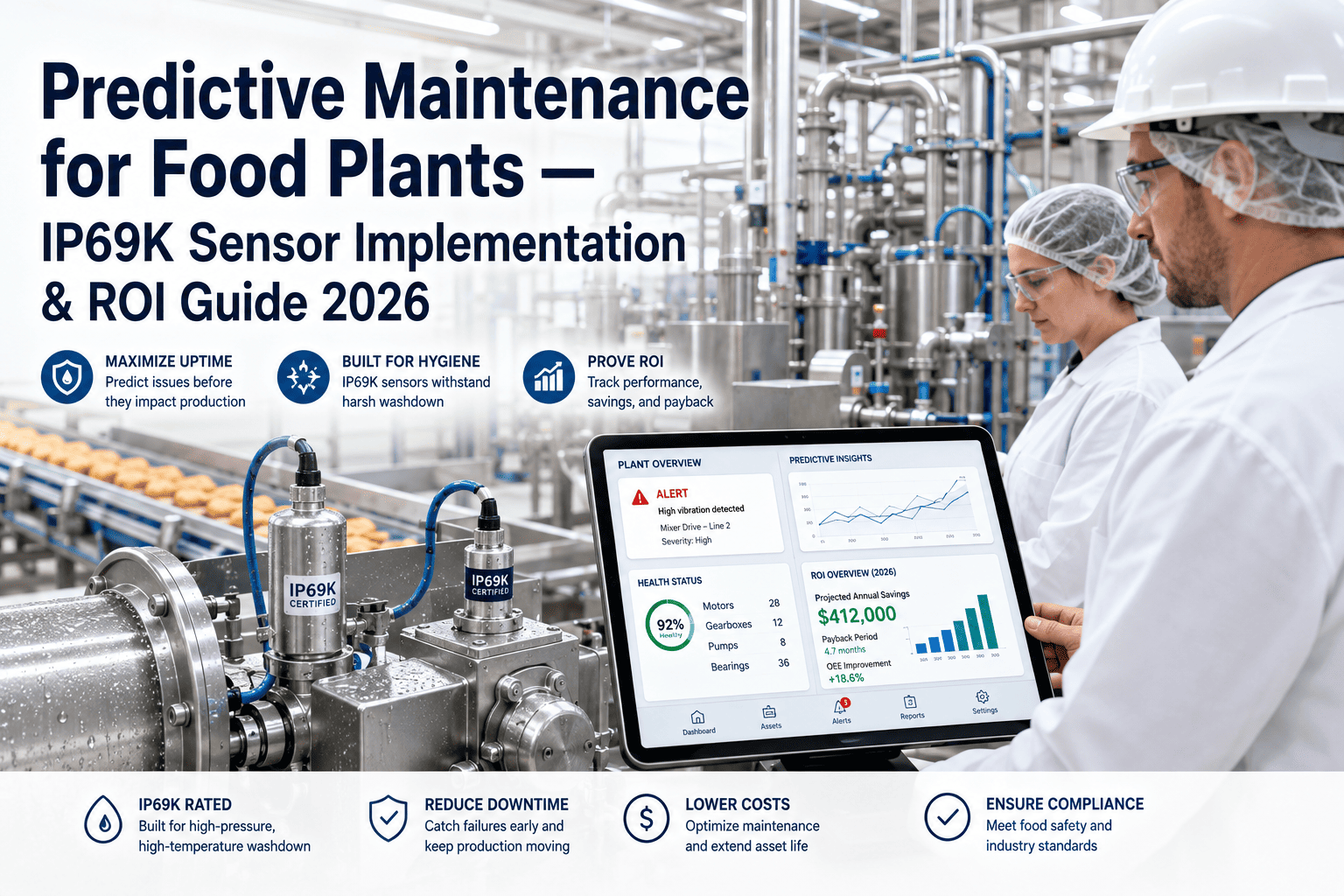
Food-grade wireless IoT sensors are installed on refrigeration compressors, conveyor drives, mixers, heat exchangers, and packaging equipment. Sensors capture vibration, temperature, pressure, current draw, and acoustic data at configurable intervals—no production interruption during installation.
02
AI Learns Your Equipment's Normal Behavior
Machine learning models build unique baselines for each individual asset in your specific operating environment—accounting for seasonal production cycles, product changeovers, CIP schedules, and ambient temperature variations that affect normal equipment signatures in food facilities.
03
Anomaly Detection and Failure Prediction
When sensor readings deviate from learned baselines, the system generates anomaly scores with predicted failure modes, estimated time to failure, and recommended actions. Alerts are graded by severity and ranked by production impact—ensuring your team focuses on the highest-cost risks first.
04
Automated Work Orders with Compliance Trail
Critical alerts automatically generate work orders in the CMMS—pre-populated with fault diagnosis, required parts, safety procedures, and assigned technician. Every action is timestamped and audit-ready, creating the documented maintenance records that FSMA, SQF, and BRC auditors require.
See It Working on Real Food Plant Data
Watch iFactory Detect a Compressor Bearing Failure 52 Days Before Shutdown
In our 30-minute demo, we walk through the full sensor-to-work-order loop using actual food manufacturing equipment data. You will see anomaly scoring, automated work order generation, the compliance documentation trail, and the real-time cost impact dashboard.
Reactive vs. Predictive Maintenance in Food Manufacturing
This comparison reflects documented outcomes from food manufacturing plants that transitioned from calendar-based or reactive maintenance programs to AI-integrated predictive platforms over a 12-month period.
Head-to-Head Performance Comparison
Performance Dimension
Reactive / Calendar-Based
AI Predictive (iFactory)
Impact
Unplanned Downtime
18–30 incidents/quarter
5–8 incidents/quarter
65% reduction
Product Spoilage Events
3–6 per year (refrigeration-related)
0–1 per year
85% reduction
Mean Time to Repair
6–14 hours average
2–4 hours average
60% faster
Emergency Parts Orders
Frequent, premium-priced
Rare, standard lead time
40% fewer orders
Maintenance Cost per Asset
Baseline (100%)
65–75% of baseline
25–35% lower
Compliance Audit Readiness
Manual records, gaps common
Automated, timestamped, complete
Audit-ready always
Equipment Lifespan
OEM recommended replacement
20–35% extended beyond OEM
Significant extension
Failure Detection Lead Time
0 days (reactive)
30–90 days advance notice
Full advance warning
Verified Results from iFactory-Powered Food Plants
These figures represent documented outcomes from food and beverage manufacturing facilities operating on iFactory's AI maintenance platform for 12 months or more.
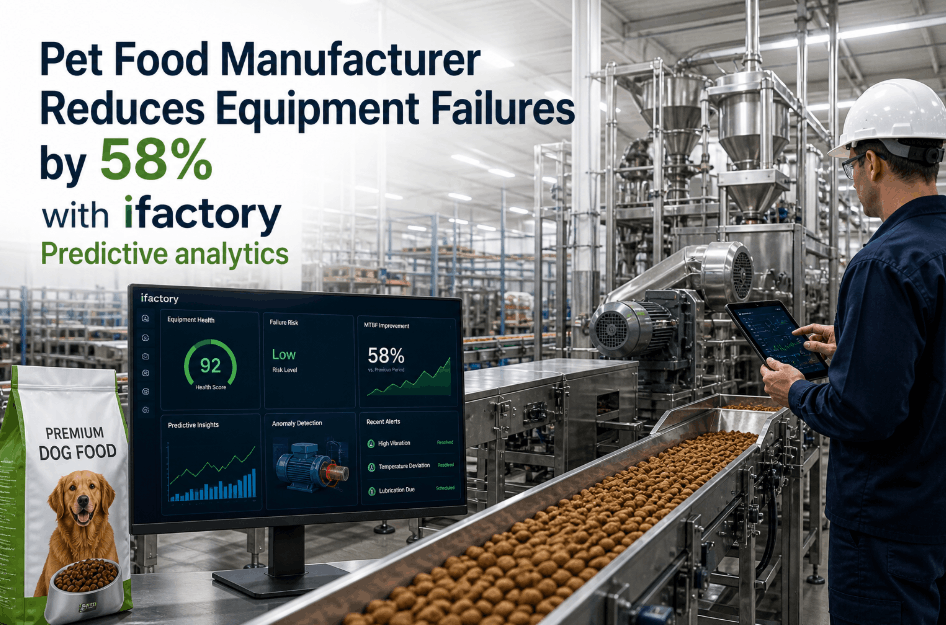
65%
Reduction in unplanned downtime incidents
30%
Total maintenance cost reduction in year one
85%
Reduction in spoilage events linked to equipment failure
40%
Fewer emergency parts procurement events
Sign up free and start generating your own measurable results. Most food plants see their first anomaly-detected savings within 30 days of sensor connection.
Food Safety Compliance Advantage
How Predictive Maintenance Strengthens Audit Readiness
FSMA, SQF, BRC, and GFSI auditors all require documented evidence that critical process equipment was maintained, calibrated, and operational during production. AI maintenance platforms generate this documentation automatically—eliminating the compliance gaps that reactive programs create.
Timestamped Maintenance Records
Every work order, sensor reading, and technician action is automatically logged with exact timestamps. Auditors see a complete, unbroken chain of maintenance activity for every CCP-related asset.
CCP Equipment Uptime Proof
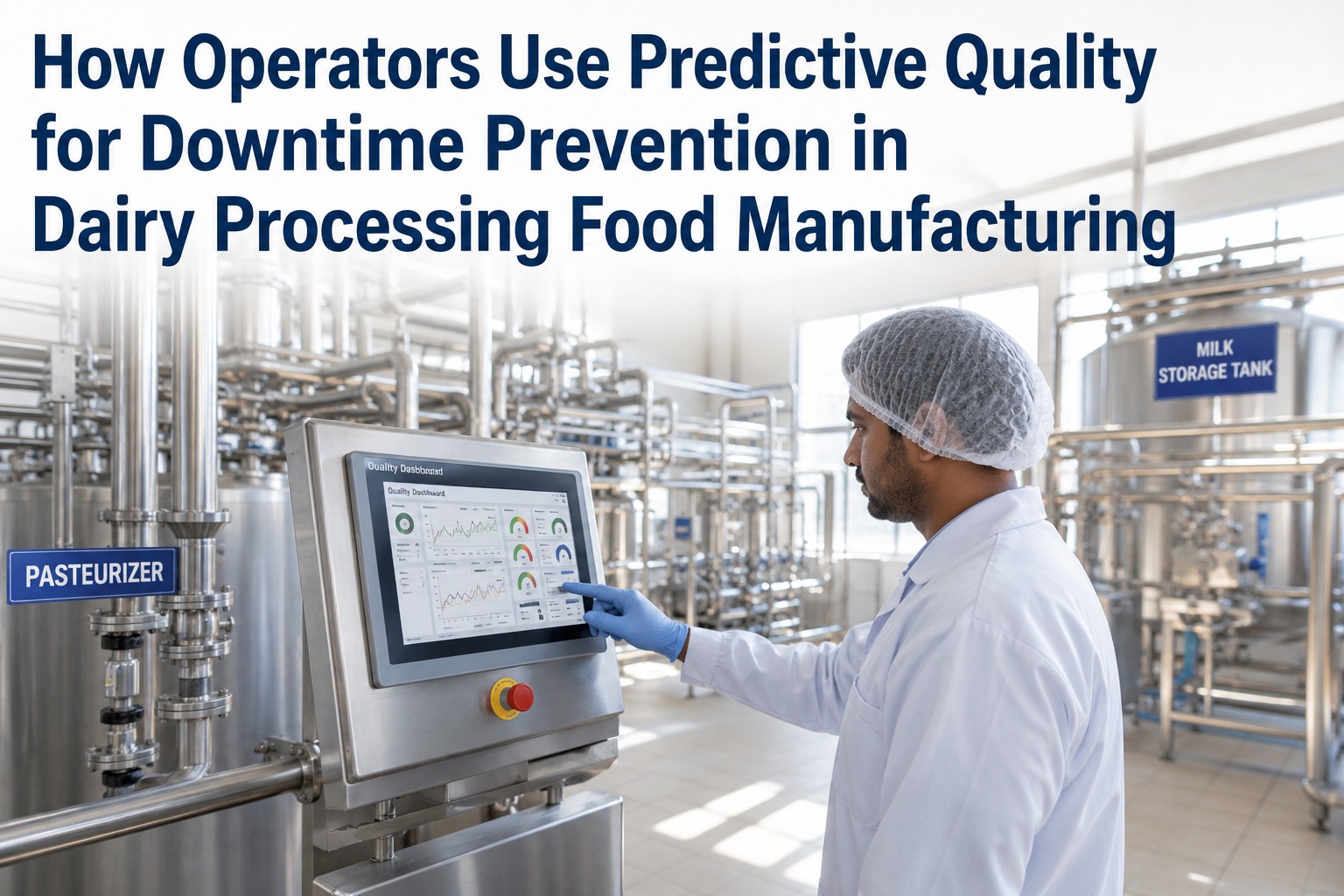
Continuous monitoring data provides documented evidence that pasteurizers, metal detectors, and temperature control systems were operational and within specification during every production run.
Calibration Tracking and Alerts
AI monitors calibration drift on weighing, temperature, and pressure instruments—alerting before readings fall outside acceptable ranges and automatically scheduling recalibration work orders.
Our biggest fear was always a refrigeration failure during a weekend production run—we had a near-miss that would have destroyed $180,000 in dairy product. After deploying iFactory on our compressors and heat exchangers, the system flagged a refrigerant leak 41 days before it would have caused a shutdown. We fixed it during a scheduled Tuesday downtime window for $4,200. The 30% maintenance cost reduction is real, but the spoilage prevention alone justified the entire platform cost.
iFactory AI Predictive Maintenance — Built for Food Manufacturing
iFactory gives food plant managers a unified AI maintenance platform that monitors refrigeration, conveyors, mixers, heat exchangers, packaging lines, and boilers—detecting failures before they cause downtime, spoilage, or compliance gaps. Connect your first assets in under 10 minutes. No rip-and-replace. No lengthy implementation.
AI anomaly detection across all connected food plant assets
Automated work orders with FSMA/SQF/BRC compliance trail
Real-time spoilage risk monitoring for cold chain assets
ROI dashboard showing cost savings from every prevented failure
How quickly does predictive maintenance start saving money in a food plant?
Most food manufacturing facilities identify their first measurable savings opportunity within 30–45 days of deploying continuous monitoring. Quick wins typically come from discovering over-maintained assets and catching early-stage refrigeration or conveyor anomalies that would have become costly failures. Sign up free and connect your highest-risk assets today to start building the baseline data that drives accurate predictions within weeks.
Will AI maintenance work with our existing food-grade equipment and sanitation protocols?
Yes. iFactory uses food-grade wireless IoT sensors that are IP67/IP69K rated and compatible with washdown environments. Sensor installation requires no modifications to existing equipment and does not interfere with CIP cycles. The platform integrates with your existing CMMS, ERP, and SCADA systems through standard API connections.
Does predictive maintenance replace our maintenance team?
No. AI predictive maintenance amplifies your team's effectiveness—it does not replace technicians. Your team gains hours back from unnecessary scheduled tasks and emergency firefighting, redirecting that time toward high-value preventive work. Most food plants report higher technician satisfaction after adoption because work becomes planned and purposeful rather than reactive and stressful.
How does this help with food safety audits specifically?
Every sensor reading, anomaly alert, work order, and technician action is automatically timestamped and stored as an audit-ready record. When SQF, BRC, or FSMA auditors ask for documentation proving that CCP equipment was maintained and operational during production, the system generates complete reports instantly—eliminating the manual record-keeping gaps that cause audit findings. Sign up to see how iFactory automates compliance documentation for your facility.
What is the minimum number of assets needed to justify the investment?
The business case depends on downtime cost per hour, not the number of assets. A single refrigeration compressor protecting $200K of perishable inventory justifies AI monitoring at almost any facility scale. Most food plants start with 3–5 critical assets (refrigeration, main conveyor drive, primary mixer) and expand as ROI is proven within the first quarter.
Can iFactory monitor cold chain temperatures for compliance alongside predictive maintenance?
Yes. iFactory integrates cold chain temperature monitoring into the same platform as equipment health monitoring. You get both real-time temperature compliance tracking and predictive alerts when refrigeration equipment is degrading—so you know about temperature risks before they become temperature violations. Book a demo to see the unified cold chain and maintenance dashboard.