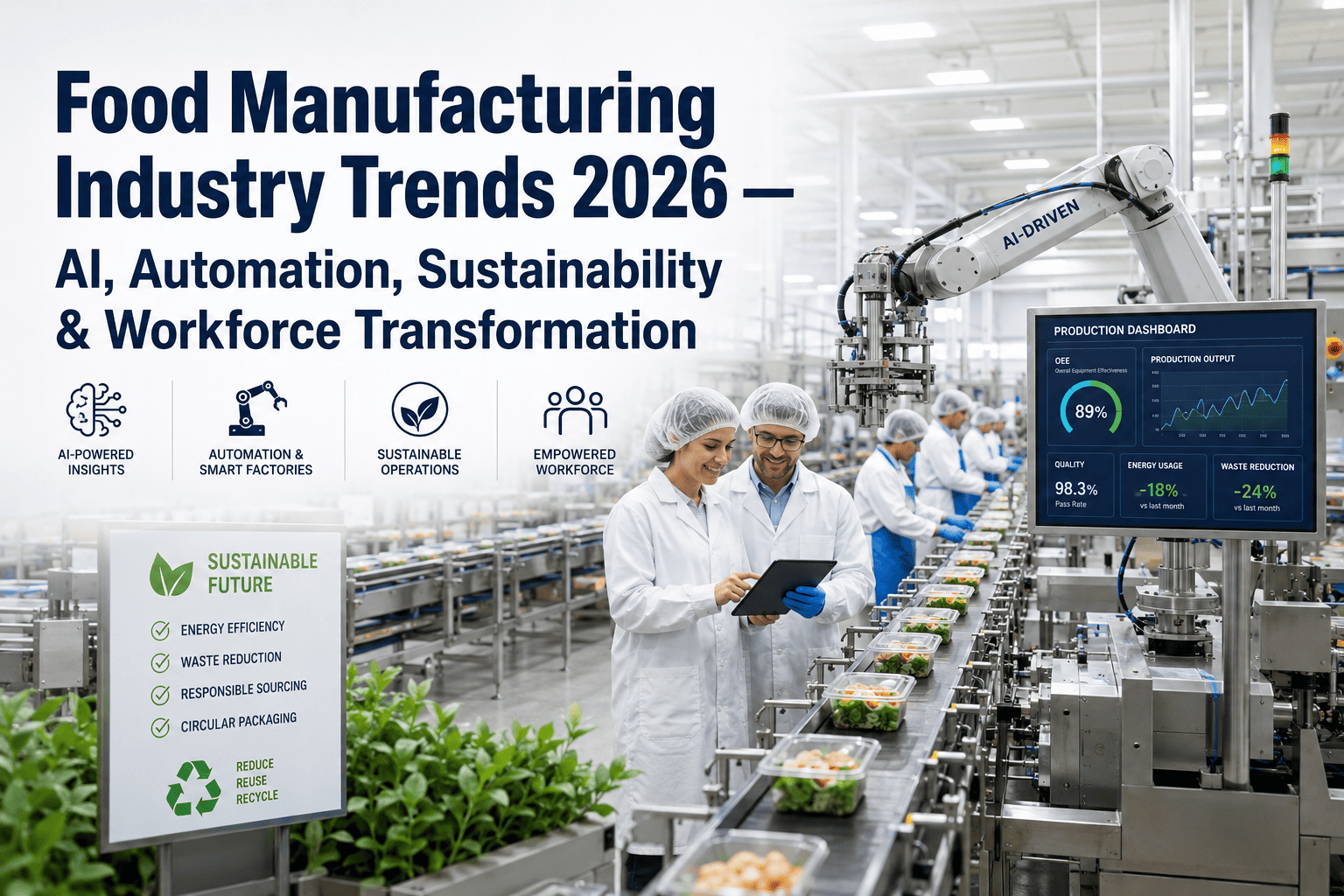
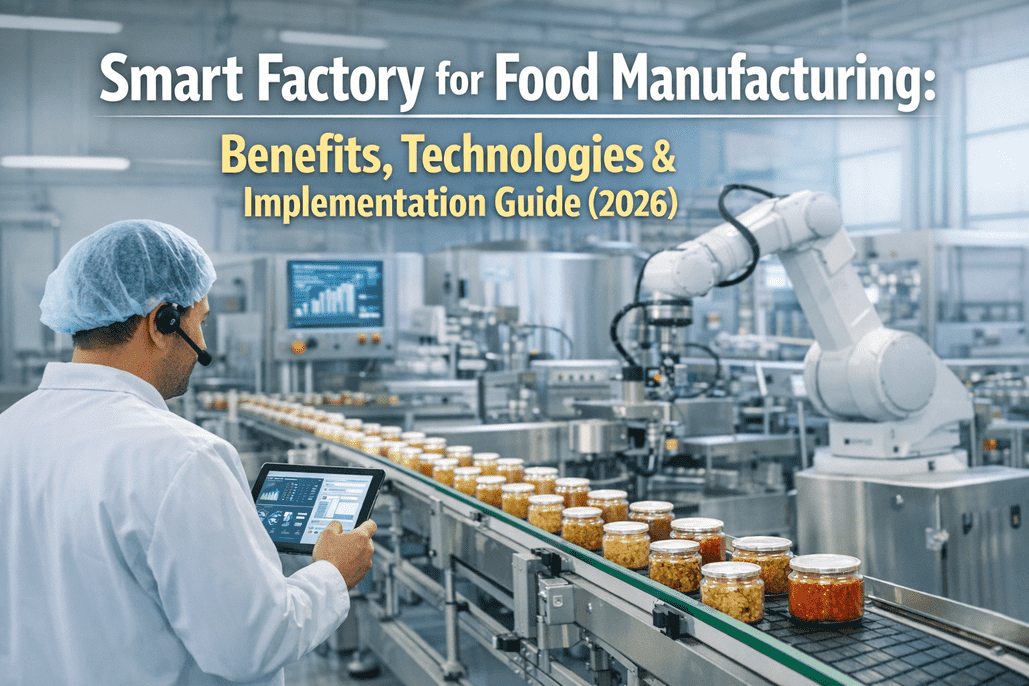
Food and beverage manufacturing trends in 2026 mark a turning point — not an upgrade. AI quality control, predictive maintenance, farm-to-fork traceability, and edge analytics have moved from pilot projects to production requirements. F&B manufacturers still running time-based PM schedules and manual inspection lines are losing ground to facilities that detect failures weeks early, generate compliance records automatically, and cut unplanned downtime by over 70%. This article breaks down the 10 trends reshaping food plant operations in 2026 — what each means, why it matters, and where to start. Book a demo to see how iFactory's AI platform positions your facility ahead of every shift covered here.
Future-Proof Your Food Plant Operations with AI
iFactory's AI-powered analytics platform gives F&B manufacturers real-time production intelligence, predictive failure detection, and automated compliance documentation — built for every trend reshaping the industry in 2026.
Why 2026 Is the Inflection Year for F&B Manufacturing
Three forces converged to make 2026 the breakpoint year. Sensor hardware costs dropped below the ROI threshold for mid-size processors. Post-pandemic downtime risk permanently raised executive tolerance for technology investment. And FDA FSMA 204 enforcement created traceability obligations that paper systems simply cannot meet. Food industry digital transformation has shifted from a competitive advantage to an operational requirement — across every facility size and product category.
Trend 1: AI-Powered Quality Control Replaces Manual Inspection
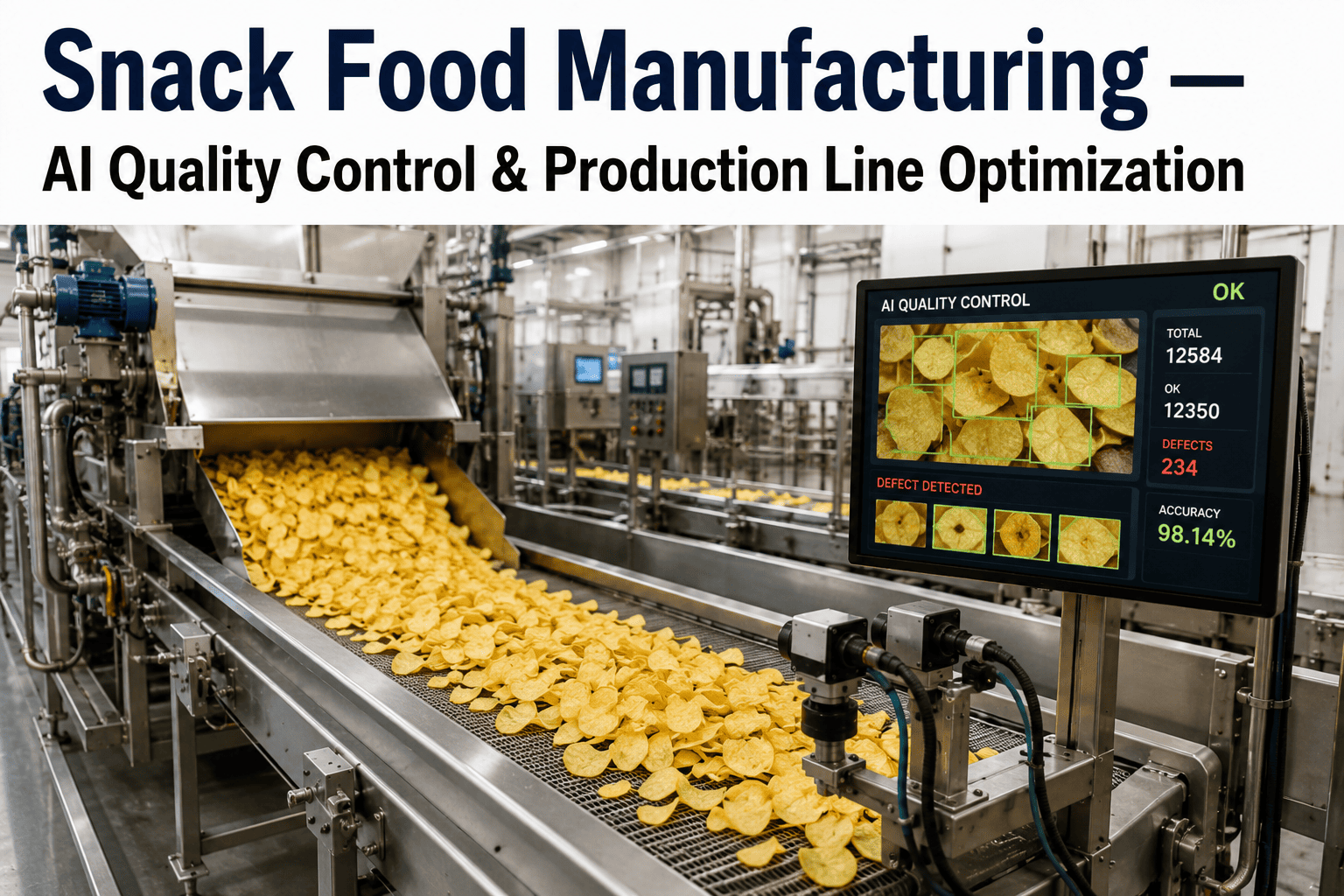
Machine vision systems now inspect 600+ units per minute with consistent accuracy that manual inspection cannot match. AI models learn continuously from defect history and connect to upstream equipment data — so rejections trigger maintenance alerts, not just line stops.
Contamination, Fill Deviation & Seal Failures
AI vision catches contamination, under-fill, label misalignment, and seal integrity failures at full line speed — defects that sampling-based manual inspection routinely misses until defect rates become statistically significant.
Quality Events Linked to Equipment Wear
iFactory correlates quality rejection spikes with filling machine actuator wear signatures 2–4 weeks before failure — turning inspection data into predictive maintenance intelligence. Book a demo to see this in action.
Trend 2: Predictive Maintenance Becomes the F&B Standard
Condition-based predictive analytics is crossing from early adopter to mainstream in 2026. Vibration sensors, current transformers, and cloud ML models now cost less than one hour of unplanned downtime per year. Plants using predictive maintenance schedule interventions during planned changeovers — eliminating the emergency repair premium and batch loss that define reactive operations. The 2026 gap isn't whether to deploy — it's how deeply to integrate failure predictions into scheduling, ERP, and compliance workflows.
Trend 3: Smart Sanitation and CIP Optimization
CIP failures are invisible until microbial testing or audit surfaces them — by which point product safety is already at risk. Smart sanitation systems catch degradation before it becomes a compliance event, and optimize cycles to cut resource waste simultaneously.
Every Cleaning Cycle Documented Automatically
Pressure, flow, and conductivity sensors validate CIP performance in real time and generate tamper-resistant hygiene records for every cycle — audit-ready without manual logbook entries or technician sign-offs.
18–25% Reduction in Water & Chemical Use
AI models identify over-specified cleaning cycles consuming excess water and chemistry without hygiene benefit — cutting CIP resource costs by 18–25% while maintaining full sanitation compliance across every production run.
CIP Pump & Nozzle Failures Caught Before They Occur
iFactory's analytics detect CIP pump degradation and nozzle blockage patterns weeks before they compromise sanitation performance — eliminating the silent failures that only surface during microbial testing or regulatory audit.
Sanitation Records Ready for FDA & BRC Audit
Every CIP event produces a structured, timestamped compliance record — chemical dosing accuracy, flow rate confirmation, cycle duration — satisfying FDA, BRC, and SQF sanitation documentation requirements automatically. Book a demo to see the output format.
Trend 4: Digital Twins Enable Virtual Plant Operations
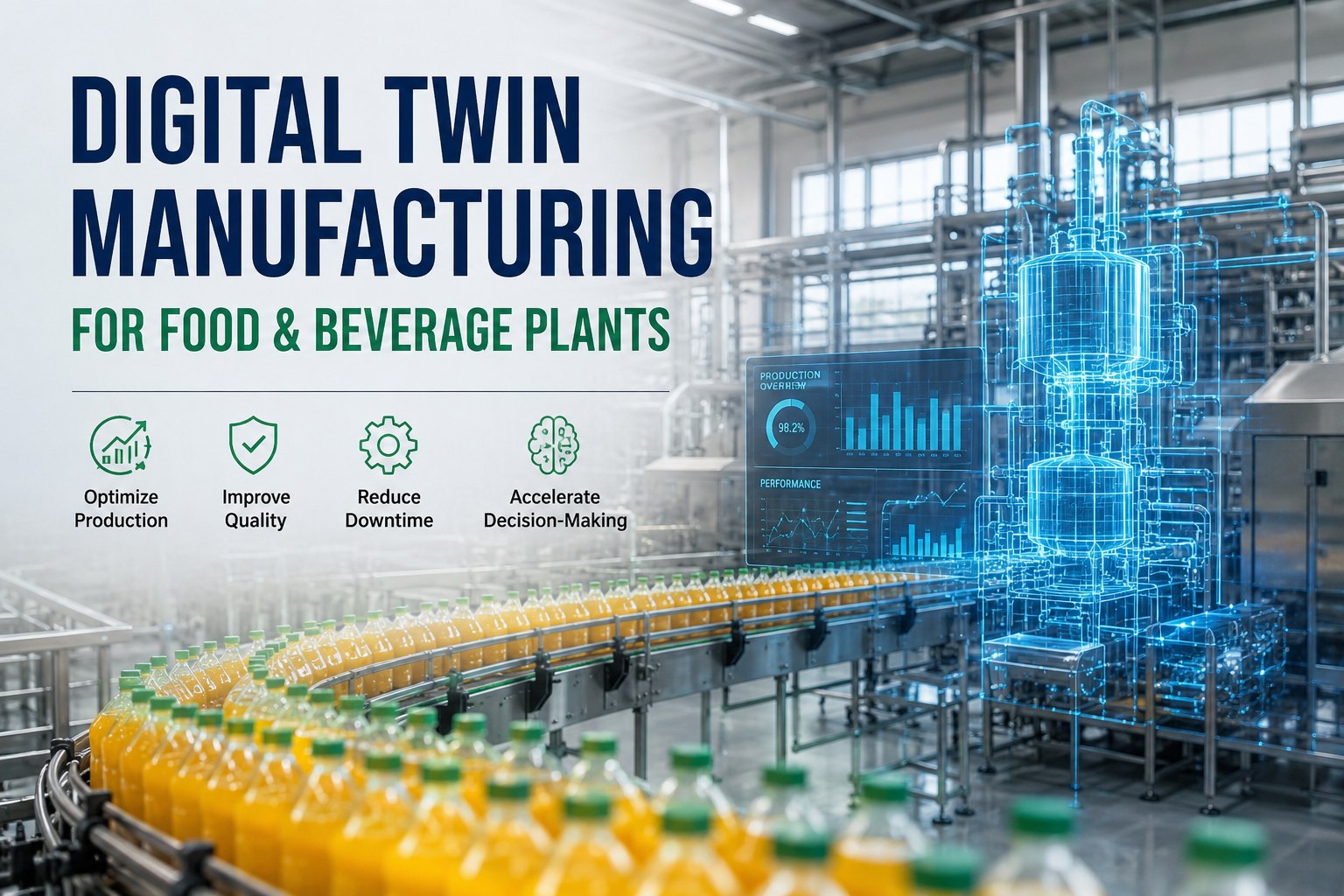
Digital twins — virtual replicas built from live sensor data and equipment history — let engineers simulate changeovers and maintenance scenarios before committing production capacity. For capital planning, they provide continuous remaining useful life projections for every asset, replacing end-of-year surprise replacement requests with data-driven multi-year forecasts. Book a demo to see how iFactory's asset health data powers digital twin deployments at your facility.
Trend 5: Collaborative Robotics on the Processing Floor
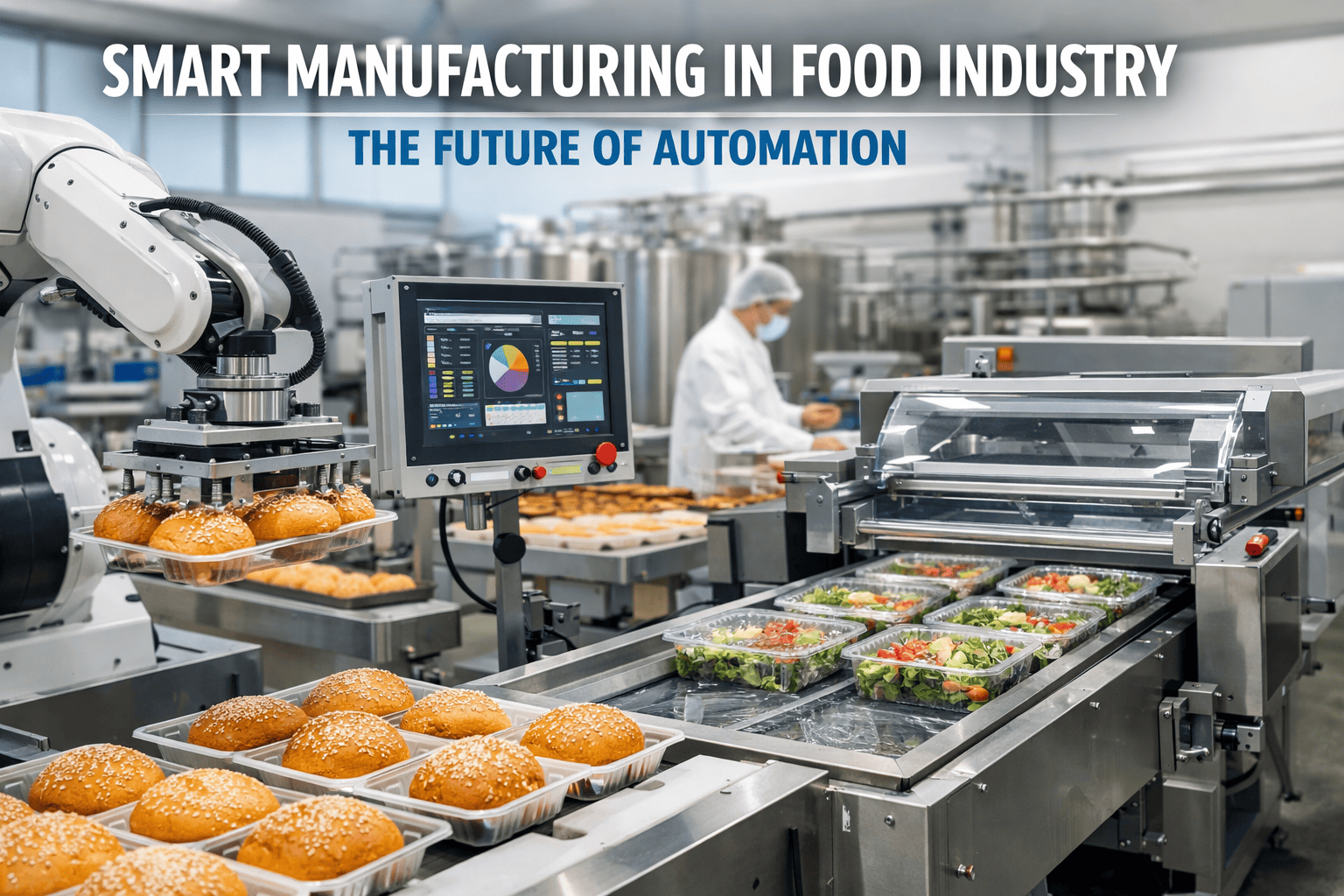
2026's cobot generation operates alongside workers in shared spaces — no safety caging required — with IP69K washdown ratings designed for food environments. Deployments are accelerating across palletizing, case packing, and portion cutting. As robotics fleets grow, predictive maintenance for joint wear and actuator performance becomes essential. iFactory's analytics extend naturally to cobot drive systems, tracking torque anomalies before throughput is affected.
Trend 6: Farm-to-Fork Traceability Under FSMA 204
FDA FSMA 204 mandates lot-level traceability records producible within 24 hours of request — a timeline paper systems cannot meet. Blockchain traceability platforms link ingredient lots, processing records, and distribution data into a single auditable environment. The competitive requirement in 2026 is instant lot isolation: executing a targeted recall in hours, not days. Equipment maintenance records from platforms like iFactory feed directly into traceability documentation as part of the same data flow.
Trend 7: Energy Intelligence and ESG Reporting
Refrigeration degradation, HVAC inefficiency, and compressed air leaks account for 20–35% of controllable energy waste in most food plants — invisible without equipment-level metering. AI analytics platforms that correlate asset health with energy draw identify the maintenance interventions that cut utility costs and advance Scope 1/Scope 2 carbon reporting simultaneously. iFactory customers report 12–22% utility cost reductions in year one — as a byproduct of standard predictive maintenance operations.
Trend 8: Edge AI for Real-Time Process Control
Cloud-dependent analytics have a hard limit: network latency makes them unsuitable for millisecond process control. Edge AI eliminates that constraint — running models on-premise, at line speed, with or without network connectivity.
Line-Speed Inference, Zero Latency
Vibration analysis, thermal monitoring, and quality inspection run locally on edge processors co-located with equipment — generating failure alerts and control signals in milliseconds, regardless of network status or cloud availability.
Edge Processing + Cloud Sync
iFactory's edge layer handles real-time detection locally while syncing to the cloud for analytics, compliance documentation, and cross-facility benchmarking — giving plants the speed of edge with the intelligence of cloud.
Trend 9: Workforce Intelligence and AI-Assisted Maintenance
Experienced maintenance technicians are retiring faster than replacement pipelines can develop their expertise. Workforce intelligence platforms close the gap by delivering fault diagnosis support, repair procedures, and parts identification to technicians' mobile devices in the field. When a pasteurizer vibration alert fires at 2 AM, the on-call tech receives AI-generated fault interpretation, asset repair history, and storeroom parts availability — compressing what previously required a senior engineer. Book a demo to see iFactory's technician mobile experience in action.
Trend 10: Automated HACCP Compliance Documentation
Manual HACCP logbooks are slow, error-prone, and impossible to retrieve at audit speed. AI analytics platforms generate every required compliance record automatically — as a byproduct of the same operations that prevent equipment failures.
Timestamped CCP Logs, Zero Manual Entry
Every sensor reading, alert event, work order, and corrective action is timestamped and stored in tamper-resistant format — ready for FDA, USDA, BRC, or SQF audit retrieval without compiling a single spreadsheet or logbook.
Continuous Evidence Trail for Enforcement Defense
The unbroken documentation chain iFactory produces doesn't just satisfy audit requirements — it provides the continuous oversight evidence required to defend against regulatory enforcement actions and product liability claims.
FDA, USDA, BRC & SQF — One Platform
iFactory's compliance documentation engine is configured for multiple regulatory frameworks simultaneously — so facilities operating under FDA, USDA, and retailer BRC or SQF obligations produce all required records from a single integrated workflow.
Full Corrective Action History, Instantly Retrievable
Every corrective action — from alert generation to work order completion — is linked, searchable, and retrievable in seconds. Audit preparation that previously took days of manual compilation is reduced to a single report export. Book a demo to see the compliance output format.
F&B Manufacturing Trends 2026: At a Glance
The table below summarizes adoption stage, primary benefit, and investment priority for each trend — a quick-reference prioritization framework for your 2026 technology roadmap.
| Technology Trend | 2026 Adoption Stage | Primary Benefit | Priority |
|---|---|---|---|
| AI Quality Control | Mainstream | Defect reduction, recall risk elimination | High |
| Predictive Maintenance | Mainstream | Downtime elimination, maintenance cost reduction | Critical |
| Smart CIP / Sanitation | Early Mainstream | Hygiene assurance, water/chemical savings | High |
| Digital Twins | Early Mainstream | Capital planning, process optimization | Medium-High |
| Collaborative Robotics | Growth Phase | Labor productivity, throughput consistency | Medium |
| Farm-to-Fork Traceability | Compliance-Driven | Recall speed, FSMA 204 compliance | Critical |
| Energy Intelligence | Growth Phase | Utility cost reduction, ESG reporting | Medium-High |
| Edge AI Processing | Early Mainstream | Real-time control, network independence | Medium |
| Workforce Intelligence | Growth Phase | Technician effectiveness, knowledge retention | Medium |
| HACCP Compliance Automation | Mainstream | Audit readiness, documentation integrity | Critical |
Building Your F&B Technology Roadmap for 2026
Sequence matters more than speed. Start with technologies that carry the highest consequence per failure: predictive analytics on CCP equipment, HACCP automation, and AI quality control on primary lines. These deliver compliance value, downtime ROI, and quality risk reduction together — funding the digital twin, robotics, and traceability expansions that follow. The key architectural decision is whether to build on a unified platform or stitch together point solutions. Siloed systems create the appearance of digital transformation while preserving the operational fragmentation that technology is meant to solve. Book a demo to walk through your facility's roadmap with an iFactory solution architect.
See Every Trend in Action Across Your Facility
From AI quality control to HACCP compliance automation — iFactory unifies every F&B manufacturing technology trend into a single operational intelligence platform. Get a live walkthrough tailored to your production environment.
Frequently Asked Questions
What is the top F&B manufacturing technology priority for 2026?
Predictive maintenance and HACCP compliance automation — they share the same sensor infrastructure, so a single deployment delivers both downtime ROI and audit-ready documentation from day one.
How does AI quality control differ from rule-based inspection systems?
Rule-based systems trigger on fixed thresholds. AI quality control learns from defect history, detects complex multi-parameter patterns, and connects to upstream equipment data to predict quality deviations before they become rejections.
What does FSMA 204 require from food manufacturers?
Covered facilities must maintain Key Data Elements for high-risk foods at every Critical Tracking Event, with records producible within 24 hours of an FDA request — a requirement only technology-enabled traceability systems can meet consistently.
How quickly can predictive maintenance go live in a food plant?
iFactory deployments on priority equipment typically go live within 4–8 weeks using non-invasive clamp-on sensors — no production downtime required during installation.
What ROI should F&B manufacturers expect from Industry 4.0 adoption?
Predictive maintenance delivers 4–6x return on platform cost through avoided downtime. For high-value products or elevated recall risk, a single prevented failure event often covers the full annual platform cost.
Position Your Plant at the Leading Edge of F&B Manufacturing in 2026
iFactory's AI-powered analytics platform gives food and beverage manufacturers the predictive maintenance intelligence, HACCP compliance automation, and real-time production visibility to lead every technology trend reshaping the industry — with measurable ROI from the first quarter of deployment.