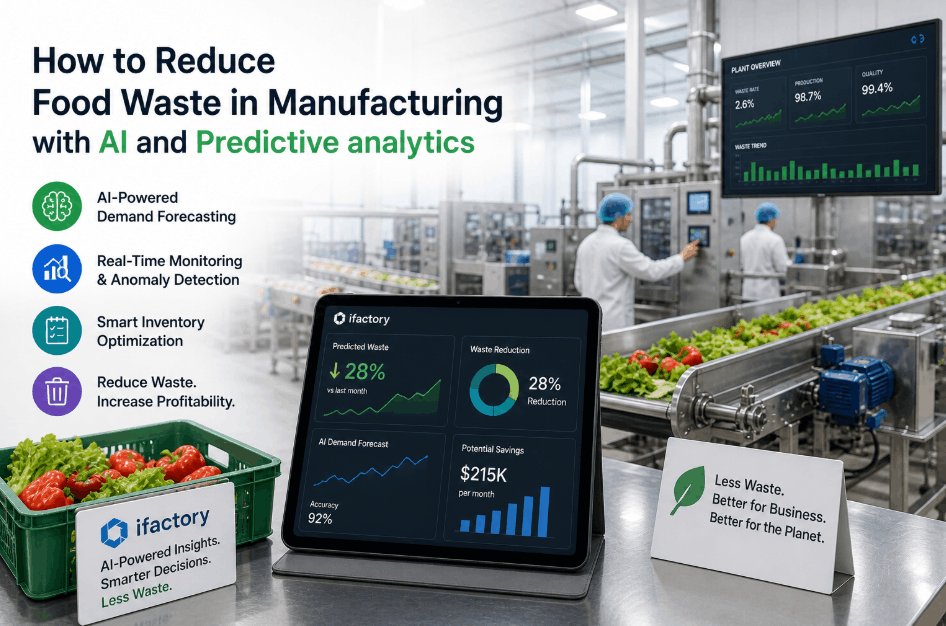
Food manufacturers lose billions annually to preventable waste — spoiled batches, equipment-driven overproduction, and inefficient processes that drain both resources and profitability. In 2026, reducing food waste in manufacturing has become a top-tier sustainability mandate, with AI and predictive analytics emerging as the most powerful tools available to operations leaders and sustainability managers. This guide explores exactly how AI-driven technologies identify waste sources, prevent spoilage before it starts, and deliver measurable reductions across every stage of the production cycle.
See How AI Reduces Food Manufacturing Waste
iFactory's manufacturing intelligence platform uses predictive analytics and real-time IoT monitoring to prevent batch failures, minimize spoilage, and deliver measurable sustainability outcomes for food manufacturers.
The True Cost of Food Waste in Manufacturing Operations
Food waste in manufacturing is not simply a disposal problem — it is a compounding operational loss that affects raw material costs, energy consumption, labor hours, and regulatory standing simultaneously. Studies across the food and beverage sector consistently show that 30–40% of total production waste originates from equipment failures, suboptimal process conditions, and scheduling inefficiencies that AI-driven systems are specifically designed to eliminate. For sustainability managers under pressure to report measurable ESG outcomes, AI food waste reduction offers a data-backed path to documented progress. Book a Demo to see how predictive analytics maps to your facility's specific waste profile.
The challenge is that traditional waste tracking methods — manual logs, end-of-shift summaries, and periodic audits — capture waste after it has already occurred. By contrast, predictive analytics for food waste continuously monitors the conditions that generate waste and intervenes before spoilage, over-processing, or batch failure becomes inevitable. This shift from reactive documentation to proactive prevention is the foundational advantage AI delivers.
How Predictive Analytics Prevents Food Spoilage from Equipment Failures
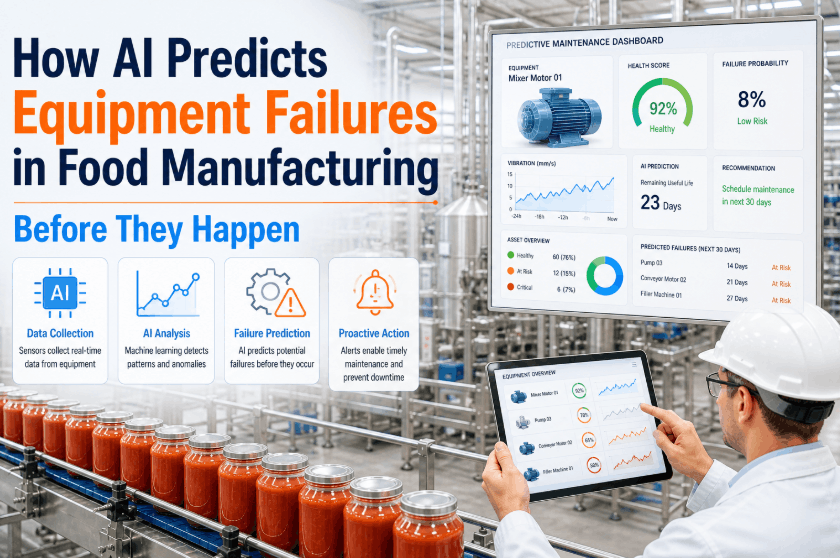
Equipment failure is the leading cause of unplanned food spoilage in manufacturing environments. A failing refrigeration compressor that goes undetected overnight can render an entire cold storage inventory non-compliant. A conveyor drive degrading toward failure mid-run can contaminate or overheat in-process product. Predictive analytics for food spoilage prevention closes this gap by deploying industrial IoT sensors that continuously monitor temperature variance, vibration signatures, electrical draw, and pressure differentials across all critical assets — feeding real-time data into machine learning models that identify failure trajectories hours or days before they result in product loss.
Cold Chain Integrity Monitoring
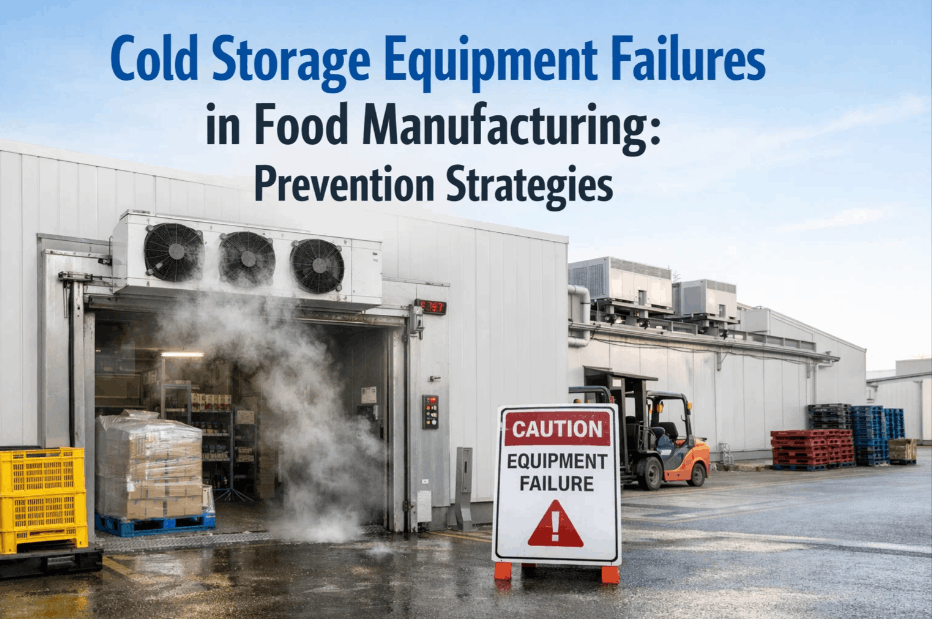
AI-driven temperature monitoring systems track refrigeration unit health in real time, predicting compressor degradation before thermal excursions occur. When anomalies are detected, automated alerts trigger immediate maintenance dispatch and initiate product protection protocols — preventing spoilage losses that can exceed tens of thousands of dollars per incident in high-volume dairy, meat, and fresh produce operations.
Process Temperature and Pressure Deviation Detection
Pasteurizers, retorts, and thermal processing equipment operating outside specification parameters generate non-conforming product that must be destroyed or reworked. Predictive analytics platforms continuously compare process sensor data against validated baseline ranges, flagging micro-deviations before they reach threshold limits — enabling corrective action within the batch window rather than after product destruction.
Filling and Portioning Accuracy Optimization
Filling machine wear and calibration drift cause systematic over-fill or under-fill conditions that generate significant ingredient waste over high-volume runs. AI monitoring detects the performance degradation signatures associated with filling head wear, triggering precision recalibration work orders before cumulative overfill losses accumulate — a high-return application of AI-driven waste tracking in portioning-intensive facilities.
CIP and Sanitation Cycle Optimization
Inefficient clean-in-place cycles waste water, chemicals, and energy while also consuming production time. Predictive analytics platforms optimize CIP scheduling based on actual soil load data and contamination risk models — running cleaning cycles that are precisely as long as necessary rather than defaulting to conservative fixed intervals that over-process and over-consume.
AI-Driven Batch Failure Prevention: Stopping Waste at the Source
Batch failures represent some of the highest-impact waste events in food manufacturing — destroying hours of production labor, raw materials, and energy in a single incident. Batch failure prevention with AI works by continuously analyzing the multivariate process conditions that historically precede failures: ingredient ratio deviations, mixing time anomalies, temperature profile non-conformances, and equipment performance degradation within the batch window. Machine learning models trained on historical batch outcome data generate real-time conformance scores throughout each production run, alerting operators to deteriorating conditions while correction is still possible. Book a Demo to see how AI batch monitoring integrates with your existing quality management workflow.
For sustainability managers, the documentation value of AI batch monitoring extends beyond waste prevention: every batch receives a full process data record that supports waste reduction reporting, regulatory compliance, and continuous improvement analysis. This makes sustainable food manufacturing commitments auditable and defensible to both regulators and ESG reporting stakeholders.
AI vs. Traditional Waste Management: A Performance Comparison
| Waste Category | Traditional Approach | AI Predictive Analytics | Reduction Impact |
|---|---|---|---|
| Spoilage from Equipment Failure | Reactive response after failure | Predictive failure avoidance | Up to 70% reduction in spoilage events |
| Batch Failures and Rework | End-of-batch quality check | Real-time in-process conformance scoring | 40–55% reduction in failed batches |
| Overproduction Waste | Fixed production schedules | Demand-aligned dynamic scheduling | 20–30% reduction in overproduction |
| CIP and Utility Waste | Fixed-interval cleaning cycles | Soil-load optimized cycle scheduling | 25–35% reduction in cleaning resource consumption |
| Ingredient Over-Use | Manual portioning calibration | Continuous fill accuracy monitoring | 15–25% reduction in ingredient give-away |
| Waste Tracking Accuracy | Manual log-based reporting | Automated sensor-driven waste analytics | Full audit-ready waste data in real time |
Production Waste Reduction Through Smart Scheduling and Demand Alignment
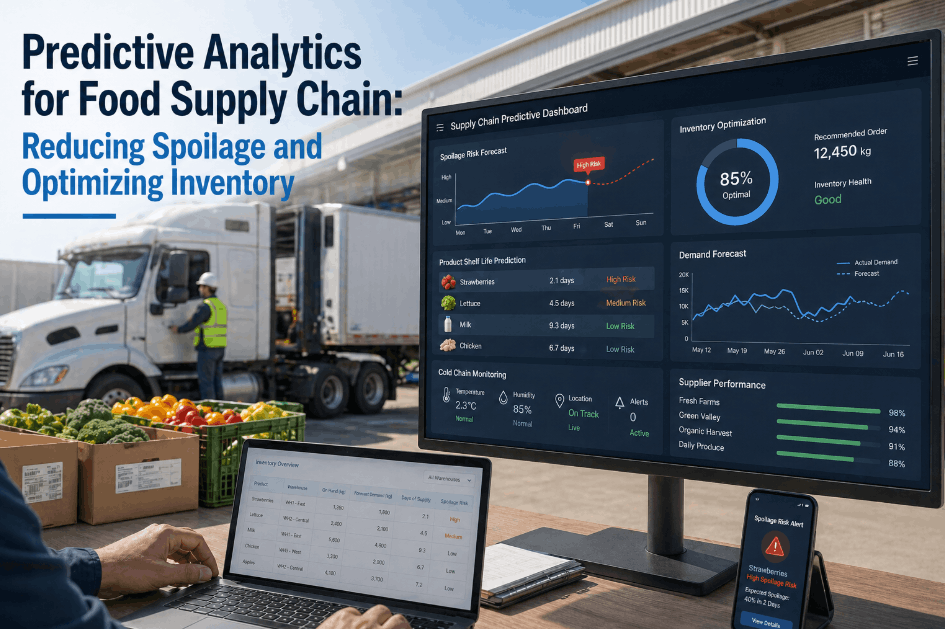
Overproduction is one of the most persistent and underreported waste categories in food manufacturing. When production schedules are built on static forecasts rather than real-time demand signals, facilities routinely produce more than distribution channels can absorb within product shelf-life windows — generating finished goods waste that inflates disposal costs and undermines sustainability targets. AI production scheduling addresses overproduction waste by continuously reconciling production sequences with live order data, inventory levels, and shelf-life constraints to generate demand-aligned schedules that minimize end-of-life product exposure. Book a Demo to evaluate AI scheduling impact on your overproduction waste categories.
Changeover waste is another significant production-stage loss point that AI scheduling directly addresses. By optimizing run sequencing to cluster compatible products, minimize allergen changeover requirements, and reduce transition cleaning time, sustainable food manufacturing AI platforms reduce the ingredient and time losses associated with every production line transition — gains that accumulate significantly across high-SKU facilities running multiple changeovers per shift.
Waste Analytics for Food Manufacturing: Building a Data-Driven Sustainability Strategy
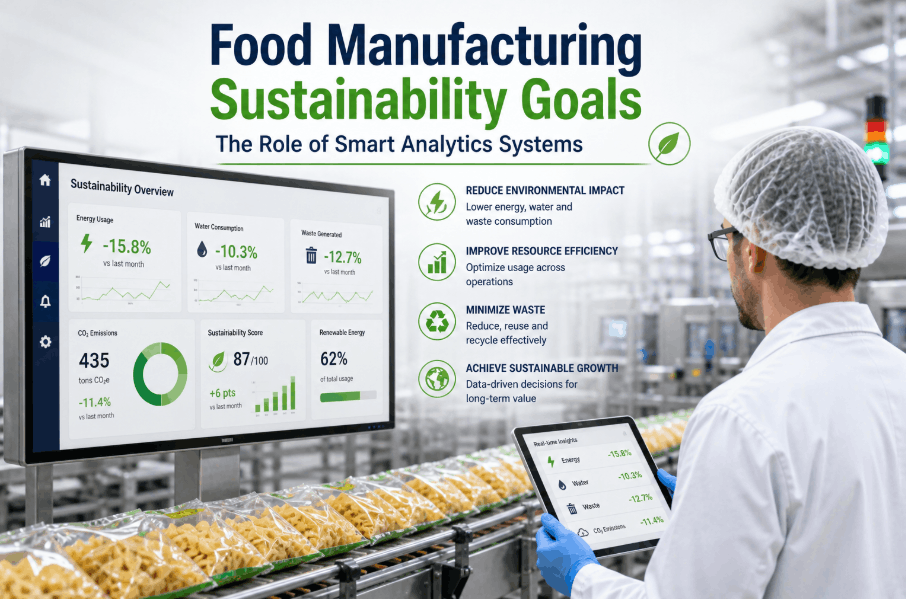
Effective sustainability management requires more than waste prevention — it requires measurement, attribution, and trend analysis that connects waste events to their operational root causes. Modern waste analytics platforms for food manufacturing provide sustainability managers with a real-time operational waste dashboard that quantifies waste by category, production line, shift, product SKU, and equipment asset — enabling targeted improvement initiatives that address highest-impact waste sources first rather than applying generic operational changes across the facility.
Real-Time Waste Event Attribution
Every waste event — spoilage, rework, over-fill, batch failure — is automatically linked to the specific equipment condition, process deviation, or scheduling decision that caused it. This attribution data powers root cause analysis and continuous improvement cycles that progressively reduce waste generation across the facility.
Sustainability KPI Dashboards
AI analytics platforms surface waste reduction KPIs — waste intensity per unit produced, waste cost per SKU, spoilage rate by line — in real-time dashboards accessible to sustainability managers, operations directors, and executive stakeholders. These dashboards support ESG reporting, regulatory submissions, and internal sustainability target tracking without manual data assembly.
Predictive Waste Trend Modeling
Machine learning models identify emerging waste generation patterns before they become chronic problems — flagging equipment whose degradation trajectory predicts increasing spoilage risk, or production sequences whose complexity generates systematically higher rework rates. Predictive trend modeling enables sustainability managers to intervene upstream rather than managing waste downstream.
Regulatory and ESG Documentation Automation
AI-driven waste tracking platforms automatically generate the documentation sustainability teams need for regulatory compliance, customer audits, and ESG disclosures — capturing waste volumes, disposal records, and reduction initiative outcomes in audit-ready formats that eliminate the manual reporting burden associated with traditional waste management programs.
Implementing AI Waste Reduction: A Phased Roadmap for Sustainability Managers
Deploying AI-driven waste reduction capabilities in food manufacturing follows a structured implementation pathway that delivers measurable sustainability improvements at each phase while building toward comprehensive food manufacturing sustainability AI maturity. Understanding the implementation journey helps sustainability managers align project expectations with operational timelines and investment parameters. Book a Demo to receive a custom implementation roadmap for your facility.
Waste Baseline Assessment and IoT Sensor Deployment
Begin by establishing a data-driven waste baseline: quantifying current waste by category, production line, and equipment asset. Deploy industrial IoT sensors on highest-criticality assets — refrigeration systems, thermal processing equipment, filling lines — and initiate the data collection pipeline that feeds AI predictive models. A 60–90 day baseline period establishes the performance benchmarks against which all subsequent waste reduction improvements are measured.
Predictive Spoilage Prevention Activation
Activate AI failure prediction models for monitored assets, integrating predictive maintenance outputs into equipment service workflows. Cold chain monitoring, process deviation detection, and filling accuracy monitoring go live during this phase — delivering the first measurable spoilage reduction results within 60–90 days of model activation. Most facilities report significant reductions in unplanned spoilage events within the first quarter of full operation.
Batch Monitoring and Production Scheduling Integration
Connect real-time batch conformance monitoring to the production scheduling engine, enabling AI to automatically adjust in-progress batch parameters, reschedule high-risk runs, and optimize changeover sequences for minimum waste generation. Integration with the manufacturing execution system creates a closed-loop waste prevention capability that continuously improves as AI models accumulate facility-specific production data.
Waste Analytics Platform and Continuous Improvement Loop
Activate the full waste analytics dashboard and sustainability reporting layer — connecting real-time waste attribution data to ESG reporting workflows, regulatory documentation systems, and continuous improvement programs. AI models continue retraining on accumulated operational data, progressively refining waste prediction accuracy and identifying new reduction opportunities as the facility's operational fingerprint becomes more precisely characterized.
Measuring ROI from AI Food Waste Reduction Programs
Quantifying the financial return on AI waste reduction investment is essential for securing ongoing sustainability program funding and demonstrating operational value to executive stakeholders. The ROI framework for AI food waste reduction programs should track both direct waste cost avoidance and indirect operational improvements that compound over time.
Frequently Asked Questions: AI and Predictive Analytics for Food Waste Reduction
How does AI reduce food waste in manufacturing compared to traditional methods?
Traditional methods track waste after it occurs through manual logs and periodic audits. AI prevents waste by continuously monitoring equipment health, process conditions, and production parameters in real time — identifying deteriorating conditions and triggering corrective actions before spoilage, batch failures, or overproduction waste events happen. This shifts waste management from documentation to prevention.
What types of food manufacturing waste does predictive analytics address most effectively?
Predictive analytics delivers the highest impact on equipment-driven spoilage, batch failures from process deviations, cold chain integrity losses, and filling accuracy-related ingredient give-away. These categories share a common characteristic — they are generated by detectable equipment or process conditions that AI models can identify and flag before waste occurs.
Can AI food waste reduction platforms integrate with existing ERP and quality management systems?
Yes. Modern AI waste analytics platforms provide pre-built API integrations with major ERP systems including SAP, Oracle, and Microsoft Dynamics, as well as CMMS and quality management platforms. This integration creates a unified operational data layer that connects waste events to their production, maintenance, and scheduling root causes without requiring system consolidation.
How long does it take to see measurable food waste reduction results from AI deployment?
Most food manufacturers report first measurable reductions in spoilage and batch failure rates within 60–90 days of AI predictive model activation. Broader waste reduction benefits — including overproduction reduction and scheduling optimization gains — typically materialize within 6–12 months as AI models accumulate facility-specific production data and scheduling intelligence matures.
How does AI-driven waste tracking support ESG and sustainability reporting requirements?
AI waste analytics platforms automatically capture and categorize waste data in audit-ready formats that map directly to ESG disclosure frameworks. Sustainability managers receive real-time dashboards tracking waste intensity, reduction progress, and disposal records — eliminating the manual data assembly burden and ensuring sustainability reports reflect accurate, sensor-validated operational data rather than estimates.
Is AI food waste reduction technology suitable for facilities with older legacy equipment?
Yes. Modern industrial IoT platforms address legacy equipment connectivity through retrofit sensor packages — vibration, temperature, current, and acoustic sensors that attach externally to non-connected equipment and transmit condition data wirelessly. This approach extends AI waste prevention capabilities across the full asset portfolio without requiring capital equipment replacement or production disruption.
What is the difference between predictive maintenance and preventive maintenance in the context of food waste reduction?
Preventive maintenance services equipment on fixed calendar intervals regardless of actual condition — meaning equipment that is still healthy gets serviced unnecessarily while equipment degrading between intervals may still cause spoilage events. Predictive maintenance uses real-time sensor data and machine learning to forecast remaining useful life, scheduling interventions precisely when degradation data indicates risk — directly preventing the equipment-driven spoilage events that preventive maintenance misses.
Ready to Build a Data-Driven Food Waste Reduction Program?
From predictive spoilage prevention and batch failure monitoring to AI-driven waste analytics and ESG reporting automation — iFactory delivers a unified manufacturing intelligence platform purpose-built for food manufacturers committed to measurable sustainability outcomes.