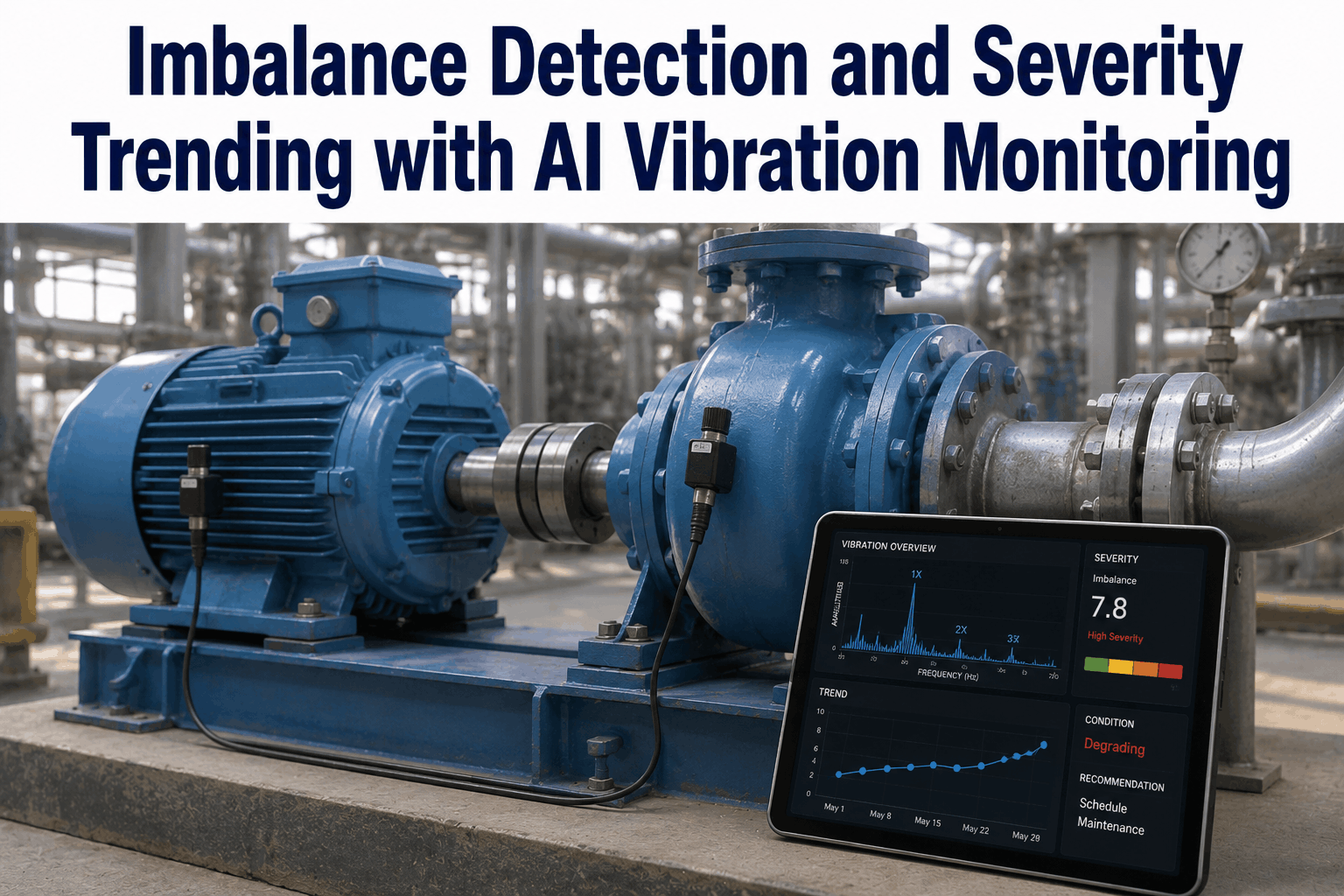
Mechanical imbalance is the most common fault condition in rotating machinery and the one most frequently misdiagnosed as bearing wear, misalignment, or resonance — because the vibration signatures of these conditions overlap in the frequency domain and a single snapshot spectrum rarely distinguishes between them cleanly. AI vibration monitoring resolves this ambiguity by tracking the 1X running speed amplitude and phase across consecutive measurement cycles, identifying the characteristic pattern of true mass imbalance against the background of other fault types, and trending severity over time so maintenance teams know not just that imbalance is present but whether it is stable, slowly worsening, or accelerating toward a corrective balance threshold. Talk to an Expert to see how iFactory deploys AI imbalance detection and severity trending across your rotating equipment fleet.
Of rotating machinery failures have imbalance as a contributing factor — making it the single most common root cause in rotating equipment maintenance programmes globally
Average lead time between AI-detected imbalance onset and the point where vibration amplitude reaches ISO 10816 alarm thresholds — sufficient for planned balancing before bearing damage accumulates
Higher bearing replacement rate on machines with undetected imbalance operating above ISO balance quality G2.5 — because imbalance loads increase bearing stress exponentially with speed
Of mass imbalance conditions detected by AI trending before amplitude reaches the corrective action threshold defined by ISO 1940 balance quality grades for the machine class
Detect Imbalance Before It Damages Bearings. Trend Severity Before It Triggers an Alarm.
iFactory's AI vibration monitoring platform identifies dominant 1X imbalance signatures, distinguishes mass imbalance from eccentricity and bent shaft conditions, and trends severity over time — giving maintenance teams weeks of lead time to schedule corrective balancing before bearing wear begins.
Why Imbalance Detection Requires Trending, Not Just Threshold Monitoring
A vibration monitoring system that only compares current amplitude against a fixed ISO 10816 alarm threshold will flag imbalance when the machine is already in an advanced fault state — by which point weeks of elevated bearing loads have already reduced bearing service life and potentially damaged seals, shaft couplings, and supporting structure. Threshold-based detection finds imbalance after it has become severe. AI trending finds imbalance as it develops, when the 1X amplitude is rising consistently across successive measurement intervals even though the absolute value remains well below the alarm level. The distinction matters because a machine trending toward alarm at 0.05 mm/s per week will reach the corrective threshold in approximately 12 weeks — enough time to plan a scheduled balancing event during a convenience shutdown rather than an emergency correction during a production run. Teams that Book a Demo with iFactory see how this trending approach converts imbalance detection from a reactive alarm response into a proactive maintenance scheduling tool with weeks of planning lead time.
Dominant 1X Amplitude and Phase Trending
AI continuously tracks the 1X running speed component of the vibration spectrum over time, detecting statistically significant upward trends before the amplitude reaches alarm thresholds.
Mass Imbalance vs Eccentricity Classification
Phase relationships between measurement planes and the 1X amplitude pattern distinguish true mass imbalance from eccentricity, bent shaft, and resonance conditions that produce similar frequency signatures.
ISO 1940 Balance Quality Grade Assessment
Detected imbalance severity is expressed as an ISO 1940 balance quality grade relative to the machine's class, giving maintenance planners a standardised corrective action threshold.
Bent Shaft Condition Identification
Bent shaft conditions produce a 1X vibration pattern with a distinctive axial component and phase relationship that AI pattern matching distinguishes from pure mass imbalance and eccentricity.
Severity Rate-of-Change Alarming
Rate-of-change alerts trigger when the 1X amplitude is accelerating beyond the expected degradation trajectory — flagging sudden imbalance increases from material loss, deposit accumulation, or coupling failure.
Balance Correction Guidance and Verification
Post-balancing verification compares the 1X amplitude against the pre-correction baseline, confirming the correction achieved the target balance quality grade and documenting the result.
Six AI Capabilities That Transform Imbalance Detection and Severity Trending
01
Continuous 1X Amplitude and Phase Vector Tracking
Core Detection Capability
The primary diagnostic signature of mechanical imbalance is a dominant vibration component at exactly 1X the rotational frequency — but this component is also elevated by misalignment, resonance, and certain bearing fault conditions. AI isolates the true imbalance contribution by tracking both the 1X amplitude and the phase angle relative to a reference position simultaneously across multiple measurement planes. A genuine mass imbalance produces a 1X amplitude that scales with the square of running speed, a phase angle that is stable across speed changes, and a specific relationship between radial and axial components. The AI model learns these characteristics from the machine's baseline behaviour and flags deviations that match the imbalance pattern rather than the alternative fault signatures.
Threshold detection lead time: 0–1 week
AI trend detection lead time: 6–12 weeks
02
Mass Imbalance vs Eccentricity Fault Type Discrimination
Diagnostic Precision
Mass imbalance and eccentricity both produce dominant 1X vibration but require different corrective actions — mass imbalance is corrected by balance weight addition or removal while eccentricity requires shaft or rotor replacement. AI discrimination between the two is based on the relationship between vibration amplitude and running speed: true mass imbalance amplitude increases with speed squared, while eccentricity-driven vibration is largely independent of speed and more influenced by bearing stiffness. Sending a machine for dynamic balancing when the actual fault is eccentricity wastes the balancing intervention and leaves the root cause unaddressed — the distinction has direct consequences for corrective action cost and effectiveness.
Manual classification accuracy: 58%
AI fault type accuracy: 89%
03
Bent Shaft Detection From Axial Phase Signature
Fault Type Classification
A bent shaft produces a vibration pattern superficially similar to mass imbalance — dominant 1X amplitude, stable phase — but with a characteristic axial vibration component that is 180 degrees out of phase between the two bearing measurement planes. This axial phase reversal is the diagnostic signature that separates bent shaft from pure mass imbalance, and it is detectable only when both measurement planes are equipped with axial sensors and the AI model is tracking the phase relationship between planes rather than just the amplitude at each individual sensor. Misidentifying a bent shaft as mass imbalance leads to balance corrections that temporarily reduce radial vibration while the underlying shaft distortion continues to load bearings asymmetrically.
Bent shaft misdiagnosis rate: 46%
AI axial phase detection rate: 91%
04
ISO 1940 Balance Quality Grade Severity Quantification
Standardised Severity
Expressing detected imbalance as an ISO 1940 balance quality grade — G0.4 through G40 — gives maintenance planners a standardised severity scale that connects directly to the corrective action thresholds and balance tolerances defined for each machine class. An AI report that states a fan rotor is currently operating at G4.5 against a specification of G2.5 communicates not just that imbalance is present but exactly how far outside specification the current condition is and what residual imbalance mass the corrective balancing run must achieve. This precision eliminates the interpretation gap between a vibration reading and a maintenance decision.
Severity communicated: amplitude only
AI output: ISO 1940 grade + delta from spec
05
Rate-of-Change Detection for Sudden Imbalance Events
Acceleration Alerting
Gradual imbalance development from corrosion, erosion, or deposit accumulation follows a slow, predictable trajectory that trending detects weeks in advance. Sudden imbalance events — a fan blade losing a section, a pump impeller losing a vane, a coupling element failing — produce a step change in 1X amplitude that appears as an anomalous rate of change rather than a gradual trend. AI rate-of-change detection is calibrated to distinguish these sudden events from normal measurement variability and alert the maintenance team within the next measurement cycle rather than waiting for the amplitude to cross a static alarm threshold, providing hours of lead time on a sudden fault rather than days.
Threshold alert delay: next manual survey
AI rate-change alert: next measurement cycle
06
Post-Correction Verification and Balance History Trending
Outcome Validation
Every balancing event is recorded as a correction point in the machine's vibration history, and AI compares the post-correction 1X amplitude and phase against the pre-correction baseline to confirm the corrective action achieved the target balance quality grade. Over multiple correction cycles, the balance history reveals patterns — machines that require frequent rebalancing due to process deposit accumulation, rotors that cannot hold balance due to component looseness, or operating conditions that cause progressive imbalance at predictable rates — enabling engineering interventions that address root cause rather than performing repeated balance corrections on fundamentally unstable systems.
Repeat balance interval (no trending): 4 months
Repeat balance interval (AI-managed): 14 months
Imbalance Fault Type Reference: Detection Signatures and Corrective Actions
Scroll for more
| Fault Type | Primary Signature | AI Discriminator | Corrective Action | ISO Reference |
|---|---|---|---|---|
| Mass Imbalance | Dominant 1X radial | Amplitude ∝ speed² | Dynamic balancing | ISO 1940 G-grade |
| Static Imbalance | 1X in-phase both planes | Phase match across planes | Single-plane balance | ISO 1940 G-grade |
| Couple Imbalance | 1X out-of-phase planes | 180° phase reversal | Two-plane balance | ISO 1940 G-grade |
| Eccentricity | 1X speed-independent | Amplitude flat vs speed | Rotor replacement | ISO 1101 runout |
| Bent Shaft | 1X + axial phase reversal | Axial 180° between planes | Shaft replacement | ISO 10816-3 |
How iFactory Connects Imbalance Detection to Maintenance Planning
AI imbalance detection is only operationally valuable when it connects directly to maintenance scheduling, and iFactory integrates vibration trending outputs with work order generation, spare parts availability checking, and shutdown planning tools so a detected imbalance trend converts automatically into a scheduled balancing event. When the AI identifies a fan rotor trending toward G4.5 with an estimated 8-week corrective action window, iFactory creates a planned balancing work order, checks the availability of the balance machine and qualified technician, and schedules the intervention during the next planned production window that falls within the estimated lead time. Teams can Talk to an Expert about connecting iFactory's imbalance trending to your maintenance planning and scheduling workflow.
Per-Asset 1X Baseline Learning
iFactory learns the normal 1X amplitude and phase range for each asset, detecting statistically significant deviations weeks before threshold alarms trigger.
Fault Type Classification Engine
Multi-plane phase analysis distinguishes mass imbalance, eccentricity, and bent shaft conditions automatically, directing the correct corrective action from the first detection.
Severity Rate Projection
Current severity rate and trending slope project the time to reach the ISO 1940 corrective threshold, giving maintenance planners a scheduling window rather than an alarm date.
Post-Balance Verification Tracking
Every balancing event is documented against the pre-correction baseline, confirming the achieved balance quality grade and building the machine's correction history for root cause analysis.
Deploying AI Imbalance Detection: Six Steps
01
Define the Monitored Machine Population
Identify rotating assets where imbalance is a likely failure mode — fans, pumps, compressors, motors, turbines — and prioritise by criticality and historical imbalance frequency.
02
Configure Multi-Plane Sensor Coverage
Ensure radial and axial vibration sensors are positioned at both bearing planes on each target machine to enable phase-based fault type discrimination.
03
Establish ISO 1940 Target Grades per Machine Class
Enter the applicable ISO 1940 balance quality grade target for each machine class into iFactory so severity assessment is automatic and corrective thresholds are standardised.
04
Run 30-Day Baseline Collection Period
Allow iFactory to collect 30 days of baseline measurement data per asset before enabling trending alerts, ensuring the AI model has sufficient data to distinguish normal variation from developing faults.
05
Configure Trend and Rate-of-Change Alert Thresholds
Set trending alert sensitivity and rate-of-change thresholds by machine class, distinguishing gradual imbalance development from sudden fault events requiring different response urgency.
06
Close the Loop With Post-Correction Verification
Record every balancing event in iFactory and run post-correction verification measurements to confirm achieved balance quality grade and build the machine's correction history.
Frequently Asked Questions
How does AI vibration monitoring distinguish mass imbalance from misalignment?
Misalignment produces a dominant 2X component alongside the 1X and elevated axial vibration in a specific phase pattern, while true mass imbalance produces a dominant 1X with stable phase that scales with speed squared. AI pattern recognition identifies these multi-parameter signatures simultaneously rather than relying on any single parameter.
What is the earliest point at which AI can detect developing imbalance?
AI trending can detect statistically significant upward trends in 1X amplitude 6 to 12 weeks before the amplitude reaches ISO 10816 alarm thresholds, depending on the rate of imbalance development and the measurement interval.
Can AI imbalance monitoring work with route-based portable vibration measurement?
Yes. iFactory ingests data from portable vibration analysers collected on regular measurement routes, applying the same trending and pattern recognition algorithms regardless of whether measurements come from continuous online sensors or periodic portable surveys.
How does eccentricity differ from mass imbalance in AI vibration analysis?
Eccentricity produces a 1X vibration whose amplitude is relatively independent of running speed, while mass imbalance amplitude increases with the square of speed. AI tracks the amplitude-speed relationship across multiple speed conditions to classify the fault type correctly.
How does iFactory integrate imbalance detection with maintenance scheduling?
When AI detects an imbalance trend with an estimated corrective action window, iFactory creates a planned balancing work order, checks technician and equipment availability, and schedules the intervention within the estimated lead time window automatically.
Imbalance That Is Trending Toward Alarm Is Already Damaging Bearings. AI Detection Finds It Weeks Earlier — When the Correction Is Still Planned, Not Urgent.
iFactory's AI vibration platform tracks 1X severity, classifies fault type, projects time-to-threshold, and connects detection to scheduled maintenance action — giving your team the lead time to balance on your schedule, not the machine's.