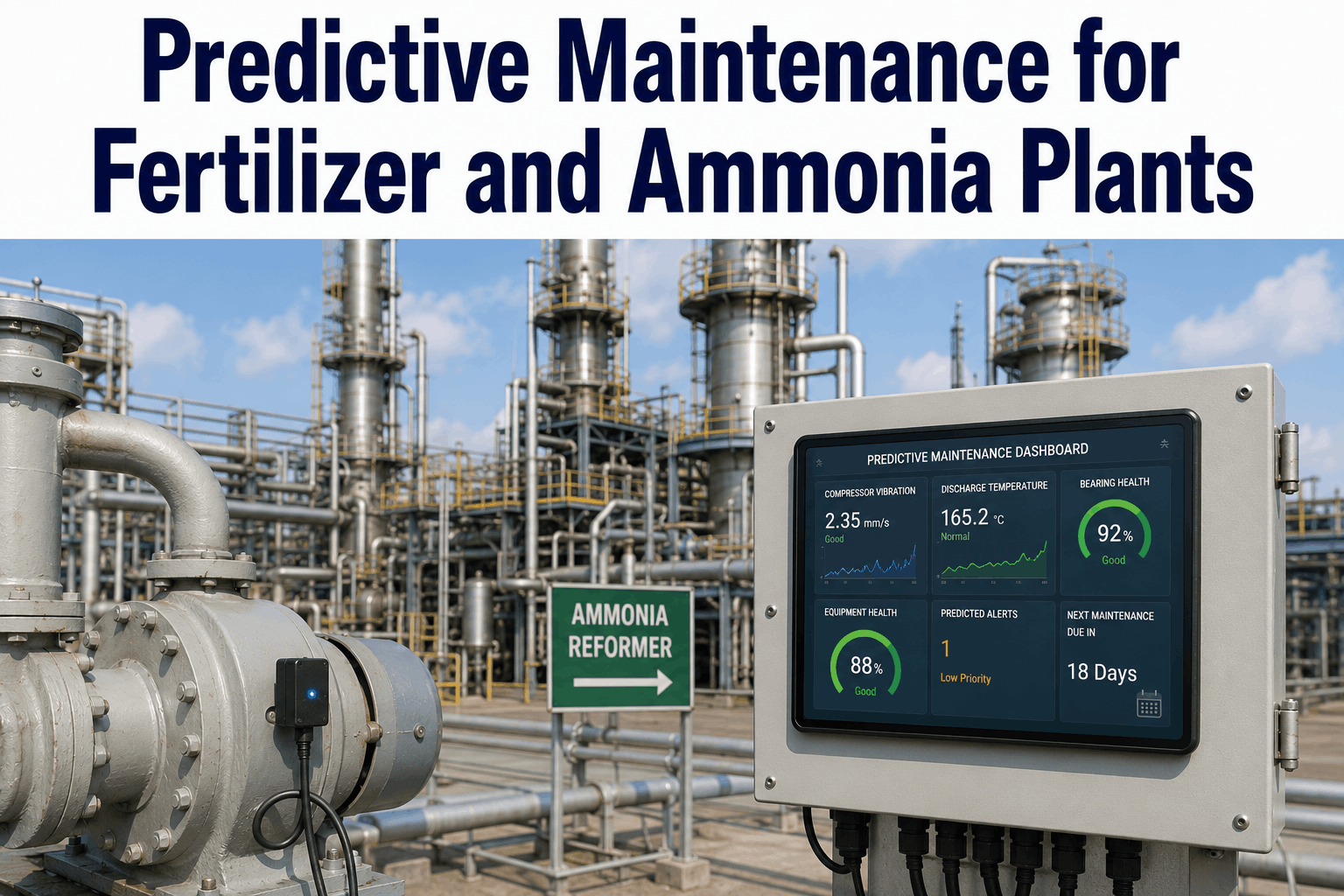
An ammonia synthesis loop running at 150–300 bar and 400–500°C is among the most mechanically demanding environments in the process industry. A forced outage in a world-scale ammonia plant produces losses of $500,000 per day or more in lost production, plus restart costs and catalyst exposure risks that can extend the actual recovery timeline far beyond the mechanical repair window. The reformers, synthesis gas compressors, and heat exchangers that make these plants run operate continuously for years at a time — and the signals that predict their failure are buried in sensor data streams that only AI can read systematically. Get iFactory Support to deploy predictive maintenance across your ammonia or fertilizer plant today.
Prevent the $500K/Day Forced Outages That End Ammonia Plant Campaigns
iFactory AI monitors reformers, synthesis loops, compressors, and heat exchangers under extreme operating conditions — detecting degradation weeks before forced shutdowns that cost more in one day than a full year of monitoring.
The Six Critical Ammonia and Fertilizer Plant Systems AI Monitors
Ammonia plant reliability management spans the full process train from natural gas feed pretreatment through synthesis loop and refrigeration. Each system below represents a distinct failure risk with different detection physics, different lead times available, and different consequence profiles if a failure is missed. Contact iFactory to configure the monitoring strategy appropriate for your specific plant design and turnaround interval.
System 1
Primary and Secondary Reformers
Primary reformer tubes operating at 800–900°C under steam-methane reforming conditions are subject to creep, carburization, and tube wall thinning. AI monitors individual tube skin temperatures from infrared tube scanner data, combustion zone heat flux distributions, and tube support differential thermal expansion — detecting tubes approaching end-of-life 6–18 months before rupture risk reaches actionable thresholds.
System 2
Synthesis Gas Compressors
Multi-stage centrifugal or reciprocating compressors driving synthesis gas to loop pressure represent the highest single-point unplanned shutdown risk in most ammonia plants. AI monitors rotor vibration, bearing metal temperatures, seal system differential pressures, valve lift profiles on reciprocating machines, and performance curve deviations — providing the 4–12 week early warning window that allows turnaround scheduling rather than emergency shutdown.
System 3
Ammonia Synthesis Converter
The synthesis converter holding the iron or ruthenium catalyst under 150–300 bar pressure is monitored primarily through differential temperature measurements across catalyst beds and pressure drop trending across beds. AI tracks bed temperature profiles and pressure drop growth rate — detecting catalyst deactivation, channeling, and bed settling that affect both conversion efficiency and flow distribution.
System 4
Heat Exchange Network
The heat exchanger network recovering energy from hot process streams represents both a significant reliability risk and an energy efficiency opportunity. Fouling in synthesis gas exchangers, reformer feed-effluent heat exchangers, and waste heat boilers degrades energy recovery efficiency and increases furnace fuel consumption. AI tracks thermal performance ratios against clean baselines — detecting fouling onset 4–8 weeks before operational impact.
System 5
Ammonia Refrigeration System
Ammonia refrigeration compressors maintaining condensation and storage temperatures for product ammonia operate continuously and are subject to the same degradation failure modes as synthesis gas compressors — bearing wear, seal deterioration, and performance curve shift from impeller fouling or wear. AI monitoring refrigeration compressor health prevents the product handling failures that force synthesis loop rate reductions.
System 6
Rotating Machinery Across the Plant Train
Beyond the critical compressors, ammonia plants operate dozens of pumps, fans, and blowers whose failure can disrupt specific process sections or utilities. AI monitoring uses vibration envelope analysis and motor current signature analysis to detect bearing, impeller, and mechanical seal degradation across the full rotating equipment population — not just the machines with dedicated condition monitoring hardware.
Reformer Tube Monitoring: The Highest-Consequence Application
Reformer tube failure is the one event in an ammonia plant that cannot be predicted by conventional monitoring — tubes fail without warning when operated to conventional alarm limits. AI infrared tube scanner analytics change this by trending individual tube skin temperatures against expected profiles, detecting the asymmetric heating patterns and hotspot development that precede tube rupture by months, not hours. Book a demo to see iFactory reformer tube analytics in a live configuration.
Scroll for more →
| Equipment / Failure Mode | Detection Method | AI Lead Time | Cost of Missed Detection |
|---|---|---|---|
| Reformer Tube Hotspot | IR scanner temperature trending, individual tube profiling | 6–18 months before rupture risk | Tube rupture: 2–4 week unplanned outage + catalyst damage |
| Syngas Compressor Bearing | Vibration envelope analysis, bearing metal temperature trend | 4–12 weeks before failure | Emergency shutdown: $500K/day × 5–14 day repair |
| Compressor Dry Gas Seal | Seal differential pressure, purge flow rate monitoring | 2–6 weeks before seal failure | Process gas leak, forced shutdown, seal replacement cost |
| Synthesis Loop Catalyst Deactivation | Bed differential temperature trending, conversion efficiency model | 3–6 months before conversion shortfall | Production rate reduction, early catalyst replacement cost |
| Waste Heat Boiler Fouling | Heat transfer efficiency ratio vs clean baseline | 4–8 weeks before forced cleaning outage | Unplanned chemical cleaning outage: 3–5 day production loss |
| CO₂ Removal System Pump | Motor current signature analysis, vibration baseline | 2–5 weeks before failure | Synthesis gas specification failure, loop rate reduction |
AI Performance in High-Consequence Process Plant Environments
Compressor Forced Outage Reduction
70–85% Fewer Forced Outages
Synthesis gas and refrigeration compressor forced outages are the primary driver of unplanned ammonia plant shutdowns. AI compressor monitoring with 4–12 weeks detection lead time converts the majority of forced outages into planned interventions — with the remaining forced events typically arising from sudden mechanical failures that even continuous monitoring cannot provide extended lead time for.
Production Campaign Length Extension
+8–15% Longer Run Lengths
AI monitoring extending the interval between turnarounds by identifying equipment that is genuinely fit for continued service — versus intervening at fixed intervals regardless of actual condition. Ammonia plants achieving 3-year turnaround intervals instead of 2-year intervals through condition-based run-length management capture the full incremental production of an additional year of operation per campaign.
Reformer Energy Efficiency Recovery
2–4% Fuel Reduction
Heat exchanger fouling and reformer combustion zone maldistribution both increase primary reformer fuel consumption without producing any process outcome change — the plant runs at higher cost without the operator being aware. AI tracking heat exchanger performance ratios and reformer tube temperature uniformity identifies energy efficiency deterioration and enables corrective action before fuel consumption increases become embedded in operating cost baselines.
Turnaround Scope Optimization
20–35% Scope Reduction
AI condition data entering turnaround planning replaces the conservative default approach of inspecting everything on a fixed schedule with evidence-based scope decisions — inspecting equipment showing anomalous trends and deferring equipment confirmed healthy by condition monitoring data. Ammonia plants using iFactory condition data in turnaround planning consistently achieve 20–35% scope reduction versus prior-cycle conservative baseline scopes.
Compressor Monitoring Deep Dive: The Most Critical Asset Class
Rotor Vibration Spectrum Analysis Primary Detection
Continuous shaft vibration monitoring using proximity probes at both bearing planes provides the primary health signal for large centrifugal compressors. AI performs real-time spectral decomposition — tracking 1× synchronous vibration for unbalance and misalignment, sub-synchronous components for rotordynamic instability, and non-synchronous harmonics for bearing degradation and aerodynamic excitation from impeller fouling or diffuser damage.
Dry Gas Seal System Monitoring
Dry gas seals on synthesis gas compressors prevent process gas from reaching the atmosphere or bearing oil system. Seal degradation produces characteristic changes in primary seal differential pressure, secondary seal purge gas flow, and barrier gas consumption — each individually trending in a direction detectable by AI 2–6 weeks before the seal reaches a state requiring emergency shutdown and seal replacement.
Performance Curve Deviation Tracking
Centrifugal compressor performance curves relate flow, head, and efficiency at rated conditions. AI models the expected operating point from suction conditions, speed, and discharge pressure — then compares actual performance against the model to detect impeller fouling, diffuser damage, and internal recirculation that reduce head or efficiency without producing alarming vibration levels. Performance degradation often precedes mechanical failure by months.
Reciprocating Compressor Valve Monitoring
Reciprocating compressor suction and discharge valves are the highest-frequency failure component in ammonia plant reciprocating machines. AI analyzes cylinder pressure indicator cards — the pressure-volume diagram of each cylinder per revolution — to detect valve leakage, broken valve elements, and partial blockage that reduce cylinder efficiency and, if undetected, progress to complete valve failure and emergency shutdown.
Lube Oil System Health
Compressor lube oil system degradation — pump wear reducing oil pressure, cooler fouling elevating oil temperature, and filter bypass valve malfunction — creates bearing lubrication risk that AI can detect before it affects bearing condition. Oil pressure, temperature, and viscosity trends across the lube oil circuit provide the secondary detection layer that complements direct vibration monitoring of the machine.
Surge Detection and Prediction
Centrifugal compressor surge — flow reversal under low-flow conditions — is both a reliability threat and a process upset. AI analyzes the approach to the surge line in real time using flow, head, and speed data — alerting operators when operating conditions are trending toward the surge boundary with enough lead time to adjust process conditions before surge occurs. Contact iFactory Support to configure surge prediction for your specific compressor curves and control system.
Plant-Wide AI Monitoring Infrastructure
DCS / PI Historian Integration
Direct connection to OSIsoft PI, Honeywell PHD, or Emerson DeltaV historians — pulling all existing process and equipment data without new sensor hardware at the data layer
API 670 Compliance
iFactory vibration monitoring integrates with existing API 670 machinery protection systems — adding AI trend analytics on top of protection system data without duplicating hardware
Turnaround Planning Integration
AI condition assessments export directly into turnaround scope planning tools — providing evidence-based defer or inspect decisions for every monitored equipment item
RCM Alignment Reporting
iFactory monitoring coverage reports map directly to RCM task lists — demonstrating which failure modes are covered by continuous AI monitoring and which require supplemental inspection
Ammonia Plant AI Deployment: 6-Phase Roadmap
01
Criticality-Based Asset Register
Build an asset criticality register ranking every major equipment item by consequence of failure — production loss rate, safety consequence, repair duration, and spare parts lead time. This register drives monitoring deployment priority. In ammonia plants, synthesis gas compressors and primary reformers are almost always in the top tier, followed by refrigeration compressors and CO₂ removal system rotating equipment.
02
PI Historian Data Inventory
Conduct a data availability audit against the iFactory monitoring requirements for each asset class. Most modern ammonia plants have 60–80% of required monitoring data already in their PI or DCS historian. Document gaps requiring additional instrumentation — typically high-frequency vibration channels on secondary machinery and some reformer tube skin temperature coverage improvements.
03
Compressor Monitoring Pilot
Deploy iFactory compressor analytics on the synthesis gas and refrigeration compressor trains first. These are the highest-consequence assets and the ones with the clearest ROI case. Run the pilot for 90 days, capturing baseline condition states and validating that AI trend models reflect actual machine condition confirmed by independent condition monitoring survey.
04
Reformer and Heat Exchanger Analytics
Expand monitoring to primary reformer tube temperature analytics and heat exchanger performance trending. This phase requires integration with infrared tube scanner systems and configuration of heat exchanger fouling models using operating data from the current campaign as the clean baseline. Reformer tube analytics typically provide the first visible ROI from energy efficiency improvement within 60 days of deployment.
05
Balance of Plant Rotating Equipment
Extend iFactory monitoring to balance-of-plant rotating equipment: CO₂ removal system pumps, boiler feed water pumps, air blowers, and cooling water pumps. This phase leverages the infrastructure established in the compressor pilot and typically requires primarily additional motor current analysis channels rather than new high-frequency vibration hardware at most pump locations.
06
Turnaround Integration and Run-Length Optimization
The final phase delivers the highest long-term value: using AI condition data to defend run-length extension decisions to management, insurers, and regulators — and to optimize turnaround scope against actual equipment condition rather than conservative default schedules. iFactory generates the documented condition evidence required to support an extended turnaround interval application. Get iFactory Support to build your run-length optimization framework.
Frequently Asked Questions
How much does a forced outage actually cost an ammonia plant per day?
World-scale ammonia plants (1,000–2,000 MTPD capacity) operating at current ammonia market prices typically lose $300,000–$700,000 per day of unplanned outage in production margin, plus restart costs including catalyst conditioning, steam system cool-down and restart cycles, and any secondary equipment damage from the shutdown event. Smaller plants have proportionally lower daily losses, but the economics of AI monitoring remain strongly positive at any scale above approximately 300 MTPD capacity.
Can iFactory monitor reformer tube condition without additional infrared equipment?
iFactory can integrate with existing fixed infrared tube scanner systems that most modern primary reformers already have installed. If an IR scanner is not installed, portable IR camera survey data can be uploaded to iFactory for trend analysis between surveys — providing partial coverage until a fixed scanner justification is made. Fixed scanner integration provides continuous monitoring and AI tube-to-tube comparison analytics that portable surveys cannot replicate.
How does AI handle the operational variability in ammonia plants — load changes, feedstock variation, ambient temperature effects?
iFactory AI models are physics-informed — they normalize equipment performance against operating conditions (load, speed, inlet conditions, ambient temperature) before detecting anomalies. A compressor efficiency drop that appears during a load increase is distinguished from a real performance deterioration because the model accounts for the expected efficiency-load relationship. This normalization is essential for any process plant AI — raw sensor value alerts without process context produce unacceptable false positive rates in variable-load operations.
What does iFactory provide to support a turnaround interval extension application?
iFactory generates a condition-based equipment fitness-for-service report for each monitored asset, documenting: the trend history of key condition indicators over the current campaign, comparison against previous campaign baselines, remaining useful life estimates with confidence bounds, and any anomalies investigated and disposition. This package provides the documentary evidence base that integrity engineers use to support run-length extension applications to insurance underwriters and regulatory bodies.
Can iFactory be deployed on a plant that uses an OSIsoft PI historian?
Yes. iFactory has a native PI connector that reads tag data directly from PI servers — either on-premises or via PI Web API. This means for PI-based plants, the data integration phase of deployment is typically completed in days rather than weeks, as existing PI tag structures map directly to iFactory asset models without requiring custom extraction scripts or middleware development.
Protect Your Ammonia Plant Campaign — Every Day of Run Length Matters
iFactory AI gives reliability engineers at ammonia and fertilizer plants 4–18 weeks of early warning on compressor, reformer, and heat exchanger failures — converting forced outages into planned turnarounds and planned turnarounds into optimized scopes.