A compressor failure during peak fermentation in July costs a craft brewery more than the equipment repair — it costs the batch. A bottling line jam on the Friday before a major distribution deadline costs more than overtime to fix. Breweries and distilleries operate with seasonal demand peaks, rigid fermentation chemistry timelines, and batch quality that cannot be recovered once compromised by a temperature excursion or process interruption. Predictive maintenance in beverage production is not about reducing costs — it is about protecting batches. Get iFactory Support to deploy AI monitoring across your fermentation, bottling, and refrigeration systems today.
Protect Every Batch, Every Season — AI Predictive Maintenance for Breweries and Distilleries
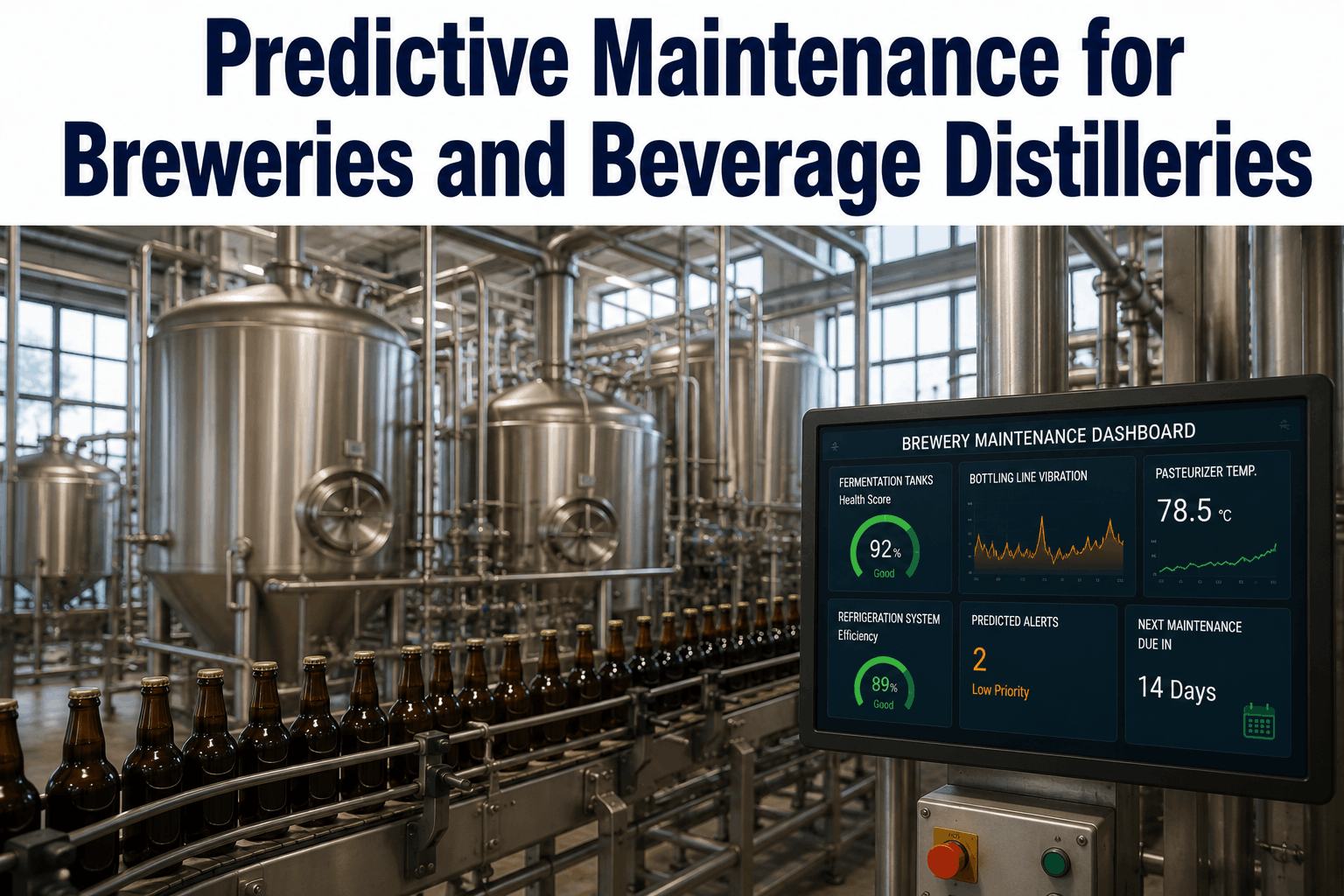
iFactory AI monitors fermentation tanks, bottling lines, pasteurizers, and refrigeration systems continuously — detecting equipment degradation before it costs you product quality or peak-season production capacity.
The Six Critical Brewery and Distillery Systems AI Monitors
Beverage production involves a tightly interconnected sequence of biological, thermal, and mechanical processes where the failure of any single system can compromise batch quality, delay distribution commitments, or trigger a complete product discard. Each system below represents a distinct failure risk with its own monitoring strategy. Contact iFactory to configure monitoring for your specific production profile and seasonal demand pattern.
System 1
Fermentation Tank Systems
Fermentation tanks require precise temperature control throughout fermentation cycles lasting 7–21 days. Glycol jacket cooling system failures, agitator motor degradation, and temperature sensor drift can all compromise yeast health and final product profile. AI monitors glycol flow rates, compressor staging, agitator current signatures, and temperature uniformity across tank zones — with alerts calibrated to the specific fermentation stage in progress.
System 2
Bottling and Canning Lines
High-speed bottling lines running at 200–800 bottles per minute accumulate wear on fillers, cappers, labelers, and conveyors continuously. AI monitors filling valve cycle times, capper torque signatures, labeler tension and registration accuracy, and conveyor drive motor current — detecting the gradual degradation that causes fill volume variation, capping defects, and line jams before they reach production-stopping thresholds.
System 3
Pasteurization Systems
Flash pasteurizers and tunnel pasteurizers must maintain precise temperature-time profiles to achieve target pasteurization units (PUs) without over-processing flavor compounds. Heat exchanger fouling reduces thermal efficiency progressively, requiring increased energy input and eventually causing PU shortfall. AI monitors plate pressure drop, temperature approach, and energy efficiency ratio to detect fouling onset 2–4 weeks before it affects product quality.
System 4
Refrigeration and Cooling Systems
Brewery refrigeration systems running compressors, glycol chillers, and cold storage maintain temperatures across cellaring, fermentation, and finished product storage zones. Compressor bearing wear, refrigerant charge loss, condenser fouling, and expansion valve degradation each reduce system capacity progressively. AI monitors compressor efficiency, suction and discharge pressure trends, and chiller delta-T — detecting capacity loss before it affects tank temperature control during peak production.
System 5
Milling and Mashing Equipment
Grain mills producing extract from malt must maintain consistent crush gap and roll condition to deliver target extract efficiency. Roll wear changes the particle size distribution gradually, reducing extract yield and affecting mash pH. AI monitors mill motor current and vibration signatures to detect roll wear before it measurably affects brew house efficiency — protecting batch-to-batch consistency in finished product character.
System 6
CIP and Sanitation Systems
Clean-in-place systems delivering caustic, acid, and sanitizer washes to all product-contact surfaces depend on pump flow rates, spray ball coverage, temperature, and chemical concentration operating within validated parameters. Pump impeller wear, spray ball blockage, and heat exchanger scaling each degrade CIP effectiveness. AI monitors CIP cycle performance against validated parameters — flagging cycles that fall below specification before microbial risk accumulates.
Seasonal Risk Mapping: When Each Failure Mode Costs Most
Brewery and distillery equipment failures are not uniformly costly across the year. A bottling line failure in January during slow season is recoverable. The same failure in the two weeks before summer peak distribution is a revenue event. iFactory AI prioritizes alert urgency based on production calendar context — the same equipment alert generates different response protocols in peak versus off-peak periods. Book a demo to see production-calendar-aware alert configuration.
Scroll for more →
| Equipment System | Peak Risk Period | Failure Cost at Peak | iFactory Detection Lead Time |
|---|---|---|---|
| Fermentation Cooling | Summer fermentation peak (Jun–Aug) | Full batch loss ($15K–$200K depending on size) | 2–5 weeks via compressor efficiency trending |
| Bottling Line | Pre-distribution rush (Apr–May, Oct–Nov) | Missed shipment windows, distributor penalties | 1–3 weeks via fill valve and drive motor trends |
| Pasteurizer | Year-round for draft; seasonal for packaged | Product recall risk if PU shortfall undetected | 2–4 weeks via heat exchanger fouling model |
| Grain Mill | High-volume production cycles | Reduced extract yield, batch quality inconsistency | 3–6 weeks via motor current and vibration |
| CIP System | Post-shutdown restart and new season startup | Microbial contamination, product loss, line sanitization | Per-cycle performance vs validated baseline |
| CO₂ Recovery System | Year-round; highest impact during CO₂ shortage periods | CO₂ purchase cost escalation, carbonation quality risk | 1–2 weeks via compressor and scrubber monitoring |
Brewery AI Monitoring: Performance Outcomes
Batch Loss Events Avoided
85% Reduction in Batch Losses
Breweries running iFactory AI on fermentation cooling systems achieve an 85% reduction in temperature excursion events that risk batch quality. Early detection of refrigeration capacity degradation — 2–5 weeks before a system unable to hold set-point temperature — provides enough lead time to schedule compressor service before summer peak demand removes the capacity buffer.
Bottling Line Uptime
+12–18 OEE Points
Bottling line OEE improvements from AI predictive maintenance come primarily from reducing unplanned stoppages caused by filler valve wear, capper mechanism degradation, and conveyor drive failures. These failure modes give 1–3 weeks of acoustic and electrical signature warning before producing a production stop — exactly the window needed to schedule a planned repair without disrupting the production calendar.
Refrigeration Energy Efficiency
12–20% Energy Reduction
Compressor efficiency degradation from bearing wear, refrigerant charge loss, and condenser fouling increases energy consumption progressively before causing capacity problems. AI detecting early-stage efficiency loss enables maintenance before energy waste accumulates — breweries typically recover 12–20% of refrigeration energy costs through AI-managed condition-based compressor maintenance.
CIP Cycle Compliance Rate
99.4% Parameter Compliance
AI monitoring every CIP cycle against validated temperature, concentration, flow rate, and contact time parameters catches out-of-spec cycles immediately — allowing reruns before product contact surfaces are returned to service. Manual verification of CIP cycle parameters catches only 60–70% of deviations because operator attention is distributed across multiple concurrent tasks.
Fermentation System Monitoring: The Highest-Value Application
Glycol Cooling System Health Highest Batch Risk
The glycol chiller system cooling fermentation and conditioning tanks is the single equipment system whose failure creates the highest-consequence, hardest-to-recover production loss in a brewery. AI monitoring compressor efficiency ratios, glycol pump flow rates, heat exchanger thermal performance, and tank temperature uniformity creates a multi-layer early warning system that prevents the "came to work on Monday and found tanks at 25°C" event that costs an entire week's fermentation capacity.
Bottling Filler Valve Condition
Individual filling valves on rotary bottle fillers wear at different rates depending on product contact cycles, cleaning chemical exposure, and fill product characteristics. AI tracks cycle time statistics for each filling valve position independently — identifying slow or inconsistent valves that produce under-fill before they trigger a fill volume audit failure or cause a label registration cascade that stops the line.
Pasteurizer Heat Exchanger Fouling
Progressive fouling of plate heat exchanger surfaces in flash pasteurizers reduces the heat transfer coefficient — requiring higher flow temperature setpoints to maintain product outlet temperature above pasteurization threshold. AI tracks the ratio of inlet-to-outlet temperature approach against a clean baseline, detecting fouling onset typically 3–4 weeks before it causes pasteurization unit shortfall or triggers manual CIP intervention.
Centrifuge and Filtration Systems
Centrifuges clarifying beer or separating yeast operate with rotating bowl assemblies at high speeds where bearing health is critical. AI vibration monitoring on centrifuge bearing housings detects imbalance from yeast cake accumulation, bearing degradation from lubricant contamination, and seal wear before these conditions produce product quality deviations or catastrophic bearing failure at speed.
CO₂ Recovery System
CO₂ recovery systems capturing fermentation gas for reuse require compressor, scrubber, and storage system reliability to maintain the CO₂ supply for carbonation and packaging operations. AI monitoring compressor performance and scrubber column differential pressure detects fouling and wear before CO₂ recovery rate drops below self-sufficiency thresholds — protecting breweries from dependence on purchased CO₂ at volatile market prices.
Compressed Air and Utilities
Brewery compressed air systems serving pneumatic valves, packaging machinery, and instrument air require oil-free quality for product-contact applications. AI monitors compressor performance, dryer dew point, and pressure drop across filter banks — detecting leaks, dryer failures, and compressor degradation that would compromise instrument air quality or packaging line pneumatic function if allowed to progress. Contact iFactory to include utilities in your monitoring scope.
Brewery Monitoring System Architecture
Fermentation Tank Sensors
Wireless temperature arrays, glycol flow transmitters, and agitator motor monitors per tank — installing in hours, not days
Refrigeration AI Models
Physics-informed compressor efficiency models that separate real degradation from load-driven efficiency variation during seasonal demand changes
Bottling Line Integration
OPC-UA connection to existing line PLC and SCADA — pulling fill volume, torque, and speed data without additional sensor hardware at most modern lines
Production Calendar Awareness
Alert prioritization that escalates response urgency during peak production and distribution windows — the same fault gets different response protocols in January versus July
Brewery AI Deployment: 6-Phase Implementation
01
Seasonal Risk Calendar Mapping
Before any sensor deployment, map your production calendar: when are peak fermentation periods, distribution deadlines, and seasonal product launches? This calendar drives monitoring priority — deploy first on the systems whose failure would cost most during the upcoming peak period, not the equipment with the longest downtime history.
02
Refrigeration System Pilot
Begin with refrigeration system monitoring as the highest-consequence single point of failure in most breweries. Install compressor vibration and efficiency monitoring, glycol circuit flow transmitters, and fermentation tank temperature arrays. Run 6 weeks before summer peak to establish baselines while the system is at normal capacity.
03
Bottling Line Connectivity
Connect iFactory to your bottling line PLC via OPC-UA or Modbus. In most modern packaging lines, 80% of the data required for AI predictive analytics already exists in the line controller — filler valve cycle times, capper torque records, conveyor speed and current. iFactory extracts and analyzes this data without additional hardware in most configurations.
04
CIP Performance Monitoring
Configure CIP cycle monitoring using existing temperature transmitters, flow meters, and conductivity sensors in your CIP circuit. iFactory compares each cycle's performance profile against the validated parameters — flagging deviations automatically without requiring a technician to review every cycle log manually.
05
Maintenance Calendar Integration
Connect iFactory remaining useful life outputs to your CMMS maintenance calendar. AI-generated intervention recommendations appear as planned work orders with urgency classifications — giving your maintenance team a condition-driven queue rather than a fixed-interval checklist. Seasonal context automatically escalates pre-peak interventions.
06
Post-Season Review and Model Tuning
After the first full seasonal production cycle, review AI alert accuracy against actual failure events: which alerts were confirmed by subsequent inspection, which were false positives, and which failures were not predicted. This review tunes alert thresholds for the next season and identifies monitoring gaps requiring additional sensor coverage. iFactory Support facilitates annual model review sessions.
Frequently Asked Questions
Can AI predictive maintenance help a craft brewery with a small maintenance team?
AI monitoring is especially valuable for small teams precisely because it replaces manual rounds and inspections with automated alerts — allowing a two-person maintenance team to monitor 50 assets with the same coverage a larger team would need to achieve manually. iFactory is designed for deployment and operation by maintenance teams without data science expertise — alerts are in plain language with recommended actions, not raw model outputs.
How does AI detect fermentation cooling problems before they affect batch temperature?
The detection pathway is: compressor efficiency drop → glycol chiller capacity reduction → tank temperature control range narrowing → eventual temperature exceedance. AI detects the compressor efficiency drop 2–5 weeks before the tank temperature is affected, allowing repair at the compressor stage rather than discovering the failure when tanks can no longer hold set-point temperature during a hot weather demand peak.
What data does iFactory need from a bottling line to run predictive analytics?
For most modern bottling lines, iFactory connects via OPC-UA or Modbus to the line controller and extracts: filler valve open/close times, capper torque values, conveyor drive motor current, and line speed. If the line controller does not expose these parameters, iFactory can supplement with external current clamps on drive motors and vibration sensors on critical mechanical components like the filler carousel bearing.
Can iFactory monitor CO₂ recovery systems and help reduce CO₂ purchase costs?
Yes. iFactory monitors CO₂ recovery compressor efficiency, scrubber column pressure drop, and storage system pressure — detecting compressor degradation and scrubber fouling that reduce recovery rate before they drop below self-sufficiency thresholds. For breweries with CO₂ recovery systems, maintaining recovery efficiency above 85% of fermentation CO₂ production eliminates or greatly reduces CO₂ purchase costs.
Protect Every Batch This Season With AI Predictive Maintenance
iFactory gives brewery and distillery teams 2–5 weeks of early warning on fermentation cooling, bottling line, and pasteurization system failures — enough lead time to repair before your peak season production is at risk.