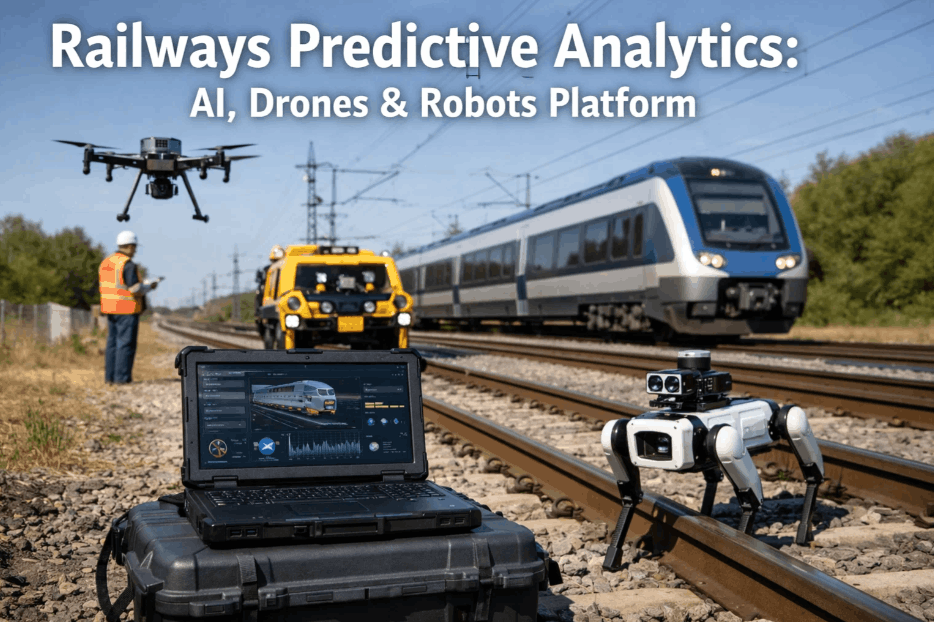
Railways predictive analytics is redefining how rail operators, infrastructure managers, and maintenance engineers across the UK, Canada, Germany, and the UAE approach asset reliability and track safety. Traditional maintenance operates on fixed schedules — faults are discovered reactively, and costly downtime accumulates in the gap between when damage begins and when a technician finds it. AI-powered predictive analytics closes that gap entirely, giving teams continuous visibility into track condition, bridge health, tunnel integrity, and signal performance before failures occur — and rail networks adopting this approach are already reporting up to 50% fewer reactive maintenance incidents within 12 months. Book a demo to see how the platform connects your infrastructure data to real-time AI analytics from day one.
What Is Railways Predictive Analytics and Why It Matters Now
Railways predictive analytics applies machine learning and AI-driven pattern recognition to forecast infrastructure degradation — track defects, bridge fatigue, signal failure — before they cause service disruption. Instead of waiting for scheduled inspections, the system continuously analyses data from sensors, drones, and robotic platforms to model asset health in real time. Rail networks in the UK, Germany, Canada, and the UAE are already using this approach to replace calendar-based maintenance with condition-based decisions, directing resources only where assets are genuinely approaching failure — and cutting emergency response costs by 30–40%. Book a demo to explore how predictive analytics works across your specific infrastructure mix.
Faults found after failure cause emergency closures and unplanned spend — rail networks running reactively lose 30–40% of their maintenance budget to emergency response.
Calendar-based inspections miss degradation between visits and waste effort on assets that are performing fine. Intervals are set by regulation, not by actual asset condition.
Track records, bridge reports, and signal diagnostics stored in separate systems make it impossible to build the integrated asset view that accurate failure prediction requires.
Without AI pattern recognition, teams can't distinguish early failure signatures from normal variation — making every response reactive rather than predictive.
Core Components of an AI-Powered Railway Predictive Analytics Platform
An effective railway AI analytics platform unifies data from track sensors, drones, robots, and signal telemetry into one system — generating condition scores, risk rankings, and maintenance work orders automatically.
Rail Track Monitoring and Defect Detection
Sensors on trains and trackside equipment stream real-time data on rail geometry, surface condition, and gauge deviation. AI detects drift from normal baselines — identifying fatigue cracks and gauge issues weeks before they become safety events.
Railway Drone Inspection Integration
Drones capture high-resolution imagery of bridges, OLE, embankments, and crossings. AI vision processes footage automatically — flagging cracks, corrosion, and drainage issues without manual review. Networks in Germany and UAE report 60%+ survey time reduction.
Railway Robot Platform for Tunnel and Track Assessment
Robotic platforms deploy autonomously during possession windows, using LiDAR, ultrasonic probes, and cameras to survey tunnels and track at speeds and accuracy beyond human capability. All data feeds directly into the analytics platform.
Bridge Structural Health Monitoring
Strain gauges, accelerometers, and crack sensors stream structural response data continuously. AI spots anomalous deflection or natural frequency shifts — changes visual inspection would never catch — giving bridge teams evidence-based intervention priorities.
Signal and Trackside Equipment Analytics
Signal telemetry and point machine diagnostics are analysed by AI to spot degradation in motor current, operation time, and failure sequences — forecasting point machine failures 2–4 weeks before a service-affecting fault occurs.
Railway Infrastructure Asset Types and Their Predictive Analytics Profiles
Each infrastructure asset type fails through different mechanisms and needs a different monitoring approach. The table below maps key assets to their failure modes, monitoring technology, AI predictive lead time, and service impact if the issue goes undetected.
| Infrastructure Asset | Primary Failure Modes | Monitoring Technology | AI Predictive Lead Time | Service Impact if Undetected |
|---|---|---|---|---|
| Rail Track (plain line) | Fatigue cracks, gauge widening, surface defects, rail break | Track geometry vehicles, ultrasonic testing, wayside sensors | 4–12 weeks | Emergency speed restriction, potential derailment |
| Railway Bridges | Structural fatigue, scour, corrosion, bearing failure | Strain gauges, accelerometers, drone imagery, LiDAR | 8–24 weeks | Bridge closure, line suspension, weight restriction |
| Tunnels | Lining deterioration, water ingress, invert subsidence | Robotic platforms, LiDAR scanning, crack sensors | 6–16 weeks | Speed restriction, emergency closure, evacuation |
| Signal Point Machines | Motor degradation, rod wear, power supply failure | Current signature monitoring, operation time telemetry | 2–4 weeks | Service-affecting failure, junction blockage |
| Overhead Line Equipment | Wire wear, stagger deviation, dropper failure | Drone inspection, contact wire measurement systems | 3–8 weeks | Traction power loss, widespread delay |
| Embankments and Cuttings | Slope instability, drainage failure, vegetation encroachment | Drone aerial survey, remote sensing, rainfall monitoring | 4–10 weeks | Emergency closures, flood or landslip events |
| Level Crossings | Barrier mechanism wear, road surface deterioration | Drone imagery, IoT sensor telemetry, CCTV analytics | 2–6 weeks | Crossing closure, safety incident risk |
How AI Vision Enhances This Industry
AI vision — computer vision applied to imagery and video — is transforming railway inspection by detecting defects faster and more consistently than manual review, at a fraction of the cost. Here are the key areas where it delivers measurable value.
AI processes inspection vehicle video automatically — flagging rail cracks, joint defects, and sleeper fractures in hours instead of days of manual review.
Computer vision grades concrete spalling, crack growth, and lining deformation from drone and robot imagery — no structural engineer needed for routine inspection data.
Drone surveys analysed by AI detect encroachment and blocked drainage across entire corridors — helping networks cut weather-related closures by 40–50%.
High-speed cameras with AI measure wire wear and stagger deviation at line speed — delivering continuous OLE health data without dedicated inspection possessions. Book a demo to see this in action.
AI vision on station CCTV monitors platform edge safety and crowd density in real time — reducing response time to safety events across busy urban rail hubs.
Automated AI monitoring of crossing barriers and lineside conditions flags abnormal behaviour or equipment wear — replacing manual patrols with always-on digital oversight.
Railway Predictive Analytics Software and Platform Landscape
Choosing the right platform depends on your network scale, asset mix, and existing data infrastructure. Book a demo to see how a unified platform compares to assembling point solutions for each asset category.
Ingests geometry and ultrasonic data to model degradation trends and forecast maintenance windows based on actual wear rates — not fixed schedules.
Processes continuous multi-sensor data from bridge instrumentation to generate condition scores aligned with structural assessment standards.
Manages drone data with AI vision processing for defect detection and georeferenced reporting — cutting post-flight processing from days to hours.
Aggregates point machine diagnostics and trackside telemetry for failure pattern recognition and automated maintenance work order generation.
Unifies track, civil, signalling, and operational data in one environment — enabling network-level risk assessment and integrated compliance documentation.
Converts LiDAR point clouds, ultrasonic scans, and robot video into structured condition assessments and audit-ready maintenance records.
Implementing Railway Predictive Analytics: A Phased Deployment Roadmap
Deploying AI analytics across a railway network works best as a phased programme — starting with highest-consequence assets and building data maturity progressively. Networks that follow this approach achieve measurable outcomes within 6–12 months.
Asset Inventory and Data Audit
Catalogue all infrastructure assets — track, bridges, tunnels, signals, OLE — and audit existing inspection data and sensor coverage. Identify gaps and prioritise assets by failure consequence.
Sensor Integration and Baseline Collection
Deploy sensors and begin drone or robot inspection programmes on priority assets. Collect 8–12 weeks of baseline data before activating AI models — baseline quality is the primary driver of detection accuracy.
AI Model Configuration and Alert Activation
Configure asset-specific AI models and set severity-tiered alert thresholds — separating immediate safety alerts from planned maintenance recommendations to prevent alert fatigue.
Network-Wide Rollout and System Integration
Expand sensor and inspection coverage to the full asset inventory. Integrate the platform with existing asset management, maintenance planning, and regulatory reporting systems.
Performance Measurement and Continuous Improvement
Track KPIs against pre-deployment baselines. Review AI model accuracy quarterly and refine thresholds as the system accumulates network-specific asset history.
ROI and Business Benefits of Railway AI Analytics
Rail networks across the UK, Canada, Germany, and the UAE report consistent financial and operational outcomes within 12–24 months of deploying AI-powered infrastructure analytics.
Challenges in Deployment and How to Solve Them
Understanding common deployment challenges in advance helps organisations plan realistically and avoid the pitfalls that slow programmes from pilot to full operation.
Historical records in disconnected systems need structured extraction before AI model training. Allocating resource to data preparation is the most common deployment underestimate. Book a demo to see how the platform handles this.
Retrofitting IoT connectivity to legacy bridges, tunnels, and trackside equipment requires engineering assessment and planned capital expenditure from programme initiation.
Teams accustomed to physical inspection need structured training to trust AI alerts. Alert fatigue from poorly calibrated models is the most common cause of programme stagnation.
UK, Germany, and Canada regulators are evolving frameworks for accepting AI and drone data — compliance planning must account for the transition period while standards mature.
Best Practices for Programme Success
Rail organisations with the strongest predictive analytics outcomes share a consistent set of programme design and operational practices.
Start With Highest-Consequence Assets
Deploy on main line bridges, critical signalling, and high-frequency tunnels first. Early wins on high-visibility assets build organisational confidence and generate the ROI data to justify expansion.
Invest in Baseline Data Quality First
AI model accuracy depends on baseline data quality. Collecting 8–12 weeks of solid baseline before activating alerts dramatically reduces false positives and accelerates programme maturity.
Integrate Alerts Directly Into Maintenance Workflows
Predictive alerts must connect directly to work order systems and mobile technician notifications — friction between detection and action is where programme value is lost.
Combine All Inspection Modalities in One Platform
Unified drone, robot, and fixed sensor data enables cross-source AI correlation — detecting failure patterns that no single data stream would reveal independently.
Review and Refine AI Models Quarterly
Models trained on 12 months of network data outperform initial deployments significantly. Quarterly reviews incorporating new failure events into training data ensure the programme keeps improving.
Frequently Asked Questions
Track plain line, bridges, tunnels, signal point machines, and OLE deliver the fastest ROI — these are the assets where failure consequence is greatest and where regulatory scrutiny of inspection records is most intensive.
Drone imagery and robot sensor data feed into a unified AI platform that processes all inspection sources together — enabling cross-modality correlation that improves defect detection accuracy beyond any single technology.
Priority asset deployment typically takes 8–16 weeks. Most networks see measurable reductions in reactive maintenance within 6–9 months. Drone inspection efficiency gains are visible from the very first cycle.
Frameworks are actively evolving in the UK, Germany, and Canada. Compliance planning should account for current requirements while building toward full AI inspection acceptance as those standards mature.
Yes — historical track geometry records, bridge reports, and signal telemetry archives all contribute to AI training, provided data quality is adequate. A data quality audit is always the first step before model training begins.


