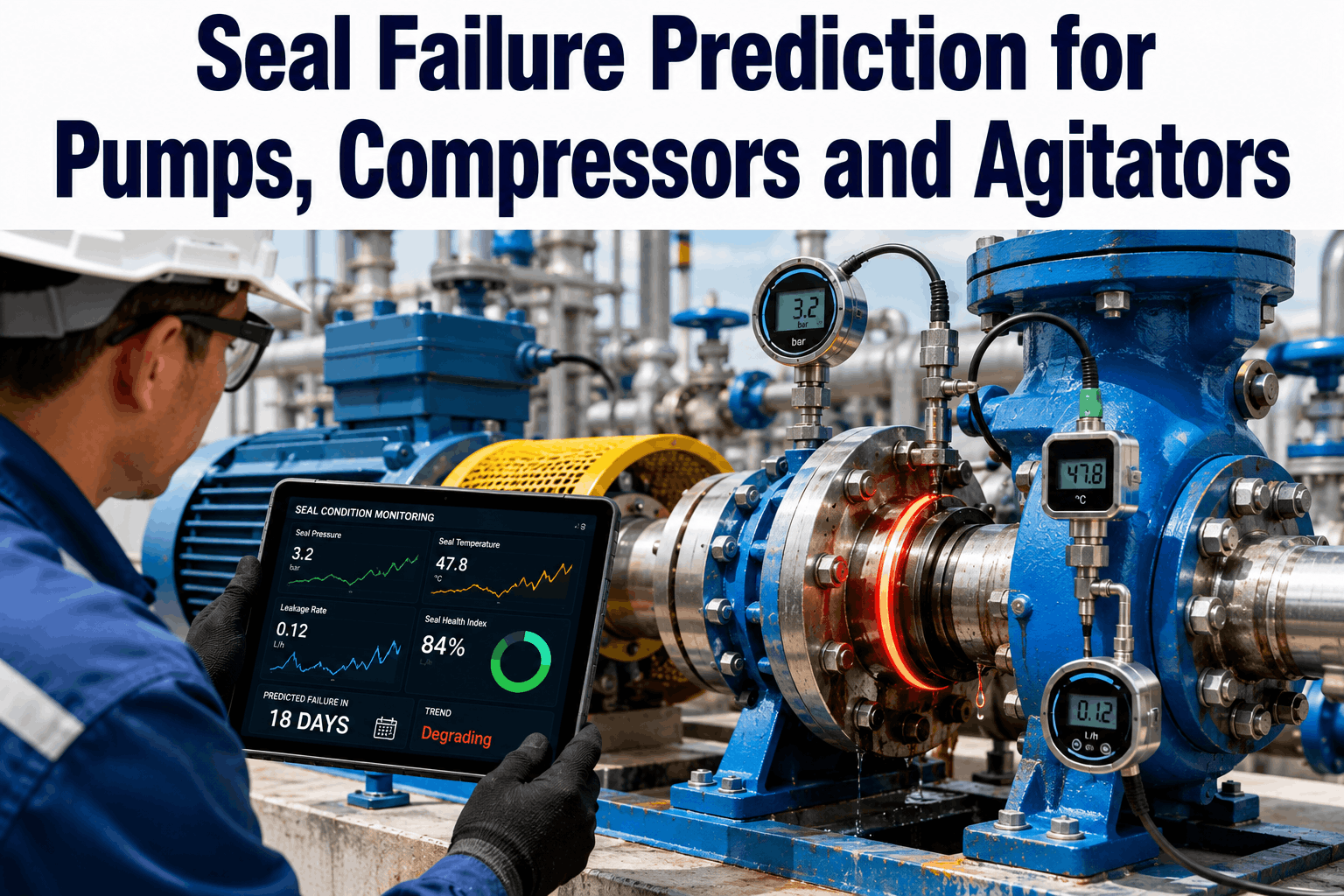
A mechanical seal failure on a process pump does not announce itself — it begins with a microscopic increase in leakage rate, a slight elevation in seal flush temperature, and a gradual change in the pressure differential across the seal faces that standard alarm-based monitoring will not flag until the seal is already in progressive failure and a process leak is imminent. AI seal condition monitoring tracks these signals continuously across time, learns the normal operating signature for each individual seal, and identifies the deviation patterns that precede failure 2 to 6 weeks before a visible leak develops. The difference between planned seal replacement during a scheduled maintenance window and an emergency pump shutdown during a production run is entirely a function of how early the deterioration is detected. Talk to an Expert to see how iFactory deploys AI seal failure prediction across your pump, compressor, and agitator fleet.
Average lead time between AI-detected seal deterioration and functional seal failure — sufficient for planned replacement in the vast majority of monitored seal types and operating conditions
Reduction in unplanned pump shutdowns from seal failure reported by facilities deploying AI seal condition monitoring across their process pump population
Cost ratio between emergency seal failure response — including production loss, environmental containment, and expedited parts — and planned preventive seal replacement on a scheduled shutdown
Of mechanical seal failures preceded by at least one of three detectable signals — flush temperature rise, leakage rate increase, or seal face pressure differential change — in the 4 weeks before failure
Predict Seal Failures 2–6 Weeks Before the Process Leak. Replace on Your Schedule, Not the Seal's.
iFactory's AI seal monitoring platform tracks flush temperature, leakage rate, and seal face pressure differential across your full pump, compressor, and agitator population — detecting deterioration trajectories weeks before alarm thresholds are reached.
Why Threshold-Based Seal Monitoring Finds Failures Too Late
A mechanical seal alarm threshold set at the leak detection limit — the leakage rate at which the sensor first registers a measurable flow — has already allowed the seal to reach late-stage deterioration before triggering any response. At that point, the seal faces have progressed from micro-leakage to measurable leakage, the flush system may be contaminated, and the remaining seal life is measured in days rather than weeks. Planning a seal replacement in this condition means an unplanned production interruption, an expedited parts order, and a maintenance response under time pressure. AI seal condition monitoring operates on a fundamentally different premise: tracking the rate of change in seal performance parameters rather than waiting for any single parameter to cross an absolute threshold. A flush temperature that has risen 3°C over eight consecutive measurements while the process temperature has remained stable is a signal that threshold monitoring ignores entirely and that AI trending flags as a developing deterioration event with a projected intervention window of 3 to 5 weeks. Teams that Book a Demo with iFactory see how this rate-of-change approach provides consistent 2 to 6 week lead times across pump, compressor, and agitator seal populations.
Seal Flush Temperature Trending
AI tracks seal flush outlet temperature relative to process temperature and ambient conditions, detecting rising trends that indicate face contact friction increase from wear or contamination.
Leakage Rate Micro-Trend Detection
Sub-threshold leakage rate increases are trended over time to identify the onset of seal face deterioration before leakage reaches the alarm detection level.
Seal Face Pressure Differential Monitoring
Changes in the pressure differential across the seal faces — indicating face opening, contamination, or spring force loss — are tracked and trended per seal assembly.
Flush System Contamination Detection
Flush fluid contamination indicators — conductivity, turbidity, and temperature differential — are monitored to detect process fluid intrusion into the seal flush circuit before seal face damage occurs.
Vibration-Seal Correlation Analysis
Elevated shaft vibration is correlated with seal deterioration rate, identifying machines where vibration-induced seal wear is the primary failure mechanism requiring vibration correction before seal replacement.
Multi-Seal Fleet Deterioration Benchmarking
Deterioration rates across similar seals in the same service are compared to identify outliers degrading significantly faster than the fleet average, flagging installation or operational root causes.
Six AI Capabilities That Predict Seal Failure Weeks in Advance
01
Individual Seal Baseline Learning and Deviation Detection
Core Predictive Capability
Each mechanical seal in the monitored fleet has a unique thermal and pressure signature that reflects its specific installation conditions, process fluid properties, seal face material combination, and flush system configuration. Generic alarm thresholds cannot account for this variation — a seal running hot by design in a high-temperature service will alarm a threshold set for a cooler application while a seal running at normal absolute temperature but 6°C above its own baseline will pass undetected. AI individual baseline learning calculates the normal operating signature for each seal from its first 30 days of monitored operation and updates the baseline continuously as process conditions vary. Deviations from this individual baseline — rather than from a population-generic threshold — form the detection signal that provides weeks of lead time.
Threshold detection lead time: 0–3 days
AI baseline deviation lead time: 2–6 weeks
02
Multi-Parameter Deterioration Pattern Classification
Failure Mode Identification
Different seal failure modes produce distinct multi-parameter deterioration patterns. Face wear from abrasive contamination shows gradually increasing flush temperature with stable leakage rate until face contact area reduces significantly. Secondary seal element degradation shows increasing leakage rate with stable flush temperature until the elastomer loses resilience and face contact is lost abruptly. Face thermal cracking shows intermittent temperature spikes with gradual leakage increase. AI pattern classification identifies the active failure mode from the combination of parameter trends, directing the corrective action — flush system filtration improvement, secondary seal replacement, cooling enhancement — that addresses the specific mechanism rather than the generic symptom.
Failure mode identified: post-failure only
AI pre-failure classification: 84% accuracy
03
Flush System Health Monitoring and Contamination Detection
Support System Integrity
Mechanical seal performance is critically dependent on the flush system that maintains clean, cool fluid at the seal faces. Flush system degradation — reduced flow rate from a blocked orifice, elevated temperature from a failed cooler, or process fluid contamination from a failed internal flush connection — progressively destroys seal performance without any change in the seal faces themselves. AI monitoring of flush system parameters identifies support system degradation before it translates into seal face damage, enabling flush system maintenance that preserves seal life rather than allowing support system failures to produce unnecessary seal replacements.
Flush system failures causing seal damage: 38%
Flush system failures caught before damage: 87%
04
Vibration-Induced Seal Wear Correlation
Root Cause Linkage
Elevated shaft vibration accelerates mechanical seal wear by imposing dynamic loads on the seal faces that exceed the design contact pressure, causing micro-impact damage that shortens seal life from years to months. AI correlates seal deterioration rate with vibration amplitude at the seal location — identifying machines where seal wear is accelerating in proportion to vibration increase and where vibration correction is the prerequisite for achieving normal seal service life. Replacing a seal on a machine with active vibration-induced wear without addressing the vibration produces a seal that will fail in a fraction of its design life and that will continue to fail on every replacement until the root cause is corrected.
Seal life on vibration-damaged machines: 4 months
Seal life after vibration correction: 26 months
05
Remaining Useful Life Estimation and Intervention Window Projection
Maintenance Planning
For each monitored seal showing a deterioration trend, AI estimates the remaining useful life based on the current degradation rate and projects an intervention window — the period during which planned replacement can be completed before the seal reaches failure. The intervention window narrows as deterioration accelerates, and iFactory recalculates it with every new measurement, providing an increasingly precise scheduling target as the replacement date approaches. When the intervention window falls within 14 days and no replacement has been scheduled, iFactory escalates the alert priority to urgent, ensuring that planning lead time is not consumed by administrative delays.
Planned replacements (no AI): 41%
Planned replacements (AI-managed): 89%
06
Environmental and Process Safety Trigger Detection
Safety and Compliance
Seal failures on pumps handling hazardous, flammable, or environmentally regulated process fluids have consequences beyond production loss — they trigger regulatory reporting requirements, environmental containment obligations, and process safety incident investigations. AI early detection of seal deterioration provides the lead time to prevent these events rather than responding to them, and the seal condition record provides documented evidence that the maintenance system was actively monitoring the seal and responding to detected deterioration before the regulatory threshold was reached. This documented monitoring record is increasingly required by environmental regulators as evidence of due diligence under Tier 1 and Tier 2 emission event reporting frameworks.
Seal failures reaching emission threshold: 23%
AI-prevented emission events: 91% of identified
Seal Monitoring Parameters and Failure Mode Reference
Scroll for more
| Monitored Parameter | Failure Mode Indicated | AI Detection Method | Typical Lead Time | Corrective Action |
|---|---|---|---|---|
| Flush Temperature Rise | Face wear, contamination | Baseline deviation trending | 3–6 weeks | Flush system inspection |
| Leakage Rate Increase | Secondary seal degradation | Sub-threshold rate trending | 2–5 weeks | Seal replacement |
| Pressure Differential Change | Face opening, spring loss | Differential trend analysis | 3–6 weeks | Spring / face assembly |
| Flush Contamination Indicators | Process fluid intrusion | Multi-sensor correlation | 1–3 weeks | Flush system isolation |
| Vibration at Seal Location | Dynamic face loading | Vibration-wear correlation | 4–8 weeks | Vibration root cause correction |
How iFactory Connects Seal Prediction to Maintenance and Compliance Workflows
Seal failure prediction is only operationally valuable when the predicted intervention window converts automatically into a planned work order with the correct replacement parts confirmed available. iFactory connects AI seal deterioration alerts to the CMMS work order system, checks parts inventory for the specific seal assembly required, and schedules the replacement within the projected intervention window. For environmentally sensitive services, iFactory also generates a monitoring record that documents the detection event, the deterioration trend, and the maintenance response — providing the compliance evidence that regulators increasingly require under Tier 1 and Tier 2 emission event frameworks. Teams can Talk to an Expert about connecting iFactory's seal prediction to your maintenance and environmental compliance workflows.
Individual Seal Baseline Engine
iFactory learns each seal's unique operating signature, detecting deviations from individual baseline rather than population-generic thresholds.
Failure Mode Classification
Multi-parameter deterioration patterns identify the active failure mechanism, directing the corrective action that addresses cause rather than symptom.
Intervention Window Projection
Remaining useful life and intervention window update with each measurement, giving maintenance planners an increasingly precise replacement scheduling target.
Compliance Record Generation
Seal condition monitoring records document detection, trending, and maintenance response for Tier 1/2 emission event due diligence requirements.
Deploying AI Seal Failure Prediction: Six Steps
01
Define the Priority Seal Population
Identify pumps, compressors, and agitators where seal failures carry the highest consequence — process safety exposure, environmental release risk, or production criticality — and prioritise these for initial deployment.
02
Configure Seal Condition Sensor Coverage
Ensure flush temperature, leakage rate, and seal face pressure differential sensors are installed and transmitting to iFactory for each priority seal, with vibration sensors at the seal location where practical.
03
Collect 30-Day Individual Baseline Per Seal
Allow iFactory to collect 30 days of normal operating data per seal before activating deterioration alerts, establishing the individual baseline needed for deviation detection.
04
Link Seal Alerts to CMMS Work Order Creation
Configure iFactory to create a planned replacement work order automatically when seal deterioration exceeds the alert threshold, with parts inventory checking and scheduling within the projected window.
05
Correlate Seal Deterioration With Vibration Data
Enable vibration-seal wear correlation analysis for pumps with active vibration monitoring to identify machines where vibration correction must precede seal replacement to achieve normal seal service life.
06
Build Compliance Records for Regulated Services
Configure automatic compliance record generation for seals in environmentally regulated services, documenting monitoring, detection, and corrective response in the format required for Tier 1/2 emission reporting.
Frequently Asked Questions
What signals does AI monitor to predict mechanical seal failure?
The primary monitored parameters are seal flush outlet temperature, leakage rate, and seal face pressure differential — supplemented by flush fluid contamination indicators and vibration at the seal location where sensors are available.
How early before failure can AI seal monitoring provide a usable alert?
AI baseline deviation detection typically provides 2 to 6 weeks of lead time before functional seal failure, with the exact window depending on the failure mechanism — face wear develops slowly while secondary seal degradation can accelerate more rapidly in the final weeks.
Can AI seal monitoring work on pumps without dedicated flush system instrumentation?
Yes. Where flush instrumentation is limited, iFactory uses available process data — pump current, bearing temperature, and vibration — as proxy signals for seal condition, with lower confidence than fully instrumented seals but still providing improvement over threshold-only monitoring.
How does AI distinguish seal flush temperature rise from process temperature increase?
iFactory normalises flush temperature against concurrent process temperature measurements, tracking the differential rather than the absolute flush temperature. A rising differential indicates seal-generated heat rather than process-driven temperature variation.
How does iFactory connect seal condition monitoring to environmental compliance documentation?
iFactory generates automatic compliance monitoring records for each seal in a regulated service, documenting the condition trend, detection event, and maintenance response in formats aligned with Tier 1 and Tier 2 emission event reporting requirements.
A Seal Failure You Cannot Predict Is a Production Shutdown You Cannot Plan For. AI Monitoring Changes That Equation.
iFactory tracks flush temperature, leakage rate, and seal face pressure across your pump, compressor, and agitator population — converting 2 to 6 weeks of advance warning into planned replacements, protected production, and documented compliance.