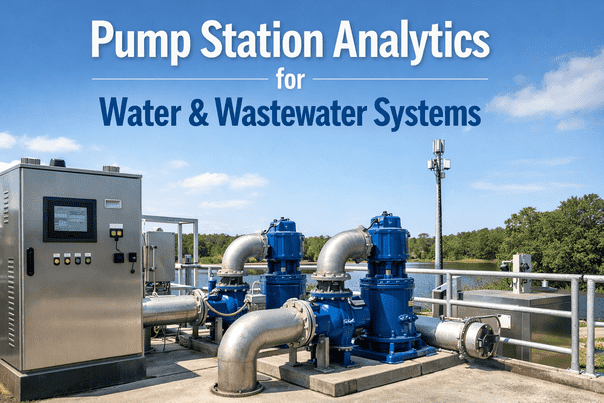
Pump stations are the circulatory system of water and wastewater networks, and they fail the same way every time: not suddenly, but gradually. A bearing running 4 degrees hotter than baseline for three weeks. A VFD drawing 6 percent more current than the pump curve predicts for that flow rate. These signals exist in the SCADA data of every modern pump station and go unread because SCADA threshold alarms are configured to fire when a problem has already happened, not when it is building. iFactory connects to your pump station SCADA via OPC-UA or Modbus read-only, applies AI pattern recognition to pump and VFD performance data in real time, and generates condition-based work orders before any pump station failure disrupts water supply or causes an overflow event. Book a free pump station analytics assessment for your utility.
iFactory monitors water and wastewater pump stations across four asset categories: submersible and vertical turbine pumps (vibration, bearing temperature, motor current, efficiency trending), variable frequency drives (output frequency vs setpoint, harmonic distortion, thermal load), wet well management (level cycling analysis, inflow rate trending, overflow risk scoring), and ancillary systems (backup power, valve position, pressure transients). All monitoring uses your existing SCADA data via read-only OPC-UA or Modbus connection with zero control system modification.
What iFactory Monitors at Every Pump Station Asset Class
Pump station reliability depends on four interdependent asset groups. A VFD fault cascades to pump over-speed. A wet well level sensor drift masks overflow risk. iFactory monitors all four simultaneously from your existing SCADA instrumentation. Book a demo to see all four categories configured for your pump station SCADA.
Most water and wastewater pump stations have sufficient SCADA instrumentation for all four monitoring categories already installed. iFactory reads your existing data via OPC-UA or Modbus and begins generating predictive alerts within the first week of connection.
Implementation Roadmap: SCADA Connection to Predictive Pump Station Monitoring
iFactory's pump station deployment follows a 3-week activation sequence that requires no SCADA modification, no PLC reprogramming, and no service disruption at any pump station in your network. Book a demo to confirm the deployment timeline for your SCADA platform and pump station inventory.
iFactory edge server deployed. OPC-UA or Modbus read-only connection established to all pump station SCADA controllers. All pump, VFD, wet well, and ancillary tags inventoried and mapped to asset categories. Pump curve data entered for efficiency baseline calculation.
AI baselines established from 7 to 14 days of live operating data per pump station. Alert thresholds calibrated for each asset class using SCADA operating history. Wet well level cycling normal patterns established per station and season. CMMS integration configured for work order auto-generation.
All pump stations in predictive monitoring mode. Network-wide pump station health dashboard live. Condition-based work orders generating automatically for any asset deviating from baseline. Monthly pump station performance report generated from iFactory data without manual compilation.
Client Results: Water and Wastewater Utilities Using iFactory Pump Station Analytics
Average reduction in unplanned pump failure events within 18 months of iFactory deployment across municipal water and wastewater pump station networks.
Average pump station energy cost reduction through efficiency-based pump selection optimization and VFD setpoint adjustment driven by real-time pump curve performance monitoring.
Average sanitary sewer overflow events attributable to pump station failures at iFactory-monitored lift stations in the 24 months following deployment, versus an average of 3.2 per year before iFactory.
Time to generate monthly pump station network performance report from iFactory automated reporting versus 3 to 4 days of manual SCADA data export and spreadsheet compilation.
iFactory identifies the bearing temperature trend, VFD efficiency decline, or wet well cycling anomaly that precedes every pump failure, typically 48 to 96 hours before the failure event. The data exists. iFactory reads it and acts on it.
iFactory vs Competing Pump Station Analytics and Maintenance Platforms
Pump station management platforms range from standalone SCADA HMI displays to full asset management systems. The key differentiator is whether the platform detects degradation before failure or displays readings after the fact. Book a demo to see iFactory compared to your current pump station monitoring approach.
| Capability | iFactory | Cityworks (Esri) | Brightly Asset Essentials | IBM Maximo | MaintainX | Limble CMMS | Trimble Unity | SCADA HMI Only |
|---|---|---|---|---|---|---|---|---|
| Predictive Monitoring | ||||||||
| Pump efficiency trending from SCADA (no added sensors) | Real-time efficiency from existing flow/power tags | No analytics layer | No analytics layer | Via IoT add-on module | No | No | Via sensor integration | Current values only |
| Wet well overflow risk scoring from level and inflow data | Real-time risk score with overflow alert | No | No | No | No | No | No | Level threshold alarm only |
| VFD fault code trend analysis (pre-trip detection) | Fault frequency trending triggers pre-trip alert | No | No | Via configuration | No | No | No | Fault alarm only |
| Operations and Architecture | ||||||||
| Automatic CMMS work order from pump anomaly detection | Pre-populated work order in 60 seconds | Work order via GIS workflow | PM scheduling only | Via workflow configuration | Manual work order | Manual work order | Via integration | No CMMS integration |
| On-premise deployment (government data sovereignty) | Full on-premise, zero cloud data egress | Cloud or on-prem | Cloud SaaS | Cloud or on-prem | Cloud SaaS | Cloud SaaS | Cloud or on-prem | On-site only |
Based on publicly available product documentation as of Q1 2025. Verify capabilities with each vendor before procurement decisions.
Regional Compliance: Pump Station Monitoring and Overflow Reporting Requirements
| Region | Key Pump Station Compliance Requirements | iFactory Coverage |
|---|---|---|
| USA | EPA NPDES SSO (Sanitary Sewer Overflow) reporting requires pump station overflow events to be reported within 24 hours. EPA CMOM program requires documentation of pump station capacity, management, operations, and maintenance. State-specific pump station inspection frequency requirements (many states require annual inspection). AWIA 2018 requires pump stations to be included in asset management plans. EPA eReporting via NetDMR for overflow event documentation. | EPA SSO overflow prevention with real-time risk scoring. CMOM documentation auto-generated from monitoring data. State inspection frequency compliance tracking. AWIA asset management plan support. NetDMR overflow event documentation. All data on-premise within US jurisdiction. |
| UAE | UAE Federal Law No. 24 wastewater collection system performance requirements. DEWA technical guidelines for lift station operation and maintenance. Abu Dhabi EAD sewage pump station standards. UAE Smart Utility requirements for digital monitoring documentation. MOCCAE wastewater infrastructure performance indicators. Dubai Municipality sewage pump station technical standards. | UAE/DEWA pump station performance monitoring. EAD maintenance standards documentation. Smart Utility digital monitoring evidence. MOCCAE performance indicators. Arabic platform outputs. All data on-premise within UAE jurisdiction. |
| UK | Environment Agency (EA) Combined Sewer Overflow (CSO) and Sewer Overflow monitoring requirements under Environment Act 2021. Ofwat DG5 customer flooding performance commitment. Water Industry Act 1991 statutory obligations for adequate pumping infrastructure. Sewer flooding incident reporting requirements. DEFRA real-time sewage overflow reporting for storm overflows from April 2023. | EA CSO and storm overflow monitoring. Ofwat DG5 flooding performance tracking. DEFRA real-time overflow reporting support. Water Industry Act statutory duty evidence. All data on-premise within UK jurisdiction. |
| Canada | Wastewater Systems Effluent Regulations (WSER) pump station performance documentation. Provincial environmental compliance (Ontario ECA, BC EMA, Alberta EPEA). Municipal wastewater regulation pump station inspection requirements. Infrastructure Canada asset management reporting for pump stations. Canadian Standards Association CSA B128 for water and wastewater pumping systems. | WSER pump station performance documentation. Provincial ECA compliance evidence. CSA B128 monitoring standards. Infrastructure Canada asset management support. Bilingual EN/FR platform. All data on-premise within Canada. |
| Germany / EU | EU Urban Wastewater Treatment Directive (UWWTD) collection system pump station requirements. German DIN EN 752 sewer system operation standards. DIN 1986 drainage system maintenance. EU NIS2 cybersecurity for water infrastructure OT systems. GDPR for pump station monitoring data. German BetrSichV (Industrial Safety Regulation) for pressurized systems including pump stations. | EU UWWTD pump station performance documentation. DIN EN 752 operation standard compliance. NIS2 OT security for pump station SCADA. GDPR compliant on-premise data processing. EU data residency guaranteed. BetrSichV pressurized system monitoring. |
Frequently Asked Questions
Continue Reading
OPC-UA, Modbus RTU, and cellular IoT connectivity. All four pump station asset categories monitored from existing instrumentation. CMOM and SSO compliance documentation generated automatically. All data on-premise within your government network.