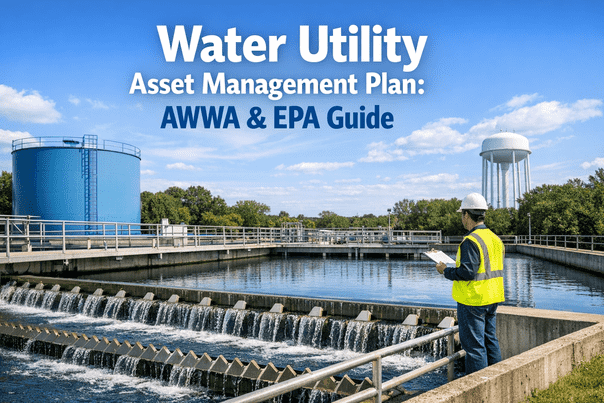
The America's Water Infrastructure Act of 2018 (AWIA) requires every community water system serving more than 3,300 people to certify an asset management program to the EPA every 5 years.Yet the majority of municipal water utilities still manage assets through a combination of spreadsheets, tribal knowledge, and reactive maintenance because they have never connected their SCADA data, GIS registry, CMMS work orders, and condition inspection records into a single coherent view of their infrastructure. iFactory is the operational data platform that makes that connection, providing the condition evidence, deterioration trending, risk scoring, and capital planning tools that AWWA and EPA asset management frameworks require. Book a free asset management readiness assessment for your utility.
AWWA's asset management framework and EPA's AWIA 2018 requirements both demand five core capabilities: asset inventory, condition assessment, risk of failure analysis, consequence of failure analysis, and life cycle cost analysis to support capital planning. iFactory provides the operational data platform for all five capabilities, connecting SCADA monitoring, GIS asset registry, CMMS work orders, and CCTV inspection records into the unified evidence base that AWWA and EPA asset management certifications require.
AWWA's Five Core Asset Management Capabilities and How iFactory Delivers Each
AWWA's asset management framework (AWWA M19, M28, and the AWIAM methodology) defines five sequential capabilities that utilities must build to achieve a comprehensive asset management program. iFactory's platform is structured to populate all five with operational data rather than manual estimates and engineering assumptions. Book a demo to see all five capabilities configured for your utility's asset base.
A complete inventory of significant infrastructure assets including pipes, pumps, tanks, treatment equipment, electrical systems, and instrumentation. Each asset must have recorded attributes: material, size, installation date, location, replacement cost, and criticality to system operation. EPA AWIA requires certification that the utility has identified its assets and their replacement costs.
iFactory imports your existing GIS asset registry and enriches it with operational data: SCADA tag assignment, maintenance history from CMMS, inspection records, and real-time condition status. Assets without GIS records are captured via the iFactory mobile app during field surveys. Replacement cost estimates are populated from material, size, and age data using AWWA replacement cost curves. The resulting asset inventory is live, continuously updated, and exportable in AWIA certification format.
A systematic condition assessment program that evaluates the physical and operational condition of assets on a regular cycle. Condition must be recorded on a standardized scale (AWWA recommends a 1-to-5 scale or equivalent), and the assessment methodology must be documented and defensible. EPA AWIA requires identification of assets critical to providing safe drinking water and their condition.
iFactory provides condition assessment from two complementary sources: continuous monitoring-based condition (for electromechanical assets: pumps, motors, blowers, drives, instrumentation) and inspection-based condition (for pipe and civil assets: NASSCO PACP for sewer, AWWA condition codes for water mains). Monitoring-based condition is updated continuously from SCADA sensor data. Inspection-based condition is updated after each inspection cycle from imported CCTV or field inspection records. Both are displayed on the same 1-to-5 AWWA-equivalent condition scale.
A risk analysis that combines the probability of failure with the consequence of failure to produce a risk score for each significant asset. The probability of failure must account for asset age, condition, material, and historical failure data. The consequence of failure must account for the impact on water service continuity, public health protection, regulatory compliance, and system hydraulic performance.
iFactory's risk model calculates probability of failure from four inputs: current condition score (from continuous monitoring or inspection), deterioration rate (from condition trend over time), material-specific failure mode library (age-adjusted for VCP, RCP, CI, PVC, ductile iron), and historical failure frequency from CMMS records. Consequence of failure is weighted by pipe diameter, service connections affected, proximity to critical facilities (hospitals, fire stations), hydraulic criticality (trunk main versus residential lateral), and regulatory exposure (source protection zones, permit conditions).
A structured assessment of the consequences if each significant asset fails, covering: water service disruption (customers affected, duration), public health impact (backflow risk, contamination potential), regulatory compliance impact (permit violations, public notification triggers), financial impact (emergency repair cost, customer penalty exposure), and resilience impact (system redundancy, backup supply availability).
iFactory calculates consequence scores from GIS-linked attributes for each asset: customer service connections downstream, critical facility connections, isolation zone size (number of valves to close and customers isolated), hydraulic model criticality index, proximity to pressure zone boundaries, and historical repair cost from CMMS. Consequence scores are recalculated automatically when GIS attributes are updated, so the consequence model reflects current system configuration without manual re-entry.
A life cycle cost analysis that evaluates the total cost of owning each asset class over its remaining useful life, comparing the cost of maintaining it in service against the cost of rehabilitation or replacement. The analysis must support a capital improvement plan that prioritizes spending based on risk and life cycle economics, and must demonstrate that the utility can sustain its infrastructure at an adequate service level over the planning horizon.
iFactory's life cycle model combines remaining useful life (from condition and deterioration rate), rehabilitation cost estimate (by method: CIPP, pipe replacement, pump overhaul, motor replacement), maintenance cost projection (from CMMS actual cost trending), and deferral cost escalation (incremental cost increase per year of delay as condition worsens). The output is a ranked capital queue with 1-year, 5-year, and 20-year capital requirement projections and a budget scenario tool that shows the system-wide condition trajectory at different annual spending levels.
AWIA 2018 certification requires demonstrating all five capabilities with documented evidence. iFactory generates that evidence automatically from your existing SCADA, GIS, CMMS, and inspection data, replacing weeks of manual data compilation with on-demand report generation.
AWIA 2018 Certification Cycle: What iFactory Generates for Each Required Document
AWIA 2018 requires community water systems to certify their asset management program to the EPA on a 5-year cycle. The certification requires specific documented evidence for each of the five capability areas. iFactory generates each required document automatically from operational data.
| AWIA 2018 Requirement | Required Evidence | iFactory Output | Generation Time |
|---|---|---|---|
| Asset Inventory Certification | Complete list of significant assets with attributes (material, age, size, location, replacement cost) | GIS-enriched asset registry export with all AWIA required attributes, replacement cost estimates, and asset class summaries | Automated, on-demand |
| Condition Assessment Documentation | Systematic condition assessment methodology, current condition scores for significant assets, assessment frequency by asset class | Condition assessment methodology document, current condition score register by asset class, monitoring and inspection data sources documented with update frequency | Automated, on-demand |
| Risk Analysis Documentation | Risk methodology documentation, risk scores for significant assets, identification of highest-risk assets | Risk model methodology documentation, risk score register for all assets, top 20 highest-risk asset report with supporting condition and consequence data | Automated, on-demand |
| Consequence of Failure Assessment | Consequence scoring methodology, consequence scores for significant assets, identification of assets critical to safe drinking water provision | Consequence model methodology, consequence score register, critical asset list with consequence attributes and GIS-mapped critical service connections | Automated, on-demand |
| Capital Improvement Plan | Risk-prioritized capital plan demonstrating adequate infrastructure investment over a planning horizon | 5-year and 20-year capital plan with risk-ranked rehabilitation queue, annual spending by asset class, budget scenario analysis, and deferral cost modeling | Automated, on-demand |
| Cybersecurity Vulnerability Assessment | Identification of cybersecurity vulnerabilities in SCADA and operational technology systems | iFactory's read-only SCADA integration architecture documentation supporting cybersecurity risk assessment. All data on-premise, no external transmission, read-only OT connection documented. | Architecture documentation provided at deployment |
Client Results: Water Utilities Using iFactory for Asset Management
Average time from iFactory deployment to first complete AWIA certification evidence package ready for EPA submission, versus an average of 14 to 18 months for manual asset management program development.
Average improvement in rehabilitation spending efficiency (defect severity per dollar spent) from risk-based prioritization versus age-based pipe replacement in utilities transitioning to iFactory asset management.
Average value of capital spending reallocated from low-risk to high-risk assets in the first capital cycle following iFactory asset management deployment, based on risk scoring evidence unavailable before iFactory.
Time to generate monthly asset management KPI board report from iFactory automated reporting versus an average of 3 to 4 days of manual data compilation and presentation preparation.
SCADA monitoring, GIS asset registry, CMMS maintenance records, and CCTV inspection history: most utilities have all four. iFactory connects them into a continuous asset management evidence base that generates AWIA certification documentation on demand, not in a 14-month manual project.
iFactory vs Competing Water Utility Asset Management Platforms
Asset management software for water utilities ranges from GIS-integrated CMMS to standalone capital planning tools. iFactory differentiates by being the operational data platform that feeds all five AWWA capability areas from live monitoring and inspection data, rather than a planning tool that requires manual data input. Book a demo to see iFactory compared to your current asset management approach.
| Capability | iFactory | Cityworks (Esri) | Lucity (CentralSquare) | AssetWorks | IBM Maximo | Brightly Asset Essentials | iWorQ Systems | Trimble Unity |
|---|---|---|---|---|---|---|---|---|
| AWWA/EPA Asset Management Capabilities | ||||||||
| Condition data from live SCADA monitoring (not manual entry) | Continuous from SCADA sensors | Manual condition entry | Manual condition entry | Manual condition entry | Via IoT integration | Manual condition entry | Manual condition entry | Via sensor integration |
| Risk score auto-calculated from condition plus consequence | Automatic from monitoring and GIS | Configurable scoring | Configurable scoring | Asset risk scoring | Via analytics module | No | No | Configurable |
| Deferral cost modeling for AWWA life cycle analysis | Annual cost escalation per asset | Not available | Not available | Not available | Via cost analytics module | No | No | No |
| AWIA 2018 certification package auto-generation | All 5 sections auto-compiled | Manual report assembly | Manual report assembly | Report export available | Via reporting module | No | Basic reports | Report export available |
| Architecture and Security | ||||||||
| On-premise deployment (government data sovereignty) | Full on-premise | Cloud or on-prem | Cloud or on-prem | Cloud or on-prem | Cloud or on-prem | Cloud SaaS | Government cloud | Cloud or on-prem |
| AWIA cybersecurity read-only OT architecture documentation | Provided at deployment | Customer-managed | Customer-managed | Customer-managed | Customer-managed | Cloud security docs | Customer-managed | Customer-managed |
Based on publicly available product documentation as of Q1 2025. Verify capabilities with each vendor before procurement decisions.
Regional Compliance: Asset Management Requirements by Region
Water utility asset management requirements are increasing in stringency globally, driven by aging infrastructure, regulatory oversight, and federal funding program requirements that mandate documented asset management programs as a condition of grant or loan eligibility.
| Region | Asset Management Requirements | iFactory Coverage |
|---|---|---|
| USA | AWIA 2018 (P.L. 115-270) requires community water systems serving over 3,300 people to certify an asset management program to EPA every 5 years. EPA Water Infrastructure Finance and Innovation Act (WIFIA) loan program requires demonstration of a sustainable asset management program. State Revolving Fund (SRF) programs in 30+ states require asset management plans as a condition of eligibility. USDA Rural Development Water and Waste Disposal loan and grant program requires asset management plans for communities under 10,000 population. | AWIA 2018 all 5 sections certification documentation. WIFIA loan program asset management evidence. State SRF eligibility documentation. USDA Rural Development asset management plan support. All data on-premise within US jurisdiction. Cybersecurity architecture documentation for AWIA vulnerability assessment. |
| UAE | UAE Vision 2031 infrastructure sustainability requirements for water utilities. Abu Dhabi Department of Energy (DoE) utility asset management framework for ADWEC and ADDC. DEWA Dubai Electricity and Water Authority strategic asset management program requirements. UAE Smart Utility initiative requiring digital asset management documentation. GCC Unified Water Policy requiring utilities to demonstrate infrastructure investment adequacy. Saudi Water Authority (SWA) asset management program for Saudi water utilities. | UAE Vision 2031 infrastructure sustainability evidence. DEWA and ADWEC asset management framework documentation. Smart Utility digital asset registry. GCC investment adequacy demonstration. SWA asset management program support. Arabic platform outputs. All data on-premise within UAE jurisdiction. |
| UK | Ofwat Asset Management Periods (AMP8, currently in development) require water companies to demonstrate 25-year investment plans with asset condition evidence. Drinking Water Inspectorate (DWI) requires maintenance programs proportionate to infrastructure risk. UK Infrastructure Bank and UKIB financing requires asset management program evidence. Water Industry Act 1991 statutory duties require adequate maintenance of infrastructure. Environment Agency requires infrastructure resilience demonstrations for abstraction license holders. | Ofwat AMP8 25-year investment plan evidence. DWI proportionate maintenance program documentation. UKIB financing asset management evidence. Water Industry Act statutory duty compliance records. EA infrastructure resilience demonstration. All data on-premise within UK jurisdiction. |
| Canada | Infrastructure Canada Investing in Canada Infrastructure Program (ICIP) requires asset management plans as a funding eligibility condition for water projects. Canada Infrastructure Bank (CIB) financing requires utility asset management program documentation. Provincial requirements: Ontario O. Reg. 588/17 (Asset Management Planning for Municipal Infrastructure) requires all Ontario municipalities to have asset management plans by 2024. Quebec, BC, and Alberta have similar provincial frameworks. FCM Green Municipal Fund requires asset management plans. | Infrastructure Canada ICIP eligibility documentation. CIB financing asset management evidence. Ontario O. Reg. 588/17 compliance documentation. Provincial asset management framework support across Canada. FCM Green Municipal Fund application evidence. Bilingual EN/FR platform. All data on-premise within Canada. |
| Germany / EU | EU Cohesion Fund and European Regional Development Fund (ERDF) water infrastructure projects require asset management plans. European Investment Bank (EIB) water infrastructure financing requires documented asset management programs. EU Water Framework Directive cost recovery assessment requires demonstrating efficient infrastructure investment. German KfW municipal infrastructure financing requires asset management plans. DVGW technical standards W 1000 and W 1001 provide the German utility asset management framework. | EU Cohesion Fund and ERDF project eligibility documentation. EIB financing asset management evidence. WFD cost recovery efficiency demonstration. KfW financing requirements. DVGW W 1000/W 1001 framework documentation. GDPR compliant on-premise data. EU data residency guaranteed. |
Frequently Asked Questions
Continue Reading
All five AWWA capability areas. AWIA certification documentation auto-generated from SCADA, GIS, CMMS, and inspection data. Risk-prioritized capital plan for SRF and WIFIA funding applications. On-premise deployment within your government network satisfying AWIA cybersecurity requirements.



-complete-guide.png)