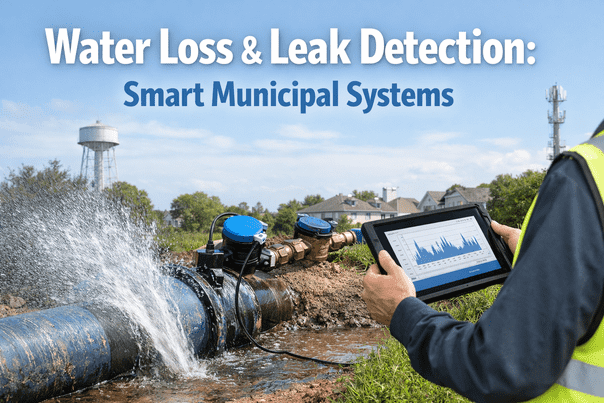
Municipal water distribution systems fail incrementally, not catastrophically. A gate valve last exercised in 2019 that is now seized partially closed creates a pressure restriction that operators have compensated for rather than corrected. A PRV drifting 8 PSI above its setpoint is accelerating main breaks in that zone. A hydrant flagged for packing repair during the last flush cycle still does not have a work order. iFactory connects to your SCADA, AMI meter infrastructure, pressure monitoring network, and GIS asset registry to monitor valves, PRVs, hydrants, and distribution mains continuously, issuing prioritized condition-based work orders before accumulated deferred maintenance becomes a main break or a regulatory violation. Book a free distribution system assessment for your utility.
iFactory monitors four water distribution asset categories from your existing SCADA, AMI, pressure loggers, and GIS data: isolation valves (exercising compliance, stuck valve detection), pressure reducing valves (setpoint drift, pilot valve condition), fire hydrants (flushing compliance, flow test trending), and distribution mains (DMA night flow leak detection, pressure zone integrity, main break risk scoring). All monitoring generates prioritized work orders automatically with no manual data entry required.
Four Asset Categories: What iFactory Monitors and Why
Distribution system analytics is most effective when all four asset categories are monitored simultaneously, because failure in one category frequently cascades to another. A stuck isolation valve cannot contain a main break. A PRV drifting high accelerates pipe fatigue. iFactory monitors all four from the data sources your utility already has. Book a demo to see all four configured for your service territory.
DMA night minimum flow analysis identifies active leaks to within a zone boundary using AMI data your utility already collects. iFactory connects to your AMI system and delivers a ranked leak zone list before any field crew is dispatched.
Implementation Roadmap: GIS Connection to Full Distribution Analytics in 3 Weeks
iFactory's distribution analytics deployment connects to your existing SCADA, GIS, and AMI data infrastructure. No new field infrastructure is required in most systems. Book a demo to confirm data source compatibility for your specific infrastructure.
GIS asset registry imported (valves, PRVs, hydrants, mains with pipe material and age). SCADA pressure monitoring connected via OPC-UA or Modbus read-only. AMI meter DMA data connected via API or batch export. All data sources mapped to distribution asset categories.
AWWA M44 valve exercising intervals and AWWA M17 hydrant flushing intervals configured per state regulatory requirement. PRV setpoint baselines established from SCADA history. DMA night minimum flow baselines established per zone from 30 days of AMI history. Main break risk model calibrated from break history and GIS pipe data.
All four monitoring categories live with automatic work order generation. Compliance dashboard shows valve exercising, hydrant flushing, and PRV status across all assets. NRW monthly report generated automatically from DMA data. AWWA water loss audit data compiled automatically.
Client Results: Municipal Water Utilities Using iFactory
Average non-revenue water percentage reduction within 18 months through DMA leak detection and prioritized repair across all municipal utility deployments.
Average reduction in emergency main break response events through pipe risk scoring, targeted rehabilitation prioritization, and pressure transient detection within 12 months.
Average compliance rate achieved within 12 months of iFactory tracking deployment, versus an average of 71% using manual scheduling alone.
Time to generate monthly NRW and AWWA water loss audit data from iFactory automated reporting versus 3 to 4 days of manual AMI data extraction and spreadsheet work.
SCADA, AMI meters, GIS registry, and field inspection mobile records. iFactory integrates all four distribution data sources and generates prioritized condition-based work orders automatically, with all data remaining on-premise within your facility.
iFactory vs Competing Municipal Distribution Management Platforms
Distribution system platforms range from GIS-integrated CMMS to standalone leak detection systems. iFactory differentiates by integrating all four asset categories with predictive work order generation and on-premise deployment that satisfies government data sovereignty requirements. Book a demo to see iFactory compared to your current distribution management tools.
| Capability | iFactory | Cityworks (Esri) | Brightly Asset Essentials | Lucity (CentralSquare) | IBM Maximo | MaintainX | Limble CMMS | iWorQ Systems |
|---|---|---|---|---|---|---|---|---|
| Distribution Monitoring and Analytics | ||||||||
| DMA night flow leak detection from AMI data | Zone-level leak identification | No analytics layer | No analytics layer | No analytics layer | Via add-on modules | No | No | No |
| PRV setpoint drift pre-alert from SCADA | Pre-alert at 5 PSI drift | SCADA display only | No SCADA integration | SCADA via integration | Via configuration | No | No | No |
| Main break risk scoring (pipe age, material, history) | GIS plus break history AI model | GIS visualization only | No | Asset history tracking | Via asset analytics module | No | No | No |
| Compliance Tracking and Architecture | ||||||||
| Valve and hydrant compliance tracking (AWWA M44/M17) | Automated per-asset tracking | GIS-based scheduling | PM scheduling | PM scheduling | PM scheduling | PM scheduling | PM scheduling | PM scheduling |
| On-premise deployment (government data sovereignty) | Full on-premise | Cloud or on-prem | Cloud SaaS | Cloud or on-prem | Cloud or on-prem | Cloud SaaS | Cloud SaaS | Government cloud |
| AWWA water loss audit data auto-compiled | Auto from AMI and SCADA | Manual data assembly | No | Manual data assembly | Via reporting module | No | No | No |
Based on publicly available product documentation as of Q1 2025. Verify capabilities with each vendor before procurement decisions.
Regional Compliance: Distribution System Monitoring Requirements
Water distribution system compliance requirements vary by region but all mandate valve exercising records, hydrant flushing documentation, and increasingly stringent NRW reporting. iFactory's on-premise architecture keeps all distribution data within your jurisdiction.
| Region | Key Distribution Compliance Requirements | iFactory Coverage |
|---|---|---|
| USA | AWWA M44 valve exercising, M17 hydrant flushing, EPA Lead and Copper Rule distribution monitoring, EPA Total Coliform Rule, AWIA 2018 asset management requirements, state-specific NRW reporting, NFPA 291 fire flow testing, EPA eReporting (NetDMR) for distribution data | AWWA M44 and M17 compliance tracking per asset. EPA LCR sampling site management. TCR distribution monitoring. NRW tracking by zone. NFPA 291 flow test result trending. AWIA asset condition evidence. All data on-premise within US jurisdiction. |
| UAE | UAE Federal Law No. 24 distribution pressure requirements, DEWA technical guidelines for distribution network operation, Abu Dhabi EAD distribution maintenance standards, UAE Smart Water Network AMI requirements, GCC Unified Water Policy distribution performance indicators, NRW targets under MOCCAE water efficiency programs | UAE distribution pressure compliance monitoring. DEWA technical standards tracking. Smart Water Network AMI integration for NRW analysis. GCC performance indicators. Arabic platform outputs. All data on-premise within UAE. |
| UK | Ofwat PR24 leakage performance commitment, Water UK Leakage Operational Framework, DWI Water Supply Regulations distribution requirements, BS EN 805 pressure standards, Environment Act 2021 water efficiency obligations, Statutory Security Standards for distribution network resilience | Ofwat leakage performance commitment tracking. DMA NRW analysis for leakage reporting. Pressure zone compliance. Water UK leakage framework evidence. BS EN 805 compliance. All data on-premise within UK. |
| Canada | Health Canada Guidelines distribution residual monitoring, provincial water loss auditing requirements (Ontario Municipal Drinking Water Licences, BC Drinking Water Protection Act, Alberta EPEA), AWWA standards adopted provincially for valve and hydrant maintenance, Infrastructure Canada asset management reporting, CPTED security standards for utility assets | Provincial water loss audit data. Distribution residual chlorine monitoring. AWWA valve and hydrant compliance tracking. Infrastructure Canada asset management evidence. Bilingual EN/FR support. All data on-premise within Canada. |
| Germany / EU | EU Drinking Water Directive 2020/2184 distribution monitoring, German TrinkwV distribution sampling and pressure requirements, DVGW W 400 distribution network technical standards, EU NIS2 for water distribution OT security, GDPR for distribution network monitoring data, EU taxonomy for sustainable infrastructure reporting | EU DWD distribution monitoring compliance. TrinkwV pressure and sampling standards. DVGW W 400 technical standard tracking. NIS2 OT security for distribution SCADA. GDPR compliant on-premise processing. EU data residency guaranteed. |
Frequently Asked Questions
Continue Reading
AMI meter data, pressure SCADA, GIS asset registry, and field inspection mobile records. iFactory integrates all four distribution data sources and generates prioritized work orders automatically. All data on-premise within your government network. Deployed in 3 weeks.