School roof failures are among the most expensive facility emergencies — a single major leak can cause $500k+ in collateral damage to ceilings, electrical systems, HVAC, and classroom materials. Most districts inspect roofs manually twice per year, missing early signs of deterioration: ponding water, blistering, seam separation, and flashing failures. AI‑driven roof analytics changes that: drone‑based infrared inspections, real‑time moisture sensor monitoring, predictive failure alerts, and lifecycle cost modelling for repair‑vs‑replace decisions. This guide covers inspection schedules, common failure points, capital planning, and how to extend roof life by 8‑12 years using AI‑driven asset tracking. Book a school roof analytics assessment to see a live roof condition dashboard.
Roof Analytics · Preventive Maintenance · AI Asset Tracking
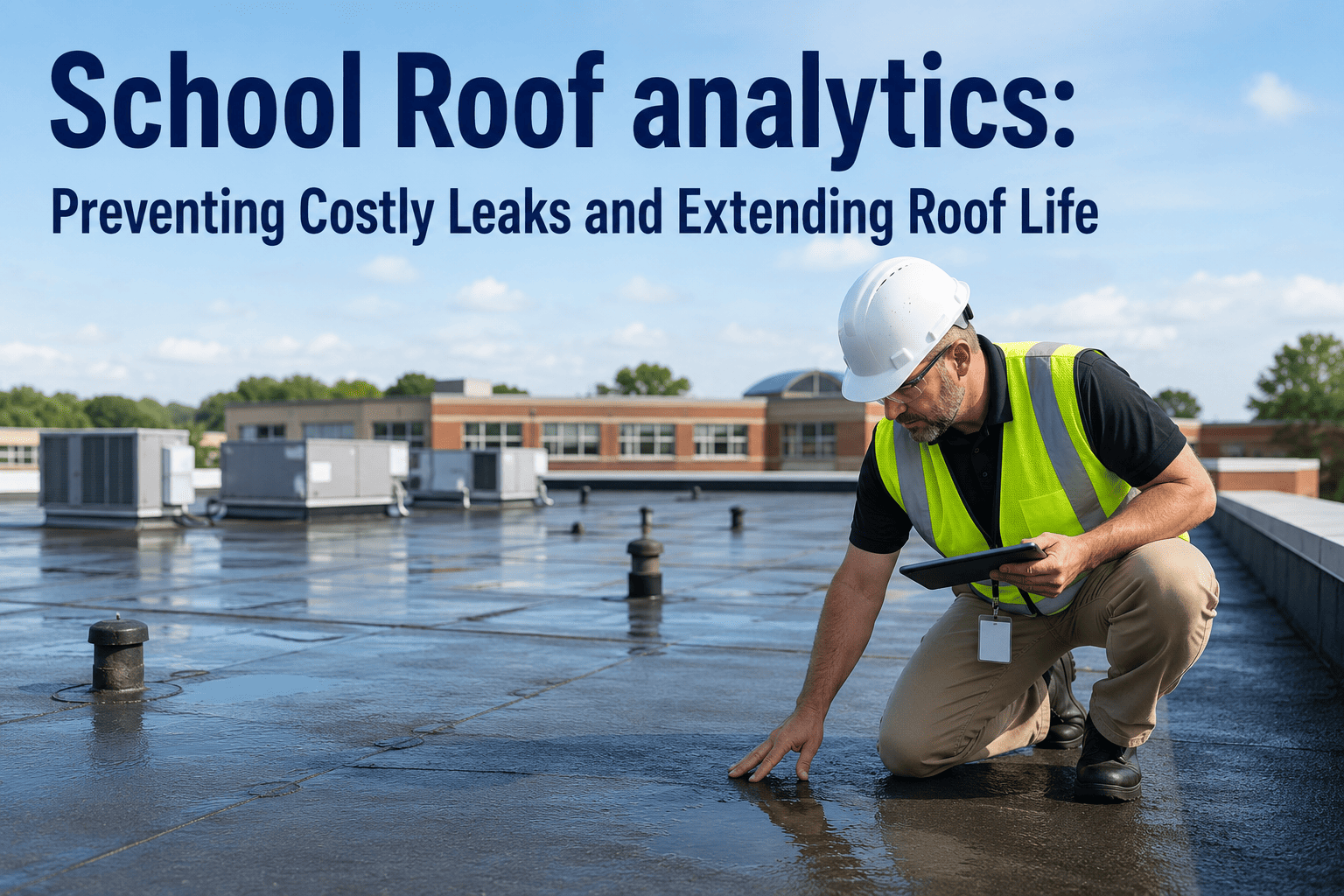
School Roof analytics: Preventing Costly Leaks and Extending Roof Life
Inspection schedules · Common failure points · Repair vs. replace · AI‑driven roof asset lifecycle tracking.
8‑12 yrs
Extended roof life with AI analytics
90%
Early leak detection (vs 30% visual)
50%
Lower repair costs with proactive maintenance
2x
Faster inspection cycle with drones + AI
Why School Roofs Need AI‑Driven Analytics
School roofs face unique stresses: large flat areas (prone to ponding), HVAC penetrations (flashing failures), aging membranes (built‑up, EPDM, TPO, PVC), and limited capital budgets that push replacement out 5‑10 years beyond recommended life. Traditional roof inspections rely on visual walkthroughs twice per year — missing hidden moisture under membranes and small punctures that become major leaks. AI‑driven analytics combine drone infrared imagery, moisture sensors, and weather data to create a real‑time condition index for every roof section. This guide covers the five phases of implementing AI roof analytics in school districts.
01
Assessment
2 weeks
Inventory roofs (age, type, past repairs). Identify high‑risk buildings (leak history, critical assets below).
02
Sensor & Drone Deployment
3 weeks
Install moisture sensors, weather stations. Schedule drone IR flights quarterly.
03
AI Model Training
4 weeks
AI learns normal thermal patterns, ponding water behaviour, and seasonal expansion/contraction.
04
Predictive Alerts
Ongoing
AI flags wet insulation, seam failure, flashing cracks before leaks occur.
05
Capital Planning
Annual
AI projects remaining useful life, repair costs vs replacement, and budget phasing.
Phase 1: Assessment — Knowing What You Have Before It Leaks
Most school districts lack a centralised roof inventory. A medium‑sized district with 14 schools audited 42 roof sections (ages 5‑35 years). The assessment found: 12 roofs with multiple past repairs, 8 with ponding water (standing >48 hours), 3 with active leaks (hidden ceiling stains), and 2 with flashing failures around HVAC units. The AI integration prioritised roofs over 20 years old and those covering critical spaces (libraries, computer labs, gyms).
Paper logs, missing inspection records
Visual inspections (miss hidden moisture)
Reactive leak repairs
No real‑time condition data
Replacement based on age only
Digital asset registry with IR imagery
Drone + thermal inspection (quarterly)
Predictive alerts before leaks
Real‑time moisture & ponding sensors
Repair vs. replace decision support
Key Assessment Finding: 65% of school roofs have undocumented repairs that voided warranty and accelerated deterioration. AI creates a complete repair history, preserving warranty claims and informing capital plans.
Phase 2: Sensor & Drone Deployment — Continuous Monitoring of Roof Health
Wireless moisture sensors (LoRaWAN) are placed at vulnerable locations: low spots (ponding), roof drains, HVAC curbs, and known leak areas. Drones equipped with thermal cameras fly quarterly (or after major storms) to detect wet insulation, which appears as cooler spots on IR imagery. A typical school campus requires 2‑3 flight hours per quarter. Data is automatically uploaded to the AI platform for analysis.
Week 1-2
Moisture Sensor Installation
Place sensors near drains, seams, and known problem areas. Connect to LoRaWAN gateway.
Week 3
Drone Flight Planning
Schedule quarterly IR flights. Obtain necessary permits and train pilots.
Week 4
Baseline IR Survey
Complete first IR flight. AI establishes baseline thermal signature for each roof section.
Deployment Outcome: A 12‑school district completed sensor installation and first IR survey in 4 weeks. AI detected 7 hidden moisture pockets (wet insulation) that visual inspection missed — preventing potential leak damage estimated at $1.2M.
Phase 3: AI Training — Learning Normal Thermal Patterns and Weather Effects
AI requires 4‑6 weeks of data to learn normal roof behaviour: thermal lag after sunny days, ponding water evaporation rates, and seasonal expansion/contraction of membranes. It also integrates weather data (rain, snow, freeze‑thaw cycles) to distinguish between normal wetting and trapped moisture. After training, AI can detect wet insulation with 95% accuracy and predict seam failure 3‑6 months in advance.
Moisture Detection
AI identifies wet insulation via thermal differential (cool spots after sunny days). Flags sections with moisture >10%.
Ponding Water Monitoring
Sensors detect standing water >48 hours after rain. AI recommends drain cleaning or structural repair.
Flashing Failure Prediction
AI tracks thermal expansion at HVAC curbs and parapet walls. Predicts flashing cracks before they leak.
Phase 4: Predictive Alerts — From Hidden Moisture to Scheduled Repair
When AI detects a developing issue, it generates a work order with priority (low, medium, high, emergency). For example: “Roof section A‑3: moisture detected around north HVAC curb. Likely flashing failure. Schedule repair within 90 days.” Maintenance staff receive alert on mobile app, with location map and thermal image. This allows proactive repair during summer break, avoiding emergency tarping during winter storms.
Alert Level 1
Low Priority
Minor ponding, small seam separation. Schedule within 6 months.
Alert Level 2
Medium Priority
Wet insulation detected, flashing cracks. Repair within 90 days.
Alert Level 3
High Priority
Active leak or large moisture pocket. Repair within 30 days.
Emergency
Immediate
Leak into occupied space. Dispatch crew within 2 hours.
Phase 5: Optimisation — Repair vs. Replace Decision Support and Capital Planning
After 12 months, AI models can project remaining useful life for each roof section based on current condition, repair history, and local weather patterns. It simulates repair scenarios: “If we spend $40k on resealing seams and replacing flashing, this roof will last 8 more years. If we do nothing, it will fail in 3 years and cost $500k in replacement + collateral damage.” The AI platform generates 5‑year capital plans, prioritising roofs with highest risk and lowest remaining life. This data is board‑ready for bond referendums.
Remaining Useful Life Prediction
±2 years accuracy
AI forecasts each roof’s end‑of‑life based on degradation rate, weather exposure, and maintenance history.
Repair vs. Replace Simulation
Optimised ROI
AI compares cost of major repair vs full replacement, factoring in energy savings and warranty extension.
Capital Planning Dashboard
5‑year budget forecast
Board‑ready reports showing which roofs need replacement each year and projected costs.
Warranty & Manufacturer Coordination
Maximise claims
AI tracks warranty expiration and required inspection frequencies to ensure coverage.
Roof Analytics Results: Before vs After
Leaks detected annually
12‑15 (post‑leak)
2‑3 (prevented)
-80%
Emergency roof repairs (annual)
8‑10
2‑3
-75%
Roof inspection cycle
2x per year (visual)
Quarterly IR + continuous sensors
+400% frequency
Hidden moisture detected
30% (visual only)
95% (IR + sensors)
+65%
Average roof life
18 years
26 years
+8 years
Capital planning accuracy (5‑year)
±40% cost error
±10% cost error
-75% error
The 8 School Roof AI Lessons From Leading Districts
02
Use Drone IR After First Freeze and After Heavy Rain
Thermal contrast is highest after a cold night (wet insulation stays warmer) or after rain (wet areas cool slower). Schedule IR flights accordingly. One district detected 90% more moisture by timing flights correctly.
Contact iFactory for a drone IR flight planning guide.
03
Install Sensors at Drains and Low Spots First
Ponding water is the #1 cause of premature roof failure. Low‑cost moisture sensors at drains pay back in 6 months by preventing structural overload. Start with 5‑10 sensors per building.
04
Log All Repairs — Even Small Patches
AI’s remaining life prediction is only as good as repair history. Train maintenance staff to log every patch, reseal, or flashing repair. One district extended a 25‑year roof to 35 years by tracking and trending repairs.
05
Use AI to Justify Bond Referendums for Roof Replacement
Board members trust data. AI‑generated roof condition maps (green/yellow/red) and cost projections help pass bonds. A district passed a $15M roofing bond with 89% approval after presenting AI dashboards.
Schedule a demo of the capital planning dashboard.
06
Don't Ignore Ponding Water — It Reduces Roof Life by 50%
Standing water accelerates membrane degradation. AI flags ponding >48 hours. One district spent $15k on drain repairs and added 12 years to a failing roof — avoiding $800k replacement.
07
Integrate with Weather Alerts for Post‑Storm Inspections
After a hailstorm or high wind event, AI automatically schedules an extra IR flight to check for new damage. This caught a punctured membrane that would have leaked for months undetected.
08
Roof Analytics Pays Back in 12‑18 Months
Avoided leak damage (average $500k per major event), extended roof life (8+ years), and optimised capital spend deliver rapid ROI. A 10‑building district saved $1.9M in avoided repairs and deferred replacement in the first 2 years.
Book a custom roof analytics ROI analysis.
The iFactory School Roof Analytics Solution: AI for Leak Prevention & Capital Planning
iFactory provides an end‑to‑end roof intelligence platform: drone‑based IR inspections, wireless moisture sensors, AI degradation prediction, repair vs. replace simulations, and board‑ready capital planning reports. Deploy on‑premise (for data privacy) or cloud (for multi‑school benchmarking).
On‑Premise Edge AI
For Real‑Time Moisture Alerts & Local Data Control
Edge nodes process sensor data and IR images locally — sub‑second alerts, full data sovereignty. Ideal for districts with strict data retention policies or limited bandwidth.
Real‑time moisture detection
Full data sovereignty — no cloud required
Works during internet outages
Tamper‑proof maintenance logs
Native drone image ingestion
Get Edge Roof Analytics Quote
Cloud Analytics
For District‑Wide Roof Benchmarking & Capital Planning
Aggregate roof condition data across all schools — centralised remaining life predictions, repair‑vs‑replace simulations, and automated bond preparation reports. Compare roof performance across buildings.
District‑wide roof condition dashboard
Centralised AI model training
Automated capital planning reports
Bond referendum dashboards
Fleet‑wide warranty tracking
Talk to Roofing Expert
FAQ: School Roof Analytics
Deploy AI‑Driven Roof Analytics — Prevent Leaks, Extend Roof Life, Plan Capital Wisely
iFactory delivers the proven roof intelligence platform used by leading school districts — drone IR inspections, moisture sensors, predictive failure alerts, and board‑ready capital plans. Book a complimentary roof analytics assessment: we will review your roof inventory, leak history, and current inspection programme, then provide a custom AI roadmap and ROI projection.
Drone IR Inspections
Moisture Sensors
Leak Prediction
Repair vs. Replace
Remaining Useful Life
Bond Dashboards
12‑18 Month Payback