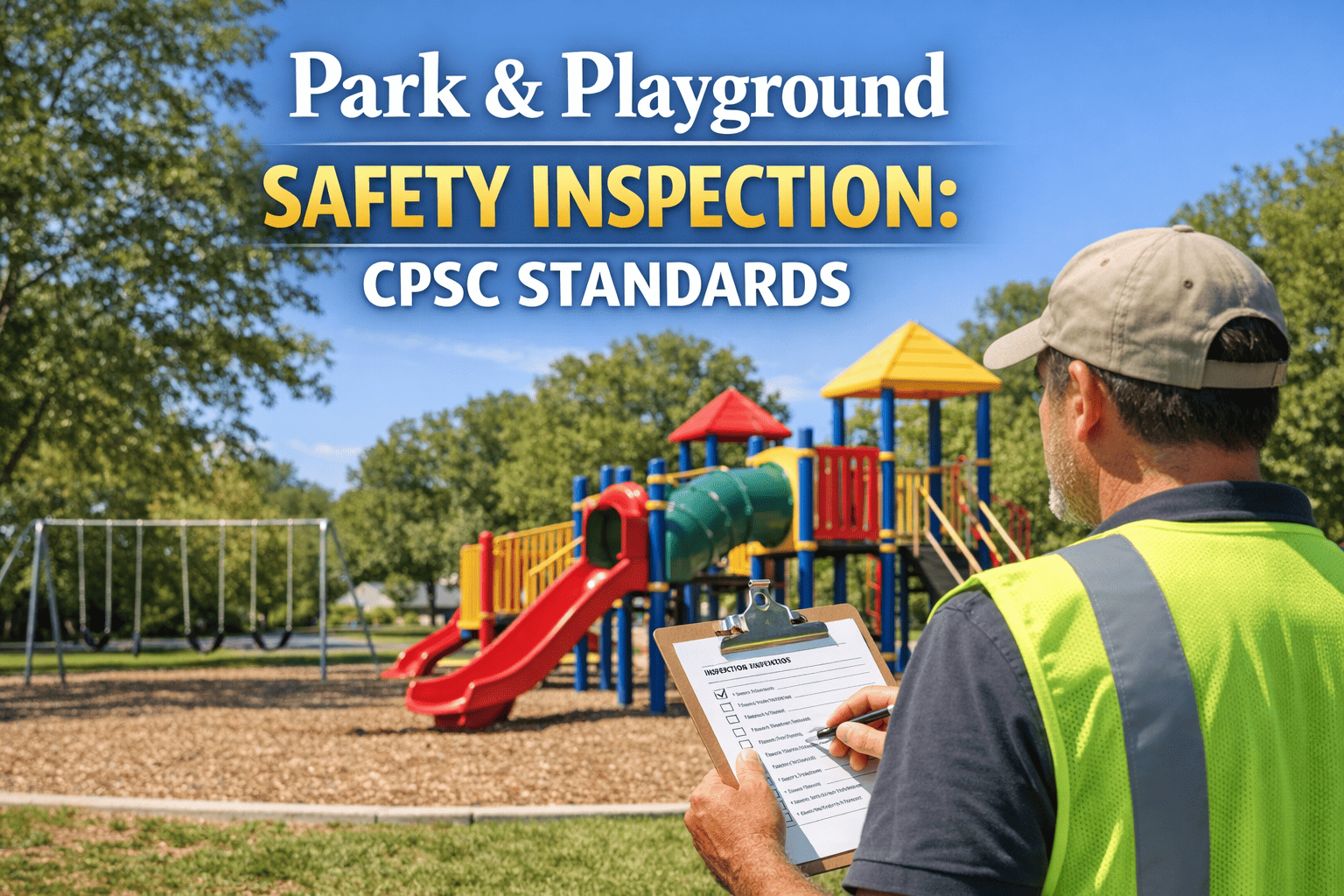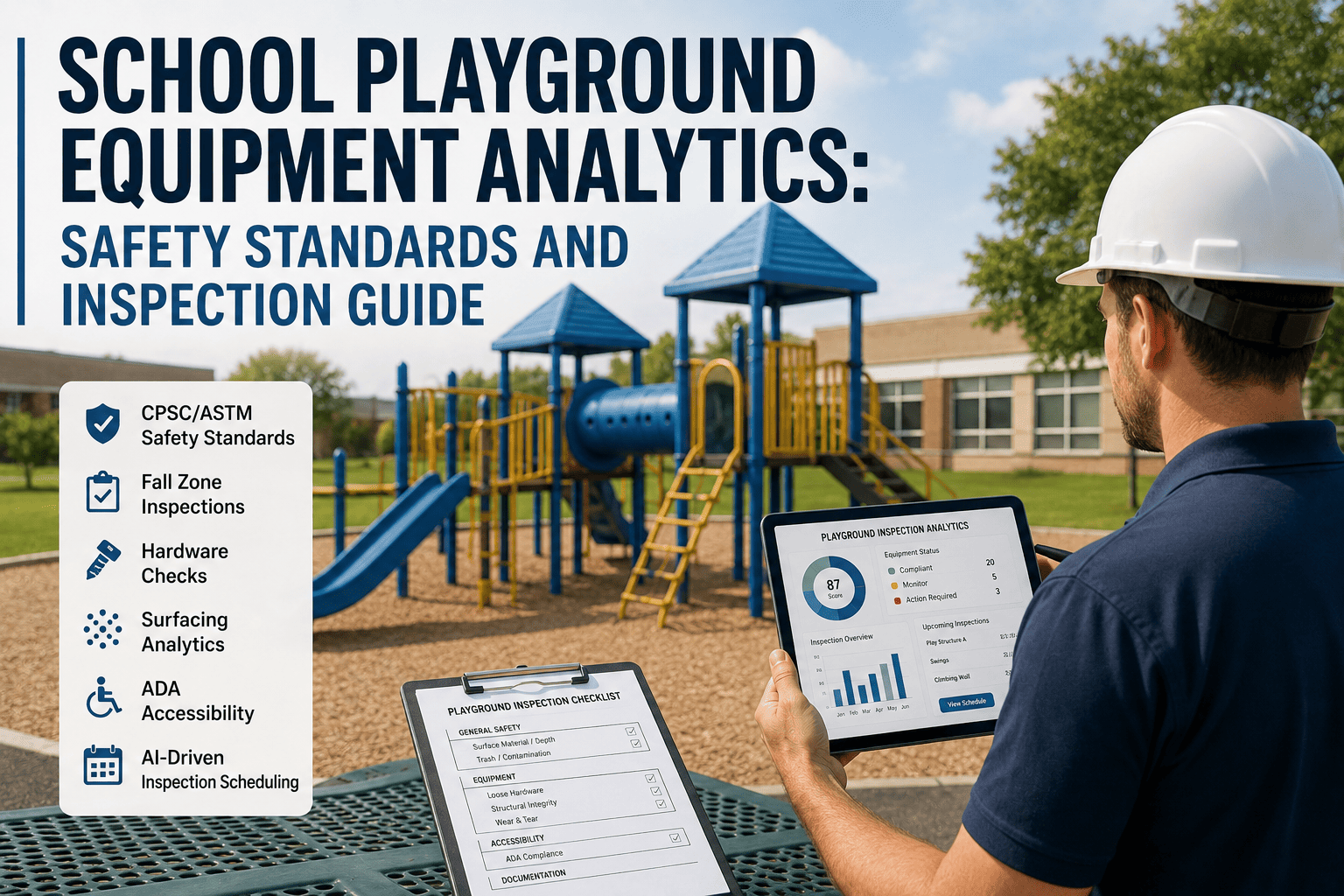
School playgrounds are high-risk facilities. A broken spring on a swing seat can cause a child's arm to be caught. A worn impact-absorbing surface can fail to protect during a fall. A rusted bolt on climbing equipment can break under load. Most school administrators don't know their playgrounds are in compliance with CPSC (Consumer Product Safety Commission) and ASTM (American Society for Testing and Materials) standards until an injury happens and liability becomes apparent. Reactive facility management costs schools in two ways: personal injury liability (lawsuits, settlements, trauma) and operational liability (regulatory fines, facility closure). Proactive playground safety management requires systematic inspections following CPSC/ASTM standards, documented maintenance, and proof of compliance. This guide walks through CPSC/ASTM safety standards in practical terms, explains the inspection checklist every school should follow monthly and annually, and shows how AI-driven inspection scheduling ensures no equipment falls through the cracks. See how schools automate playground safety compliance — Book Demo with Us.
School Playground Equipment Analytics: Safety Standards and Inspection Guide
CPSC/ASTM compliance explained · Fall zone inspection · Hardware checks · Surfacing analytics · ADA accessibility · AI-driven scheduling.
Playground Safety Crisis: Why Inspections Matter
A child falls from a 6-foot climber onto hard-packed ground. Concussion. Parents sue the school district. Investigation reveals: equipment had excessive fall height and no adequate impact-absorbing surface. The district had no documented inspection records proving compliance with safety standards. Settlement: $2M. This scenario repeats across America because playgrounds are often the lowest priority for facility managers — until an injury forces attention. CPSC and ASTM publish detailed standards precisely because playground injuries are predictable and preventable. Every piece of playground equipment has specific inspection requirements, maintenance schedules, and replacement timelines. Schools that follow these standards systematically experience near-zero injury rates. Schools that ignore them roll the dice.
CPSC & ASTM Standards: What They Require
What it is: CPSC publishes "Guidelines for Public Playground Safety" covering equipment design, installation, maintenance, and inspection. Not federal law, but industry standard and legal expectation in negligence cases.
Key requirements:
- Fall height documentation for each piece of equipment
- Impact-absorbing surface (mulch, rubber, sand) meeting thickness requirements
- Equipment spacing (minimum distance between pieces)
- Age-appropriate equipment zones (toddler vs school-age)
- Monthly visual inspections + annual detailed inspections
- Documented maintenance and repair records
Inspector checklist: Is your equipment CPSC-compliant? Do you have inspection records for the past 12 months?
What it is: ASTM publishes detailed technical standards (ASTM F1487 for playground equipment, ASTM F1292 for fall surface testing). More specific than CPSC; used by engineers and safety inspectors.
Key requirements:
- Hardware inspection (bolts, fasteners, rust/corrosion)
- Surface impact testing (shock absorption measurement)
- Entrapment hazard checks (gaps/openings that could trap limbs)
- Structural integrity assessment (stress testing)
- Annual third-party certification (many districts hire ASTM-certified inspectors)
Inspector checklist: Have you had an ASTM-certified inspector evaluate your playground in the past year?
What it is: ADA requires playgrounds be accessible to children with disabilities. Not just physical access (wheelchair ramps), but usability (equipment adapted for different abilities).
Key requirements:
- Accessible route to playground (path without barriers)
- Ground-level play options (not just elevated)
- Wheelchair-accessible equipment (if feasible)
- Sensory equipment (for visually/hearing impaired children)
- Accessible seating/rest areas
Inspector checklist: Can a child in a wheelchair access and use your playground? Are there ground-level play options?
The 5-Point Playground Inspection Framework
What to check:
- Impact surface depth: Measure mulch/rubber thickness. CPSC requires 6–12 inches depending on equipment fall height. Compressed or missing surface = liability.
- Surface coverage area: Fall zone extends 2–6 feet in all directions from equipment. Bare ground outside fall zone = accident waiting to happen.
- Surface degradation: Is mulch compacted? Is rubber cracking? Both reduce shock absorption. Replace/refresh annually.
- Foreign objects: Rocks, sticks, glass in fall zone? Remove immediately.
Monthly check (5 min): Visual inspection of surface completeness and cleanliness.
Annual check (30 min): Measure mulch depth at 5+ points under equipment. Test surface compaction. Document findings.
What to check:
- Bolts & fasteners: Are they tight? Any missing? Rust or corrosion? Corroded fasteners can fail unexpectedly. Tighten/replace as needed.
- Welds & connections: Any cracks in welds or connection points? Structural integrity compromised = equipment must be removed.
- Moving parts: Swing chains, pivot bolts, spring loading — do they move freely? Any grinding/squeaking? Lubricate or replace.
- Paint/coating: Peeling paint can expose rust. Touch up or repaint. Lead paint (pre-1978) requires special handling.
Monthly check (10 min): Visual inspection for obvious damage, rust, or loose fasteners.
Annual check (45 min): Detailed hardware inspection with tools. Test fastener tightness. Document all findings.
What to check:
- Gap entrapment: CPSC defines specific gap sizes that trap child's head or limbs (2.25–6 inches = entrapment hazard). Check all gaps: between equipment pieces, around bolts, under railings.
- Equipment spacing: Equipment must be spaced to prevent child from falling from one piece and hitting another. Typically 2–6 feet depending on fall height.
- Protrusions: Any bolts, hooks, or sharp edges protruding? These can snag clothing or cause laceration.
Monthly check (10 min): Visual scan for obvious gap hazards or dangerous spacing.
Annual check (45 min): Measure gaps with feeler gauges. Verify spacing distances. Document any entrapment hazards.
What to check:
- Equipment height labeling: Each piece should have a sign indicating age range (2–5 years, 5–12 years). This prevents toddlers from accessing equipment designed for older children.
- Zone separation: Are toddler equipment and school-age equipment physically separated? Should prevent younger children from entering high-fall-height zones.
- Supervision signage: Is there signage indicating adult supervision required? Important for liability.
Monthly check (5 min): Check that signage is visible and legible. Replace faded or damaged signs.
Annual check (10 min): Verify signage accuracy for each piece of equipment.
What to check:
- Accessible route: Is there a path to playground accessible to children with mobility aids (wheelchair, crutches)? Surface should be firm and slip-resistant.
- Ground-level equipment: Can children with mobility limitations use any equipment? Swings, sandboxes, sensory panels at ground level count.
- Accessible seating: Are there accessible benches for children/caregivers with mobility limitations?
- Accessible parking: For children arriving in wheelchairs or mobility vehicles.
Monthly check (5 min): Visual check that accessible route is clear of obstacles.
Annual check (15 min): Detailed accessibility audit. Document gaps. Plan upgrades.
Monthly vs Annual Inspection Schedule
| Inspection Level | Frequency | Time Required | Inspector | What's Included |
|---|---|---|---|---|
| Visual Inspection | Monthly (first school day of month) | 30–45 min | School staff (trained) | Visible damage, rust, cleanliness, signage, accessible route clear |
| Detailed Inspection | Annually (summer, before reopening) | 3–4 hours | CPSC/ASTM-certified inspector (external) | All 5 points: surface depth, hardware, entrapment, signage, ADA. Full documentation. Maintenance plan created. |
| Post-Incident Inspection | Immediately after injury | 1–2 hours | ASTM inspector + legal team | Detailed documentation of equipment condition and potential injury causes. Critical for liability protection. |
| Maintenance Implementation | As needed (ongoing) | Varies | Facilities team | Repairs, replacements, refinishing. Track every maintenance action for compliance documentation. |
Common Compliance Violations & Fixes
What it looks like: Mulch under a 6-foot climber measured 3 inches (should be 9+ inches). Mulch compacted from years of foot traffic. Shock absorption significantly reduced.
Why it's dangerous: Child falls 6 feet onto inadequate surface. Head injury results. Impact surface failed to protect.
Fix: Add mulch to reach 9-inch depth. Loosen compacted mulch. Alternatively, replace with engineered wood fiber or engineered rubber. Budget: $1,000–3,000 per equipment zone.
Prevention: Aerate/refresh mulch annually. Document depth measurements. Replace mulch every 3–5 years.
What it looks like: Swing set bolts showing rust. Hand-tightening one bolt causes it to spin freely (threads stripped). Fasteners corroded, integrity compromised.
Why it's dangerous: Equipment structural integrity fails. Bolt shears under load. Swing falls with child attached.
Fix: Replace all corroded fasteners. Use stainless steel bolts (rust-resistant). Re-torque all bolts to specification. Budget: $200–500 per piece of equipment.
Prevention: Inspect bolts monthly. Apply anti-corrosion coating annually. Use stainless steel fasteners on new equipment.
What it looks like: Gap between climbing bars measures 3.5 inches (CPSC defines 2.25–6 inch gaps as entrapment hazard). Child's head could fit through and get stuck.
Why it's dangerous: Strangulation or asphyxiation risk if child's neck gets trapped.
Fix: Reduce gap below 2.25 inches or above 6 inches by adding guard panels or repositioning bars. Budget: $300–1,000 depending on equipment.
Prevention: When installing new equipment, verify all gaps meet CPSC specifications before placement.
What it looks like: 6-foot climbing structure has no age-range sign. Toddlers (2–3 years) access equipment designed for 5–12 year olds. Fall height exceeds toddler protection requirements.
Why it's dangerous: Age mismatch between child and equipment increases injury risk. Signage is primary control preventing inappropriate use.
Fix: Install CPSC-compliant age-range signs on all equipment. Signs must specify: "Ages 5–12 years." Include supervision requirement. Budget: $50–100 per sign.
Prevention: Require signage during installation. Replace faded signs annually. Document signage in compliance records.
AI-Driven Inspection Automation: Scheduling & Documentation
Playgrounds require systematic inspection. Without automation, inspections get deferred. "We'll do it next month." Next month becomes next quarter. A year passes with zero documented inspections. When injury occurs, the absence of inspection records becomes damaging evidence. AI-driven playground management automates scheduling and documentation:
System sends calendar reminder: "Monthly playground inspection due." Links to inspection checklist. Inspection assigned to facilities staff. Non-completion flagged to supervisor.
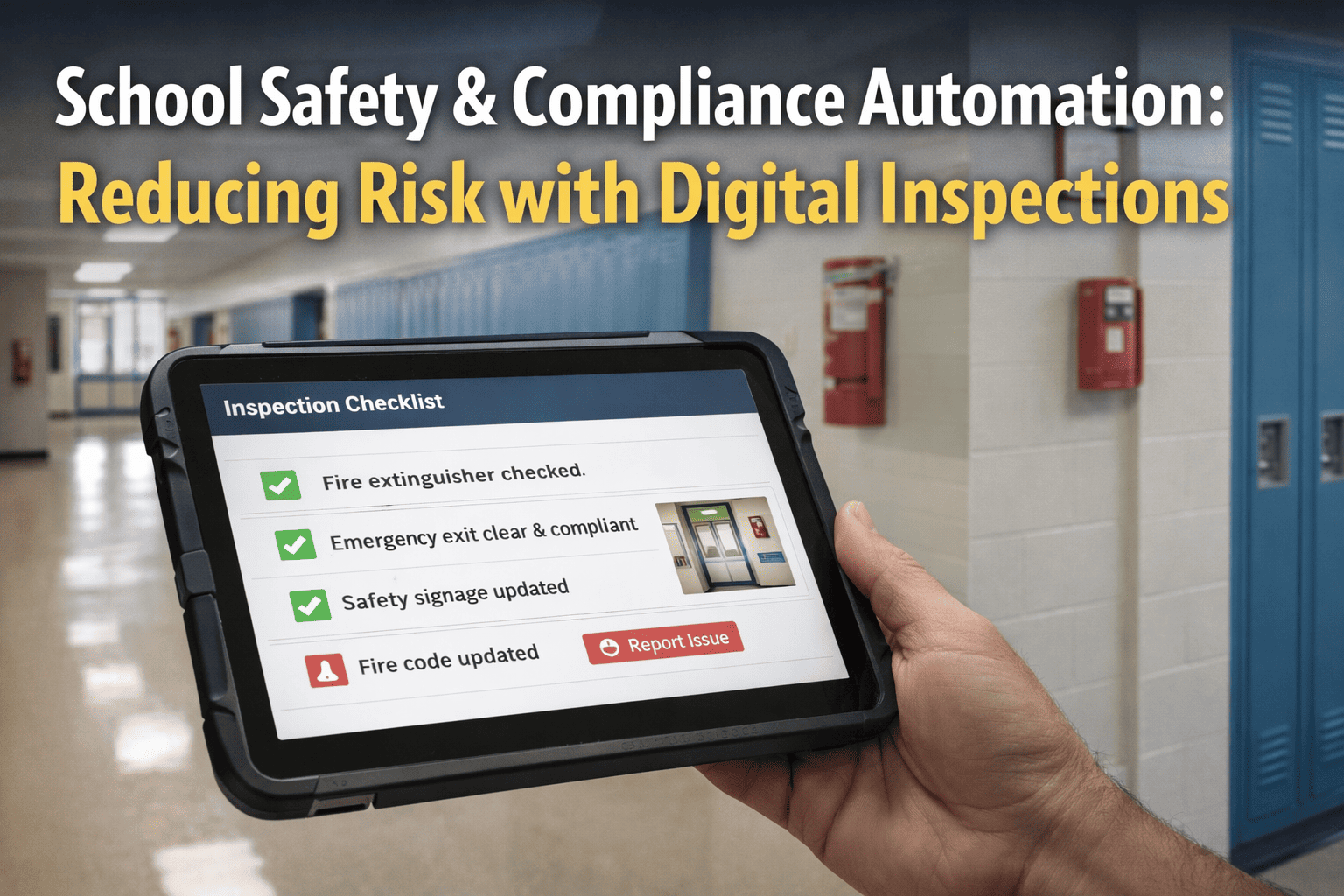
Inspector uses mobile app with built-in checklist. Photos of damage auto-tagged by location. Notes capture findings in real-time. System stores all documentation (proof of compliance).
System tracks when ASTM-certified inspector was last hired. Generates annual reminder 60 days before due date. Notifies district: "Annual detailed inspection due in 60 days. Schedule ASTM inspector."
Inspection findings auto-generate maintenance work orders. "Replace corroded bolts on swing set. Replace mulch in fall zone (currently 3 inches, needs 9 inches)." Facilities team tracks completion.
District sees real-time compliance status: "100 playgrounds. 95 with current monthly inspections. 5 overdue. 100 with current annual ASTM inspection. 0 with unresolved safety issues." Central visibility prevents oversight.
If injury occurs, system pulls 12-month inspection history, maintenance records, and equipment condition at time of incident. Provides clear documentation of whether injury was due to negligent maintenance or unavoidable accident.
Frequently Asked Questions
Protect Your School: Build Comprehensive Playground Safety Compliance
Systematic inspection following CPSC/ASTM standards, documented maintenance, and AI-driven scheduling eliminate 90% of playground liability risk. One serious injury can cost $500K–$5M. Preventing injury through proactive compliance costs $10–20K annually. The ROI is immediate and unlimited.