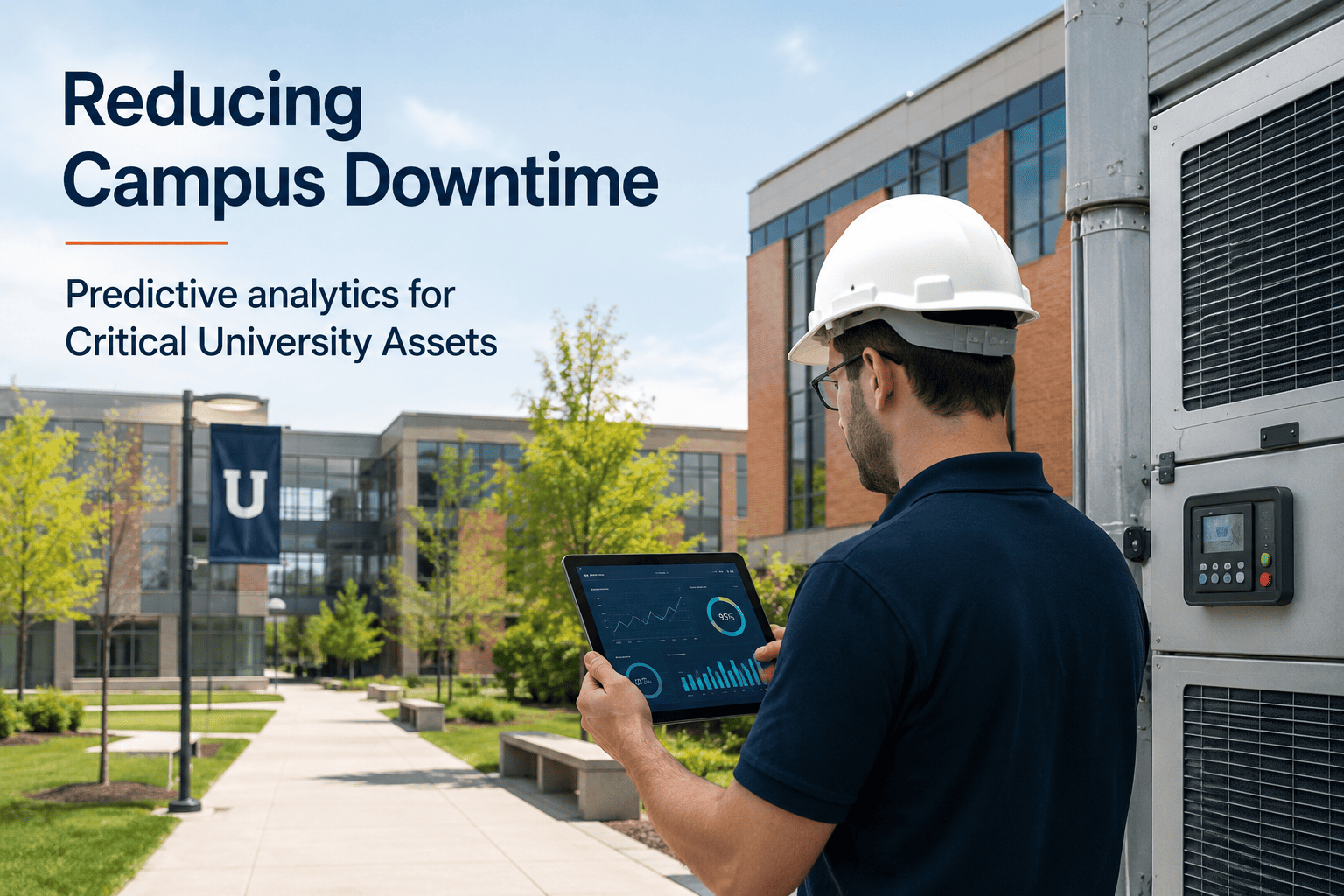
Every summer, thousands of school districts and university campuses discover the same expensive truth: HVAC systems that appeared functional in May fail catastrophically in June. Classrooms become unusable. Summer programs cancel. Emergency repair crews work overtime at premium rates. Dormitory residents relocate. The financial damage from a single large-scale HVAC failure routinely exceeds $200,000 in combined repair, operational disruption, and lost program revenue. Predictive analytics eliminates this cycle entirely by identifying failing components weeks before they fail, converting emergency shutdowns into scheduled maintenance events at a fraction of the reactive cost. Book a Demo to see how AI-driven HVAC monitoring works across your campus portfolio.
Why HVAC Failures Peak at Summer Break
The pattern is consistent across every climate zone and institution size. HVAC systems in school buildings operate at low load through spring, masking developing faults. When summer arrives and cooling demand spikes to maximum capacity, the stress exposes every weakness the system has been quietly accumulating. Compressors that were cycling irregularly fail under full load. Refrigerant leaks that were minor become complete system failures. Heat exchangers corroded through winter condensation fail on the first 95-degree day of the season.
This failure pattern is not random. It is predictable. The deterioration signals that precede every major HVAC failure, including abnormal current draw, temperature differential changes, vibration anomalies, and runtime irregularities, all appear weeks before the failure event. Reactive institutions never see these signals. Institutions running AI-driven predictive analytics see every one of them, automatically, across every monitored unit simultaneously.
For K-12 districts managing hundreds of buildings and universities managing thousands of HVAC units, the scale advantage of predictive monitoring over manual inspection is not marginal. It is the difference between a controlled summer maintenance program and a crisis-response operation that consumes the entire facilities budget before August.
The Real Cost of Reactive HVAC Management in Schools
The invoice from an emergency HVAC contractor captures only a fraction of the true cost of a reactive failure. The full financial impact spreads across departments, budgets, and fiscal years in ways that make reactive operations look affordable on any single line item while quietly consuming resources that should be funding instruction.
How AI Predictive Analytics Detects HVAC Failures Weeks in Advance
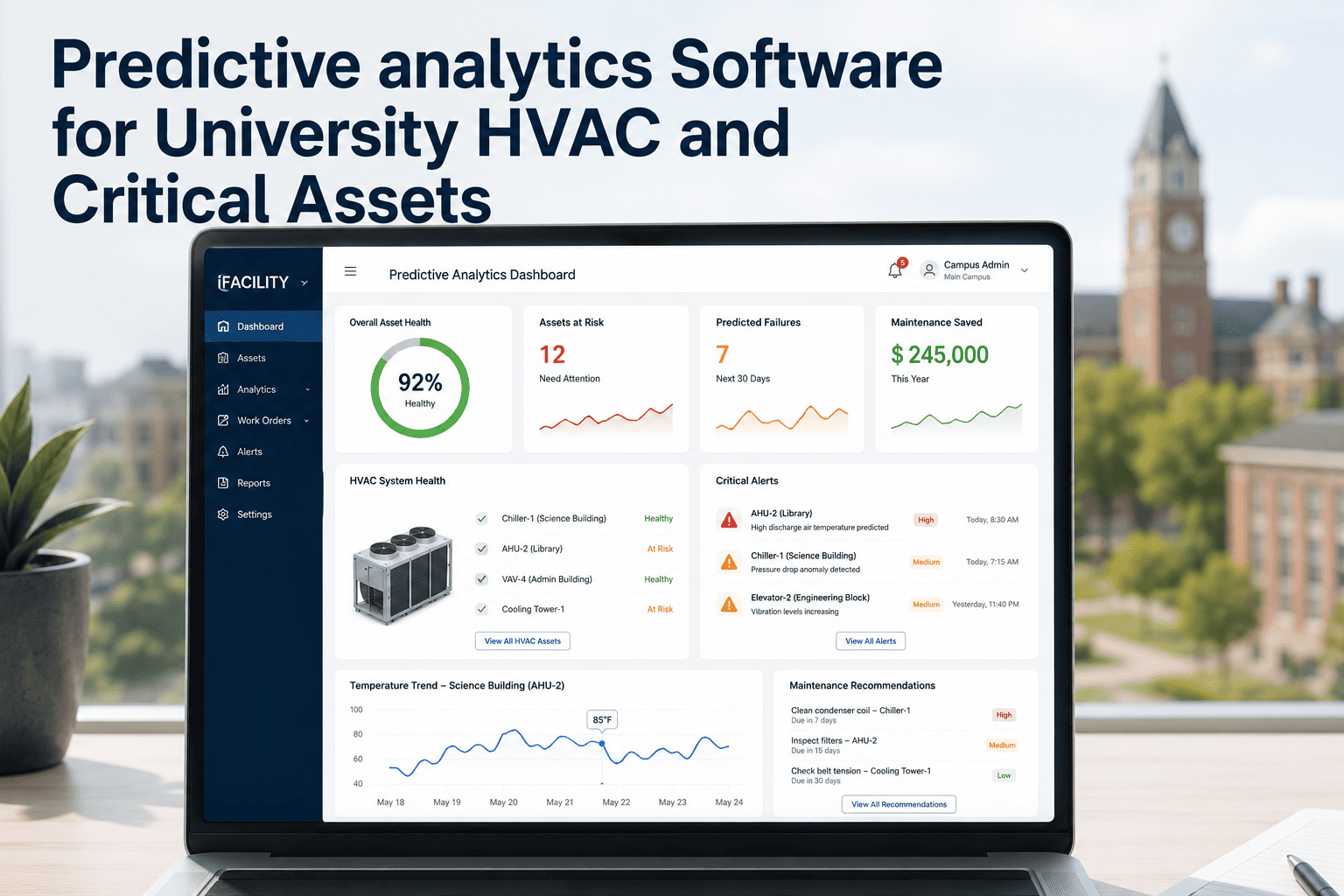
AI-driven HVAC monitoring works by establishing a continuous baseline of normal operating signatures for every monitored unit and then tracking deviation from those baselines in real time. Every HVAC unit has a unique performance fingerprint: normal current draw at given ambient temperatures, expected temperature differentials across coils, typical runtime cycles per hour, and characteristic vibration signatures at operating speed. When any of these parameters drifts outside its learned normal range, the AI flags the deviation and generates an alert before the drift becomes a failure.
- Current transducers, temperature sensors, and vibration monitors on every critical unit
- Data streamed continuously to AI analytics platform without manual data collection
- Integration with existing BAS and BMS systems via open API without equipment replacement
- Sensor data validated automatically to flag measurement anomalies before they affect scoring
- Machine learning models trained on campus-specific HVAC performance history
- Failure prediction accuracy improves each month as unit-specific data accumulates
- Multi-variable anomaly detection identifies compound failures missed by single-parameter alarms
- Seasonal adjustment automatically recalibrates baselines for summer and winter operating modes
- Pre-failure alerts generated automatically when condition thresholds are breached
- Work orders created and assigned without manual scheduling intervention
- Alert priority scored by failure probability, building criticality, and repair cost trajectory
- Maintenance crew dispatch optimized across all flagged units simultaneously
- Per-unit energy consumption tracked against baseline efficiency benchmarks continuously
- Efficiency degradation flagged before it becomes visible in utility bills
- Refrigerant loss, coil fouling, and control failures identified through energy signature analysis
- Energy savings documented per building for capital planning and board reporting
- AI risk scoring identifies highest-failure-probability units before summer demand spike
- Field inspection resources deployed to highest-risk assets first across all buildings
- Summer readiness reports generated automatically for facilities directors and boards
- Parts procurement triggered automatically when component replacement is forecasted
- OSHA 2026 maintenance schedules and temperature records generated from live monitoring data
- EPA and state energy reporting automated directly from operational performance data
- Audit-ready maintenance history maintained for every tracked unit at all times
- Compliance reports exportable in one click without manual assembly by facilities staff
Pre-Summer HVAC Readiness: A Four-Phase Deployment Program
Deploying AI-driven HVAC predictive analytics before summer break does not require a capital budget increase or a service disruption. The program is structured to deliver monitoring coverage and initial risk scoring within 60 days, with full predictive model maturity and documented cost reductions achieved within 12 to 18 months of deployment. Book a Demo to see a deployment timeline specific to your campus.
- All HVAC units connected to unified monitoring platform
- Asset registry validated with install dates and lifecycle data
- Initial AI baseline established for all monitored units
- Facilities staff onboarded in under 12 hours
- AI risk scoring active across all monitored HVAC units
- High-risk units identified and prioritized for inspection
- Summer readiness report generated for facilities director
- Parts procurement triggered for forecasted replacements
- Automated work orders replacing manual scheduling entirely
- Energy monitoring flagging inefficiency before utility bills reflect it
- Emergency work orders begin measurable decline
- First OSHA-compliant reporting cycle produced automatically
- 18-30% total maintenance cost reduction fully documented
- 15-19% energy cost reduction across monitored buildings
- Zero OSHA compliance audit deficiencies on HVAC documentation
- AI model accuracy improving continuously with campus-specific data
Results: What Predictive HVAC Analytics Delivers
Across K-12 districts and university campuses, the transition from reactive HVAC management to AI-driven predictive monitoring has produced documented, measurable outcomes across every performance dimension. All results are measured against the same operational budget with no additional funding allocated. Book a Demo to see how these outcomes map to your institution's HVAC portfolio.
| Metric | Reactive Baseline | Predictive AI Platform | Change |
|---|---|---|---|
| Emergency HVAC Events | 60-75% of maintenance budget | 60-75% fewer events | -60% to -75% |
| Energy Cost per Building | No per-unit visibility | 15-19% reduction documented | -15% to -19% |
| Pre-Failure Detection Window | Zero (failure discovered at breakdown) | 3 to 6 weeks advance notice | Transformational |
| HVAC Condition Data Age | 18-26 months average | Under 30 days continuously | -98% |
| OSHA Compliance Deficiencies | Undocumented exposure | Zero findings documented | -100% |
| Total Maintenance Cost per Sq Ft | $4.85 average reactive | $3.40-$3.99 documented | -18% to -30% |
| Staff Hours per Reporting Cycle | Approx 140 hrs manual | Approx 18 hrs automated | -87% |
| Summer Failure Rate | Peak failure window unmanaged | High-risk units resolved pre-season | Structurally eliminated |
| Capital Project Cost Variance | 22% average overage | 6% average documented | -73% |
Key Benefits for Schools and Universities
Predictive HVAC analytics delivers compounding value across budget performance, compliance standing, energy efficiency, and long-term capital stewardship. Each outcome reinforces the institution's ability to maintain safe, functional learning environments without the reactive cost premium that quietly erodes instructional budgets year after year.
AI risk scoring identifies every high-probability failure unit 3 to 6 weeks before the summer demand spike. Planned replacements are scheduled, parts are procured, and crews are dispatched before any failure event occurs. Summer programs run uninterrupted. Dormitory residents stay housed. Emergency contractors are never called.
No new funding is required. AI-driven scheduling converts reactive emergency spend at 3-5x planned cost into preventive work orders. Districts redirecting these savings have funded instructional programs and faculty positions from existing maintenance budgets without any additional appropriation.
The platform generates all required HVAC maintenance schedules and temperature monitoring records automatically from live data. Every occupied space is covered. Every maintenance event is documented. Compliance audit preparation requires no manual assembly from facilities staff at any point during the year.
HVAC systems account for 35-50% of total building energy consumption. Continuous per-unit efficiency monitoring identifies refrigerant loss, coil fouling, and control failures before they appear on utility bills, delivering documented savings that compound annually as the model accumulates campus-specific seasonal data.
FCI-backed capital requests with five-year cost-of-deferral analysis replace anecdotal failure summaries. Boards approve HVAC replacement programs when condition data is current, scored, and defensible. Documented deployments show single-session board approvals when condition data supports the request with AI-validated scoring.
Each month of platform operation adds campus-specific HVAC deterioration data that improves AI model accuracy and sharpens PM scheduling. The cost savings documented at month 18 represent the documented floor. The trajectory is upward as the model matures across multi-year seasonal cycles unique to each campus.
Conclusion
HVAC failures before and during summer break are not random events. They are predictable outcomes of reactive management applied to systems that produce measurable deterioration signals weeks before they fail. U.S. K-12 districts and universities collectively spend hundreds of millions annually on HVAC emergency repairs that AI-driven predictive monitoring would have prevented at a fraction of the cost.
The institutions achieving 18-30% maintenance cost reductions, 60-75% fewer HVAC emergencies, and clean OSHA compliance audits are not operating on larger budgets. They are operating on better data. AI-driven predictive analytics platforms convert the same maintenance dollar from reactive emergency spend into planned preventive work and generate the capital planning documentation that gives boards confidence to fund HVAC renewal programs rather than defer them indefinitely.
The cost of deploying AI-driven HVAC analytics is fixed and quantifiable. The cost of the reactive liability it prevents is neither. Book a Demo or Contact Support to begin quantifying your institution's HVAC risk exposure today.