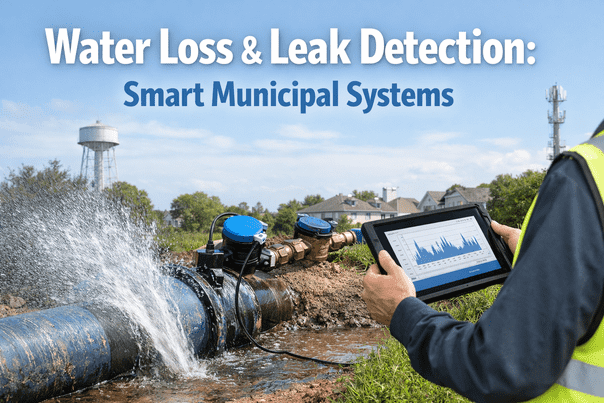
The average municipal water utility in the US loses between 16 and 24 percent of all treated water before it reaches a paying customer. At a utility treating 10 million gallons per day, that represents 1.6 to 2.4 million gallons of treated, pumped, and pressurized water disappearing into the ground every single day, at a fully loaded cost of $4 to $8 per thousand gallons. Non-revenue water is not a plumbing problem. iFactory's water loss detection platform connects acoustic sensors, AMI meter data, DMA night flow analysis, and pressure zone management into a single AI-driven non-revenue water reduction program that identifies the highest-loss zones nightly and generates prioritized field crew dispatch work orders automatically. Book a free NRW assessment for your utility.
iFactory reduces municipal non-revenue water through four integrated detection methods: DMA night minimum flow analysis from AMI data (zone-level leak identification nightly), acoustic sensor correlation (pipe-level leak location within 1 to 3 meters), pressure management analytics (pressure reduction zone optimization reducing new break rate), and apparent loss detection (meter accuracy trending, tamper event revenue recovery). All four methods operate simultaneously from existing AMI and SCADA infrastructure, generating the AWWA M36 water loss audit data automatically for regulatory and funding submissions.
Four Detection Methods: How iFactory Finds and Quantifies Your Water Losses
No single detection method identifies all non-revenue water losses. iFactory operates all four methods simultaneously, with each method targeting a different loss category at a different spatial scale, from utility-wide balance to pipe-level location within meters. Book a demo to see all four methods configured for your distribution network.
Between 2 AM and 4 AM, legitimate customer consumption is at its lowest and most predictable. Any flow into a DMA above the expected minimum night flow (calculated from customer count, property type, and seasonal baseline) indicates an active leak in that zone. iFactory calculates the expected minimum night flow per DMA nightly and compares actual AMI meter readings against this baseline, ranking every zone by estimated leak volume from highest to lowest.
Acoustic leak correlation sensors installed at fire hydrants, valve chambers, and meter boxes listen for the acoustic signature of water escaping under pressure from pipe defects. iFactory's AI signal processing filters environmental noise and traffic vibration from genuine leak signals, correlates signal timing across sensor pairs to calculate leak location, and classifies leak severity from signal amplitude. Sensor deployment is optimized by iFactory to the highest-priority zones identified by DMA night flow analysis.
Excess pressure is the primary cause of new pipe breaks and accelerates existing leak flow rates. iFactory monitors pressure zone minimum night pressure from SCADA or dedicated pressure loggers and identifies zones operating at pressures above the minimum needed to maintain supply pressure at the most critical demand point. Pressure reduction in high-pressure zones reduces new pipe break rates by 20 to 40 percent and reduces existing leak flow rates, producing an immediate NRW reduction without any pipe repair.
Apparent losses are water that is delivered to a customer but not billed correctly because of meter accuracy degradation, tamper events, or unauthorized consumption. iFactory monitors AMI meter consumption patterns for low-flow registration decline, register drift, and tamper event sequences, scores each meter by estimated revenue loss, and prioritizes meter testing and exchange work orders by financial return. Apparent losses typically represent 3 to 8 percent of total production volume at utilities without structured meter management programs.
DMA night flow analysis runs every night from your AMI head-end data. Acoustic sensor arrays are deployed to the zones your DMA analysis identifies as highest priority. Pressure optimization recommendations update continuously from SCADA. Apparent loss scoring runs continuously from AMI meter data. All four methods generate field crew work orders automatically, without manual data analysis.
NRW Component Breakdown: Where Your Water Losses Are Coming From
AWWA M36 requires utilities to audit water losses by component annually. iFactory generates the M36 component breakdown automatically from AMI, SCADA, and field investigation data, replacing the manual spreadsheet process with a continuous real-time NRW dashboard.
Client Results: Municipal Utilities Using iFactory Water Loss Detection
Average non-revenue water percentage reduction across iFactory municipal utility deployments within 18 months of full platform activation across all four detection methods.
Average annual financial value recovered from NRW reduction combining real loss repair savings, apparent loss revenue recovery, and water treatment cost avoidance per year at mid-size utility scale.
Average time from active leak onset to iFactory DMA alert identifying the affected zone, enabling field crew dispatch before the leak reaches reportable surface expression.
Average time to generate annual AWWA M36 water loss audit data from iFactory automated reporting, versus 3 to 5 days of manual data compilation before iFactory deployment.
iFactory does not replace your existing leak detection crews or equipment. It tells them exactly where to work each morning, redirecting the same resources to the zones with the highest confirmed losses instead of covering the network on a fixed rotation that may not visit a high-loss zone for months.
iFactory vs Competing Water Loss and Leak Detection Platforms
Water loss management platforms range from standalone acoustic survey software to integrated NRW analytics systems. iFactory differentiates by combining all four detection methods with AWWA M36 compliance documentation in a single on-premise government platform. Book a demo to see iFactory compared to your current water loss management tools.
| Capability | iFactory | Cityworks (Esri) | Lucity (CentralSquare) | IBM Maximo | iWorQ Systems | Brightly Asset Essentials | MaintainX | PubWorks |
|---|---|---|---|---|---|---|---|---|
| Detection Analytics | ||||||||
| DMA night flow zone leak ranking from AMI data | Nightly zone-level ranking | No AMI analytics | No AMI analytics | Via IoT add-on | No | No | No | No |
| Acoustic sensor AI correlation (1 to 3m pipe-level location) | Integrated acoustic sensor management | No | No | No | No | No | No | No |
| Pressure zone optimization (break rate reduction) | Continuous SCADA-based optimization | No | No | Via analytics add-on | No | No | No | No |
| Compliance and Architecture | ||||||||
| AWWA M36 water loss audit auto-generated | Full M36 component breakdown in 4 hours | Manual GIS data assembly | Manual data assembly | Via reporting module | Basic reports | No | No | Basic reports |
| On-premise deployment (government data sovereignty) | Full on-premise, zero cloud egress | Cloud or on-prem | Cloud or on-prem | Cloud or on-prem | Government cloud | Cloud SaaS | Cloud SaaS | Government cloud |
Based on publicly available product documentation as of Q1 2025. Verify capabilities with each vendor before procurement decisions.
Regional Compliance: Water Loss Reporting and NRW Management Requirements
| Region | Key Water Loss Regulatory Requirements | iFactory Coverage |
|---|---|---|
| USA | AWWA M36 Water Loss Control Manual: annual water loss audit required for State Revolving Fund (SRF) loan and EPA Water Infrastructure Finance and Innovation Act (WIFIA) grant eligibility in most states. AWIA 2018 requires water loss assessment as component of 5-year asset management certification. EPA AWWA Water System Optimization (WSO) program targets NRW below 10% for program eligibility. Many states have enacted specific NRW reporting requirements: California requires utilities over 3,000 connections to submit annual water loss audits to the state water board. Texas TCEQ requires annual water loss audits for all community water systems. | AWWA M36 annual audit auto-generated. SRF and WIFIA grant application data compiled. AWIA 2018 water loss assessment evidence. WSO program reporting. California and Texas state water loss audit requirements. All data on-premise within US jurisdiction. |
| UAE | UAE National Water Security Strategy 2036 targets NRW reduction across all federal and emirate-level utilities. DEWA water loss performance reporting requirements for Dubai utility network. Abu Dhabi DoE water efficiency performance indicators including NRW metrics. UAE Smart Utility program requires digital NRW tracking and reporting for participating utilities. MOCCAE water conservation targets requiring NRW documentation. GCC Water Security Strategy NRW management requirements for member states. | UAE National Water Security Strategy 2036 NRW tracking. DEWA performance reporting. Abu Dhabi DoE efficiency indicators. UAE Smart Utility digital NRW documentation. Arabic platform outputs. MOCCAE conservation target tracking. All data on-premise within UAE jurisdiction. |
| UK | Ofwat PR24 leakage performance commitment: each water company has a binding leakage reduction target set by Ofwat for the 2025 to 2030 regulatory period. Environment Agency water resource management plan requirements include leakage component as a demand management measure. UK Water UK's Leakage Operational Framework (LOF) requires DMA metering and night flow analysis. Water UK's Leakage Target: industry ambition to halve leakage by 2050 from 2017 baseline. Water fittings regulations for customer supply pipe leakage responsibility. | Ofwat PR24 leakage performance commitment tracking. EA water resource management leakage component. Water UK LOF DMA monitoring. Industry 2050 leakage target progress tracking. Customer supply pipe leakage evidence. All data on-premise within UK jurisdiction. |
| Canada | Infrastructure Canada asset management reporting for water infrastructure includes NRW performance as a condition indicator. CWWA (Canadian Water and Wastewater Association) NRW management guidelines recommend AWWA M36-equivalent annual water loss audits. Provincial water efficiency regulations: British Columbia requires water utilities to submit conservation plans that include leakage reduction measures. Ontario's O. Reg. 588/17 asset management planning for water systems includes infrastructure performance metrics encompassing water loss. Quebec and Alberta provincial water efficiency programs include NRW reduction as a priority measure. | Infrastructure Canada NRW performance reporting. CWWA M36-equivalent audit data. BC conservation plan leakage documentation. Ontario O. Reg. 588/17 performance metrics. Quebec and Alberta provincial program reporting. Bilingual EN/FR platform. All data within Canada. |
| Germany / EU | EU Water Framework Directive cost recovery principle requires utilities to demonstrate efficient water use including leakage management. German DVGW W 392 standard for water loss management and network monitoring. EU Drinking Water Directive 2020/2184 Article 4(1) requires member states to take measures to ensure water losses do not compromise water safety or efficiency. GDPR for smart meter and AMI data used in leak detection. German LAWA (German Working Group on Water Issues) reporting requirements for water resource efficiency. EU NIS2 Directive cybersecurity for water distribution network monitoring systems. | EU WFD cost recovery efficiency documentation. DVGW W 392 network monitoring compliance. EU DWD 2020/2184 efficiency measures. GDPR compliant on-premise AMI data processing. LAWA efficiency reporting. NIS2 OT cybersecurity for distribution network monitoring. EU data residency guaranteed. |
Frequently Asked Questions
Continue Reading
Four detection methods running simultaneously: DMA night flow zone ranking, acoustic sensor pipe-level location, pressure zone optimization, and apparent loss AMI analytics. Field crew work orders generated automatically. AWWA M36 compliance documentation generated on demand. All data on-premise within your government network.