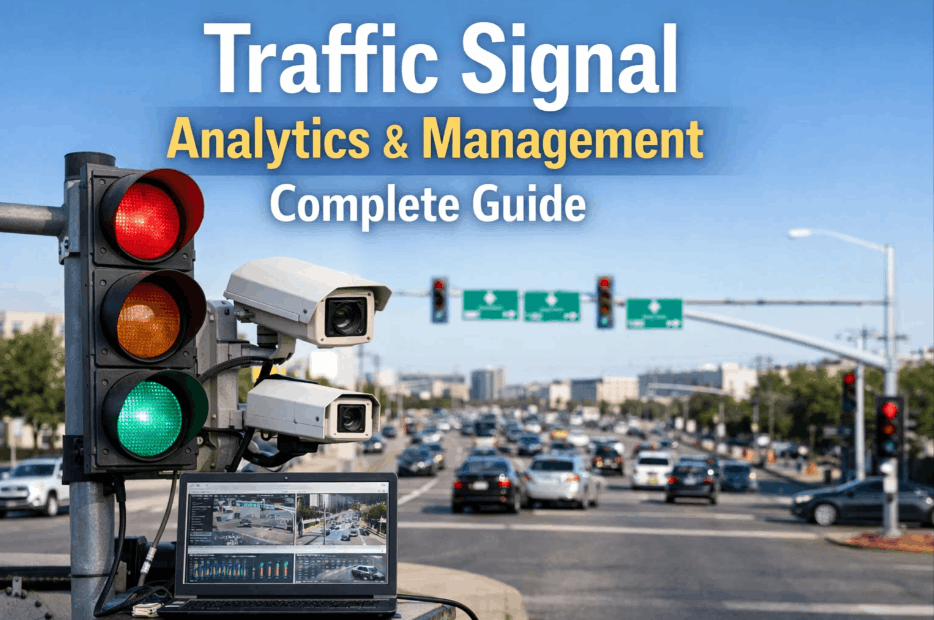
Traffic signal analytics has become the backbone of modern municipal traffic operations. As cities across the US, UK, Canada, Germany, and the UAE manage increasingly complex road networks, relying on manual signal checks and reactive repair cycles is no longer viable. A robust traffic signal analytics management program — powered by smart software, automated diagnostics, and AI-driven insights — enables traffic engineers to monitor signal health, optimize timing plans, and dramatically reduce unplanned downtime across hundreds of intersections simultaneously. Book a free demo to see how signal analytics works for your municipality.
What Is Traffic Signal Analytics Management?
Traffic signal analytics management is the systematic process of collecting, monitoring, and analyzing data from signal controllers, conflict monitors, LED hardware, and timing systems to keep every intersection operating safely and efficiently.
Unlike traditional break-fix maintenance, a signal analytics program uses real-time data streams from field devices to detect faults before they cause failures, optimize signal timing based on live traffic demand, and generate audit-ready compliance records for federal and state reporting.
For municipalities managing 50 to 5,000 signalized intersections, the difference between a reactive and a data-driven analytics approach can mean millions of dollars in avoided emergency repairs, reduced accident liability, and measurable improvements in intersection throughput.
Core Components of a Signal Analytics Management Program
A complete signal analytics management program integrates controller diagnostics, timing analytics, field hardware monitoring, and preventive maintenance scheduling into a single platform. Each component feeds actionable data to traffic operations staff — eliminating the guesswork that drives up costs and safety risk.
Connects to NEMA and ATC controllers via NTCIP to pull fault logs and cabinet data automatically. Engineers get instant alerts when a fault is detected — before it affects drivers.
Tracks test results, fault histories, and replacement cycles for every unit in the field. Automated scheduling ensures no conflict monitor exceeds its testing interval — keeping you compliant.
Analyzes split failures, max-outs, and queue spillback to evaluate timing plan performance. Engineers can update timing plans directly from the platform — cities in the UK and Canada have cut delays by 15–25%. See timing analytics in action.
Tracks photometric performance of LED heads and flags units below visibility standards. Replacement work orders are generated automatically — no manual inspection cycles needed.
Uses asset age, fault frequency, and service intervals to target the highest-risk intersections first. Data-driven PM cuts emergency calls by up to 60% compared to fixed calendar cycles.
Monitors spare parts across all facilities and triggers automatic reorder alerts. Technicians always have the right parts on hand — eliminating costly return trips to the same location.
Signal Analytics Across Key Infrastructure Types
Different intersection and corridor types require tailored analytics approaches. A signal analytics platform must handle everything from isolated rural intersections to complex urban coordinated arterials and school zone flashers — each with distinct performance metrics, compliance requirements, and maintenance priorities.
Manual Signal Management vs. Analytics-Driven Operations
The transition from paper-based maintenance logs and annual timing reviews to a real-time analytics platform fundamentally changes how traffic operations teams work — and what they can deliver for the public. The performance gap compounds every year that reactive practices remain in place.
How AI Vision Enhances Traffic Signal Analytics
AI vision systems turn existing intersection cameras into powerful analytics tools — detecting vehicles, pedestrians, and hardware faults in real time without costly new sensors. Here is how municipalities across the US, UK, Canada, Germany, and UAE are putting it to work.
Traffic Signal Analytics Platform Comparison
Selecting the right signal analytics platform requires evaluating core capabilities — not just feature checklists. The table below outlines the functional areas most critical to municipal traffic operations and how a purpose-built signal analytics system compares to generic asset management and traditional SCATS/SCOOT-only platforms.
| Capability | Spreadsheet / Manual | Generic CMMS | Purpose-Built Signal Analytics |
|---|---|---|---|
| Real-Time Controller Diagnostics | None | Limited | Full NTCIP integration |
| Signal Timing Analytics | Manual review only | Not available | Automated, continuous |
| Conflict Monitor Scheduling | Paper calendar | Basic scheduling | Automated + audit trail |
| LED Performance Monitoring | None | None | Photometric tracking |
| AI Vision Integration | None | None | Native or API integration |
| Federal / State Compliance Reports | Manual compilation | Generic reports | One-click generation |
| Mobile Field Technician Tools | None | Basic work orders | Full field analytics app |
| Multi-Agency / Regional Deployment | Not scalable | Limited | Built-in multi-agency support |
Measurable Benefits of Signal Analytics for Municipal Operations
The business case for traffic signal analytics is clear and quantifiable. Agencies that deploy analytics-driven signal management programs consistently report improvements across safety, operational efficiency, cost control, and public satisfaction.
Compliance Requirements Managed by Signal Analytics Software
Municipal traffic agencies face an overlapping matrix of federal, state, and local compliance requirements. Signal analytics software automates the tracking, documentation, and reporting that keeps agencies audit-ready — eliminating the weeks of manual record compilation that typically precede safety audits and federal program reviews.
| Requirement | Applies To | How Analytics Helps |
|---|---|---|
| MUTCD Signal Warrants | All signalized intersections | Automated volume/warrant data collection and report generation |
| Conflict Monitor Testing | All NEMA TS1/TS2 and ATC installations | Automated test scheduling, result logging, expiry alerts |
| ADA Pedestrian Accessibility | All signalized pedestrian crossings | APS function tracking, timing compliance documentation |
| FHWA HSIP Safety Requirements | Federally funded signal projects | Crash pattern analysis, before/after performance documentation |
| State DOT Signal Maintenance Standards | State route intersections | PM interval compliance tracking, technician certification logs |
| Battery Backup System Testing | Intersections with UPS/BBS installations | Automated test logging, capacity trend analysis, replacement forecasts |
Common Challenges in Signal Analytics Programs — and How to Solve Them
Implementing a signal analytics program is not without obstacles. Understanding the most common implementation challenges — and proven approaches to overcoming them — helps traffic agencies move from pilot to full deployment faster and with fewer setbacks.
Solution: Purpose-built platforms use multi-vendor protocols and field gateways to bring legacy controllers online — no full hardware replacement needed.
Solution: Automated alerts and ML-based anomaly detection surface only the signals that need attention — so staff focus on the 5% that matter.
Solution: Mobile-first work order apps tied to real intersection data show technicians immediate value. UK and Canadian agencies report 85%+ adoption within 60 days.
Solution: Most agencies recover costs within 12–18 months through avoided emergency repairs alone. Model your projected savings.
Solution: Platforms support cellular, radio, and fiber backhaul — and queue data during outages, uploading automatically when connectivity is restored.
Solution: Role-based access controls let regional partners share corridor data while each agency retains full control over its own infrastructure records.
Best Practices for Building a Signal Analytics Program
Agencies that achieve the highest ROI from signal analytics investments share a common set of implementation practices. These principles apply whether you are deploying analytics across 50 signals or 5,000.
Conclusion: Build a Signal Analytics Program That Protects People and Budgets
Data-driven signal management is now accessible to municipalities of all sizes — in the US, UK, Canada, Germany, and the UAE. Cloud platforms, AI vision, and NTCIP connectivity have removed the barriers that once limited analytics to large metro agencies.
Agencies that act now are cutting emergency repair costs, staying compliant with less staff effort, and delivering safer intersections for the communities they serve. Book a walkthrough to see signal analytics in action for your agency.