Water treatment plant operations have not changed fundamentally in decades: operators walk rounds checking meters that SCADA already reads, chemical dosing is adjusted manually from lab results that arrive hours after the process has already drifted, and inspections of tanks, clarifiers, and filter media require confined space entry and service interruptions. iFactory introduces robotics and AI automation across all six water treatment process stages without disrupting existing SCADA or PLC infrastructure. Chemical dosing adjusts continuously from real-time turbidity, pH, and disinfection demand analytics. Every automated detection generates a compliance-ready work order with supporting evidence attached. Book a free automation readiness assessment for your treatment plant.
iFactory deploys AI automation and robotics across six water treatment process stages: raw water intake monitoring (turbidity, algae, source water quality), coagulation and flocculation optimization (automated jar test correlation, coagulant dose adjustment), sedimentation monitoring (sludge blanket level, solids loading), filtration analytics (headloss trending, turbidity breakthrough, backwash optimization), disinfection CT compliance (real-time chlorine residual and contact time calculation), and finished water distribution interface monitoring. All automation connects to existing SCADA via OPC-UA read-only, with all AI processing on-premise.
Six Automation Streams: Where iFactory Eliminates Manual Processes at Your Treatment Plant
Each automation stream targets a specific manual process that water treatment operators currently perform on fixed schedules regardless of actual process conditions. iFactory replaces the fixed-schedule with continuous AI-driven monitoring and automated action triggers. Book a demo to see all six streams activated for your treatment plant configuration.
iFactory connects to your existing SCADA via OPC-UA or Modbus read-only and begins delivering automation value across all six stages within 3 weeks of connection. Zero PLC reprogramming. Zero production impact. All AI processing on-premise within your government network.
Robotics Deployment Roadmap: From SCADA Connection to Full Treatment Plant Automation
iFactory's treatment plant automation deployment follows a phased sequence that begins generating value from the first week of connection without requiring any capital construction, SCADA modification, or service outage. Book a demo to review the deployment sequence for your specific treatment plant configuration.
iFactory edge server deployed on-premise. OPC-UA read-only connection established to treatment plant SCADA. All process tags (turbidity, flow, chemical dose, CT, filter headloss, UV intensity) mapped to treatment stage model. Historical SCADA data loaded for baseline calculation. LIMS API connection configured for lab result import.
AI baselines established for each process stage from live operating data. CT compliance thresholds configured to SDWA requirements and state primacy permit limits. Filter headloss and turbidity breakthrough models calibrated per filter cell. Coagulant dose optimization model trained from historical jar test results and SCADA dose-response data. Compliance documentation templates configured for your state reporting format.
All six automation streams active. Chemical dose optimization generating recommendations. CT compliance pre-alerts configured. Filter backwash optimization comparing scheduled vs AI-recommended intervals. Robotic camera inspection patrols configured for clarifier mechanism and filter gallery inspection routes. Monthly compliance report templates populated and tested against prior month data.
AI models updated from first month of live operating data. Seasonal source water quality variations incorporated into coagulant demand model. State compliance report submitted from iFactory data for the first time. AWIA 2018 treatment plant asset inventory and condition assessment evidence compiled from robotics inspection records and SCADA condition data. Annual reporting cycle established.
Client Results: Water Treatment Plants Using iFactory Automation
Average reduction in coagulant and disinfection chemical costs through AI dose optimization across iFactory water treatment plant deployments.
Average Safe Drinking Water Act violations attributable to CT compliance or filter turbidity exceedances at iFactory-monitored treatment plants in the 24 months after deployment.
Average reduction in confined space entry procedures for clarifier mechanism and filter gallery inspection using robotic camera patrols replacing scheduled manual inspections.
Average time to generate monthly state compliance report from iFactory automated reporting versus 3 to 5 days of manual data compilation before iFactory deployment.
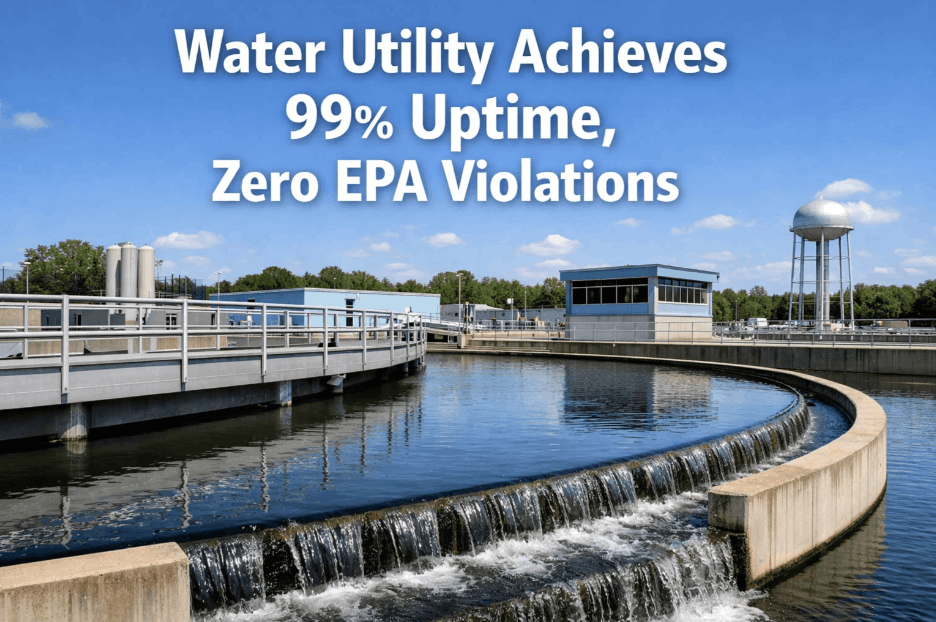
Every benefit above came from an iFactory connection to existing treatment plant SCADA, not from replacing instrumentation or adding capital infrastructure. If your plant has SCADA and laboratory data, iFactory activates all six automation streams from the data you already have.
iFactory vs Competing Water Treatment Automation Platforms
Water treatment automation platforms range from SCADA historian tools to standalone chemical dosing optimization software. iFactory differentiates by covering all six treatment stages in a single platform with compliance documentation generation and on-premise government deployment. Book a demo to compare iFactory to your current automation investments.
| Capability | iFactory | Cityworks (Esri) | IBM Maximo | Brightly Asset Essentials | MaintainX | SafetyCulture | Trimble Unity |
|---|---|---|---|---|---|---|---|
| Treatment Process Automation | |||||||
| AI coagulant dose optimization from SCADA + lab data | Real-time demand prediction | No process analytics | Via IoT add-on | No | No | No | No |
| Real-time CT ratio compliance pre-alert (SDWA) | Pre-alert at CT 1.05 (15-30 min advance) | No | No | No | No | No | No |
| Filter turbidity breakthrough prediction (8 hrs advance) | Headloss trending per filter cell | No | Via add-on | No | No | No | No |
| Compliance and Architecture | |||||||
| Monthly SDWA CCR report auto-generated | Automated, 4-hour generation | Manual assembly | Via reporting module | No | No | Audit reports only | Basic reports |
| On-premise deployment (government network, zero cloud egress) | Full on-premise, read-only SCADA | Cloud or on-prem | Cloud or on-prem | Cloud SaaS | Cloud SaaS | Cloud SaaS | Cloud or on-prem |
Based on publicly available product documentation as of Q1 2025. Verify capabilities with each vendor before procurement decisions.
Regional Compliance: Water Treatment Automation and Robotics Requirements
| Region | Key Treatment Compliance Requirements | iFactory Automation Coverage |
|---|---|---|
| USA | SDWA Surface Water Treatment Rule (40 CFR 141): 0.3 NTU individual filter turbidity, CT compliance for Giardia and Cryptosporidium inactivation, continuous turbidity monitoring at each filter outlet. Stage 2 D/DBPR LRAA monitoring. CCR annual report to customers. OSHA 29 CFR 1910.146 confined space safety for clarifier and filter gallery inspection. AWIA 2018 treatment facility asset management certification. | Real-time CT compliance pre-alert at 1.05 ratio. Per-filter turbidity monitoring at 0.24 NTU pre-alert. Stage 2 LRAA tracking from LIMS. CCR automated generation. Robotic inspection reduces confined space entries by 80%. AWIA 2018 asset inventory from inspection records. On-premise within US jurisdiction. |
| UAE | UAE.S 5:2012 drinking water quality standard: turbidity below 0.5 NTU, residual chlorine 0.2 to 0.5 mg/L at supply. ESMA metrological compliance for water quality monitoring instruments. DEWA treatment plant operation standards. Abu Dhabi EAD technical standards for water treatment facilities. UAE Smart Utility digital monitoring documentation requirements. MOCCAE environmental compliance for water treatment chemical discharge. | UAE.S 5:2012 turbidity and chlorine residual monitoring. ESMA instrument calibration tracking. DEWA and EAD operation standard compliance documentation. Smart Utility digital monitoring evidence. Arabic platform outputs. All data on-premise within UAE jurisdiction. |
| UK | Water Supply (Water Quality) Regulations 2016: turbidity below 1 NTU at consumer tap (0.5 NTU treatment target), DWI coagulation efficiency monitoring, Cryptosporidium Direction turbidity monitoring at each filter outlet. Drinking Water Inspectorate (DWI) annual process monitoring returns. Environment Agency IPC permit for chemical storage and discharge. UK ATEX regulations for electrical equipment in chemical storage areas. | DWI turbidity monitoring per filter outlet. Cryptosporidium Direction compliance monitoring. DWI annual monitoring returns auto-compiled. EA chemical discharge monitoring. ATEX-rated robotic inspection for chemical storage areas. All data on-premise within UK jurisdiction. |
| Canada | Health Canada Guidelines for Canadian Drinking Water Quality: turbidity below 0.1 NTU at filter outlet (target), CT compliance for Giardia and Cryptosporidium inactivation. Provincial regulations: Ontario O. Reg. 170/03 continuous turbidity monitoring requirements, BC Drinking Water Protection Act, Alberta EPEA treatment standards. Health Canada AWQI notification within 24 hours of adverse water quality indicator events. | Health Canada CT and turbidity compliance monitoring. Provincial regulation compliance (O. Reg. 170/03, BC DWPA, Alberta EPEA). AWQI 24-hour notification trigger. Provincial reporting automation. Bilingual EN/FR platform. All data on-premise within Canada. |
| Germany / EU | EU Drinking Water Directive 2020/2184: turbidity below 1 NTU, parametric values for 26 chemical and microbiological parameters, risk-based monitoring approach (WSP). German Trinkwasserverordnung (TrinkwV 2023) implementing EU DWD. DVGW W 201 treatment standards. EU NIS2 Directive cybersecurity for water treatment OT systems. GDPR for water quality monitoring data. German WSGVO (Wasserversorgungsgesetz) water supply safety requirements. | EU DWD 2020/2184 parametric monitoring. TrinkwV 2023 compliance. DVGW W 201 treatment standards. WSP risk-based monitoring framework. NIS2 OT security controls for treatment plant SCADA. GDPR compliant on-premise processing. EU data residency guaranteed. |
Frequently Asked Questions
Continue Reading
All six water treatment process stages automated. CT compliance pre-alerts at 1.05 CT ratio. Filter turbidity breakthrough detected 8 hours in advance. Monthly CCR generated in 4 hours. Robotic clarifier inspection replacing manual confined space entry. All AI processing on-premise within your government network.


.png)