Chiller Predictive Maintenance
Preventing Costly Failures with AI and IoT
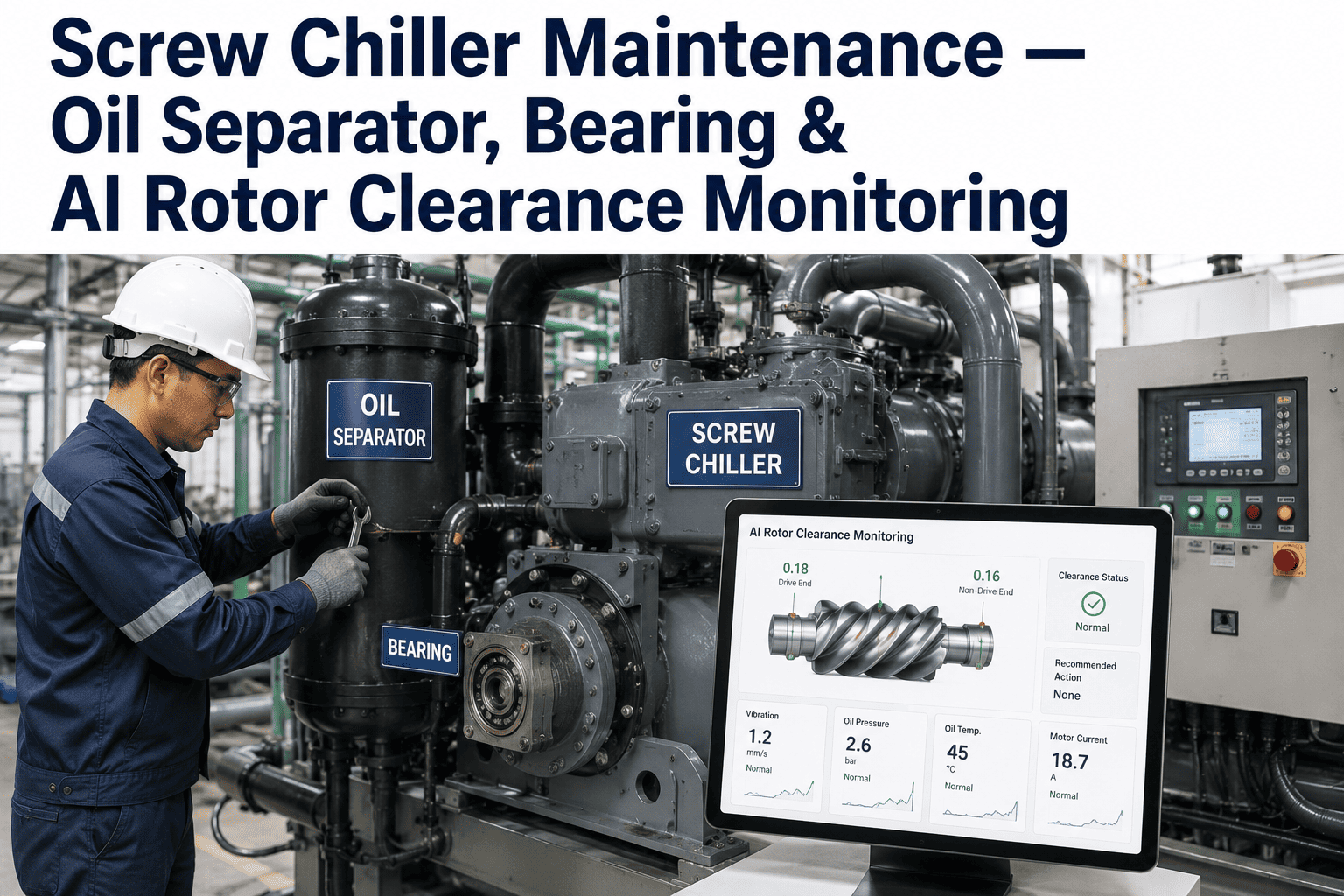
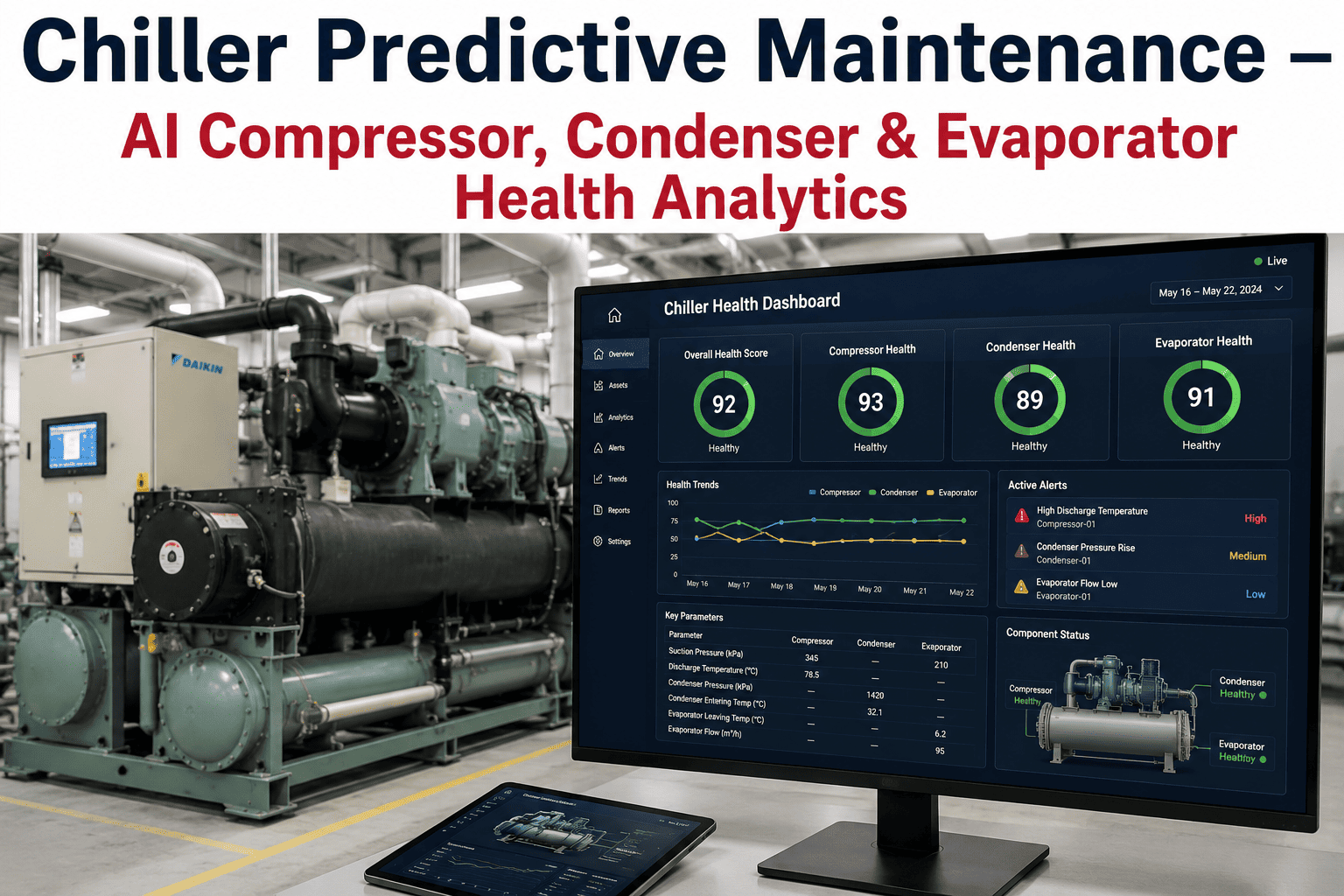
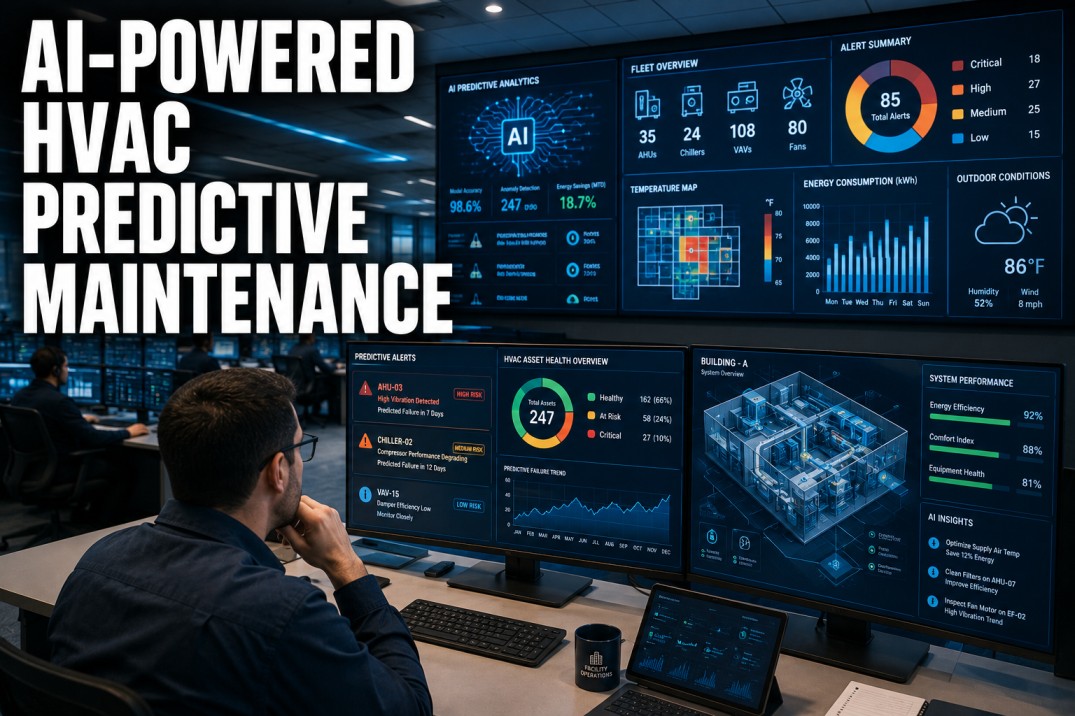
Chillers represent the most capital-intensive and failure-critical equipment in any HVAC system. A single compressor failure on a 500-ton centrifugal chiller can trigger $50,000+ in unplanned costs. AI models trained on thousands of chiller sensor streams now identify refrigerant issues, bearing wear, fouling degradation, and electrical faults 2–8 weeks before breakdown — delivering predictive accuracy that time-based maintenance schedules can never match.
Of total building energy consumed by chiller systems on average
Average cost of a single unplanned centrifugal chiller failure event
Maximum advance warning AI delivers before chiller failure events
Reduction in unplanned downtime achieved with AI predictive maintenance
Why Traditional Chiller Maintenance Fails
Facilities relying on fixed PM schedules and reactive repairs are accepting unnecessary downtime, energy waste, and capital destruction as the cost of doing business. Here is where conventional maintenance breaks down.
Calendar-Based Blind Spots
Fixed maintenance intervals — quarterly, semi-annual, annual — are designed around average equipment behavior, not your chiller's actual condition. A compressor that ran 6,000 hours under high load and poor water quality degrades 3x faster than the calendar assumes. PM schedules consistently miss developing faults or over-service equipment that needs no attention.
Reactive Fault Detection
Most building management systems only trigger alarms when parameters exceed hard thresholds — by which point damage is already occurring. A chiller operating with 10% refrigerant undercharge runs for months with degraded efficiency and elevated compressor stress before any alarm fires. The fault is detectable weeks earlier through trend analysis of subtle performance deviations.
Isolated Sensor Data Silos
Facilities typically monitor chiller parameters independently — discharge pressure here, motor current there, entering water temperature somewhere else. Failure patterns emerge from the correlation of multiple signals simultaneously declining. Without AI cross-referencing 30–80 parameters in real time, the early-warning composite signature of impending failure remains invisible until it is too late.
Energy Waste Hidden in Degradation
A chiller with fouled condenser tubes, low refrigerant charge, or worn impeller seals consumes 15–35% more electricity than its design rating — silently burning energy with no alarms, no alerts, and no intervention. This degradation-driven energy waste is estimated to cost US commercial facilities $4.2 billion annually, most of it undetected by conventional monitoring systems.
AI Fault Detection by Chiller Failure Category
Each failure mode generates a unique multi-parameter signature that AI models detect weeks before conventional alarms — enabling planned intervention instead of emergency response.
Compressor Degradation (Primary Failure Risk)
Centrifugal, Screw, Scroll, ReciprocatingHeat Exchanger Fouling (Efficiency Killer)
Condenser, Evaporator, Plate, Shell & TubeRefrigerant System Issues (Performance Loss)
Charge Level, Leak Detection, Expansion ValveOur maintenance engineers will configure a live demo showing AI predictions for your chiller types, failure modes, and facility profile.
How AI Chiller Predictive Maintenance Works
From raw sensor data to actionable maintenance intelligence — a five-stage pipeline that turns hundreds of IoT data streams into failure predictions, work orders, and energy optimization recommendations.
IoT Sensor Integration
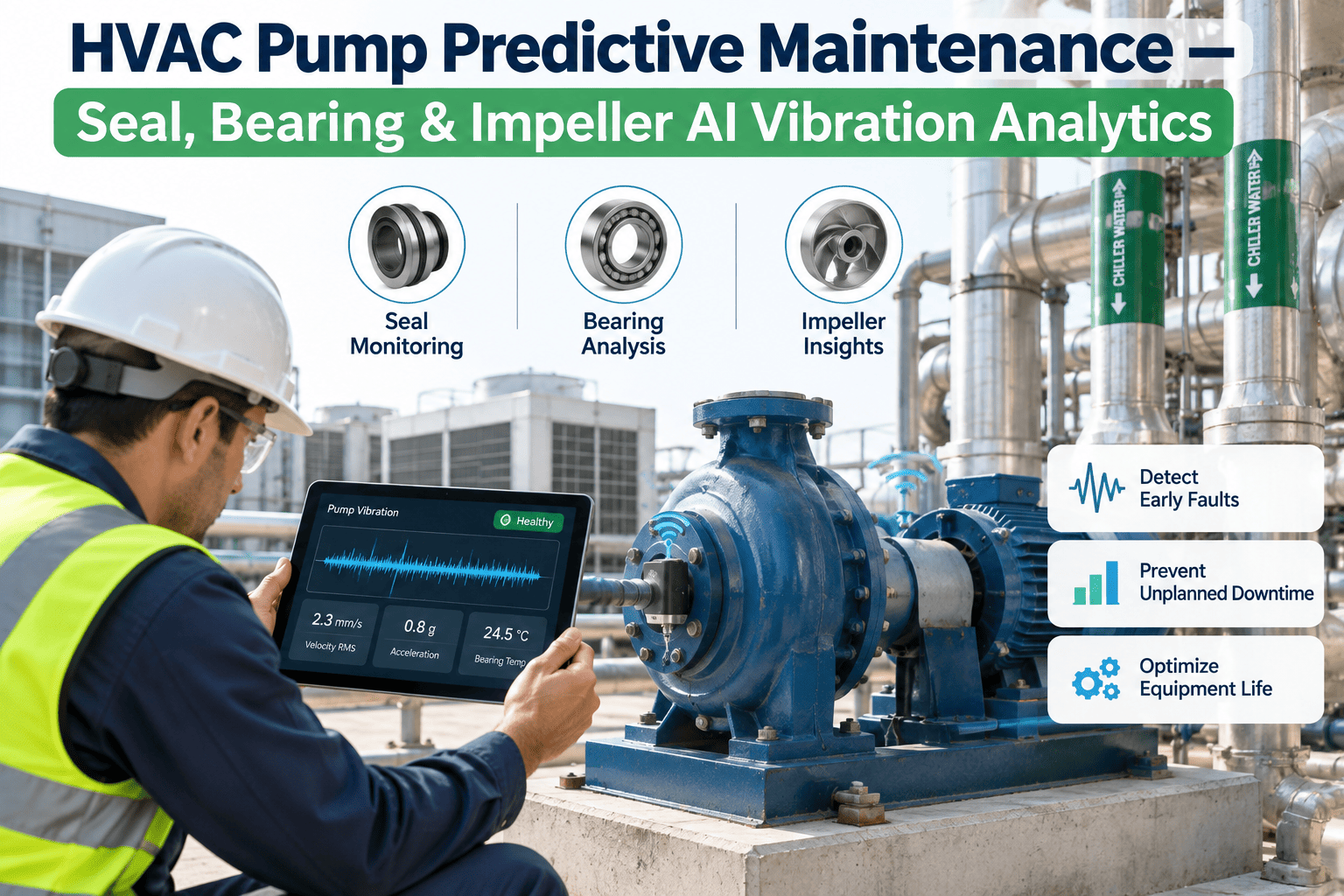
Continuous data acquisition from temperature sensors, pressure transducers, vibration accelerometers, current transformers, flow meters, and humidity sensors — 30–80 data points per chiller sampled every 15–60 seconds. Integration with BMS/BAS systems, chiller manufacturer gateways (Trane Tracer, Carrier i-Vu, York Multistack), and modbus/BACnet protocols ensures no data gap.
Baseline Performance Modeling
AI establishes a thermodynamic baseline for each chiller under its specific load, ambient, and water conditions — calibrating expected COP, heat rejection rates, compressor efficiency, and electrical consumption curves. This chiller-specific baseline is what separates genuine anomaly detection from false alarms generated by generic threshold models.
Multi-Parameter Anomaly Detection
Machine learning models continuously compare live sensor readings against expected values across all monitored parameters simultaneously. Fault signatures — combinations of subtle deviations across 5–15 parameters — are matched against libraries of known failure patterns from thousands of chiller-hours of operational data, generating fault probability scores for each failure mode.
Remaining Useful Life Estimation
For each detected degradation trend, AI projects the trajectory to critical failure — estimating remaining useful life with confidence intervals. This transforms a vague "something is wrong" alert into an actionable "compressor bearing will require replacement within 3–5 weeks" maintenance directive that fits your planned maintenance schedule.
CMMS Work Order Generation
Fault predictions automatically generate prioritized work orders in your CMMS — including fault description, severity rating, recommended intervention, required parts list, and estimated labor hours. Integration with OxMaint, Maximo, SAP PM, and ServiceNow ensures maintenance teams act on AI intelligence within existing workflows without additional software overhead.
What AI Predictive Maintenance Delivers — The Numbers
| Metric | Reactive / PM Approach | AI Predictive Maintenance | Improvement |
|---|---|---|---|
| Unplanned Downtime | 12–20 events/year per chiller | 2–4 events/year per chiller | 73% reduction |
| Fault Detection Lead Time | 0–2 days (alarm-driven) | 2–8 weeks in advance | 14–56x earlier |
| Emergency Repair Cost | $15,000–$75,000 per event | $2,000–$8,000 planned repair | Up to 85% lower |
| Energy Efficiency | Baseline (degraded operation) | 15–25% energy reduction | $40K–$120K/yr savings |
| Chiller Service Life | 15–20 years typical | 22–28 years with AI care | 5–10 year extension |
| Maintenance Labor | Baseline (reactive dispatching) | 25–35% labor reduction | Planned vs emergency |
Reactive Maintenance vs. AI Predictive Intelligence
AI Chiller Maintenance by Facility and Industry
Commercial Office and Retail
Office towers and retail centers run chillers at 60–85% average load for 10–14 hours daily. Tenant comfort SLAs make unplanned failures unacceptable. AI predictive maintenance aligns chiller interventions with occupancy schedules, minimizes disruption, and demonstrates energy efficiency performance to ESG-reporting requirements.
Hospitals and Healthcare Facilities
Healthcare chillers support OR suites, MRI cooling, pharmacy storage, and patient comfort — environments where chiller failure is a clinical risk, not merely a comfort issue. AI's 2–8 week warning window allows scheduled chiller redundancy management, ensuring zero downtime during planned maintenance windows in 24/7 critical operations.
Data Centers and Technology
Data center chillers operate at the intersection of maximum criticality and maximum runtime — 8,760 hours per year with PUE targets below 1.4. AI predictive maintenance prevents thermal events that cascade to server shutdowns, optimizes chiller sequencing for PUE improvement, and supports N+1 redundancy planning with real-time health scoring of each chiller unit.
Industrial and Manufacturing Plants
Process chillers cooling injection molding, pharmaceutical manufacturing, food processing, and semiconductor fabrication are tied directly to production output. Chiller downtime stops the line. AI predictive maintenance integrates chiller health scoring into production planning — scheduling maintenance during planned production changeovers to eliminate line stoppage costs entirely.
Chiller Types and Systems Supported
Chiller Predictive Maintenance — Frequently Asked Questions
How accurate is AI chiller fault detection?
After a 60–90 day calibration period on your specific chiller models, AI systems typically achieve 90–94% fault detection accuracy with false positive rates below 5%. This means fewer nuisance alarms than threshold-based BMS alerting while catching real faults weeks earlier. Accuracy improves continuously as models build equipment-specific operational history. Early detection of refrigerant issues, fouling, and bearing degradation has been validated across thousands of chiller-operating-hours of field data. See accuracy benchmarks in a live demo.
What sensors and IoT hardware are required?
Most modern chillers (post-2010) have sufficient onboard sensors — the platform connects via BACnet, Modbus, LONWORKS, or direct manufacturer gateway integration (Trane Tracer, Carrier i-Vu, York Quantum). For older equipment or enhanced monitoring, a supplemental IoT kit adding vibration accelerometers, additional temperature sensors, and current transformers typically costs $800–$2,500 per chiller and installs in 4–8 hours without system downtime. Full sensor requirements are assessed during the free consultation.
How far ahead can AI predict chiller failures?
Prediction horizon varies by failure mode: bearing and compressor wear is detectable 4–8 weeks ahead; refrigerant charge issues show statistical signals 3–6 weeks before performance impact; heat exchanger fouling trends are visible 6–12 weeks ahead of efficiency degradation. These windows allow parts procurement, contractor scheduling, and planned maintenance execution — eliminating the emergency premium entirely. All predictions include confidence scores and recommended intervention urgency levels.
Does this integrate with our existing BMS and CMMS systems?
Yes. The platform provides bidirectional integration with all major BMS platforms via BACnet/IP and REST APIs, and connects to CMMS systems including OxMaint, IBM Maximo, SAP PM, ServiceNow, and UpKeep. Detected faults automatically generate CMMS work orders with fault description, severity, parts list, and labor estimate attached. No replacement of existing systems is required — the AI layer augments your current infrastructure. See BMS and CMMS integration in action.
How long does deployment take?
Initial connectivity and monitoring activation completes in 1–3 weeks depending on BMS integration complexity and the number of chillers. Baseline calibration — where AI learns your specific equipment's normal operational signature — takes 60–90 days of monitored operation. Full predictive capability with confidence-scored fault detection is typically active within 90 days of deployment. Energy optimization recommendations begin generating from week one, delivering immediate ROI before predictive capabilities are fully calibrated.
What is the typical ROI for AI chiller predictive maintenance?
For a facility with 3–5 chillers, typical annual savings break down as: energy efficiency improvement ($40,000–$120,000), prevented emergency repair costs ($60,000–$180,000), extended equipment life capital deferral ($50,000–$150,000 amortized), and labor optimization ($15,000–$40,000). Total annual benefit typically ranges from $165,000–$490,000 against a platform cost that delivers full payback within 4–8 months. ROI calculations are performed as part of the free consultation using your actual chiller fleet and operating costs. Get a custom ROI estimate.
Ready to Stop Your Next Chiller Failure Before It Starts?
Every unplanned chiller failure is a preventable cost. Join facility managers and plant operators who have eliminated 73% of unplanned downtime, cut energy waste by up to 25%, and extended chiller service life by 5–10 years through AI-powered predictive maintenance. See the platform configured for your chiller fleet in a free 30-minute demo.