Most commercial roofs don't fail in a single event. They fail slowly — a flashing that separates by a millimeter each season, a drain that clogs for the third straight year, a membrane blister that finally ruptures after sitting untouched through two inspection cycles. By the time water reaches interior ceiling tiles, the actual damage is already weeks or months old. This guide maps the five most common commercial roofing problems — cause, symptom, and fix — so property analytics teams can stop reacting and start intervening at the right stage.
Catch roof defects before they reach the ceiling — not after.
iFactory connects building inspection data with live work order workflows so facilities teams respond to evidence, not complaints.
The Cost Gap Between Early and Late Action
The financial case for proactive roof management is straightforward: the same defect costs 4 to 8 times more to repair after water infiltration has saturated insulation and reached the structural deck than it does at the blister or early flashing stage. Yet most commercial facilities still operate on a complaint-triggered inspection model — walking the roof only after a tenant calls.
The shift to scheduled, documented inspection cycles is not complicated. It requires a consistent form, a dated record, and a system that turns a failed checklist item into an assigned work order before the next rain event. See how iFactory supports commercial envelope programs.
Five Commercial Roofing Problems — Cause, Symptom, Fix
Each problem below follows a consistent three-part diagnosis. Understanding all three prevents the most common mistake in commercial roofing: treating the visible symptom while the underlying cause continues to operate.
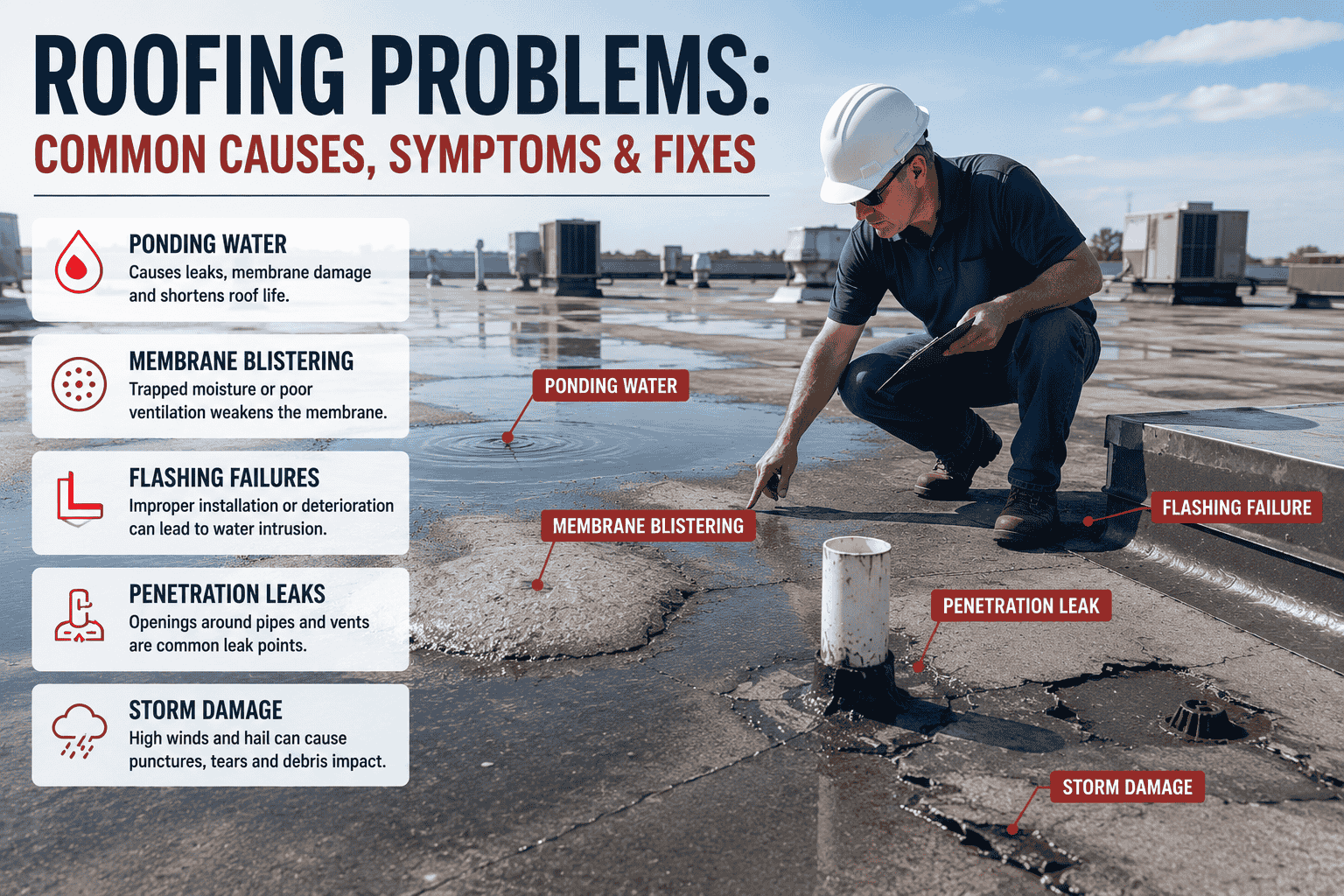
Ponding Water
High RiskInsufficient slope (below ¼ in/ft), clogged interior drains, blocked scuppers, structural deck deflection, or re-roofing that raised surface elevation around drain sumps.
Standing water visible 48 hours after rain. Algae or vegetation rings marking chronic wet zones. Accelerated membrane surface degradation within pooling areas.
Clear and re-seat drain sumps. Install tapered insulation to redirect flow. For structural deflection, engage a structural engineer before any membrane work begins.
Membrane Blistering
Medium RiskMoisture trapped under membrane at installation, outgassing from wet insulation or decking, or adhesive applied in cold temperatures. Common when re-roofing over an unconfirmed-dry existing system.
Raised dome-shaped bubbles ranging from golf ball to dinner plate size. Spongy texture underfoot. Ruptured blisters with lifting membrane edges exposing substrate beneath.
Monitor small intact blisters quarterly. Cut, dry, and patch ruptured blisters with compatible membrane material. Widespread blistering indicates systemic installation failure requiring section replacement.
Flashing Failures
High RiskThermal expansion cycles loosening termination bar fasteners and sealants. Incompatible materials bonded together. Missing counterflashing on parapet walls, or base flashing height below the required 8-inch vertical run.
Cracked or peeling sealant at wall-to-roof transitions. Open gaps at parapet caps. Rust staining below metal edge flashing. Visible daylight at HVAC curb corners viewed from the ceiling plenum at night.
Remove all failed sealant fully before reapplying — caulking over existing caulk accelerates re-failure. Severely corroded metal base flashings require full replacement with primed, coated aluminum or galvanized steel.
Penetration Leaks
High RiskPipe boots cracking from UV exposure. HVAC curb seals deteriorating without maintenance cycles. MEP contractors cutting new penetrations without a formal roofing sign-off. Vibrating pipes working loose from membrane boot collars over time.
Interior ceiling staining directly below pipe or conduit penetrations. Leaks appearing only during wind-driven rain, indicating a directional gap around a pipe collar. Visible daylight around pipe boots during nighttime interior inspection.
Replace deteriorated pipe boots with EPDM or TPO-compatible pitch pockets filled with pour-grade sealant. Inspect and reseal all four HVAC curb corners. Establish a formal penetration sign-off for any MEP work on roofed structures.
Storm Damage
Variable RiskHail impact puncturing or bruising insulation under single-ply membranes. High winds pulling edge metal and flashings loose. Flying debris scoring membrane surfaces. Freeze-thaw cycles expanding existing micro-cracks into active failure points.
Circular impact marks or lacerations across the field membrane post-hail. Lifted edge metal visible from ground level. Displaced ballast on ballasted EPDM systems. Interior staining within 24–48 hours of a weather event.
Inspect within 72 hours while damage is documentable for insurance. Photograph all impact patterns, measure affected areas, and obtain an independent consultant report before filing any claim. Apply temporary tarping to punctures immediately.
Repair Priority Matrix
Consistent triage logic across a portfolio separates life-safety emergencies from planned maintenance items and prevents over-dispatching contractors for low-priority defects. See how iFactory manages multi-property triage and work order assignment.
Inspection Checklist: What to Verify Every Roof Walk
A consistent inspection form closes the "I assumed someone else checked that" gap. Every item that fails should generate a dated work order with photographic evidence before the inspection team leaves the property.
Every failed checklist item becomes a tracked work order — automatically.
iFactory digitizes building envelope inspections and assigns corrective work orders from flagged defects, keeping a full audit trail across every property. Book a demo to see the workflow.
Expert Review
The single most preventable cost in commercial roofing is reactive repair following undetected ponding and flashing degradation. Property teams that maintain two formal inspection cycles per year — spring after freeze-thaw stress and fall before winter loading — and record findings in a structured work order system consistently extend roof service life by five to eight years versus inspection-on-complaint programs. The checklist above reflects the sequence used in formal Reserve Study assessments. A maintained digital record of inspections, assigned defects, and completed repairs provides the documentation chain insurers require during storm damage claim review, and demonstrates active maintenance stewardship that directly affects coverage terms and commercial property premium rates.
Frequently Asked Questions
How often should a commercial flat roof be inspected?
Twice per year is the standard minimum — spring after winter freeze-thaw stress and fall before snow loading or freezing temperatures return. Roofs with heavy foot traffic or rooftop mechanical equipment should also receive a post-storm inspection after any significant weather event. Book a demo to see iFactory's inspection scheduling features.
What causes the majority of commercial roof leaks?
Flashings and penetrations — not the field membrane — account for roughly 70 percent of commercial roof leaks. Parapet wall transitions, HVAC curbs, and pipe boot failures are the highest-frequency locations. The field membrane in a well-maintained system rarely fails as a primary point unless it has exceeded its rated service life.
Is ponding water always a problem on a flat commercial roof?
Yes. Water that drains within 24 to 48 hours after rainfall is less critical, but any standing water persisting beyond that window creates measurable risk. Chronic ponding accelerates membrane UV degradation, creates structural loading that can exceed design limits, and eventually infiltrates seams and penetrations. Most manufacturer warranties are voided when chronic ponding is documented during a manufacturer inspection.
Can a commercial roof be repaired rather than fully replaced?
In most cases, yes — provided water infiltration has not compromised the insulation layer or structural deck. Localized membrane repairs, flashing replacement, and penetration resealing can extend service life by 5 to 15 years at a fraction of full replacement cost. An infrared moisture scan is the most reliable pre-decision tool for determining whether insulation is still dry and salvageable before committing to either option.
How should facilities teams document roof conditions for insurance purposes?
Photograph every defect with dated, location-referenced images, log the location relative to a roof grid or drain reference point, and record observations in a consistent digital format each inspection cycle. A maintained record of inspection dates, defect findings, work orders, and completed repairs provides the documentation chain insurers require when reviewing storm damage claims and demonstrates active maintenance stewardship that affects commercial coverage terms.
Conclusion
Commercial roofing problems — ponding water, membrane blistering, flashing failures, penetration leaks, and storm damage — all share one characteristic: they become dramatically more expensive the longer they go undetected. The property teams that consistently avoid emergency repair cycles are not the ones with the newest roofs. They are the ones with documented inspection programs, structured work order histories, and escalation criteria that are applied before water reaches interior surfaces.
Every defect that gets photographed, logged, and assigned is a defect that does not turn into a damage claim. See how iFactory's building analytics platform supports commercial envelope programs for facilities teams managing single assets and large multi-property portfolios.
Give your property team the visibility your building envelope has always needed.
iFactory connects inspection data, defect tracking, and work order workflows into one platform — so your team responds to evidence, not emergency calls.