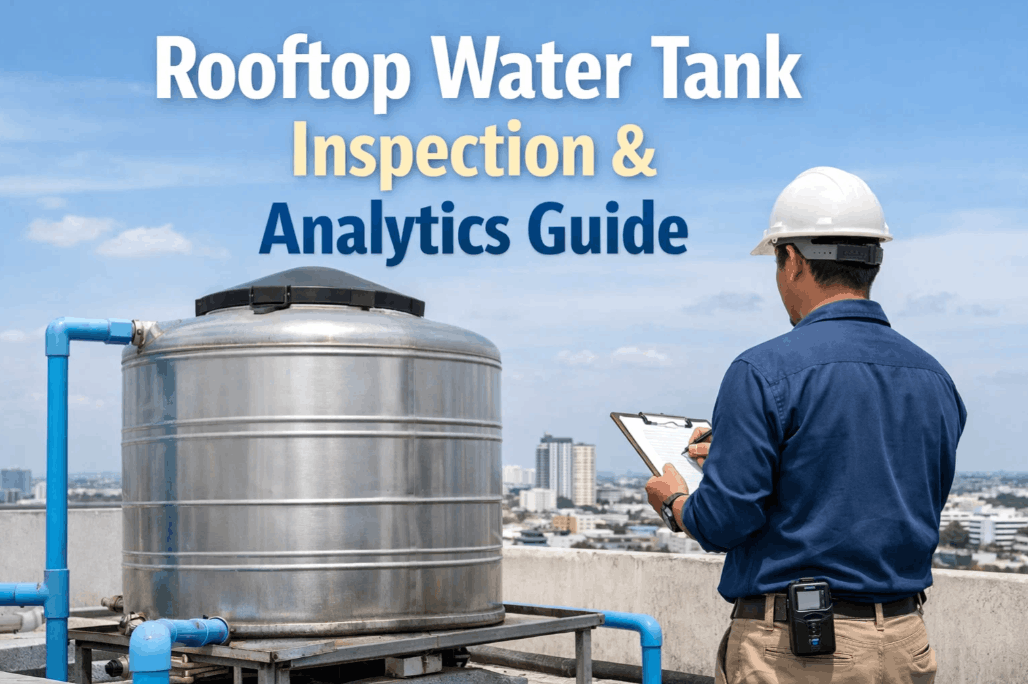
Rooftop water storage tanks are the silent workhorses of commercial building water infrastructure — gravity-fed systems that buffer demand, maintain pressure during peak hours, and provide emergency reserve capacity for fire suppression and domestic supply. Yet these assets are among the most under-inspected components in a typical commercial building maintenance program. Concealed on rooftop plant levels, tanks accumulate sediment, develop internal coating failures, experience structural cracking from thermal cycling, and harbor Legionella pneumophila colonies in warm, stagnant water zones — all without triggering a single work order until a health department notice or public health event makes the failure undeniable. A structured rooftop water tank inspection and analytics program for commercial buildings addresses every failure vector — structural, water quality, mechanical, and regulatory — through a documented inspection cycle that gives building owners defensible evidence of diligent asset management. Book a demo to see how iFactory automates your entire rooftop tank inspection and compliance workflow.
Automate Rooftop Water Tank Inspections — Structural, Water Quality, Compliance, and Seasonal Protocols in One Platform
iFactory's building maintenance platform delivers structured tank inspection checklists, Legionella risk assessment workflows, water quality test trending, overflow system verification, and one-click compliance documentation — purpose-built for commercial building water tank management.
Why Rooftop Water Tanks Are the Highest-Risk Unmanaged Asset in Commercial Buildings
Unlike mechanical equipment with visible performance indicators — pumps that lose pressure, chillers that trip on high head pressure, fans that vibrate — rooftop water storage tanks fail silently. A concrete tank developing hairline cracks from rooftop thermal cycling continues to hold water while progressively contaminating it with concrete carbonation products, reducing pH and accelerating internal corrosion. A galvanized steel tank developing pinhole corrosion at its base seam weeps water that damages the roof membrane for months before a ceiling leak is reported two floors below. A tank with a faulty ballcock allows overflow water to discharge onto the roof, creating standing water that breeds mosquitoes and accelerates membrane degradation — all invisible from the occupied floors below.
Regulatory risk amplifies these physical failure modes. In most jurisdictions, rooftop potable water tanks supplying domestic water are subject to local health department inspection authority — with tank cleaning, water quality testing, and inspection documentation required annually at minimum. Buildings that cannot produce inspection records on demand face compliance notices, public health orders, and in some jurisdictions, mandatory water service cessation until documentation is provided. Schedule a water system compliance assessment to identify documentation gaps before they become enforcement actions.
Buildings with rooftop water storage tanks that lack a Legionella Water Management Program (WMP) under ASHRAE 188-2018 face significant liability exposure. Legionella amplification in poorly maintained storage tanks has been linked to multiple building-associated Legionnaires' disease outbreaks — each carrying average litigation costs of $2–15M per confirmed case for building owners who cannot demonstrate a compliant WMP.
Rooftop Tank Types: Inspection Approach by Construction Material
The inspection methodology for a rooftop water storage tank is determined by its construction material — each with distinct structural failure modes, internal coating vulnerabilities, and cleaning requirements. Knowing your tank type is the first step in building a correctly calibrated inspection program.
Reinforced Concrete Tanks
Most common in older mid-rise and high-rise commercial buildings. Key failure modes: carbonation-induced reinforcement corrosion, construction joint cracking, internal surface spalling, and sealant/render failure. Inspect crack widths annually — cracks wider than 0.2mm in potable water tanks require immediate remediation. Internal waterproof render condition is the critical inspection item.
Galvanized Steel Tanks
Common in commercial and industrial buildings from 1960–1990. Zinc coating provides corrosion protection with finite service life — typically 15–25 years depending on water chemistry. Internal inspection for rust staining, pit corrosion, seam weld condition, and zinc white deposits is required annually. Water chemistry (pH 6.5–8.5, low chloride) must be maintained to preserve zinc layer integrity.
Glass-Fused-to-Steel (GFS) Tanks
Modern bolted steel tanks with glass-fused coating providing excellent corrosion resistance. Inspect panel joint sealants, anchor bolt condition, and base ring seal annually. Internal coating damage at bolt holes is the primary failure mode — magnetic particle inspection of bolted joints identifies developing leaks before visible staining appears on the exterior.
HDPE & GRP (Fibreglass) Tanks
High-density polyethylene and glass-reinforced plastic tanks offer excellent corrosion resistance and are increasingly specified for potable water storage. Inspect for UV degradation (surface chalking, colour change), impact damage, joint sealant condition, and support frame corrosion. Internal surfaces are more resistant to biofilm but require equal cleaning frequency to prevent sediment accumulation.
Stainless Steel Tanks
Grade 316L stainless steel provides the highest corrosion resistance for potable water storage. Inspect weld joints for crevice corrosion (particularly in chloride-rich coastal environments), manhole gasket condition, and external surface for chloride-induced stress corrosion cracking. The highest-specification choice for new installations where long service life and minimal maintenance are priorities.
Sectional Rooftop Tanks
Modular bolted-panel tanks assembled on site from pre-manufactured sections — common where tank replacement must occur within an existing building envelope. Key inspection items: panel-to-panel gasket condition across all joints, structural frame corrosion, level and plumb of the assembled structure, and tie rod tension verification. Gasket failure is the primary leak initiation point.
Complete Rooftop Water Tank Inspection Schedule & Checklist
A compliant and comprehensive rooftop water tank inspection program requires four inspection frequencies — each targeting failure modes specific to that interval. The table below maps each inspection frequency to the specific items that must be checked, tested, or verified. Book a demo to see how iFactory digitizes and auto-schedules this entire framework for your building's tank assets.
| Inspection Category | Weekly | Monthly | Quarterly | Annual |
|---|---|---|---|---|
| Water Level & Float Operation | Check level + ballcock | Float valve full test | Valve service + flush | Full valve replacement eval. |
| Overflow Pipe & Discharge | — | Visual check | Flow test + screen clean | Overflow capacity verification |
| Structural Integrity (External) | — | Visual walkround | Detailed structural check | Full structural survey |
| Internal Tank Condition | — | — | — | Full internal inspection + clean |
| Water Quality Sample | — | Temperature + turbidity | Coliform + Legionella risk | Full microbiological suite |
| Manhole Cover & Seal | — | Visual + lock check | Gasket condition | Gasket replacement eval. |
| Inlet, Outlet & Drain Valves | — | — | Operate all valves | Valve overhaul or replacement |
| Insulation & Cladding (Cold Climate) | — | — | — | Pre-winter condition check |
| Roof Structure Below Tank | — | — | Leak & drain check | Structural load verification |
iFactory Tank Analytics Platform: Documented Building Results
Commercial properties using iFactory's water tank inspection and analytics module maintain continuous compliance documentation, detect deterioration earlier, and avoid the emergency remediation costs that follow neglected inspection programs. Book a demo to see these results applied to your building's water infrastructure.
Legionella Risk Management: The Mandatory Compliance Layer for Rooftop Tanks
ASHRAE Standard 188-2018, Legionellosis: Risk Management for Building Water Systems, requires a documented Water Management Program (WMP) for any building water system with conditions conducive to Legionella growth — which rooftop storage tanks inherently satisfy. Water temperatures in upper zones of a storage tank can reach the 25–45°C optimal growth range for Legionella pneumophila during warm months. Stagnation of water in tank areas rarely disturbed by turnover, combined with sediment accumulation providing organic nutrient substrate, creates the perfect incubation environment.
Legionella Control Measures for Rooftop Storage Tanks
A compliant Legionella Water Management Program for a rooftop storage tank addresses three control principles: temperature management, disinfectant residual maintenance, and physical cleaning to eliminate sediment and biofilm. Schedule a Legionella compliance review to assess your current program against ASHRAE 188 requirements.
ASHRAE 188 Control Measures iFactory Tracks for Storage Tanks
- Cold water temperature: Stored water should be maintained below 20°C (68°F) to inhibit Legionella growth — monitor and record water temperature at least monthly, with additional monitoring during summer months
- Chlorine disinfectant residual: Maintain 0.2–0.5 mg/L free chlorine residual at the tank outlet — measure and record at each monitoring visit, with corrective action documented if residual falls below 0.2 mg/L
- Turnover rate monitoring: Calculate average daily tank turnover — tanks with less than 50% daily turnover have elevated stagnation risk and require enhanced monitoring frequency or inlet/outlet configuration review
- Annual tank cleaning and disinfection: Full drain, clean, and superchlorination to 50 mg/L free chlorine for a minimum 2-hour contact time, followed by flushing to restore normal residual and sampling before return to service
- Legionella culture sampling: Quarterly water samples analyzed for Legionella species under ISO 11731 or equivalent — results trended and action levels (100 CFU/L for precautionary, 1000 CFU/L for immediate remediation) monitored against ASHRAE 188 and local health authority guidelines
- Sediment depth measurement: Inspect and record sediment depth at each annual cleaning — sediment depth exceeding 2mm at the lowest tank point indicates inadequate drainage or turnover requiring system review
Conditions That Elevate Legionella Risk in Rooftop Tanks
- Water temperature in the tank exceeding 20°C for more than 24 hours (common in uninsulated tanks in warm climates)
- Low tank turnover — buildings with storage capacity exceeding 3 days of peak demand have extended stagnation periods
- Dead legs in tank outlet pipework — sections of pipework between the tank outlet and first draw-off that rarely receive flow are high-risk stagnation zones
- Scale and corrosion debris on internal tank surfaces providing organic substrate for biofilm development
- Manhole covers without insect-proof seals allowing organic contamination from external sources
- Absence of chlorination or inadequate chlorine dosing due to a failed chlorination system that has not been identified by inspection
Annual Internal Tank Inspection: Step-by-Step Procedure
The annual internal inspection is the most critical event in the rooftop water tank maintenance calendar — the only opportunity to directly observe internal coating condition, sediment accumulation, structural crack development, and inlet/outlet fitting integrity that external inspection cannot reveal. The procedure must be conducted by trained confined space entry personnel with appropriate PPE and atmospheric monitoring equipment.
Pre-Entry Isolation & Safety Setup
Isolate tank inlet valve and lock out. Notify building occupants of temporary supply interruption. Confirm atmospheric conditions in tank void space (O2 19.5–23.5%, CO below 35 ppm, H2S below 10 ppm) before entry. Deploy tripod and harness rescue system at manhole. Minimum two-person team — one inside, one as standby with emergency rescue capability.
Drain, Sediment Removal & Pre-Inspection Rinse
Drain tank to base via drain valve — record drain time as indicator of effective drainage. Remove accumulated sediment by wet vacuum from tank floor — weigh and record sediment volume as a trend indicator. High-pressure rinse of all internal surfaces to remove loose scale and biofilm before detailed inspection is conducted.
Internal Structural & Coating Condition Survey
Inspect all internal surfaces systematically: floor, walls, roof, columns (if any), and inlet/outlet fittings. Document crack locations and widths (photo + measured), coating condition using the SSPC-VIS 2 or equivalent rust grading system, corrosion extent, and condition of all penetrations and fittings. Compare against prior year survey photos.
Superchlorination, Flush & Return to Service
Fill tank with treated water dosed to achieve 50 mg/L free chlorine. Maintain contact time minimum 2 hours. Flush to waste until free chlorine returns to 0.2–0.5 mg/L normal operating residual. Take pre-return-to-service water quality samples. Open inlet and return tank to service after sample results confirm compliance — typically 24–48 hours for laboratory results.
Seasonal Analytics: Rooftop Tank Preparation by Season
Rooftop water tanks experience the most extreme thermal environment of any building water system component — direct solar gain in summer, potential freezing conditions in winter, and rapid temperature swings during seasonal transitions that stress structural joints and sealants more than stable-condition operation. A seasonal maintenance calendar addresses the specific risks each season creates.
Post-Winter Condition Assessment & Annual Inspection
Spring is the optimal timing for the annual internal inspection — after winter freeze-thaw cycling has stressed joints and sealants, but before summer heat accelerates Legionella risk in warm stored water. Inspect all external joints and penetrations for freeze-thaw damage. Remove winter pipe insulation jackets for inspection before refitting. Verify overflow pipe discharge is clear of winter debris accumulation.
Elevated Legionella Monitoring & Temperature Management
Increase Legionella monitoring frequency during summer months when tank water temperature risk is highest. Check that tank insulation (if fitted) is intact and preventing solar gain. Verify chlorine residual more frequently — heat accelerates chlorine decay in stored water. Monitor tank turnover rate against summer demand patterns — increased building occupancy typically improves turnover, reducing stagnation risk.
Pre-Winter Insulation & Pipe Protection Verification
Inspect all exposed pipework associated with the tank — overflow pipe, inlet and outlet pipework on the rooftop — for adequate frost insulation. Verify heat trace cables (if fitted) are operational before first frost. Check that manhole cover insulation is intact and sealing correctly to prevent heat loss from the stored water body. Verify float valve mechanisms are lubricated and moving freely before cold weather restricts movement.
Freeze Risk Monitoring & Emergency Response Readiness
Weekly visual inspection during cold snaps to confirm no frost damage to exposed pipework or float valve mechanisms. Verify heat trace is energized during sustained sub-zero periods. Confirm emergency supply bypass is operational in case primary tank supply is temporarily isolated for frost repair. Document any freeze events for structural assessment at the following spring inspection — freeze-thaw cycles accelerate concrete crack propagation and joint sealant degradation.
Ready to Automate Your Rooftop Tank Inspection Program and Eliminate Compliance Risk?
iFactory's water tank module delivers inspection checklists, ASHRAE 188 Legionella tracking, water quality test trending, and seasonal maintenance scheduling — fully documented and audit-ready from day one.
Frequently Asked Questions: Rooftop Water Tank Inspection & Analytics
Structural. Water Quality. Legionella. Seasonal. All Tracked Automatically.
Complete rooftop water tank compliance in one platform — inspection checklists, ASHRAE 188 WMP documentation, water quality trending, and seasonal maintenance scheduling. Activated in days.