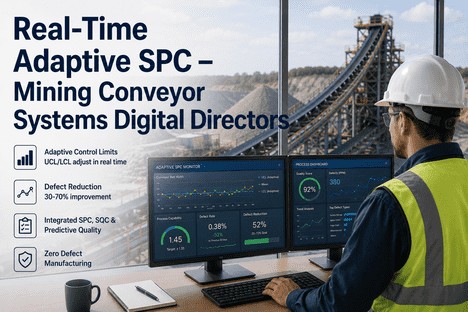
Three defect categories define the quality landscape of every pelletizing plant: oversize and undersize pellets that fail the size specification, crush-strength failures that emerge hours after induration, and chemical composition deviations that invalidate entire production batches for specific end-use markets. Quality leaders know the cost of each — the oversize recycle that consumes balling capacity, the crush-strength rejection that scraps a full furnace run, the composition deviation that triggers a customer hold notification. What most quality programmes do not adequately address is why these defects keep recurring despite correction. The answer is almost always the same: the SPC system that should have detected the process drift used static control limits that were calibrated for a different ore blend, a different binder batch, or a different recipe — and by the time the real drift appeared against those outdated limits, the defect was already produced. Adaptive SPC eliminates this structural gap. This is the quality leader's guide to deploying it.
Quality Leaders Who Sustain Defect Rates Below 2% in Pelletizing Have One Thing in Common: Their Control Limits Move With Their Process.
iFactory's adaptive SPC platform gives quality leaders dynamic control limits that recalibrate to every material change, recipe transition, and process regime shift — with predictive defect forecasts, machine vision integration, and audit-ready compliance records built in from day one.
Defect reduction achievable with adaptive SPC and predictive analytics in mineral processing operations — documented across pelletizing, flotation, and sinter programmes
92%
Defect prediction accuracy achieved by AI-powered SPC systems analysing hundreds of process parameters simultaneously — with yield issue forecasting up to 24 hours ahead
50–70%
False alarm reduction when adaptive ML control limits replace static limits — restoring operator alert credibility and driving response rates back to near 100%
15%
Overall yield increase documented when AI-SPC systems predict yield issues 24 hours ahead, enabling corrective action before defects are produced
The Quality Leader's Core Problem in Pelletizing: Why Defects Keep Recurring After Correction
A corrective action closes the defect event. A new SPC record opens. The process returns to the logged specification range. Three weeks later, under conditions that look similar to the quality leader but not identical to the quality system, the same defect category appears again. The investigation reconstructs the same cause. The same correction is applied. The corrective action record cites a different event number, but the root cause column reads essentially the same text as the last one. This is the defining quality management failure in pelletizing — not the inability to correct defects, but the inability to prevent their recurrence — and it is caused by a single structural problem: the SPC system cannot distinguish between a process change that legitimately shifts what normal looks like and a process deviation that represents genuine defect risk. Adaptive control limits make this distinction automatic and continuous.
The Four Root Causes of Recurring Defects in Pelletizing — and How Adaptive SPC Eliminates Each One
01
Static Limits Miss Ore Blend Transitions
When the ore blend changes — different stockpile, different mineralogy, different particle size distribution — the normal operating range for moisture, disc speed, and binder dosage all shift simultaneously. Static control limits do not know this happened. They fire false alarms on parameters that are legitimately operating at new setpoints, and they may miss genuine drift because the process has entered a new regime where the old limits no longer bound the actual risk zone.
Adaptive SPC fix: Blend change registered → limits recalibrate to new baseline within configurable transition window.
02
Binder Batch Variation Goes Undetected
Bentonite binder from natural deposits varies in swelling index, moisture absorption capacity, and binding efficacy between batches and sources. A binder batch with lower swelling index requires higher dosage to achieve the same green ball strength — but static limits on binder addition rate do not account for this. The quality system sees the dosage as within specification. The pellets are systematically weaker than the dosage history suggests. Crush strength failures follow.
Adaptive SPC fix: Binder batch change triggers limit adjustment and green strength correlation tracking for new efficacy profile.
03
Recipe Changes Invalidate All Existing Limits
Switching between pellet grades for blast furnace versus direct reduction customers changes the target chemistry, the balling moisture window, the induration temperature profile, and the acceptable size range simultaneously. Every SPC limit in the system is now calibrated for the wrong product. Quality leaders manage this manually — or not at all — and the transition period produces elevated defect rates that are absorbed as acceptable changeover loss rather than prevented through systematic limit reconfiguration.
Adaptive SPC fix: Grade change logged → full limit set transitions automatically to the new recipe specification profile.
04
Alert Desensitisation From False Alarms
The accumulated effect of all three root causes above is an operator population that has learned to treat SPC alerts as noise. When 60 to 80% of alerts during ore transitions, binder changes, and recipe shifts are false positives, the credibility of the alert system is destroyed. The one genuine defect precursor that fires during a shift looks identical to the fifteen false alarms that preceded it. Adaptive limits reduce false alarm rates by 50 to 70% — and the alerts that remain are almost always real. Operators respond because the system has earned its credibility back.
Adaptive SPC fix: False alarm rate drops 50–70%. Every alert that fires reflects a genuine process event requiring response.
Defect Root Cause · Adaptive Limits · Cross-Stage Traceability · ISO 9001 Audit Records
When Defects Recur After Correction, the SPC System Is Not the Safety Net — It Is the Source of the Gap. Adaptive Limits Close It.
iFactory builds the distinction between process change and process deviation directly into the limit calculation — so quality leaders receive alerts that reflect genuine risk, not limits that stopped tracking reality at the last capability study.
The Adaptive SPC Architecture for Pelletizing Quality Leaders
The iFactory adaptive SPC platform operates as a three-layer quality intelligence system — adaptive control in real time at the process level, predictive defect forecasting at the batch level, and audit-ready documentation at the compliance level. Each layer serves a different quality management function, and all three run simultaneously without requiring quality leader intervention to maintain.
Layer 01
Adaptive Real-Time Control
Dynamic UCL/LCL that move with the process regime
The adaptive control layer ingests all monitored process variables — balling moisture, binder dosage, disc speed and angle, feed rate, particle size proxies, induration temperature zones, and pellet size distribution measurements — and maintains a rolling statistical model of the current process baseline. Control limits are recalculated continuously against this model: when the process is stable and capability is high, limits tighten to increase sensitivity. When a legitimately new regime is detected (ore blend change, recipe transition, binder batch change), limits transition to the new baseline without generating false alarms during the transition. The quality leader sees live control charts where every alert reflects a genuine deviation from the current operating norm — not from the norm of three months ago.
Continuous limit recalculation
Regime change detection
Transition window management
Layer 02
Predictive Defect Forecasting
Forecast defect risk 2–24 hours before the quality test confirms it
The predictive layer uses an ML model trained on historical process variable patterns and their correlation with quality test outcomes — crush strength, tumble index, size distribution, and chemical composition. When the current combination of process parameters matches a pattern historically associated with an off-spec outcome, the system generates a predictive quality alert before the test result is available. For crush strength failures, which emerge 4 to 8 hours after induration, this provides the quality leader with an intervention window measured in hours — enough time to isolate the affected batch for additional testing, adjust the firing profile for the next run, or authorise a production hold before additional product is committed. This is the capability that Quality Magazine's 2026 analysis identifies as the defining trend: AI that adds foresight to the statistical rigor that SPC already provides.
Crush strength forecast
Size defect prediction
Composition risk alert
Layer 03
Audit-Ready Compliance Records
Automated ISO 9001 and customer audit documentation
Every adaptive limit change, every predictive alert, every quality leader action, and every test result is logged automatically with a timestamp and the process context data — ore blend code, recipe version, binder batch ID — in use at the time. This creates the documentation chain that ISO 9001 Clause 10.2 nonconformance requirements demand: not just a record that a defect occurred, but a record showing what the adaptive system detected before the defect was confirmed, what intervention was taken, and what the outcome was. For customer quality audits, the record demonstrates that the quality management programme responded proactively — a materially stronger compliance position than a programme that documents defects after they are discovered. Cpk trend reports, CAPA linkage records, and process capability histories are all generated automatically and exportable for any date range, product grade, or process zone.
ISO 9001 event records
CAPA linkage and tracking
Cpk history by grade and blend
What the Adaptive SPC Quality Dashboard Shows the Quality Leader
The quality leader's view of the adaptive SPC system is not a process control interface — it is a quality programme management tool. The dashboard is designed around the questions that quality leaders need to answer continuously: Is the process in control right now? What is the current defect risk and which parameter is driving it? Is the Cpk trend moving toward or away from target? And when the next audit arrives, is the documentation ready?
Quality View 01
Live Defect Risk by Product Grade and Process Zone
A single-screen view of defect risk across all active product grades and process zones — balling circuit, induration furnace, screening and testing. Each zone displays a current risk status (in control, trending, elevated) with the adaptive limit compliance rate and the top-ranked parameter contributing to any elevated risk. Quality leaders see the plant quality status in one view without navigating machine-by-machine.
Quality leader action: Prioritise investigation by zone risk level. Elevated zones receive immediate review.
Quality View 02
Cpk Trend by Quality Characteristic — Live and Forecast
Cpk is calculated continuously for each monitored quality characteristic — green ball strength, pellet size distribution, crush strength, and chemical composition — and displayed as a trend line with the current value and the projected Cpk at current trajectory. Quality leaders see whether capability is improving, holding, or declining — not as a shift-end report, but as a live leading indicator that allows intervention before capability falls below the 1.67 target.
Quality leader action: Falling Cpk trend triggers investigation before it crosses the 1.33 warning threshold.
Quality View 03
Defect Pareto — Ranked by Grade, Blend, and Time Period
The defect Pareto view ranks defect occurrences by category, product grade, ore blend, and time period — making cross-period patterns visible that isolated corrective action investigations never connect. A quality leader who sees that 70% of crush-strength defects occur within the first 8 hours of a binder batch transition has a systemic finding that drives a protocol change, not a repeat corrective action. The Pareto is generated automatically from the adaptive SPC event log without manual data compilation.
Quality leader action: Pareto patterns escalate to engineering as systemic input, driving protocol changes not individual fixes.
Quality View 04
CAPA Effectiveness Tracking — Closed Loop From Alert to Resolution
Every adaptive SPC alert that generates a corrective action is tracked through closure — the alert, the quality leader action, the parameter correction, and the subsequent Cpk trend confirming or failing to confirm the effectiveness of the intervention. If the same parameter combination generates another alert within a configurable period after a corrective action was closed, the system automatically flags the CAPA as ineffective and re-opens the investigation. This closes the loop that most pelletizing quality programmes leave open: verifying that the correction actually prevented the recurrence, not just that the ticket was closed.
Quality leader action: CAPA re-opened automatically if defect pattern recurs — recurrence prevention, not just documentation.
Quality View 05
Audit Export — ISO 9001 Records in One Click
Every piece of documentation the quality audit requires — SPC compliance records, defect event logs, CAPA records with effectiveness evidence, Cpk trend history by grade, limit change logs with statistical rationale — is generated automatically and held in a searchable, exportable format. Audit preparation time drops from days of manual data compilation to a single export covering any date range, product grade, or process zone the auditor specifies. The adaptive limit change log — which shows every limit adjustment, the process data that triggered it, and the statistical justification — is the record that demonstrates the quality programme actively maintains current, defensible control limits.
Quality leader action: Export full audit package on demand. No manual compilation required.
Quality View 06
Machine Vision Integration — Surface and Dimensional Quality at the Pellet Level
For quality programmes deploying machine vision on green pellet conveyors or post-induration screening systems, iFactory integrates vision inspection outputs directly into the adaptive SPC control chart as additional quality data streams. Vision-detected surface defects — cracks, spalling, shape anomalies — are logged against the batch record and contribute to the Cpk calculation for physical quality characteristics. This gives quality leaders a 100% inspection record for surface quality alongside the sample-based crush strength and tumble index data — the combination that closes the coverage gap between mechanical testing and visual quality.
Quality leader action: Vision defect data feeds adaptive SPC automatically — no separate system to manage.
"
Our corrective action system was full of records that closed and then re-opened within eight weeks — same defect category, slightly different production context, same root cause in the investigation. The CAPA process was treating each event as isolated when it was clearly systematic. The adaptive SPC platform changed this by surfacing the pattern across events rather than within events. Within the first three months, the defect Pareto showed us that 65% of our crush-strength failures were occurring in a 12-hour window after binder batch changes — something our event-by-event CAPA process had never identified because no single event was severe enough to escalate. We changed the binder transition protocol. Crush-strength defect frequency dropped 58%. That finding came from the Pareto, not from the corrective action database.
Defect elimination in pelletizing is not a corrective action problem — it is a detection architecture problem. When the SPC system generates alerts that do not reflect current process conditions, when corrective actions close events without identifying the systemic pattern, and when predictive warning capability is limited to a single assay cycle's worth of lag, defects recur because the quality programme is structurally unable to prevent them. Adaptive SPC addresses all three dimensions simultaneously: limits that move with the process so alerts reflect genuine risk, cross-event pattern detection that surfaces systemic causes, and predictive forecasting that provides intervention lead time measured in hours rather than shift reports.
The industry evidence for 2025 and 2026 is clear: AI-powered SPC systems that predict yield issues 24 hours ahead and analyse hundreds of process parameters simultaneously have documented 92% forecast accuracy and 15% overall yield improvement in comparable mineral processing environments. The 30 to 70% defect reduction range is not a projection — it is the documented outcome range from operations that moved from static to adaptive quality management. The quality leaders achieving the upper end of that range are the ones who deployed adaptive limits early, configured cross-stage traceability from balling through induration, and used the Pareto and CAPA effectiveness tracking to convert individual defect corrections into systemic protocol improvements.
iFactory's adaptive SPC platform is designed for quality leaders in mining pelletizing operations who need to eliminate defect recurrence, not just manage it. Book a Demo to see the adaptive SPC system configured for your pellet grade portfolio and ore blend profile, or talk to an expert about a free Cpk and audit-readiness assessment for your pelletizing quality programme.
Frequently Asked Questions
ISO 9001 Clause 7.5 requires that documented information be controlled and maintained. For control limits, this means every limit change must have a documented rationale. iFactory addresses this through an automatic limit change log that records every adaptive recalculation — the timestamp, the triggering event (ore blend change, recipe update, binder batch registration, statistical baseline shift), the previous limit values, the new limit values, and the statistical basis for the recalculation (the data window used and the algorithm applied). This log is exportable in a structured format suitable for direct inclusion in QMS documentation and is searchable by product grade, process zone, and date range. Auditors reviewing the adaptive limit history see a controlled, documented process — not a system that changed limits without traceability. The key argument for adaptive limits in an ISO 9001 context is that limits calibrated on outdated process data are less defensible than limits that are demonstrably current, with the recalculation logic fully documented. Talk to an expert about configuring the limit change log format for your QMS documentation requirements.
The predictive model initialises using historical data from the process historian paired with quality test records from the LIMS — the same data the quality team already uses for retrospective analysis. A minimum of 6 months of paired process-variable-to-test-outcome history is sufficient to build an initial model for the primary defect categories. Twelve to eighteen months covers more ore blend and recipe variability, which improves forecast accuracy during transitions. The model deploys in shadow mode first — generating forecasts in parallel with the existing quality programme without using them to drive decisions — allowing the quality leader team to validate forecast accuracy against actual test outcomes before relying on the predictive output for quality holds or corrective action. Shadow mode typically runs for 2 to 4 weeks. Documented accuracy data from this period provides the evidence needed to transition the forecast to a primary decision input. Book a Demo to see accuracy validation data from comparable pelletizing deployments.
Every corrective action record in iFactory links to the adaptive SPC alert that initiated it and the process parameter state at alert time. When a CAPA is closed, the system continues monitoring the parameter combination that generated the original alert for a configurable effectiveness window — typically 30 to 90 days depending on the pelletizing cycle and production volume. If the same parameter combination generates a defect alert within the effectiveness window, the CAPA is automatically flagged as ineffective and the record is updated with the recurrence event. The quality leader receives a notification that the corrective action did not prevent recurrence — and the two events are linked in the system, making it visible that the root cause was not adequately addressed by the first intervention. This is the documentation trail that ISO 9001 Clause 10.2 requires for demonstrating that corrective actions are evaluated for effectiveness, and it is generated automatically rather than relying on quality leader memory to link the second event to the first. Talk to an expert about configuring CAPA effectiveness windows for your defect category mix.
Yes. iFactory's product grade architecture registers each pellet grade as a separate specification profile — with its own size range, crush strength target, chemical composition limits, and balling moisture window. When the production line transitions between grades, the active specification profile switches automatically and the adaptive SPC limits transition to the new grade's baseline. The quality leader sees clearly which grade is currently active, which specification profile is in use, and what the Cpk is for each quality characteristic against the current grade's limits. Historical Cpk data is segmented by grade automatically, so the quality leader can compare performance on blast furnace grade versus direct reduction grade without manual data sorting. For plants producing multiple grades in the same week, the system maintains separate defect histories, CAPA records, and Pareto analyses by grade — giving the quality leader the visibility to manage a mixed-grade production programme as confidently as a single-grade one. Book a Demo to see multi-grade adaptive SPC configured for your production grade portfolio.
Defects That Recur Have a Pattern. Adaptive SPC Finds It Before the Next Corrective Action Opens. Get a Free Cpk and Audit-Readiness Assessment.
iFactory's adaptive SPC platform for pelletizing quality leaders — dynamic limits that adapt to every material change, predictive defect forecasting up to 24 hours ahead, CAPA effectiveness tracking, and ISO 9001-aligned audit documentation generated automatically from the quality data your process already produces.