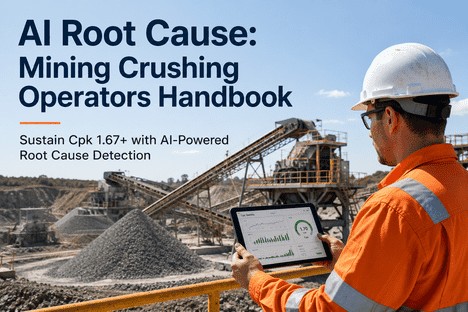
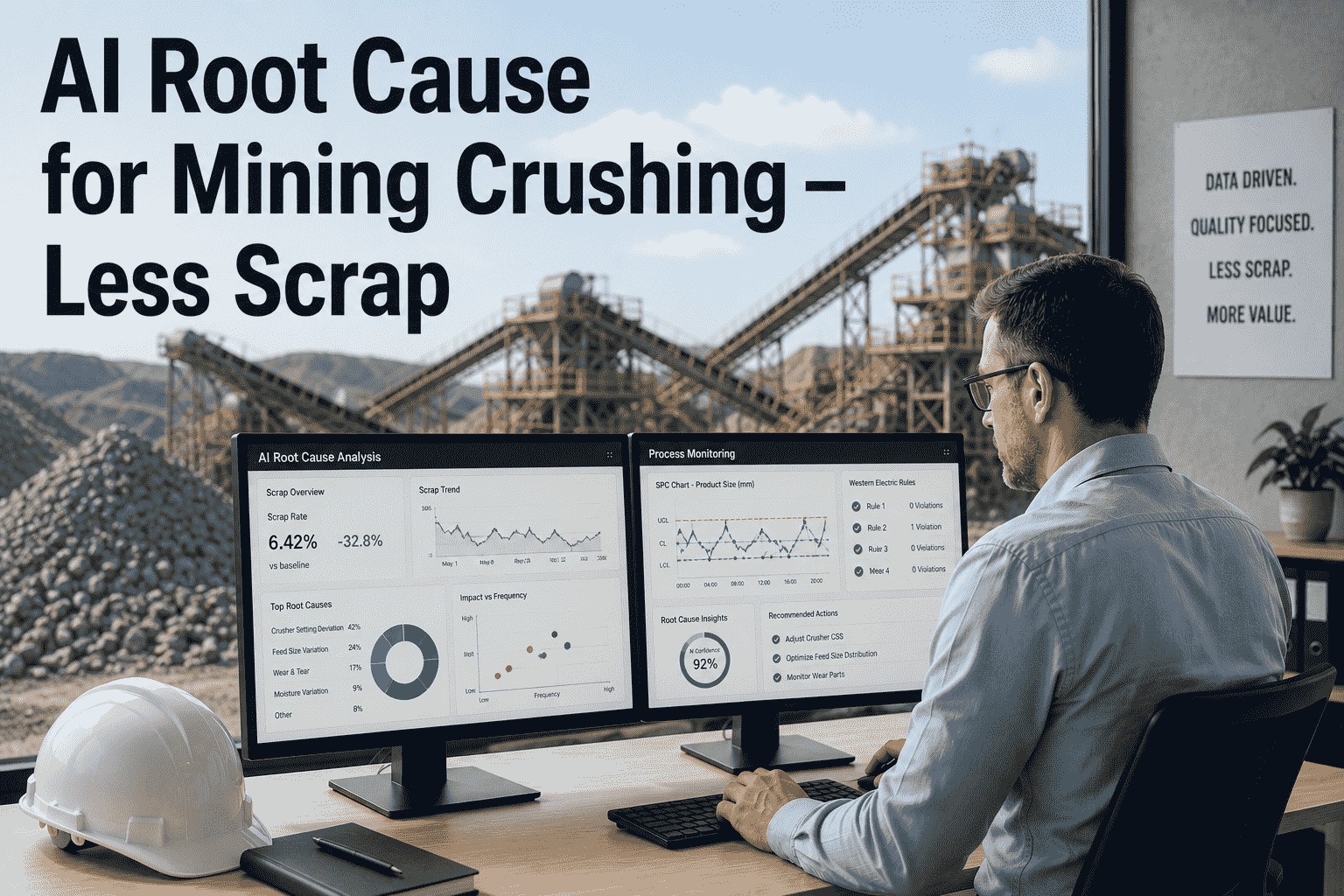
Your Cpk just dropped to 1.1. The screen report shows out-of-spec product. The shift supervisor wants an answer. You check feed size — looks normal. You check gap setting — within range. Power draw is elevated but not alarming. You adjust the CSS and wait. Thirty minutes later the Cpk is at 1.3 and climbing. You log it as resolved. But you never found the root cause. And in 18 days, under similar conditions, the same drift will happen again — and the cycle will repeat. This is the single most expensive quality problem in mining crushing operations: not the defect itself, but the inability to trace it to its origin across 100+ simultaneous process variables before it repeats.
Multivariate ML · Continuous Cpk Tracking · Predictive Scrap · Audit-Ready Records
Cpk 1.67+ Is Not a Target You Hit Once. It Is a Process State You Sustain — With AI.
iFactory's AI root cause detection engine correlates 100+ crushing process variables in real time — pinpointing the specific parameter driving Cpk degradation before the next shift, not after the next audit.
1.67+
Cpk target that defines Six Sigma process capability — sustainable only with continuous root cause visibility, not reactive adjustment
100+
Process variables in a typical crushing circuit — feed size, ore hardness, CSS, power draw, moisture, liner wear, screen efficiency, and more
80%
Of mining companies planning data-driven KPI adoption — with Cpk stability and OEE as primary targets for crushing and processing
5–10%
Energy reduction reported in crushing and grinding circuits using AI closed-loop control with real-time root cause visibility
Why Crushing Operators Struggle to Sustain Cpk — and Why It Is Not a Skill Problem
Crushing is not a single-variable process. Feed ore arrives with changing hardness, moisture content, and size distribution — none of which operators control and few of which are measured continuously. The crusher itself introduces wear variables: liner geometry changes daily, creating a moving target for gap settings. Downstream screens, conveyors, and classification circuits add further variation. Cpk is the aggregate output of all of this — and when it drops, the cause could be upstream, downstream, mechanical, or geological. No operator can correlate 100+ variables in real time through experience and observation alone. The ones who sustain Cpk 1.67+ are the ones whose systems do it for them.
The Cpk Degradation Cycle — Without AI Root Cause Detection
1
Cpk drops below 1.33
Inspection flags out-of-spec product. Shift alert raised.
2
Operator adjusts CSS
Most accessible parameter. Fix is experience-based, not data-driven.
3
Cpk recovers — ticket closed
Recovery logged. Root cause never confirmed. Underlying variable unresolved.
4
Same drift — 18 days later
Under similar conditions, Cpk drops again. Cycle repeats. Yield loss accumulates.
The cost is not the one Cpk event. It is the recurring cycle — scrap, rework, and throughput loss accumulating every time the same unresolved variable reasserts itself.
The Variables That Move Cpk in a Crushing Circuit — and How AI Sees Them Together
Cpk degradation in crushing is almost never caused by a single variable. It is caused by a specific combination of variables interacting — ore hardness above threshold plus liner wear at mid-life plus feed rate elevated by the upstream shovel cycle. No single parameter alarm captures a multivariate interaction. AI does.
Variable Group
How It Drives Cpk Degradation
AI Detection
Feed Ore Characteristics
Ore hardness variation shifts the energy required for size reduction. Feed size distribution outside design parameters causes bridging, chamber surge, and uneven product size — all driving Cpk below threshold without any equipment fault.
Correlates power draw pattern with feed origin to identify ore change impact
Closed Side Setting (CSS)
CSS drifts with liner wear — a gap that produces spec product with new liners will produce out-of-spec product at 60% liner life without adjustment. The relationship between CSS, liner wear, and product P80 is nonlinear and changes continuously.
Tracks CSS-to-P80 relationship across liner life stages and predicts drift onset
Power Draw and Motor Load
Elevated power draw signals over-loading from coarser feed or harder ore. AI identifies the power draw signature of impending choke condition before throughput drops — enabling dynamic feed rate reduction that maintains Cpk through the event.
Detects choke precursor patterns 8–15 minutes before event
Moisture Content
High moisture increases fines adhesion, causes packing in the crushing chamber, and reduces screen efficiency downstream — effects that compound each other and produce Cpk drift that looks like a CSS problem but is actually a moisture and screening problem.
Separates moisture-linked from mechanical root causes using multivariate pattern matching
Liner Wear Progression
Liner wear is continuous and invisible without tracking. A liner at 70% life changes the crushing chamber geometry enough to shift P80 by 5–8mm on standard cone crushers. AI tracks wear-linked drift and schedules liner replacement before Cpk falls — not after it does.
Builds liner wear curve from historical power draw and product data; forecasts replacement window
SPC · Multivariate ML · Continuous Cpk · Root Cause Ranking
Cpk Tells You the Process Shifted. AI Root Cause Tells You Which Variable Moved First.
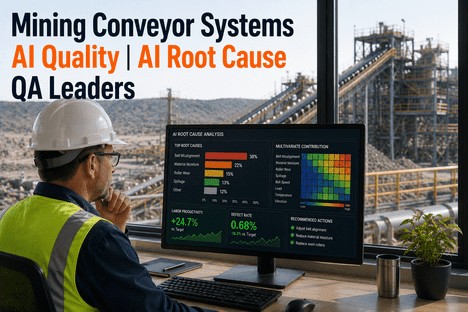
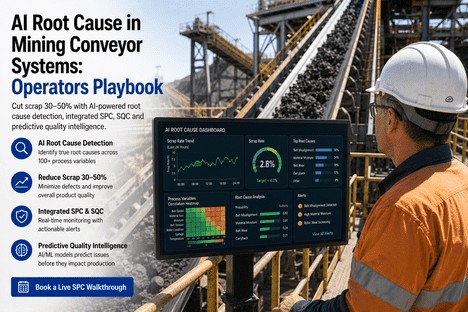
iFactory's multivariate ML engine ranks the process variables most correlated to your Cpk event — giving operators a confirmed root cause, not a list of possibilities, within minutes of detection.
How iFactory's AI Root Cause Engine Works at the Operator Level
The system is designed for the operator on shift — not the quality engineer reviewing data two days later. Every output is ranked, specific, and actionable. The goal is to give the operator the same answer a three-hour manual investigation would produce, in under three minutes, at the moment the Cpk event is occurring.
Step 01
Continuous Cpk Tracking — Not Batch Reporting
Cpk is calculated continuously against the rolling production window — not at the end of a shift or a production lot. The SPC chart updates in real time as product data arrives. When Cpk crosses a control limit, the alert fires at that moment — not when the batch report is generated. Operators see the Cpk trend line moving toward a limit before it breaches, not after the damage is done.
Operator sees: Live Cpk chart with control limits, trend direction, and time-to-limit projection at current trajectory
Step 02
Multivariate Correlation — 100+ Variables Ranked Instantly
When Cpk degrades, the ML engine runs a correlation analysis across all monitored process variables — comparing the current parameter window against historical patterns associated with this type of Cpk event. Variables are ranked by correlation strength: the top-ranked variable is the most likely root cause. The ranked list is presented to the operator as a specific, ordered finding — not a dashboard of all 100 parameters to interpret manually.
Operator sees: "Root cause ranked #1: CSS drift +4mm above liner-wear-adjusted baseline. Confidence: 87%."
Step 03
Predictive Scrap Alert — Before the Product Leaves the Circuit
The system identifies the parameter combination that historically precedes out-of-spec product — and fires a predictive scrap alert when that combination reappears in real-time data. This is different from a Cpk alarm: it fires before Cpk degrades, based on the leading indicators in the process variable set. Operators can intervene — adjust feed rate, correct gap setting, flag the upstream shovel — before off-spec material enters the downstream circuit.
Operator sees: "Predictive scrap risk: HIGH. Pattern matches 14 of 17 prior Cpk events. Intervene now or confirm hold."
Step 04
Audit-Ready Record — Every Event Documented Automatically
Every Cpk event, every root cause finding, every operator action, and every corrective intervention is logged automatically with a timestamp and the process variable state at the time of the event. This creates the audit trail that quality managers and mine site auditors require — without operators needing to manually document findings in a separate system. The record is structured, searchable, and exportable in standard quality audit formats.
Auditor sees: Timestamped Cpk event log with ranked root cause, operator response, corrective action, and resolution confirmation
What Cpk Stability Actually Looks Like With and Without AI Root Cause
Without AI Root Cause Detection
Cpk alarms fire after product is already out of spec — scrap has occurred before intervention
Root cause identified by experience — the most experienced operator on shift sets the investigative agenda
Same Cpk event recurs 2–6 weeks later under similar conditions — fix addressed symptoms, not cause
Audit record is manual shift logs and paper-based corrective action reports — incomplete and inconsistent
Liner replacement scheduled by calendar — not by actual wear state or Cpk impact
With iFactory AI Root Cause Detection
Predictive scrap alert fires before Cpk breaches — operator intervenes before out-of-spec product is produced
Root cause ranked by ML correlation — specific parameter identified within minutes, not hours
Confirmed root cause addressed — same event does not recur because the underlying variable is corrected, not masked
Audit trail auto-generated — every event, finding, action, and outcome timestamped and exportable
Liner replacement triggered by wear-linked Cpk impact forecast — replacing before drift, not after failure
"
We had a recurring Cpk problem on our secondary cone crusher that we had been managing with CSS adjustments for two years. Every six weeks, roughly, the Cpk would drop below 1.33 and we'd make an adjustment and recover. When we deployed the AI root cause system, it identified within the first month that the event was consistently preceded by a specific combination of high moisture in the feed — above 8% — and liner age above 65% of nominal life. Neither factor alone triggered the drop. Together, they did every time. We replaced the liner at 60% life as a rule and have not had a sub-1.33 Cpk event on that unit in seven months.
— Process Control Supervisor, Copper Concentrator — Secondary Crushing Circuit, South America Operations
Frequently Asked Questions
Conclusion
Sustaining Cpk 1.67+ in a mining crushing circuit is not an adjustment problem — it is a root cause problem. The adjustments operators make are correct and necessary. But adjustments without confirmed root cause produce the same event again under the same conditions, and the cycle of reactive correction and recurring drift continues indefinitely. AI root cause detection breaks that cycle by doing what experience-based investigation cannot: correlating 100+ process variables simultaneously, ranking the specific parameter driving the event, and delivering a confirmed cause to the operator within minutes — before the next shift, not after the next audit.
iFactory's multivariate ML engine is built for crushing operators — continuous Cpk tracking, predictive scrap alerts, ranked root cause output, and audit-ready documentation in one operational layer. Book a Demo to see the root cause detection engine running on real crushing circuit data, or Get In Touch to begin the data connectivity assessment for your site.
Your Cpk Is Telling You Something Moved. AI Root Cause Tells You What — Before It Moves Again.
iFactory correlates 100+ crushing variables in real time, ranks the root cause of every Cpk event, and delivers the confirmed finding to your operator dashboard — with the audit trail your quality team requires and the predictive alerts your process needs to sustain Cpk 1.67+.