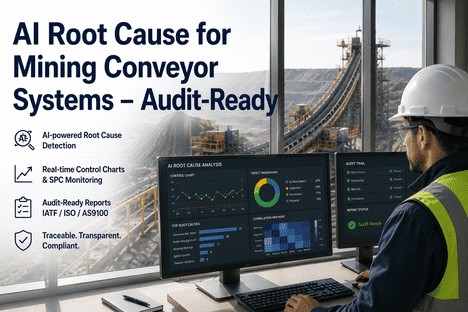
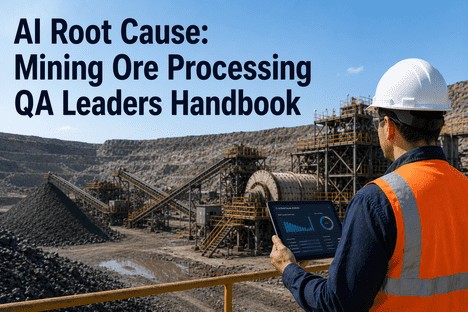
Every shift in ore processing generates thousands of data points across feed, grinding, flotation, thickening, and filtration circuits. When a concentrate grade falls below specification, the standard response is to search through shift logs, SCADA trends, and lab results for the cause. By the time the root cause is found, the scrap is confirmed, the shift report is written, and the same conditions may already be building toward the next off-spec event. The gap is not data. The gap is correlation. Operators see individual parameters moving but cannot see how thirty variables interacted to push recovery outside the control band. AI root cause detection closes that gap by modelling the multivariate relationships that no manual investigation can hold simultaneously, and surfacing the specific combination of variables that drove the defect, minutes after it is detected, not days later when the investigation report is due.
Three limitations of traditional root cause investigation make it structurally incapable of keeping pace with modern ore processing complexity. First, manual investigation is reactive by design. It starts after the defect is confirmed and proceeds linearly through possible causes. In a process where feed grade, reagent dosing, pH, air flow, and grind size interact non-linearly, linear investigation misses the interaction effects that multivariate models capture as a matter of routine. Second, manual root cause relies on the investigator's ability to recall and correlate events across different data sources. The process historian stores the data, but no operator can hold a twelve-hour window of thirty parameters in working memory and identify which combination crossed the threshold first. Third, the investigation itself consumes operator time that should be spent on process optimization. Every hour spent searching for a root cause is an hour not spent on keeping the current shift in spec. AI root cause detection addresses all three limitations simultaneously by performing the correlation work continuously, in real time, and surfacing results as structured, documented evidence.
Why Manual Root Cause Investigation Cannot Keep Up with Ore Processing Variability
Ore processing is a multivariable environment by nature. Feed mineralogy shifts, reagent effectiveness changes with pulp chemistry, and grinding circuit performance propagates through every downstream stage. The root cause of an off-spec concentrate grade is rarely a single parameter that crossed a limit. It is almost always a combination of parameters that, together, created conditions outside the process capability envelope. Manual root cause investigation cannot see these combinations because the human brain is not designed to track thirty parameters across a twelve-hour window and compute interaction effects. The investigation tools commonly used, spreadsheets, shift log notes, SCADA trend replay, are sequential and retrospective. They impose a linear narrative on a non-linear process, which is why the same quality deviations recur across consecutive shifts: the root cause was never fully identified because the investigation method could not see the interaction.
How Multivariate AI Root Cause Detection Works in Ore Processing
AI root cause detection does not replace the operator's knowledge of the process. It extends it. The ML model continuously monitors the correlation structure between process parameters and quality outcomes, learning which combinations of variables are most predictive of defects. When a quality deviation occurs, the model returns the specific variable interaction that drove the event, ranked by contribution, with a confidence score and supporting data window that the operator can verify and act on.
Root Cause Detection Across the Four Ore Processing Circuits
Each ore processing circuit has a distinct root cause signature. The parameters that predict a grinding circuit defect are different from those that predict a flotation recovery loss, and the multivariate models must be circuit-specific to capture the correct interaction effects. The following table maps the primary root cause drivers and detection approach for each circuit.
What Audit-Ready Root Cause Documentation Looks Like
IATF 16949 Clause 10.2.3 requires organisations to document the results of root cause analysis and the corrective actions taken for each quality event. AS9100 Clause 8.7 requires evidence of the disposition of non-conforming product and the corrective action taken to prevent recurrence. ISO 9001 Clause 10.2 requires documented information as evidence of the nature of the nonconformities and any subsequent corrective actions. In a manual system, meeting these requirements means assembling shift logs, lab reports, SCADA screenshots, and operator notes into a structured file for each event. The assembly effort alone can take hours per event. AI root cause detection eliminates the assembly step by generating the required documentation automatically as structured output linked to each quality deviation event.
Frequently Asked Questions
Standard SPC monitors individual process parameters against control limits and fires an alarm when a single parameter exceeds its limit. The operator then investigates manually, reviewing trends, logs, and lab results to identify the cause. AI root cause detection does not wait for an alarm. It continuously models the correlation structure between all process parameters and quality outcomes, so when a deviation occurs, the root cause assignment is computed automatically from the multivariate interaction model. The key difference is that standard SPC tells you a parameter is out of control. AI root cause detection tells you which combination of parameters caused the defect and why, with structured evidence that can be exported directly for audit submission without manual investigation. Get In Touch to see how iFactory's AI root cause layer integrates with continuous SPC tracking across your ore processing circuits.
Most modern ore processing operations already have the sensor infrastructure required. The AI root cause model ingests process data from standard historians and SCADA outputs feed rate, mill power draw, particle size, pulp density, reagent flow, pH, thickener torque, grade analyser results, and assay lab data. The minimum requirement for model training is six to twelve months of historical process and quality data covering a representative range of operating conditions, ore types, and defect events. iFactory connects to common industrial historians including OSIsoft PI, AspenTech IP.21, Inductive Automation Ignition, and standard SQL-based process data stores. The first root cause models are typically live and producing structured output within weeks of data connection. Get In Touch to schedule a data assessment for your facility.
iFactory stores every root cause event with structured fields that map directly to the documentation requirements of each standard: event description, contributing variables with contribution scores, baseline vs deviation parameter values, operator corrective action, outcome verification, timestamps, and operator attribution. For IATF 16949 Clause 10.2.3, iFactory documents the root cause investigation results and corrective actions with timestamps that demonstrate the problem-solving methodology. For AS9100 Clause 8.7, iFactory captures the non-conformance disposition and corrective action with supporting parameter evidence. For ISO 9001 Clause 10.2, iFactory maintains the documented information required as evidence of the nature of nonconformities and subsequent actions. Compliance reports are exportable in structured format on demand without manual assembly. Book a Demo to review the audit report formats iFactory produces for mining quality compliance.
Yes, and this is one of the primary advantages of multivariate AI root cause detection over manual methods. A grinding circuit feed hardness change that propagates through flotation recovery is invisible to an operator investigating only the flotation circuit because the cause originated in a different section of the process two to four hours earlier. The multivariate model correlates parameters across all circuits simultaneously, so an interaction between feed hardness, grind size, and flotation recovery is captured as a single root cause signature rather than three separate events. This cross-circuit visibility is what makes recurrent defects visible and correctable at the systemic level rather than the symptomatic level. Operators who deploy cross-circuit AI root cause detection typically see the most significant reduction in recurrent defect rates. Book a Demo to see cross-circuit root cause detection demonstrated across a complete ore processing workflow.
Conclusion
The ore processing operations that consistently meet IATF 16949, AS9100, and ISO 9001 audit requirements without recurring non-conformances are not the ones with the largest quality teams or the most detailed shift logs. They are the ones whose root cause detection is automated, continuous, and comprehensive enough to see the multivariate interactions that manual investigation structurally misses. The AI in mining market is growing at 41.9% annually because the gap between operations that use AI-driven root cause detection and those that rely on manual investigation is measurable, documented, and reflected in audit outcomes and defect recurrence rates.
iFactory's AI root cause detection platform correlates 100+ process variables across every ore processing circuit, surfaces the specific parameter interaction that caused each quality deviation, and generates structured audit-ready documentation that maps directly to IATF 16949, AS9100, and ISO 9001 requirements without manual investigation or document assembly. Book a Demo to see how iFactory delivers AI root cause detection for your specific process circuits, or Get In Touch to start the data assessment for your ore processing operation.