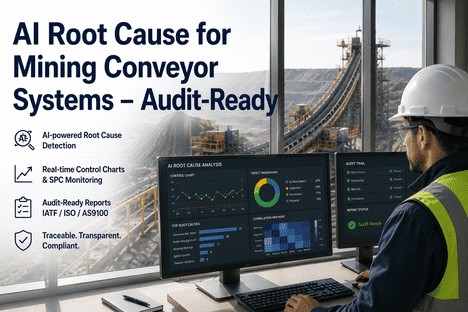
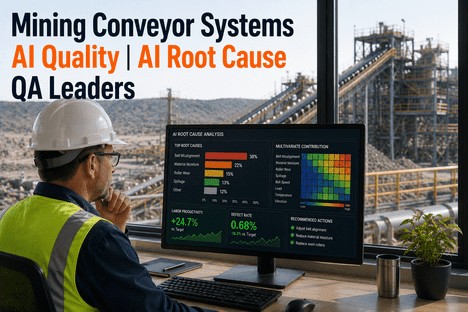
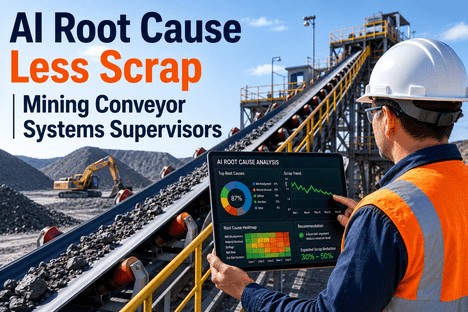
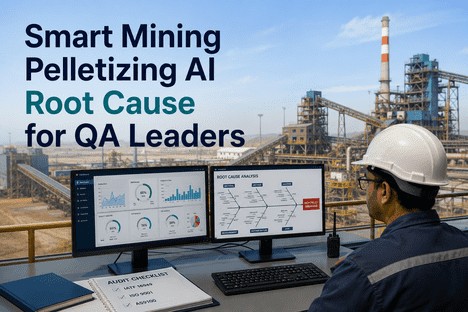
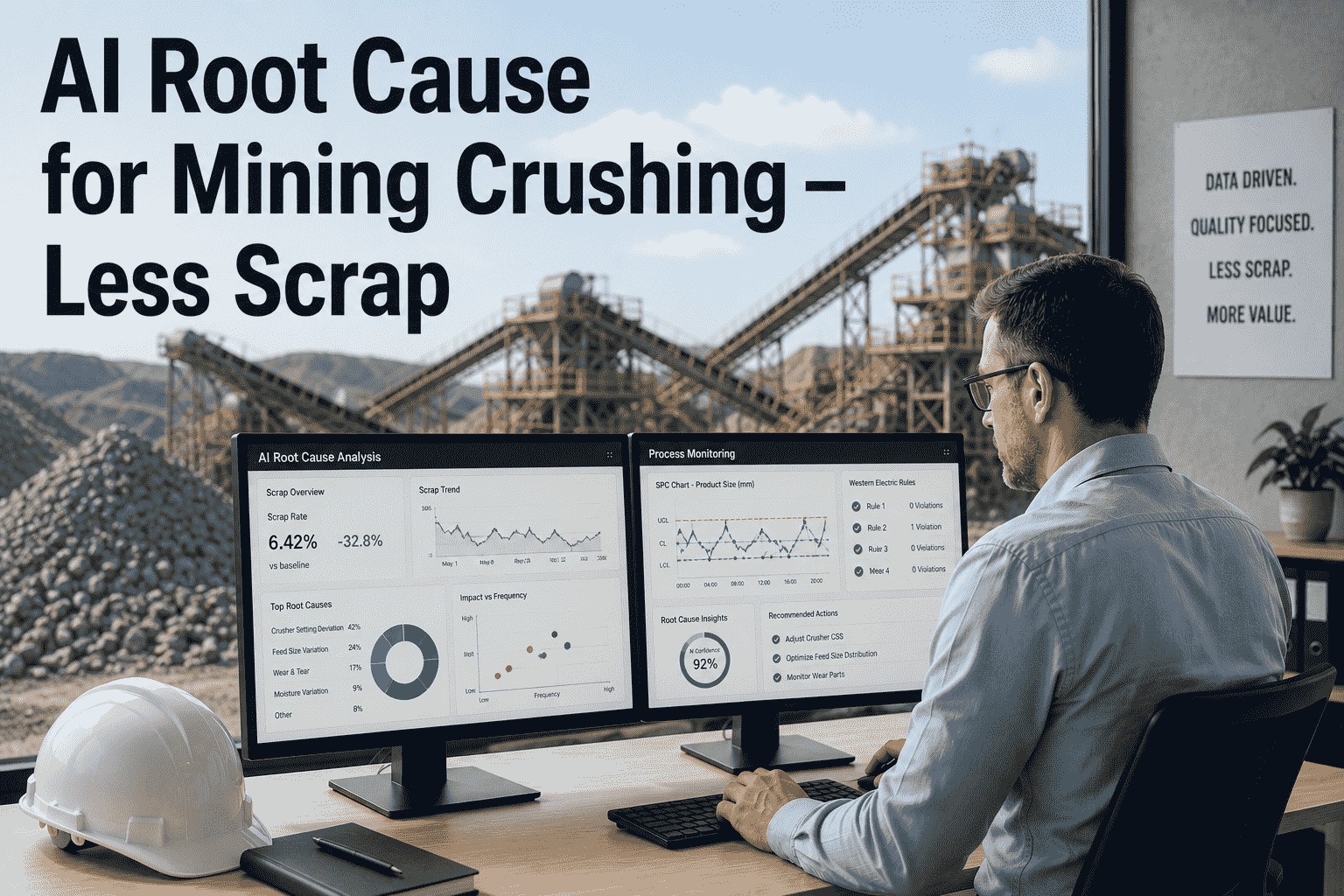
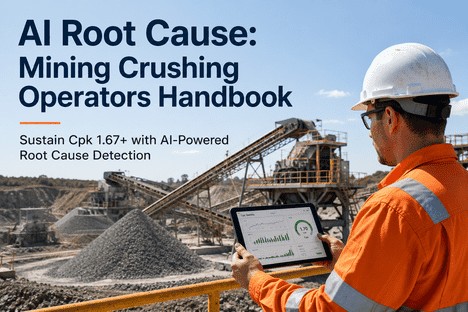
Cpk just dropped to 1.1. The screen report shows out-of-spec product on the belt. The supervisor checks feed size — looks normal. Gap setting — within range. Power draw is elevated but not alarming. CSS is adjusted and thirty minutes later Cpk climbs back to 1.3. The event is logged as resolved. But the root cause was never found. And in eighteen days, under similar conditions, the same drift will happen again. This is the single most expensive quality problem in mining crushing: not the defect itself, but the inability to trace it to its origin across a hundred simultaneous process variables before it repeats. Every shift supervisor knows the feeling of adjusting a parameter that seems right, hoping the problem goes away, knowing it will return. AI root cause detection breaks this cycle by correlating every process variable against every quality outcome simultaneously, surfacing the specific parameter interaction that drove the Cpk event, and delivering a confirmed cause within minutes — not after a three-hour manual investigation that reaches the same conclusion the next shift will have to act on.
Crushing is not a single-variable process. Feed ore arrives with changing hardness, moisture content, and size distribution — none of which the operator controls and few of which are measured continuously. The crusher itself introduces wear variables: liner geometry changes daily, creating a moving target for gap settings. Downstream screens, conveyors, and classification circuits add further variation. A typical cone crusher circuit has 80 to 150-plus measurable variables at any given moment: feed rate, power draw per tonne, closed-side setting position, bearing temperatures, hydraulic pressure, liner wear accumulation, screen efficiency, vibration signatures, and product size distribution indices. Cpk is the aggregate output of all these interacting variables. When it drops, the cause could be upstream, downstream, mechanical, or geological. No operator can correlate a hundred variables in real time through experience alone. The ones who sustain Cpk 1.67 or higher are the ones whose systems do it for them.
Cpk degradation in crushing is almost never caused by a single variable. It is caused by a specific combination of variables interacting — ore hardness above threshold plus liner wear at mid-life plus feed rate elevated by the upstream shovel cycle. No single parameter alarm captures a multivariate interaction. AI does. And unlike a manual investigation that checks variables one at a time, the AI model examines every variable against every other variable simultaneously, ranking them by their contribution to the event.
AI root cause detection operates through a four-stage cycle that runs continuously on the edge layer, processing every data point from the crusher control system and ranking variable contributions within milliseconds of a Cpk event. The cycle transforms an anonymous alarm into a confirmed, actionable root cause before the supervisor has finished reading the alert.
The ML model ingests data from every available sensor and control system source in the crushing circuit. It does not require new instrumentation. It connects to the data already flowing through the existing SCADA and DCS infrastructure and learns the relationships between every variable and every quality outcome.
Bond work index (hardness)
Feed size distribution
Moisture content
Blend ratios
Power draw per tonne
Liner wear progression
Bearing temperatures
Hydraulic pressure
Vibration signatures
Product PSD curve
Screen efficiency
Yield per ton
Downstream mill feedback
For the shift supervisor, AI root cause detection transforms the experience of responding to quality events. Instead of spending 40 to 60 percent of the shift investigating Cpk alarms through manual variable checks, the supervisor receives a confirmed root cause with a ranked contribution list and acts on it immediately. The investigation that once took three hours and often reached the wrong conclusion takes three minutes and reaches the right one.
AI root cause detection directly improves Cpk by eliminating the recurrence of quality events that manual investigation fails to resolve. The table below shows the Cpk improvement observed across common root cause categories after deploying multivariate ML root cause analysis in cone and impact crushing circuits.
Our Cpk was cycling between 1.1 and 1.4 every three to four weeks. We would see the fines rate climb, adjust the CSS, watch Cpk recover, and log it as resolved. But we never once identified the actual root cause during that cycle. The AI system identified that liner wear at 70 percent life, combined with a specific ore hardness range from the north pit, was producing a gap geometry shift that our static CSS sensor could not detect. The root cause was liner wear interacting with feed origin. We had been adjusting the wrong variable every cycle for eighteen months. Within one liner change scheduled by the AI recommendation, Cpk stabilised above 1.7 and stayed there.
AI root cause detection deploys as a multivariate ML layer on top of existing DCS and SCADA infrastructure. The system connects to data historians and control networks via OPC-UA and Modbus TCP without requiring new sensors or control system modifications. The deployment is designed so supervisors see ranked root cause findings on their existing dashboard within the first shift of activation.
Sustaining Cpk 1.67 or higher in a mining crushing circuit is not an adjustment problem. It is a root cause problem. The adjustments supervisors make are correct and necessary. But adjustments without confirmed root cause produce the same event again under the same conditions, and the cycle of reactive correction and recurring drift continues indefinitely. AI root cause detection breaks that cycle by doing what experience-based investigation cannot: correlating a hundred-plus process variables simultaneously, ranking the specific parameter driving the event, and delivering a confirmed cause to the supervisor within minutes — before the next shift, not after the next audit.
The crushing operations that consistently sustain Cpk 1.67 or higher share a common capability: multivariate ML models that correlate every process variable against every quality outcome in real time, surface ranked root causes the moment Cpk degrades, and eliminate the recurrence cycle that keeps Cpk below target. That capability is available today as a software layer on existing crushing infrastructure. No new sensors. No control system replacement. No data science team required.
iFactory's AI root cause detection platform is purpose-built for mining crushing supervisors. It integrates with existing DCS and SCADA infrastructure to deliver continuous Cpk tracking, ranked root cause output, predictive scrap alerts, and automated audit-ready records without changing the supervisor's workflow or tools.