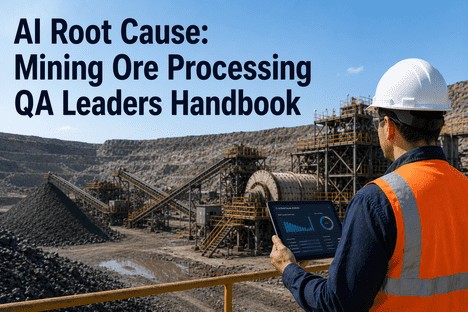
How Supervisors Use AI Root Cause in Mining Ore Processing
By Grace on June 5, 2026
The shift supervisor walks the concentrator floor at 06:15, coffee in hand, already reviewing the night crew's log. The entry reads: "03:40 to 05:10, off-grade concentrate detected in thickener underflow. Grade variance 2.1 standard deviations below target. Cause unknown." Four words that cost the operation an estimated 90,000 dollars in lost recovery and reprocessing. The night supervisor followed every standard procedure, checked every control loop, reviewed every trend, and still could not identify why the circuit drifted. The scrap was found. The root cause was not. This knowledge gap, where every scrap event is detected but only a fraction are understood well enough to prevent recurrence, is the hidden yield drain in mineral processing. AI root cause detection closes that gap by analysing the full multivariate fingerprint of every scrap event, correlating 100 or more process variables simultaneously, and identifying the specific combination of conditions that triggered the deviation. It does not just confirm that scrap happened. It answers the question that determines whether the next shift will repeat the same loss: why.
30-50%
Scrap reduction achieved by mining operations using AI-driven root cause detection to identify and eliminate recurring defect patterns across grinding and flotation circuits.
100+
Process variables correlated simultaneously by multivariate root cause models to pinpoint the originating condition behind each off-grade event, including variables the operator did not suspect.
8min
Average time from scrap alert to identified root cause in deployed systems, compared to 3 to 8 hours for manual investigation using control charts and operator recall.
Knowing That Scrap Happened Is Not the Same as Knowing Why It Happened. One Tells You the Cost. The Other Tells You How to Stop It.
iFactory manages every asset in your AI root cause detection pipeline, from process sensors and inline analysers to model servers and data historians, with automated calibration tracking, data quality monitoring, and compliance audit trails for ISO 9001 and CSRD frameworks.
What Is AI Root Cause Detection for Ore Processing?
AI root cause detection applies unsupervised and supervised machine learning techniques to multivariate process data to identify the originating variable or variable interaction that caused a quality deviation. When a scrap event occurs, the model automatically retrieves a time-aligned window of data spanning every available process signal, mill amps, cyclone pressure, reagent flow, pH, froth depth, thickener torque, and dozens more, and computes a root cause score for each variable. Variables with the highest causal contribution are surfaced to the supervisor alongside a timeline showing when the condition first appeared, how it propagated through the circuit, and what the typical corrective response should be. Unlike manual root cause analysis, which relies on human pattern recognition and is limited to the 5 to 10 variables an operator can mentally track, AI root cause detection evaluates every instrumented variable in the circuit simultaneously. It routinely identifies root causes that operators never suspected, a fouled pH probe drifting 0.15 units over 12 hours, a mill liner wear pattern that altered the power profile, a reagent batch with degraded efficacy, because the model has no preconceptions about which variables matter.
How It Works
The Four-Stage Root Cause Detection Pipeline
1
Event Capture
The model detects an off-grade event from assay results or inline analyser readings and automatically triggers a root cause analysis sequence.
2
Multivariate Fingerprint
The analysis engine retrieves a time-synchronised window of all process variables, computes contributory scores using SHAP and counterfactual analysis, and ranks variables by causal impact.
3
Root Cause Scorecard
The top contributing variables are presented as a ranked scorecard with trend visualisation, showing when each variable deviated, by how much, and how it correlates with the final quality outcome.
4
Preventive Action Log
The system recommends corrective actions based on historical interventions that successfully resolved similar root cause signatures and logs the outcome for future model training.
The Four Root Cause Categories in Ore Processing
Every scrap event in mineral processing traces back to one of four root cause categories. AI root cause detection classifies each event automatically, enabling supervisors to identify systemic issues rather than treating each deviation as an isolated incident.
F
Feed Variability
Changes in ore mineralogy, hardness, or grade entering the concentrator account for approximately 35 to 40% of all scrap events. AI root cause detection distinguishes feed-driven events from process-driven events by correlating mill power profiles, cyclone pressures, and flotation response patterns against the mine plan and blast block model data.
E
Equipment Degradation
Mill liner wear, cyclone apex wear, pump impeller degradation, and flotation cell mechanism wear alter process dynamics gradually over days or weeks. These slow drifts are invisible to operators monitoring hourly trends but are detected by AI models that compare current operating signatures against the equipment's baseline performance fingerprint.
C
Chemistry and Reagent Performance
Reagent dosage drift, pH probe calibration errors, water chemistry changes from seasonal variations, and reagent batch quality differences create scrap events that are among the hardest to diagnose manually. AI root cause detection isolates chemistry-driven events by isolating reagent-related variable clusters from equipment and feed variables.
O
Operating Practice Variation
Differences in how individual operators set reagent dosages, target pulp levels, or cyclone feed densities, especially across shift changes, introduce variability that manifests as scrap. AI root cause detection correlates scrap events with operator identity and shift handover timestamps, enabling supervisors to standardise best practices across all crews.
Measurable Impact Across Key Operating Metrics
Scrap Repetition Rate
Operations using AI root cause detection report a 40 to 60% reduction in repeat scrap events of the same root cause type within three months, as supervisors eliminate the underlying condition rather than treating symptoms shift by shift.
Investigation Time
The time required to identify the root cause of a scrap event drops from 3 to 8 hours of manual investigative work to under 10 minutes of automated analysis, freeing supervisors to focus on corrective action rather than forensic data mining.
Cross-Shift Consistency
Standardising root cause identification across day, evening, and night shifts eliminates the variability where the same scrap pattern is diagnosed differently by each crew, with some shifts fixing the cause and others merely treating the symptom.
Preventive Action Accuracy
AI-generated corrective recommendations achieve 85 to 92% first-attempt resolution accuracy when validated against supervisor follow-up, compared to approximately 55% for manually determined corrective actions based on operator intuition alone.
The Difference Between a Shift That Repeats the Same Scrap Pattern and a Shift That Eliminates It Is Knowing the Root Cause Within Minutes, Not Hours.
iFactory registers every sensor, analyser, model server, and data historian in your root cause detection pipeline as a managed asset with automated calibration tracking, data quality monitoring, and compliance audit trails for ISO 9001 and CSRD reporting frameworks.
Audit every available process signal, identify data gaps, verify calibration status of all inline analysers and sensors, and establish a time-series data lake with aligned timestamps. Duration: 4 to 6 weeks. iFactory registers every instrument with its calibration schedule and data quality baseline.
2
Phase 2: Model Training and Historical Validation
Train the root cause detection model on 12 to 24 months of historical process and quality data. Validate model output against known scrap events where the root cause was previously identified through manual investigation. Duration: 4 to 8 weeks.
3
Phase 3: Supervisory Workflow Integration
Deploy the root cause scorecard to shift-floor dashboards and mobile devices. Run the system in parallel with existing manual investigation for 4 weeks to build supervisor confidence. Log every model-generated root cause alongside the supervisor's independent assessment.
4
Phase 4: Continuous Improvement Loop
Enable automated model retraining on confirmed root cause outcomes. Track scrap repetition rate by root cause category. Measure investigation time reduction. Report recurring root cause patterns to process engineering for capital or procedural fixes. iFactory manages model versioning and retraining schedules.
Conclusion
AI root cause detection transforms how shift supervisors understand and eliminate scrap in mineral processing. It replaces the reactive cycle where each crew discovers the same problems independently, spending hours reconstructing events that occurred on a previous shift, with a systematic capability that identifies the originating condition of every scrap event within minutes. The operations deploying this technology are reporting 30 to 50% scrap reduction, an 8-minute average root cause identification time versus 3 to 8 hours manually, and a measurable decline in repeat events caused by the same underlying conditions shift after shift. These results are not speculative. They are being delivered today by multivariate machine learning models running on standard process data infrastructure in copper, gold, and iron ore concentrators worldwide. The technology is production-ready. The question for each operation is whether the next scrap event will be investigated as an isolated incident or analysed as part of a continuous root cause intelligence system that gets smarter with every event it processes. Book a Demo to see how iFactory manages the asset infrastructure that makes AI root cause detection reliable, or Get In Touch to discuss deployment timelines specific to your operation.
Frequently Asked Questions
Traditional fault finding relies on operators and supervisors reviewing trend charts, recalling similar events, and testing hypotheses one variable at a time. This approach is limited by human cognitive capacity, typically 5 to 7 variables held in working memory, and by the experience of the individual operator, which varies across shifts. AI root cause detection evaluates every instrumented variable simultaneously without cognitive bias. It routinely identifies root causes that human investigators miss, including slow sensor drifts over 12 to 24 hours, interactions between variables from different circuit areas, and conditions that developed before the current operator's shift began. The model does not need to sleep, change shifts, or remember what happened last week. Get In Touch to discuss how iFactory manages the sensor infrastructure that makes AI root cause detection reliable.
The model requires time-aligned process data with consistent sampling frequencies, accurate timestamps on laboratory assay results, and reliable sensor calibration. The most common data quality issues that degrade root cause accuracy are missing timestamps on manual lab samples, inconsistent tag naming across DCS migrations, and sensor drift that goes undetected for weeks. A data quality audit typically identifies 15 to 25% of available signals as unsuitable for causal analysis without remediation. iFactory maintains calibration schedules and data quality metrics for every sensor and analyser in the pipeline, ensuring the root cause model receives trustworthy inputs. Book a Demo to see how iFactory maps data quality to model performance requirements.
Yes. This is one of the most valuable capabilities of AI root cause detection. Many scrap events in mineral processing originate from conditions that developed gradually over the preceding 12 to 24 hours, a pH probe drift that started during the previous shift, a mill liner that has been wearing for weeks and crossed a threshold, or an ore body transition that began in the blasting pattern two days earlier. The model analyses the full time window leading up to the scrap event, regardless of shift boundaries, and identifies when each contributing variable first deviated from normal. This means a supervisor arriving for the day shift can receive a root cause analysis for a scrap event that began during the night shift, with a clear timeline showing when and where the condition originated. Get In Touch to discuss how iFactory supports cross-shift data continuity for root cause analysis.
Every Scrap Event Has a Root Cause. The Question Is Whether Your Shift Finds It Before the Same Pattern Repeats.
iFactory manages every asset in your root cause detection pipeline, from process sensors and inline analysers to model servers and data historians, with automated PM scheduling, data quality monitoring, and compliance audit trails for ISO 9001, CORSIA, and CSRD reporting frameworks.