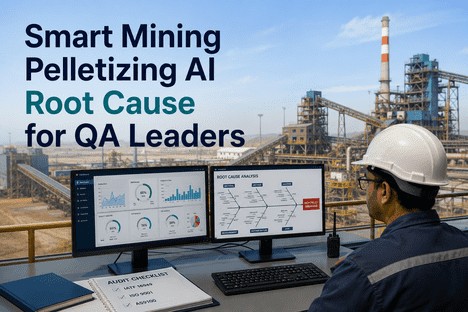
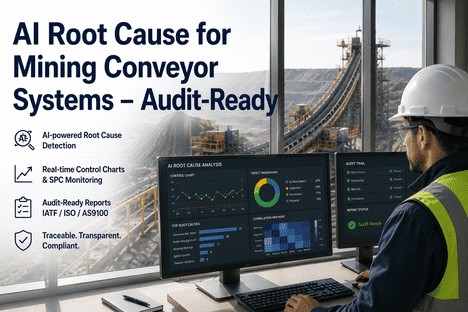
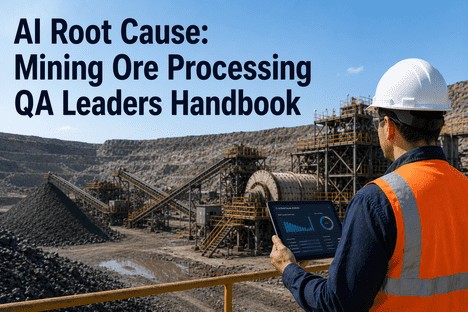
A pellet quality deviation is detected at the screen. The oversize rate has climbed to 22% in the last hour against a 12% target, and the quality leader needs to answer one question before the auditor arrives: which parameter caused it, and when did it first deviate? The process involves 40-plus variables — moisture feed, binder dose rate, disc speed, disc angle, ore blend particle size distribution, induration temperature across six zones, grate speed, bed depth, hood pressure, and cooling air flow — each one interacting with the others in nonlinear ways that make single-variable root cause analysis unreliable. A quality leader using traditional methods must pull time-series data from the DCS historian, overlay shift logs and operator notes, manually correlate variable movements across the deviation window, test hypotheses against production records and laboratory results, consult with process engineers, and arrive at a conclusion that is often still a probability rather than a certainty. The entire investigation takes two to three days. AI root cause detection compresses that timeline from days to minutes by performing multivariate correlation across the full variable set in real time, ranking each variable by its probability of being the primary cause, and delivering a single recommendation with an associated confidence score — before the next shift changeover.
Multivariate Correlation · Ranked Root Causes · Audit-Ready Records · Real-Time RCA
AI Root Cause Detection for Mining Pelletizing: The Quality Leader’s System for Audit-Ready Causal Records in Minutes, Not Days
iFactory’s AI root cause detection platform gives pelletizing quality leaders multivariate correlation across 100-plus process variables, ranked root causes with confidence scores, and automatically generated causal audit records — so every quality investigation ends with a timestamped, traceable answer and no manual RCA report writing required.
90%+
Reduction in root cause identification time across pelletizing operations using AI-driven multivariate correlation instead of manual investigation
100+
Process variables correlated simultaneously across balling, induration, and screening — delivering ranked root causes with lead-lag detection
5,000+
Pairwise variable relationships evaluated continuously by the correlation engine — every variable pair, every update cycle, without bias
100%
Audit-ready causal records generated automatically for every quality deviation — no manual RCA documentation required at any stage
The Root Cause Resolution Gap: Manual Investigation vs AI-Driven Correlation
The difference between manual root cause investigation and AI-driven root cause detection is not just speed — it is structural. Manual RCA follows a sequential process: detect the deviation, pull the data, build hypotheses, test each one, consult, conclude. Each step depends on the previous one, and each step takes time because it relies on human attention, domain knowledge, and access to data that lives in different systems. AI root cause detection runs the entire sequence in parallel — collecting data, correlating variables, ranking causes, and delivering a conclusion within minutes of the deviation being detected.
The comparison below shows the real timeline difference as it plays out on a pelletizing line. The manual timeline assumes an experienced quality leader with direct access to the DCS historian and shift logs. The AI timeline reflects the iFactory platform operating on the same data sources with the same process configuration.
Manual Root Cause Investigation
Typical Timeline: 2 to 3 Days
Day 1
Detect deviation and log event. Access DCS historian, export time-series data for all suspect variables across the deviation window. Cross-reference shift logs and operator notes. Build initial hypothesis list based on visible correlations.
Day 2
Manual correlation of variable trends against the deviation timeline. Test each hypothesis against laboratory results and production records. Consult with process engineers on possible interactions not visible in time-series data alone. Narrow candidate list to top 3 to 5 variables.
Day 3
Confirm primary root cause and validate against available evidence. Write RCA report documenting findings, causal reasoning, and corrective action taken. Submit for quality management review. File completed record in audit documentation system.
Total: 40 to 60 hours from deviation detection to documented root cause
AI-Driven Root Cause Detection
Typical Timeline: 2 to 5 Minutes
Min 1
Adaptive SPC detects deviation. Multivariate correlation engine begins cross-correlation across 100-plus variables simultaneously. Dynamic correlation model already maintained — no manual data pull required. Lead-lag relationships are pre-computed.
Min 2
Probabilistic ranking engine assigns root cause probability score to every variable. Top 3 causes displayed on supervisor dashboard with confidence scores, lead-lag evidence, and time offset between cause movement and effect detection.
Min 3
Recommended corrective action displayed with expected effect. Operator acknowledges and logs action against the alert. System monitors trend reversal and confirms effectiveness. Complete causal record written to audit log automatically.
Total: 2 to 5 minutes from deviation detection to documented root cause with corrective action and confirmation
How AI Root Cause Detection Works Across the Pelletizing Circuit
The AI root cause detection engine operates continuously across the full pelletizing circuit — from the balling disc to the induration furnace to the finished pellet screen. It ingests data from every available source: DCS process variables, vision inspection classifications, laboratory test results, and operator shift logs. The engine does not wait for a deviation to occur before analysing relationships. It builds and maintains a dynamic correlation model of the entire process in real time, updating the relationship weights between every pair of variables with every new data point. When a deviation is detected, the engine already knows which variables are most correlated with which quality outcomes — the investigation is already largely complete before the alert fires.
1
Continuous Multivariate Data Ingestion
The engine ingests data from the DCS historian, vision inspection cameras, laboratory information system, and operator shift logs in real time. Every process variable — moisture, binder dose, disc speed, disc angle, ore blend particle size, induration temperature zone 1 through 6, grate speed, bed depth, hood pressure, cooling air flow, screen vibration amplitude, and 30-plus additional parameters — is streamed into the correlation model at the native update rate of the source system. No data transformation or manual export step is required. The model receives the full-resolution signal for every variable at every update cycle, maintaining a rolling window of recent data that supports both immediate correlation analysis and longer-term trend comparison across shifts and recipe campaigns.
2
Dynamic Pairwise Correlation with Lead-Lag Detection
The correlation engine computes and maintains the pairwise correlation coefficient for every combination of process variables — over 5,000 variable pairs for a typical pelletizing circuit with 100-plus monitored parameters. Critically, the engine detects lead-lag relationships: it identifies not just that two variables are correlated, but which one consistently moves first and by what time offset. This lead-lag detection is what separates root cause from consequence. Moisture drifts upward, and three minutes later the pellet size distribution shifts toward oversize. The engine identifies moisture as the leading variable and size distribution as the lagging response — establishing causality, not just correlation. The lead-lag matrix is updated continuously so that when a deviation occurs, the causal direction is already known.
3
Probabilistic Root Cause Ranking with Confidence Scoring
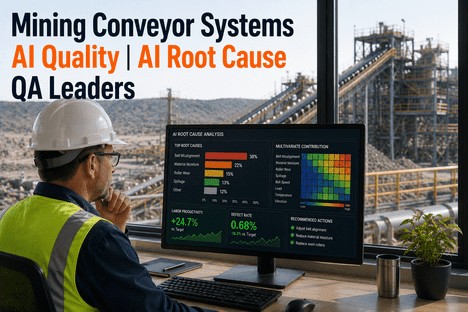
When a quality deviation is detected — an oversize rate exceedance, a Cpk drop below threshold, a vision defect classification trend crossing the alert boundary — the engine applies a probabilistic ranking algorithm to every variable in the correlated set. Each variable receives a root cause probability score between 0 and 1, with the sum of all probabilities equal to 1 across the variable set. The output is a ranked list: moisture feed at 0.87 probability of being the primary cause, binder dose rate at 0.09, disc speed at 0.03, and all other variables combined at 0.01. The ranking is delivered with the lead-lag evidence and the time offset that supports it — so the quality leader sees not just the conclusion but the causal reasoning behind it, with no need to reconstruct the analysis manually.
4
Automated Causal Record Generation for Audit Readiness
Once the root cause is identified and ranked, the system writes the complete causal record automatically: the deviation event with timestamp, the ranked root cause list with probability scores, the lead-lag correlation data supporting the top-ranked cause, the corrective action recommended and logged against the alert, and the confirmation of trend reversal after corrective action was applied. This record is stored in the searchable audit log with the recipe, ore blend batch, and shift identifier attached. When the auditor asks for the root cause investigation of the 14:22 oversize excursion on shift 3, the quality leader opens the audit log, filters by timestamp and parameter, and presents the complete causal record — generated in under 5 minutes, documented in full detail, and ready for review without hours of manual reconstruction or retrospective data gathering.
Multivariate Correlation · Probabilistic Ranking · Causal Records · Audit-Ready RCA
The Root Cause Investigation That Used to Take Two Days Now Completes Before the Deviation Reaches the Screen. AI Root Cause Detection Makes That the New Baseline for Quality Leadership.
iFactory’s AI root cause detection platform for pelletizing quality leaders — multivariate correlation across 100-plus process variables, ranked root causes with confidence scores, and automatically generated audit-ready causal records that replace days of manual investigation with minutes of automated analysis.
What AI Root Cause Detection Delivers for the Quality Leader
For the quality leader in a pelletizing operation, the value of AI root cause detection is not theoretical process insight. It is concrete, measurable improvement in the three areas that define quality leadership effectiveness: audit compliance, deviation response time, and cross-shift quality consistency.
Benefit 01
Audit-Ready Causal Records Without Manual RCA Documentation
Every quality deviation generates a complete causal record automatically — the root cause, the probability score, the lead-lag evidence, the corrective action taken, and the outcome confirmation. The quality leader does not write RCA reports. The system writes them as a standard operating output, and the quality leader reviews and signs off within minutes of the deviation event. The audit record for the last six months is searchable, filterable by shift or recipe or ore blend, and exportable in under 20 minutes without requesting data from any other team or system.
Benefit 02
Deviation Response Time Collapsed from Days to Minutes
When a deviation is detected, the quality leader receives the ranked root cause with confidence score and recommended corrective action within minutes — not after days of manual investigation. The timeline compression means the corrective action can be applied while the deviation is still developing upstream, preventing the quality excursion from propagating through the downstream process and reaching the screen or the customer. The deviation that used to produce three days of investigation and a scrap batch now produces a 5-minute alert response and on-spec output.
Benefit 03
Cross-Shift Root Cause Visibility and Quality Consistency
The correlation model operates continuously across all shifts without reset or degradation. When a quality deviation occurs on the night shift, the incoming day shift quality leader sees the complete causal record — the root cause identified, the corrective action logged, and the outcome confirmed — without waiting for a verbal handover or a written shift log entry. Recurring deviations that share a common root cause across different shifts are detected by the correlation engine before the quality leader has to connect the dots manually across multiple shift records and separate investigations.
Why Leading Pelletizing Operations Are Deploying AI Root Cause Detection Now
The adoption of AI root cause detection across pelletizing operations is accelerating for three converging reasons that together create a compelling case for deployment in 2026.
Driver 01
Audit Standards Are Tightening Causal Traceability Requirements
ISO 9001:2015 and IATF 16949:2016 auditors are increasingly focused on causal traceability — not just whether a corrective action was taken, but whether the root cause was identified, documented, and linked to the deviation with timestamped evidence. Pelletizing operations that supply direct reduction and blast furnace feed are being held to the same causal documentation standards as automotive tier-one suppliers. Manual RCA processes that rely on investigator expertise and retrospective data analysis are struggling to meet this standard consistently across all shifts. AI root cause detection automates the causal traceability requirement at the system level, producing the documented causal chain for every deviation as a standard operating output rather than an exception-driven investigation that consumes days of quality team time.
Driver 02
Process Complexity Exceeds Manual Correlation Capacity
A modern pelletizing circuit with 100-plus monitored variables produces over 5,000 pairwise variable relationships, many of which involve nonlinear interactions, time delays, and conditional dependencies that change with ore blend and recipe. The human quality leader can investigate at most 5 to 10 variable relationships in a single analysis session, and the investigation is unavoidably biased by prior experience — the variables that have caused problems before receive disproportionate attention. The AI correlation engine evaluates every pair simultaneously, without bias, and updates the correlation weights continuously as new data arrives. It detects relationships that no human investigator would think to test because they involve variables from different process zones that are not intuitively connected — such as a correlation between cooling air flow rate at the furnace exit and green pellet moisture three hours earlier at the balling disc.
Driver 03
Data-Driven Quality Leadership Is Becoming the Sector Standard
The quality leaders who are advancing to plant and regional quality management roles are increasingly being selected for their ability to demonstrate data-driven decision-making, not domain experience alone. Deploying AI root cause detection is a concrete demonstration of data-driven quality leadership: the quality leader who can show an auditor a complete causal record generated in 5 minutes for every deviation across the last six months is operating at a standard that manual RCA cannot match. Pelletizing operations that invest in AI root cause detection now are building the quality management infrastructure that will define the sector benchmark for audit readiness over the next three to five years, and the quality leaders who lead those deployments are positioning themselves at the forefront of that standard.
Conclusion
The quality leader’s fundamental responsibility in a pelletizing operation is to know with certainty and with timestamped evidence what caused every quality deviation that occurs on their shifts. Manual root cause investigation cannot deliver that certainty within a timeframe that allows preventive action, and it cannot produce the causal traceability documentation that modern audit standards require without a disproportionate allocation of the quality team’s time to retrospective analysis rather than forward-looking quality improvement.
AI root cause detection changes the quality leader’s operating model from reactive investigation to proactive correlation. The deviation is detected, the root cause is identified and ranked by probability, the corrective action is recommended and logged, and the causal record is written — all within minutes, all automatically, and all linked to the recipe and process context that an auditor will ask for. The quality leader’s role shifts from investigator to reviewer: from spending days reconstructing what happened to spending minutes confirming what the system has already determined and approving the corrective action that the system has already recommended based on probabilistic evidence from the full correlated variable set.
That shift is not a future capability. It is available today on pelletizing lines that have deployed iFactory’s AI root cause detection platform — and the quality leaders who are running those lines are already operating at a level of audit readiness, deviation response speed, and cross-shift quality consistency that the rest of the sector will be measured against within the next certification cycle.
iFactory’s AI root cause detection platform is purpose-built for pelletizing quality leaders — with continuous multivariate correlation across 100-plus process variables, lead-lag causal detection that distinguishes cause from effect, probabilistic root cause ranking with confidence scores, and automated audit-ready causal records that replace manual RCA documentation. Book a Demo to see the platform configured for your pelletizing circuit and review the causal record format with your quality management team, or talk to an expert about a live walkthrough using your process data.
Frequently Asked Questions
Your Next Root Cause Investigation Should Take Minutes, Not Days. AI Root Cause Detection Makes That the Standard Operating Procedure.
iFactory’s AI root cause detection platform for pelletizing quality leaders — continuous multivariate correlation across 100-plus process variables, lead-lag causal detection, probabilistic root cause ranking with confidence scores, and automated audit-ready causal records that replace manual RCA documentation. See it running on your process data.