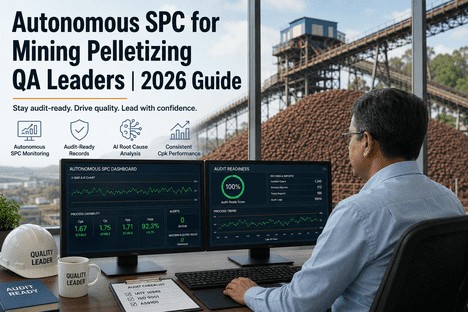
Autonomous SPC for Mining Pelletizing QA Leaders | 2026 Guide
By Grace on June 11, 2026
Your last IATF 16949 surveillance audit flagged three procedural observations — none serious enough to jeopardise certification, but each one pointing at the same root cause: your SPC control limits were last updated the quarter before the ore blend changed, and your Cpk calculations are still running against specification limits that were set for a different pellet grade. The corrective action plan is due in 30 days, and the quality engineer who wrote the original control plan retired 18 months ago. This is not a hypothetical. It is the reality for quality leaders in mining pelletizing who are expected to deliver audit-ready process control records while the ore feed, binder chemistry, and customer specifications keep moving.
Autonomous statistical process control does not fix the audit trail after the fact. It builds it continuously — from self-tuning control limits that track the current process state, through Western Electric rule violations logged with timestamps and root-cause context, to real-time Cpk, Cp, Pp, and Ppk calculations that give the quality manager a complete process capability record at the end of every shift, without anyone filling in a log sheet.
IATF 16949 · AS9100 · ISO 9001 · ISO 50001
Your SPC Limits Expired the Last Time the Ore Blend Changed. Autonomous SPC Recertifies Them Every Shift.
iFactory's autonomous SPC engine self-tunes UCL/LCL, runs Western Electric rules continuously, and calculates Cpk/Cp/Pp/Ppk in real time — giving quality leaders the audit-ready process record that IATF 16949 and ISO 9001 demand, without adding documentation work to the operator's shift.
Audit-ready shift records generated automatically — zero manual documentation required from operators or quality managers
50-70%
Reduction in false SPC alerts within two weeks — quality leaders see only real process deviations, not ore transition noise
Continuous
Cpk, Cp, Pp, and Ppk tracking — process capability visible during the shift, not calculated weeks later in a monthly report
Auto
UCL/LCL recalibration on ore blend, binder batch, or recipe change — no manual limit update required from the quality team
The Audit Readiness Gap in Pelletizing — Why Static SPC Cannot Keep Up
Quality leaders in mining pelletizing face a structural problem that no amount of procedure writing can fix: the process changes faster than the documentation cycle. An IATF 16949-compliant control plan specifies control limits, sampling frequency, and reaction plans for each process characteristic. But those limits were calculated from a process capability study performed under a specific set of conditions — a particular ore blend, binder batch, moisture target, and pellet size distribution. When any of those conditions change, the control limits are technically invalid. Yet in most pelletizing plants, the limits stay on the control chart until the next capability study, which may be months or quarters away.
The Five Audit Gaps That Static SPC Creates in Pelletizing
1
Control limits decoupled from current process conditions
Ore blend transitions, binder batch changes, and moisture target shifts all change the process centre and spread. Static limits calculated under prior conditions are no longer statistically valid — yet they remain on the control chart because updating them requires a full PPAP-level capability study that the quality team does not have bandwidth to run every week.
2
Cpk calculations run on stale data
In most pelletizing plants, capability indices are calculated monthly by the quality engineer from the previous month's production data. An unfavourable Cpk trend that started on day three of the month is not visible until the monthly report is issued — meaning the quality manager cannot intervene until the condition has already produced weeks of excess variation and potential nonconforming product.
3
Western Electric rule violations lack process context
A static SPC system flags every Western Electric rule violation against fixed limits. During an ore blend transition, the system generates a storm of out-of-control signals that are actually expected process behaviour — but the SPC board does not know the transition happened. Operators learn to ignore the alerts. Real deviations get lost in the noise.
4
No traceable record of limit changes or corrective actions
When an operator adjusts a setpoint or a supervisor changes a control limit, the action is typically recorded in a paper shift log or not recorded at all. IATF 16949 and ISO 9001 auditors require documented evidence of process control decisions. If the audit trail lives in handwritten logs that are filed away after the shift, it is not audit-ready — it is audit-vulnerable.
5
Energy and quality data exist in separate silos
Quality managers review pellet quality data. Energy managers review specific energy consumption. Neither system connects the upstream process deviation to the downstream energy consequence. When an auditor asks for the documented relationship between moisture variation and energy consumption, there is no single record that traces the cause-effect chain across both domains.
What Autonomous SPC Delivers for Audit Readiness
Autonomous SPC closes every one of those gaps by making the control limits, capability calculations, and audit trail self-maintaining. The system does not require a quality engineer to recalculate limits when the ore blend changes — it does it automatically. It does not wait for a monthly report to show a declining Cpk trend — it flags it during the shift. And it generates a complete, timestamped, traceable process record for every shift without anyone filling in a log.
What Static SPC Leaves Exposed
Limits calculated once — invalidated by every ore blend or recipe change
Cpk reported monthly — too late to act on declining capability
False alarm storms during transitions — operators ignore the SPC board
Paper shift logs — vulnerable to audit findings on documentation
Quality and energy data siloed — no traceable cause-effect record
What Autonomous SPC Delivers
Self-tuning UCL/LCL — continuous recalibration against current ore, binder, and recipe
Real-time Cpk/Cp/Pp/Ppk — capability visible during the shift, actionable immediately
Context-aware alerts — Western Electric rules run against the current adaptive baseline
Auto-generated audit records — timestamped, searchable, exportable for every shift
Unified quality-energy trace — every process deviation linked to its energy impact
How Self-Tuning Control Limits Work in a Pelletizing Environment
The core technical difference between autonomous SPC and conventional SPC is that the control limits are not fixed values computed once and never revisited. They are dynamic boundaries that follow the process as it evolves — recalculated on a sliding window of recent data that is weighted to reflect the current operating regime. In pelletizing this matters because the process is never truly stationary. Ore feed mineralogy drifts. Binder activity varies with each delivery. Moisture targets shift with pellet size distribution. A static limit treats every deviation from an outdated baseline as a signal. An adaptive limit distinguishes between expected process movement and genuine special-cause variation.
The Autonomous SPC Control Limit Lifecycle
01
Baseline Calibration
System collects initial process data across the configured sliding window — typically 30 to 90 minutes — and computes the first adaptive UCL, centreline, and LCL for each monitored variable against the current ore blend and recipe.
02
Continuous Monitoring
Every new data point is evaluated against the adaptive limits. Western Electric rules are applied continuously. Cpk/Cp/Pp/Ppk are recalculated with each new subgroup. Violations are flagged only when the deviation exceeds what the current process state predicts.
03
Transition Detection
When a blend transition, binder change, or recipe switch is logged — manually by the operator or automatically from a DCS event tag — the system flags the transition window and begins recalibrating limits against incoming data from the new regime.
04
Audit Record Creation
Every limit change, Western Electric violation, operator action, and Cpk calculation is timestamped and stored in the audit log. At shift end, a complete quality record is generated — exportable and auditor-ready without any manual compilation.
Real-Time Cpk: The Capability Index That Quality Leaders Need During the Shift
For quality leaders in mining pelletizing, Cpk is the single metric that communicates whether the process is capable of producing within specification — and how close it is to the edge. But conventional Cpk is a lagging indicator, calculated from data that is already cold. Autonomous SPC turns it into a leading indicator by computing capability indices continuously, on current data, against specification limits that the quality manager defines and the adaptive control limits that the system maintains.
Capability Indices — What Each Metric Tells the Quality Leader in Real Time
Cpk
Centring and Spread Relative to Specification
The primary capability metric for audit purposes. Cpk below 1.33 indicates the process is not fully capable — the variation is too wide or the centre is too close to one specification limit. Real-time Cpk on green pellet moisture, fired pellet crush strength, and size distribution tells the quality manager whether the process is running at the capability level documented in the control plan.
Cp
Process Potential — Spread Only
A high Cp with low Cpk tells the quality leader that the process variation is tight but the mean is off-target. In pelletizing, this often indicates that the balling disc or furnace is running at the wrong setpoint — precise but inaccurate. Autonomous SPC flags the Cp/Cpk divergence and recommends the centring adjustment before nonconforming product is produced.
Ppk
Long-Term Performance Index
Captures all sources of variation — short-term process noise plus long-term shifts from ore blend changes, binder transitions, and environmental factors. A declining Ppk trend across shifts tells the quality manager that process variation is widening from a systemic cause, not random noise. This is the earliest indicator of a process that needs capability restoration.
Pp
Performance — Actual vs Specified Spread
Compares the actual variation of all production data to the specification width. In fired pellet quality, a declining Pp score over a week of production is the earliest warning that the induration process is becoming less stable — visible before any individual shift shows a quality reject. Combined with Cpk, it tells the full capability story.
Western Electric Rules Run Against an Adaptive Baseline — Not a Static One
Western Electric rules are the industry-standard method for detecting non-random patterns on control charts. They work. But they only work correctly when the control limits they reference are valid for the current process state. Running Western Electric rules against static limits during an ore blend transition is not SPC — it is a false alarm generator. Autonomous SPC runs the same four rules against an adaptive centreline and sigma estimate that reflect what the process is actually doing right now. The result is that a genuine Rule 1 violation — a point beyond the 3-sigma control limit — is a real event, not a false positive triggered by an outdated baseline.
The Four Western Electric Rules in Autonomous SPC
Rule 1: One point beyond the 3-sigma adaptive control limit — immediate signal of a special cause requiring investigation.
Rule 2: Two of three consecutive points beyond the 2-sigma zone on the same side — early indicator of a process shift developing.
Rule 3: Four of five consecutive points beyond the 1-sigma zone on the same side — sustained drift that needs corrective action.
Rule 4: Eight consecutive points on the same side of the adaptive centreline — gradual bias that signals a systemic change.
What Adaptive Baselines Change
With static limits, a Rule 4 violation — eight points on one side of the centreline — fires repeatedly during every ore blend transition because the centreline no longer matches the process average. Operators see the alerts, recognise the pattern, and dismiss them. The system has trained them to ignore the SPC board. With adaptive limits, the centreline follows the process through the transition. A Rule 4 violation only fires when genuine bias develops against the current process state — not when the process has legitimately moved to a new operating point. The difference is the difference between a quality alert that operators trust and one they learn to silence.
From Monthly Reports to Shift-Level Audit Records
The most visible change that quality leaders experience after deploying autonomous SPC is the shift from retrospective reporting to contemporaneous record-keeping. Instead of receiving a monthly capability report compiled from data that is already three to four weeks old, the quality manager has access to a complete, audit-ready record for every shift — generated automatically at shift end and stored with full traceability to the process data that produced it.
Every Alert Is a Documented Event
Each Western Electric rule violation, each Cpk threshold breach, each limit recalibration is timestamped and stored with the process data that triggered it. If an auditor asks about any alert on any shift, the complete context — the ore blend, binder batch, recipe, operator response, and corrective action — is available instantly.
Shift Reports That Meet ISO Standards
The end-of-shift quality report includes specific energy per tonne, Cpk for every monitored characteristic, the complete alert log with operator actions, and the active recipe and ore blend. Exportable in standard formats and aligned with ISO 9001, IATF 16949, and ISO 50001 documentation requirements.
Zero Manual Documentation Burden
Quality leaders do not need to chase operators for log sheets or compile data from multiple sources. The autonomous system generates the audit trail as a byproduct of normal process monitoring — no additional work for the quality team, the supervisor, or the operator.
Why Audit Readiness Demands Autonomous SPC in 2026
The convergence of three forces is making autonomous SPC a necessity rather than an upgrade option for quality leaders in mining pelletizing. First, IATF 16949 and customer-specific requirements are tightening documentation standards — auditors are increasingly asking for real-time process control records rather than retrospective summaries. Second, the workforce transition means that the operators and supervisors who held decades of process knowledge in their heads are retiring, and the documentation systems they maintained informally are retiring with them. Third, the ore supply is becoming more variable as higher-grade deposits deplete, which means more frequent blend transitions and more process states that static SPC cannot track.
Tighter Audit Standards
IATF 16949:2016 and customer-specific requirements demand documented evidence of process control that retrospective reports cannot satisfy. Autonomous SPC generates the contemporaneous record that auditors expect — timestamped, traceable, and complete for every shift.
Rising Ore Variability
Declining feed grades and more frequent blend transitions mean the process baseline shifts more often. Static SPC was designed for stable, long-run production. Autonomous SPC was designed for the dynamic process environment that pelletizing plants operate in today.
Workforce Knowledge Transfer
Experienced quality professionals who understood the relationship between process variables and capability are retiring. Autonomous SPC captures that intelligence in the system — maintaining the audit trail and capability monitoring regardless of who is on shift.
Conclusion: Audit Readiness Is Not a Document — It Is a Continuous Process State
The fundamental shift that autonomous SPC brings to quality leaders in mining pelletizing is this: audit readiness is no longer something you prepare for in the weeks before a scheduled surveillance visit. It is a continuous property of the way you run the process. Every shift generates its own complete, traceable, auditor-ready record — the control limits that were active, the Western Electric rule evaluations that ran, the Cpk values that were calculated, the alerts that fired, and the corrective actions that operators took. There is no documentation backlog to clear before the auditor arrives. There is no question about whether the control limits were valid for the ore blend that was actually running. There is no gap between the process data and the audit record.
For quality leaders who are accountable for IATF 16949, AS9100, or ISO 9001 certification in a pelletizing operation, autonomous SPC is not a technology project. It is the system that closes the gap between how fast the process changes and how fast the documentation can keep up. Self-tuning control limits that stay valid through every ore blend transition. Real-time Cpk, Cp, Pp, and Ppk that show capability during the shift, not six weeks after it. Western Electric rules that run against an adaptive baseline — so every violation is a real event, not a false alarm. And an automatic audit trail that meets the documentation requirements of the most demanding quality standards without adding a single minute of manual record-keeping to anyone's shift.
iFactory's autonomous SPC platform is built for the quality leader in mining pelletizing — with the self-tuning intelligence to maintain process capability across changing ore blends, the real-time Cpk visibility to act on quality trends during the shift, and the audit-ready documentation to satisfy IATF 16949 and ISO 9001 requirements automatically. Book a Demo to see autonomous SPC running on a pelletizing use case matched to your production profile, or talk to an expert about what a deployment looks like for your plant configuration.
Frequently Asked Questions
IATF 16949 clause 8.5.1.1 requires that the control plan remain a living document, updated when control methods change or the process is found to be non-statistically capable. Autonomous SPC satisfies this requirement by continuously validating that the adaptive control limits are consistent with the current process state — and automatically flagging when Cpk drops below the threshold specified in the control plan. Every limit recalibration, Cpk calculation, and Western Electric rule violation is logged with full traceability. The end-of-shift report serves as documented evidence that the control plan was active and valid throughout the production run. For plants that need to align the autonomous record structure to existing QMS document formats, iFactory supports customisation during deployment. Talk to an expert about IATF 16949 alignment for your quality management system.
Yes. The autonomous SPC system operates in three modes: fully adaptive where limits self-tune within configured boundaries, manager-supervised where the system recommends limit updates that require quality manager approval before taking effect, and manual where limits are set and locked by the quality manager. The mode can be configured per variable — so critical quality characteristics like fired pellet crush strength can operate in manager-supervised mode while non-critical variables run fully adaptive. All mode changes and limit overrides are logged in the audit trail with the user ID, timestamp, and reason, maintaining full ISO 9001 and IATF 16949 compliance. For initial deployment, iFactory typically recommends manager-supervised mode so quality leaders can observe the adaptive behaviour before transitioning to fully autonomous operation. Book a Demo to see the limit management modes demonstrated.
The default pelletizing configuration covers green pellet moisture, green pellet size distribution, balling disc speed and power draw, binder addition rate, firing zone temperatures across all furnace zones, drying air volume and temperature, bed thickness (straight-grate) or kiln temperature profile (grate-kiln), exhaust gas temperature, and fired pellet crush strength. All variables are monitored against adaptive control limits with Western Electric rule evaluation. Cpk, Cp, Pp, and Ppk are calculated continuously for each variable against the specification limits defined in the control plan. Additional variables — such as conveyor weights, screen efficiency, or specific energy consumption — can be added during configuration. The system is not a generic template; iFactory maps the variable set to your specific furnace type, DCS architecture, and control plan during the deployment assessment. Talk to an expert about variable mapping for your plant configuration.
The system supports both integration modes. For plants with ABB, Siemens, Rockwell, or other DCS platforms that expose data via OPC-UA or REST API — which covers most modern pelletizing plants — the autonomous SPC engine ingests process variable data directly at the sensor polling rate. For laboratory data such as fired pellet crush strength or chemical composition, the system integrates with LIMS or accepts manual entry. For plants where full DCS integration requires a longer IT procurement cycle, the system operates in operator-entry mode with manual data input at each measurement cycle — the autonomous model runs against the entered data, providing the same adaptive limit and Cpk functionality at the measurement frequency. iFactory's deployment team assesses the integration pathway during the initial site assessment and recommends the optimal approach. Book a Demo to discuss the integration pathway for your control system.
The adaptive recalibration begins immediately when the blend transition is registered — either manually by the operator or automatically from a DCS event tag. The system uses a configurable sliding data window, typically set between 30 and 90 minutes depending on the stability of the transition. During this window, the dashboard displays an active calibration indicator so the quality manager has context for any process behaviour. For most pelletizing plants, the limits stabilise within one hour of a blend transition. The window length is configurable per variable: critical quality characteristics like fired pellet strength may use a longer window for statistical confidence, while less critical variables can recalibrate faster. After stabilisation, the system resumes full Western Electric rule evaluation and Cpk calculation against the new adaptive baseline. Talk to an expert about calibration window configuration for your blend transition frequency.
Yes. The shift quality report includes all data required for standard quality audits — specific energy per tonne, Cpk/Cp/Ppk/Pp for each monitored characteristic, complete alert log with corrective actions, and active recipe and ore blend records. For customers with specific customer audit templates, iFactory can configure the export format to match the document structure required by your auditors. The system exports in standard formats including PDF, CSV, and XML. For plants serving multiple customers with different audit requirements, the quality manager can configure report templates per customer and generate the appropriate format for each production run. All underlying data remains stored in the audit log with full traceability, so any custom report can be generated retrospectively without data re-entry. Book a Demo to see the report configuration options demonstrated for a pelletizing use case.
Your Monthly Capability Report Tells You What Already Happened. Autonomous SPC Tells You What Is Happening Now — and Keeps the Audit Trail Automatically.
iFactory's autonomous SPC platform for mining pelletizing quality leaders — self-tuning control limits, real-time Cpk/Cp/Pp/Ppk, Western Electric rules against adaptive baselines, and audit-ready shift documentation that satisfies IATF 16949, AS9100, and ISO 9001 requirements. Schedule a personalised walkthrough.