Every pellet plant supervisor knows the feeling: the oversize rate climbs to 17%, the SPC board turns red, the operator adjusts the disc angle, the rate drops — and nobody asks why it happened. The alert fired. The response was made. The log was updated. But the root cause — a particle size shift from the regrind circuit that happened 90 minutes earlier — was never connected to the outcome. Next shift, the same pattern plays out again. This is not an operator problem. It is a control system problem. Static SPC limits were designed for a process that does not change. Pelletizing is not that process.
The Supervisor's Real Problem: Control Limits Built for a Process That No Longer Exists
A process capability study generates the numbers behind your SPC control limits. That study was run on a specific day, using a specific ore blend, a specific binder batch, and a specific recipe. Every input to that study has since changed — multiple times per shift, in some plants. Yet the limits remain. The upper and lower control lines on the disc moisture chart still reflect the variation range from the study date, not from today's concentrate particle distribution or today's bentonite lot.
The result is predictable: false alarms accumulate fastest after ore blend transitions and recipe changes — exactly the moments when a supervisor is already managing a process adjustment. Operators learn to treat the board as background noise. Alert credibility collapses. When a real drift finally appears, it looks identical to every false alarm that preceded it. Scrap is produced before the signal is taken seriously. Adaptive SPC breaks this cycle by recalculating limits against the actual current process state — not the one from the last capability study.
Where Yield Is Lost in a Pellet Plant — and Where Adaptive SPC Recovers It
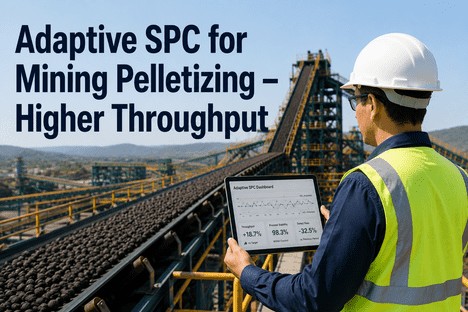
Yield loss in pelletizing is not random. It concentrates at three specific points in the process, and each one has a clearly identifiable set of upstream variables that a well-configured adaptive SPC system can monitor in real time. The gap between what most plants achieve and what is recoverable is almost entirely explained by how early those upstream signals are detected.
What the Supervisor Dashboard Actually Shows — and Why It Works on the Shift Floor
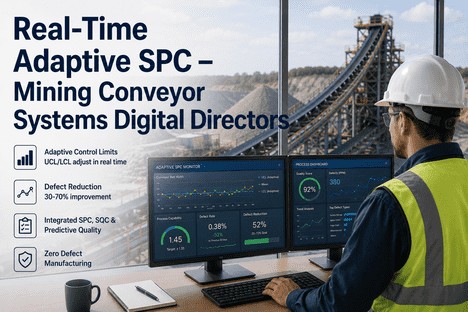
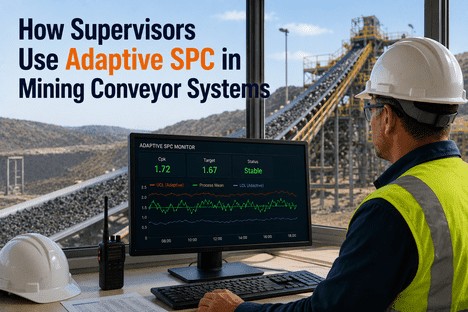
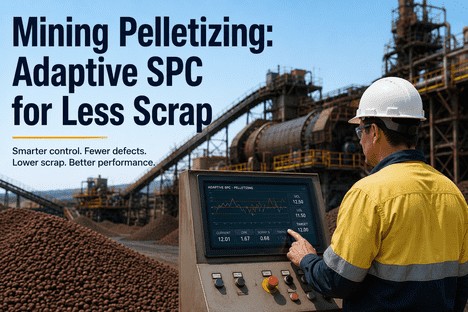
Adaptive SPC is not a statistical display for the quality engineer reviewing end-of-month reports. It is a shift-floor operating tool designed to give pelletizing supervisors four specific things during an active shift: current process stability against today's actual baseline, an alert that fires before scrap is produced, a ranked cause that tells them which variable to act on and in which direction, and an automatic shift record that requires no manual log entry to maintain.
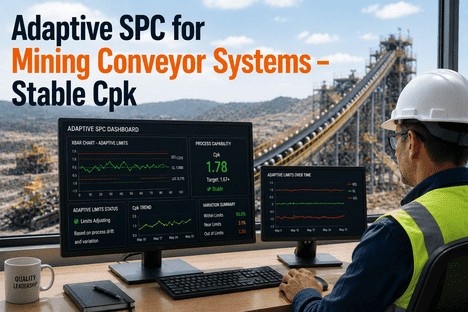
Control charts display current measurement values against adaptive upper and lower control limits that have already incorporated today's ore blend, binder batch, and recipe. Normal variation from today's inputs stays within the bands. Genuine drift stands out against limits calibrated to current conditions — not conditions from the last capability study. Amber trends are noted; red breaches are responded to. Both signals are real, because the limits move with the process.
When the adaptive model identifies a parameter combination trending toward a scrap outcome, the predictive alert fires before the product is affected. The alert surfaces the ranked root cause and a specific recommended action: moisture is 0.4% above the adaptive optimal for the current particle size — reduce moisture addition by 0.3 L/min. No investigation required. The supervisor executes, logs the action, and the alert clears when the trend reverses. The next shift inherits the resolved state, not the open investigation.
Each time a recipe change, ore blend transition, or binder batch change is logged — manually or automatically from a DCS event — the adaptive engine begins transitioning control limits to the new baseline using a configurable incoming data window. The supervisor sees which regime is currently active and when limits transitioned. Recipe changes that shift the balling moisture target are applied automatically. Both the departing and incoming limits remain visible during the transition window, giving context for any process behaviour across the changeover period.
At the end of each shift, the system generates a quality summary: oversize rate, predictive alerts fired, corrective actions taken, and the Cpk for each monitored quality characteristic across the shift. Every alert, supervisor action, and limit change is timestamped and searchable. The summary satisfies internal quality record requirements without manual log entry and provides the handover documentation the incoming supervisor needs to understand exactly where the process stands and what occurred in the previous 8 to 12 hours.
How iFactory's Adaptive SPC Connects to Your Existing Control Infrastructure
Supervisors and process engineers consistently ask the same question before deployment: does this require a major integration project, or can it work with the systems already on the floor? The answer depends on your control system, but most modern pellet plants are closer to live deployment than they expect.
Direct integration with ABB, Siemens, or Rockwell control systems via OPC-UA or REST API pulls process variable data at sensor polling rate — typically 1 to 5 seconds. This enables real-time adaptive limit calculation and predictive alerts at the timescale that pelletizing operations require. No manual data entry. No operator overhead. The dashboard updates continuously from the live historian.
For sites where historian integration is not immediately available, operator-entered readings from key parameters — moisture, disc speed, binder rate, oversize rate — feed the adaptive model at the measurement frequency the operator uses. This mode delivers meaningful scrap prediction and alert improvement even before automation investment is made, and transitions to full historian integration without model rebuilding.
iFactory's adaptive model configures a lag correlation window that maps upstream parameter signals to downstream quality outcomes based on your plant's actual process residence time. The balling-to-screen lag and the induration-to-test-result lag are learned from your historical data — not estimated from published averages — because equipment configuration and throughput affect these timings significantly. Predictive alerts fire at the upstream measurement, giving the supervisor the full lag window as intervention time.
Conclusion
Pelletizing yield loss is not inevitable and it is not random. Every oversize batch, every spalled pellet load, every tumble index failure has an identifiable upstream cause — a moisture deviation, a binder dosage shift, a temperature profile that drifted 20 minutes before the product was committed. The reason these causes keep producing scrap is not that they are unknowable. It is that static SPC limits cannot distinguish between a process that has genuinely drifted and a process that has simply changed. The resulting false alarm accumulation trains supervisors to treat every alert as noise. When the real signal eventually appears, it is indistinguishable from everything that preceded it.
Adaptive SPC restores the credibility of the alert system by building that distinction into the limit calculation itself. Limits that recalibrate dynamically against the current ore blend, binder batch, and recipe can only fire when something is genuinely wrong — because what is normal has already been accounted for. The supervisor sees fewer alerts, responds to more of them, and intervenes upstream before the loss is recorded at the product screen.
For pelletizing supervisors managing ore blend variability, recipe changes, and binder lot variation within the same shift, the gap between static and adaptive SPC is measured directly in the oversize recycle rate, the tumble index failure frequency, and the yield points recovered per quarter. Book a Demo to see adaptive SPC configured against a pelletizing use case matched to your production profile, or talk to an expert about what adaptive limits would look like on your actual process data.