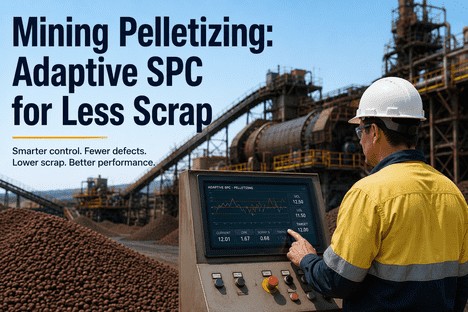
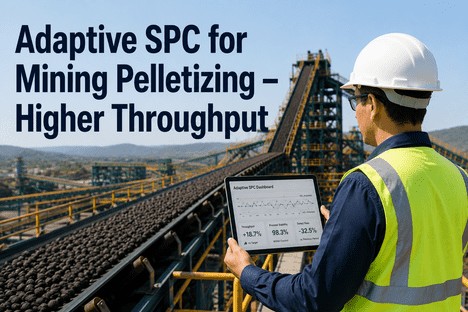
The green pellet screen kicks out 18% oversize. The balling disc operator checks moisture — 9.2%, within the logged specification of 8.8–9.6%. Feed rate looks steady. Binder addition is on schedule. Everything is nominally in spec, but the pellets are running large and the oversize recycle is climbing. The operator adjusts the disc angle by half a degree and waits. The oversize rate drops to 14%, then 12%. Problem managed. But the root cause — a feed particle size distribution that shifted an hour ago when the regrind circuit changed — was never identified. The same pattern will repeat with the next regrind adjustment, and the operator will make the same empirical correction that addresses the symptom without connecting it to the cause. This is what static SPC control limits do to operators in pelletizing: they tell you when you are out of specification, but they do not tell you which of the 40+ interacting process variables moved first, and they do not adapt when a recipe change, ore blend change, or binder batch change legitimately shifts what normal looks like. Adaptive SPC does both — and the difference is 30 to 50% less scrap.
Dynamic UCL/LCL · Recipe-Aware Limits · Predictive Scrap Alerts · Audit-Ready Records
Static SPC Limits Were Set for Last Month's Ore. Your Process Is Running on This Month's. Adaptive SPC Knows the Difference.
iFactory's adaptive SPC engine recalculates control limits dynamically against your current ore blend, binder batch, and recipe — eliminating false alarms from process changes and catching real drift before it becomes oversize, undersize, or off-spec crush strength.
30–50%
Scrap reduction achievable with adaptive SPC and predictive quality analytics in mining pelletizing operations
8–16 mm
Target green pellet diameter range — a specification that is only consistently held when balling disc parameters adapt continuously to moisture and feed variation
20%
Efficiency improvement projected for iron ore pellet plants through AI-driven controls and adaptive process optimisation by 2026
40+
Process variables influencing green pellet quality — moisture, binder dose, disc angle, rotation speed, feed rate, particle size, and ore blend composition
Why Static SPC Limits Fail Pelletizing Operators — and Why It Is Not the Operator's Fault
Static SPC control limits are calculated from a process capability study conducted at a specific point in time — typically during initial process qualification or an annual review. They reflect the process behaviour on the ore blend, binder batch, and recipe in use at the time of the study. The problem in pelletizing is that every one of those inputs changes continuously. Iron ore concentrate from different stockpiles varies in particle size distribution, moisture content, and surface chemistry. Bentonite binder batches from natural deposits vary in composition and binding efficacy. Recipe changes for different pellet grades shift the optimal balling moisture window. When any of these inputs changes, the normal variation range for disc speed, moisture addition rate, and pellet size distribution all shift — and static limits that were correctly set for last month's conditions generate false alarms under this month's conditions, or worse, fail to flag real drift because the process has moved into a new regime that the old limits do not capture.
Static SPC vs Adaptive SPC: What Changes at Every Stage of Pelletizing Quality Control
Process Event
Static SPC Response
Adaptive SPC Response
New ore blend arrives
False alarms on moisture and disc speed — operators learn to ignore alerts during ore transitions
Limits recalibrate to new blend baseline — only genuine drift generates an alert
Binder batch change
Binder dosage needs adjustment but static limits do not reflect the new binder efficacy — oversize rate climbs before the operator recognises the shift
Adaptive limits detect the binder-linked process shift and alert the operator to adjust dosage before oversize accumulates
Recipe grade change
Balling moisture window shifts with the new recipe — operators must manually reset expectations; static alarms fire continuously on parameters now operating at legitimate new setpoints
Recipe-aware limits load automatically when the grade change is registered — limits reflect the new normal immediately
Seasonal moisture variation
Ambient humidity changes alter the effective moisture of filter cake inputs — static limits generate seasonal false alarm patterns
Adaptive limits incorporate environmental context — seasonal moisture shifts update the baseline, genuine drifts still generate alerts
Induration temperature drift
Static limits fire when temperature deviates from the nominal setpoint — but do not correlate temperature drift with its downstream crush strength consequence
Adaptive model correlates induration temperature with fired pellet strength prediction — alerts before the crush strength test returns an off-spec result
Balling Disc · Induration Kiln · Green Pellet Screen · Crush Strength · Operator Dashboard
A False Alarm the Operator Ignores Today Is the Real Defect the Operator Misses Tomorrow. Adaptive Limits Stop the Cycle.
iFactory's adaptive SPC eliminates the false alarm noise that desensitises pelletizing operators — so when a real scrap risk appears, the alert lands with full credibility and a ranked cause, not as background noise in a system that cries wolf every shift change.
The Pelletizing Scrap Map: Where Scrap Forms and What Adaptive SPC Detects at Each Stage
Pelletizing scrap originates at specific points in the process — and each origin has a different set of process variables that a well-configured adaptive SPC system monitors and alerts on in real time. Understanding which scrap type is generated at which stage is the foundation of an effective operator alert configuration.
Stage 01
Balling — Green Pellet Formation
Oversize, Undersize, Weak Green Ball
Green pellet size and wet strength are determined by the balling disc or drum parameters and the moisture content of the feed. Moisture variation of ±0.5% above the optimal balling window is sufficient to produce rapid pellet growth leading to oversize — which is recycled back through the disc, consuming capacity and energy. Moisture below the optimal window produces weak green pellets with insufficient wet strength, which spall during transport to the induration furnace. The binder dosage amplifies both effects: under-dosed binder with high moisture produces unstable large pellets; over-dosed binder with low moisture suppresses growth and creates dense, slow-growing pellets that miss the size window. Adaptive SPC tracks moisture, binder rate, and disc speed simultaneously — alerting the operator when the combination is trending toward an oversize or undersize outcome before the screen confirms it.
Moisture deviation alert
Binder dose correlation
Size distribution trend
Stage 02
Induration — Drying and Firing
Spalling, Under-Fired, Low Crush Strength
The induration furnace hardens green pellets through controlled drying, preheating, firing, and cooling stages — targeting temperatures of 1200°C to 1350°C. Excessive moisture in green pellets entering the drying zone causes spalling — steam pressure builds inside the pellet and ruptures it before adequate strength develops. Temperature profile drift in the firing zone produces under-fired pellets with insufficient crush strength, which fail the tumble index specification and generate fine scrap downstream. Each transition zone of the furnace — drying, preheating, firing, cooling — has its own critical parameter window. Adaptive SPC monitors temperature profiles against expected ranges that adjust for the current pellet moisture and size distribution entering the furnace — catching thermal excursions before they translate into batch-level crush strength failures.
Temperature zone profile tracking
Spall risk pre-alert
Crush strength forecast
Stage 03
Screening and Quality Testing
Off-Spec Size, Tumble Index Failure
Post-induration screening separates on-spec product (typically 9–16mm for direct reduction pellets) from oversize, undersize, and broken pellets. The crush strength and tumble index tests confirm mechanical quality. Defects at this stage are entirely preventable — they are the downstream consequence of upstream parameter deviations that occurred hours earlier. When the oversize rate exceeds target, the root cause is always in the balling moisture and disc parameters from the previous cycle. When tumble index fails, the root cause is always in the induration temperature profile from the furnace run that produced those pellets. Adaptive SPC closes this time gap by detecting the upstream deviation in real time and forecasting the downstream quality outcome before the test results confirm it.
Oversize rate trend alert
Upstream-to-downstream traceability
Quality test forecast
What the Operator Sees: Adaptive SPC on the Shift Floor Dashboard
Adaptive SPC is not a complex statistical display for quality engineers — it is a shift-floor operating tool designed to give the pelletizing operator three specific things: a live view of process stability, an alert that fires before scrap is produced, and a ranked finding that tells them which parameter to adjust and in which direction.
Dashboard View 01
Live UCL/LCL With Current Regime Baseline
The control chart shows the current measurement values against the adaptive UCL and LCL — limits that have already incorporated the current ore blend, binder batch, and recipe state. The operator sees a chart where normal variation from today's inputs stays within the bands — and where genuine process drift stands out clearly because it crosses limits that are already calibrated to today's conditions. No more crying-wolf alerts on parameters that are legitimately different today than they were when the limits were last set.
Operator action: Amber trend — note it. Red breach — respond. Both are real because the limits adapt to what is normal now.
Dashboard View 02
Predictive Scrap Alert With Ranked Cause
When the adaptive model identifies a parameter combination trending toward a scrap outcome, the predictive alert fires before the product is affected. The alert shows the operator the ranked root cause: "Oversize risk elevated. Primary driver: moisture at 9.8% — 0.4% above adaptive optimal for current particle size. Reduce moisture addition by 0.3 L/min." The operator does not need to investigate. The system has done the correlation. The recommended action is specific and immediate. The operator executes, logs the action, and the alert clears when the trend reverses.
Operator action: Execute the recommended adjustment, log the action, confirm the trend reversal on the chart.
Dashboard View 03
Recipe and Blend Change Registry
Every time a recipe change, ore blend transition, or binder batch change is logged, the adaptive SPC system registers the change and begins transitioning the control limits to the new baseline using a configurable window of incoming data. The operator sees which regime is currently active and when the limits transitioned — giving them context for any process behaviour during the transition period. Recipe changes that shift balling moisture targets are applied automatically to the moisture control limit, with the old and new limits both visible during the transition window.
Operator action: Log the recipe or blend change. The system handles limit recalibration. No manual limit update required.
Dashboard View 04
Shift Scrap Summary and Event Log
At the end of each shift, the system generates an automatic quality summary: total oversize rate, any predictive alerts fired, corrective actions taken, and the Cpk for each monitored quality characteristic across the shift. Every alert, operator action, and limit change is timestamped and searchable. The shift summary satisfies internal quality record requirements without manual log entry — and provides the handover documentation the next shift needs to understand what happened and where the process currently stands.
Operator action: Review at shift end. Hand over the live dashboard to incoming operator. No paper logbook required.
"
Our biggest quality problem was not that operators were not paying attention — it was that the SPC system was generating false alarms every time we changed ore source or switched between pellet grades for different customers. Over a shift with two ore transitions and a recipe change, operators would see 15 or 20 alerts, most of which were just the system not knowing we had changed inputs. By the time a real drift appeared, everyone was ignoring the board. Adaptive limits fixed this. Within two weeks of deployment, the alert rate dropped by more than 60% and the alerts that did fire were almost always real. Operators started responding again because the system had earned its credibility back. Our oversize recycle rate dropped 34% over the first quarter.
— Process Control Operator Lead, Iron Ore Pelletizing Plant — 4.5 Mtpa Capacity, Grate-Kiln Induration
Conclusion
Pelletizing scrap is not random. Every oversize batch, every spalled pellet load, and every tumble index failure has a root cause in a specific process variable deviation that occurred hours earlier — visible in the moisture trends, the temperature profiles, and the disc parameters. The reason scrap keeps recurring is not that the causes are unknowable. It is that static SPC limits cannot distinguish between process deviation and process change, and the resulting false alarms have trained operators to treat every alert as noise. Adaptive SPC restores the credibility of the alert system by building the distinction into the limit calculation itself — limits that move with the process regime and only fire when something is genuinely wrong.
For operators, the change is concrete: fewer false alarms, more credible alerts, and a ranked cause that eliminates the manual investigation step. The moisture reading, the disc angle, the binder dose — the parameter driving the scrap risk is identified and served to the operator dashboard before the green pellet screen confirms it. The operator adjusts. The alert clears. The event is logged. And the same pattern does not recur without another alert, because the adaptive model has now seen it and will recognise it earlier next time.
iFactory's adaptive SPC platform is purpose-built for pelletizing operators — with dynamic UCL/LCL limits that adapt to every ore blend, binder batch, and recipe change, predictive scrap alerts with ranked parameter causes, and automatic shift quality documentation that replaces manual log entry. Book a Demo to see adaptive SPC configured for a pelletizing use case matched to your production profile, or talk to an expert about a live SPC walkthrough on your pelletizing process data.
Frequently Asked Questions
Your Operators Are Not Ignoring Alerts Because They Do Not Care. They Are Ignoring Them Because Static Limits Cry Wolf. Adaptive SPC Fixes That.
iFactory's adaptive SPC platform for pelletizing operators — dynamic UCL/LCL that adapt to every process change, predictive scrap alerts with ranked causes, and shift quality documentation that replaces the paper log. Book a walkthrough on your process data.