The green pellet screen is running 17% oversize. You check the control chart — moisture, disc speed, binder rate all fall within the logged specification bands. Everything looks fine on paper. But the pellets tell a different story, and the audit scheduled for next Thursday will want to know exactly why the oversize rate spiked, when it started, which parameter moved first, and what corrective action was taken. Can your current system answer all four of those questions from timestamped records alone? For most pelletizing supervisors, the honest answer is no. AI vision quality inspection changes that — and it does it at the shift-floor level, not in the quality lab after the fact.
What AI Vision Quality Inspection Actually Does on a Pelletizing Line
Traditional pellet quality inspection relies on two things: laboratory sampling after induration and operator observation at the screen. Both are retrospective. The lab result comes back after the batch has been committed. The operator sees the oversize rate after the disc has already been running off-target for 20 minutes. AI vision quality inspection operates at a fundamentally different timescale — real-time, continuous, and upstream of the quality consequence rather than downstream of it.
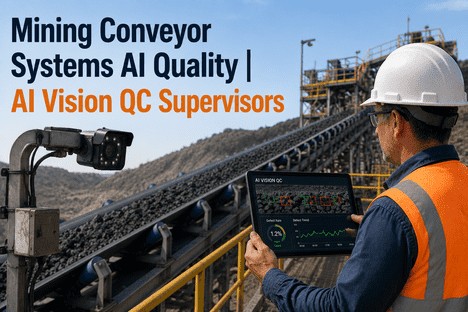
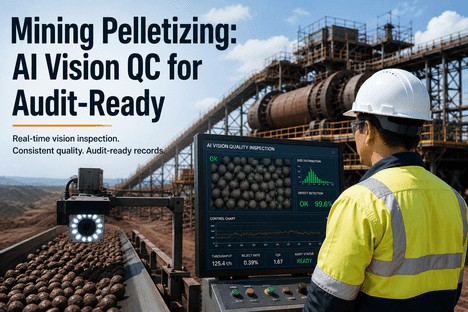
At the balling disc, a high-resolution camera system captures images of the pellet stream at production speed. A deep-learning model — trained on thousands of labelled images of on-spec pellets, joint pellets, crushed pellets, and oversize agglomerates — classifies every pellet in the field of view in real time, generating a continuous size distribution signal that updates the supervisor dashboard every few seconds. This is not a pixel counter or a simple threshold detector. The model learns the visual signature of quality deviations that precede screen rejection, so the alert fires before the oversize rate climbs, not after it is already logged.
Why Audit Readiness Is the Supervisor's Real Challenge — and Why AI Vision Solves It
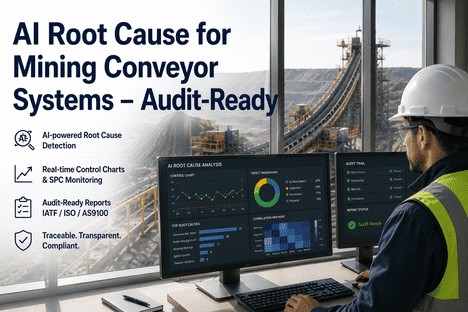
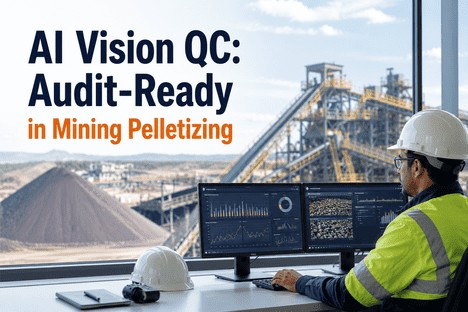
An ISO 9001 or IATF 16949 audit does not ask whether your process was in control. It asks whether you can prove it. That proof has to come from records — timestamped, traceable, complete, and available for review without a three-hour manual reconstruction exercise the morning before the auditor arrives. Most pelletizing operations can produce process data. Very few can produce the causal record: which parameter deviated, when was it detected, what corrective action was taken, and was the action effective. The gap between those two things is where audit findings are written.
AI vision quality inspection closes that gap automatically. Every pellet classification event, every adaptive SPC alert, every operator corrective action logged against an alert, and every quality characteristic Cpk calculated across a shift is stored with a timestamp, linked to the recipe and ore blend active at the time, and exportable as a structured audit record. The supervisor does not build this record. The system builds it continuously as the shift runs.
The Three Defect Types AI Vision Catches Before Manual Inspection Can
Pelletizing defects are not random. They fall into three categories, each with a specific visual signature that deep-learning models can detect at production line speed — and each with an upstream process cause that, once detected visually, can be traced back to the parameter deviation that produced it.
The Supervisor Dashboard: What You See and When You See It
AI vision quality inspection is only as valuable as the information it surfaces to the person who can act on it. The iFactory supervisor dashboard is designed around one principle: the right information, at the right time, in the format that supports an immediate and confident decision. Not data volume. Not statistical complexity. Operational clarity.
The live inspection panel shows the current pellet size distribution as a histogram updating every 5 seconds, the defect classification rate for the last 10 minutes broken down by defect type, and a rolling quality score that combines size conformance and surface quality into a single shift KPI. When the distribution shifts toward oversize, the histogram bar extends and changes colour before the screen oversize rate reflects it — giving the supervisor a minimum 10-to-20-minute lead time over the lagging screen measurement.
Every predictive alert fires with a ranked cause and a specific recommended action. The alert does not say "quality deviation detected." It says: "Joint pellet rate rising. Primary driver: moisture at 9.9% — 0.5% above adaptive optimal for current particle size and disc speed combination. Recommended action: reduce moisture addition by 0.3 L/min and monitor size distribution for 5 minutes." The supervisor executes, logs the action against the alert, and the system confirms resolution when the joint pellet rate drops back inside the adaptive band. The alert, the action, and the resolution are all recorded automatically.
The SPC panel shows live control charts for every monitored parameter — moisture, binder rate, disc speed, oversize rate, induration temperature zones — with adaptive UCL and LCL that have already incorporated the current ore blend, binder batch, and active recipe. When a recipe or ore blend change is logged, the limits recalibrate automatically using a rolling data window, eliminating the false alarms that static limits generate during process transitions. Each control chart is exportable as an audit-ready record with the regime context embedded in the chart metadata.
At shift end, the system generates a complete quality summary: total tonnes produced, oversize rate, defect classification breakdown by type, all predictive alerts fired with their corrective action records, Cpk for every monitored quality characteristic, and a traceability index linking each quality event to the recipe and ore blend active at the time. This report is timestamped, digitally signed by operator ID, and stored in the searchable audit log. The incoming shift supervisor sees the handover state at a glance. The quality manager has the full shift record available for review without requesting it from anyone.
The audit preparation used to take our quality team two days before every certification review — pulling shift logs, reconstructing corrective action timelines, chasing operators for signatures on paper entries. With iFactory, the audit pack is just there. Every alert, every action, every Cpk from the previous six months, all searchable and exportable in 20 minutes. The last ISO audit went through our pelletizing records with no findings. The auditor actually commented that our process documentation was the most complete they had seen at a plant our size.
— Shift Supervisor, Iron Ore Pelletizing Plant — 3.8 Mtpa, Travelling Grate IndurationConnecting Vision Inspection to SPC: How the Two Systems Work Together
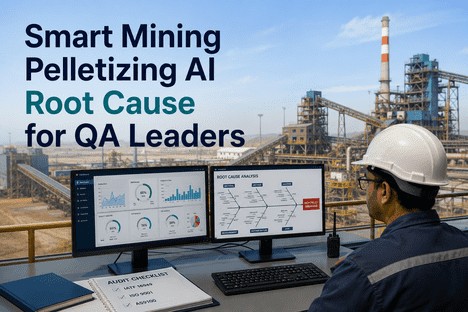
AI vision inspection and adaptive SPC are most powerful when they are connected — not operating as separate tools generating separate alerts, but integrated into a single quality intelligence system where the vision model output feeds the SPC model and vice versa. When the vision model detects a rising joint pellet rate, that signal is fed as a real-time input into the adaptive SPC model monitoring moisture and binder dose. The SPC model cross-correlates the visual defect rate with the upstream process parameters to confirm which parameter is the primary driver, assign a confidence score to the root cause, and fire a single ranked alert rather than two separate alarms from two separate systems.
This integration is what separates a quality monitoring system from a quality intelligence system. Monitoring tells you something happened. Intelligence tells you what caused it, how confident it is in that diagnosis, and what specific action will resolve it — before the downstream consequence is confirmed by a test result or a screen reading.
Conclusion
The pelletizing supervisor's quality challenge in 2026 is not a lack of data. It is a lack of interpretation at the right moment and a lack of records in the right format when the auditor arrives. AI vision quality inspection addresses both sides of that challenge simultaneously — detecting defects before they are confirmed by downstream tests, identifying root causes before they require manual investigation, and building the audit record automatically as the shift runs rather than reconstructing it the night before certification review.
For supervisors who are currently managing quality reactively — adjusting disc parameters after the screen oversize rate climbs, explaining shift deviations from incomplete paper logs, preparing for audits by manually assembling records from multiple system exports — the change that AI vision quality inspection delivers is concrete and measurable. Fewer defect escapes, faster root cause identification, lower scrap recycle rates, and a compliance record that is complete, searchable, and exportable at any time without preparation. The technology to run a pelletizing line this way is available today. The supervisors who implement it now will set the quality benchmark that everyone else in the sector is measured against by the end of this decade.
iFactory's AI vision quality platform is purpose-built for pelletizing operations — with deep-learning pellet inspection, adaptive SPC with recipe-aware limits, predictive defect alerts with ranked root causes, and automatic shift documentation that replaces manual log entry. Book a Demo to see the platform configured for your pelletizing circuit, or talk to an expert about a live walkthrough on your process data.