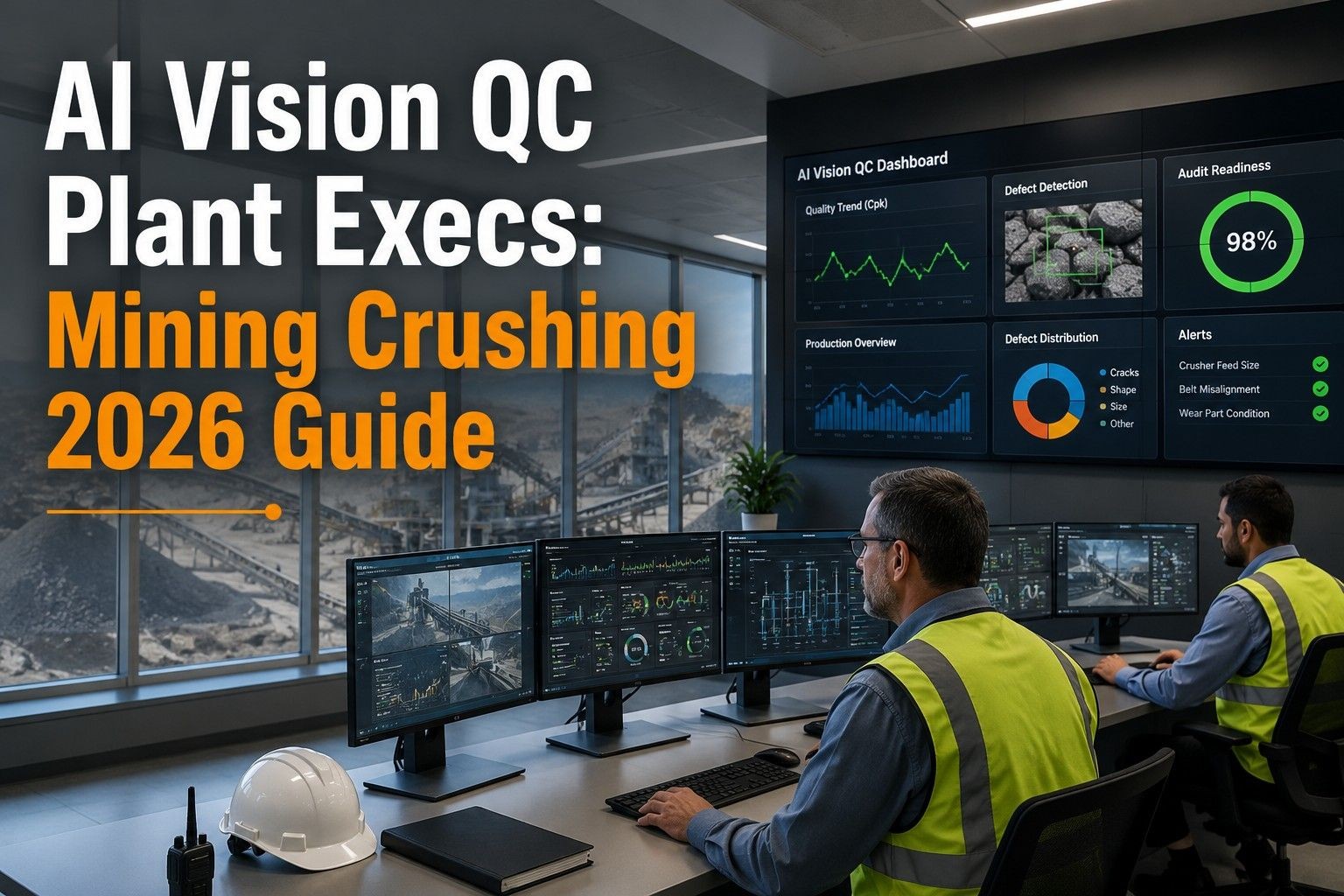
AI Vision QC Plant Execs: Mining Crushing 2026 Guide

By Grace on June 8, 2026

ai-vision-quality-mining-crushing-plant-executives-audit-readiness

The plant executive receives the notification eight weeks before every audit. The quality manager requests SPC charts for every critical characteristic. The shift supervisors compile inspection logs for the audit period. The laboratory pulls assay records and cross-references them against production reports. The documentation team assembles binders of corrective action records, control limit change approvals, and capability study results. The process consumes 200 to 300 labor hours per facility and produces a compliance package that the auditor will spend two days reviewing — with a 30 to 40 percent probability of finding a documentation gap that triggers a non-conformance. The gap is rarely a quality failure. It is almost always an evidence gap: an out-of-control event that was corrected but not recorded, an inspection that was performed but not documented with sufficient detail, a corrective action that was closed but without effectiveness verification. For plant executives accountable for both production performance and compliance audit outcomes, the structural cost is not the audit preparation labor. It is the operational reality that between audits, the quality evidence required to prove process control exists only in scattered shift logs, laboratory reports, and operator memory — and that evidence is never audit-ready until the scramble begins. AI vision quality with automated audit trail generation eliminates this cycle entirely by transforming every inspection event into an immutable, structured, and exportable compliance record that is audit-ready at all times.

AI Vision Quality for Mining Crushing
How Plant Execs Use AI Vision QC to Stay Audit-Ready in Crushing Operations
AI vision quality with automated audit trail generation transforms every inspection event into an immutable, structured compliance record — eliminating manual evidence gathering and ensuring ISO 9001, IATF 16949, and AS9100 audit readiness at all times.
The Audit Readiness Gap in Crushing Operations

Audit readiness in mining crushing operations is not a documentation problem. It is a data granularity problem. Traditional quality control relies on manual belt inspection, periodic laboratory sampling, and shift-log documentation that captures a fraction of the production process. An operator performing visual belt inspection catches what they can see in the moment and documents what they remember after the fact. A laboratory assay provides a precise measurement of material that left the circuit 45 to 90 minutes earlier. The SPC charts that quality managers present during audits are built from this sparse data, and the gaps between data points are filled by assumption. When an auditor asks for evidence of process control during a specific 15-minute window on a specific shift three months ago, the answer is almost always a reconstruction rather than a record.

AI vision quality closes this gap by placing continuous, deep-learning-based inspection directly on the conveyor belt at line speed, with every particle and every surface measured against statistical control limits that update with every production shift. Every AI inference generates an immutable record with timestamped visual evidence, confidence scores, and classification data that maps directly to the documentation requirements of ISO 9001, IATF 16949, and AS9100. The inspection coverage rate moves from below 15 percent to 100 percent. The evidence trail moves from retrospective reconstruction to continuous, always-on documentation. And the 200 to 300 labor hours of manual audit preparation are eliminated because the evidence already exists — structured, searchable, and exportable on demand.

Audit Readiness Gap: Current State vs AI Vision Enabled
Inspection Coverage
15% vs 100%
Manual
Gap
AI Vision
Documentation Completeness
30% vs 100%
Manual
Gap
AI Vision
Evidence Retrieval Time
Days vs Minutes
Days
Gap
Min

Non-Conformance Risk
30-40% vs Below 5%
Manual
Gap
AI

AI Vision Architecture for Continuous Audit Readiness

AI vision quality for audit readiness is not a single camera or a single model. It is a four-layer architecture that transforms raw visual data from conveyor belts, transfer points, and screen decks into real-time quality intelligence and immutable compliance records. Each layer runs on-premise with zero cloud dependency and connects to existing plant infrastructure through standard industrial protocols.

Layer 4
Compliance and Audit Trail
Every defect detection event logged with AI-annotated image, confidence score, defect classification, and timestamp. CAPA workflows triggered automatically. Audit-ready reports exportable on demand for any date range. Immutable audit trail with e-signatures and AES-256 encryption. Mapped to ISO 9001, IATF 16949, and AS9100 documentation requirements.
Layer 3
Correlation and SPC Engine
AI correlates visual defect patterns with upstream PLC, SCADA, and OPC-UA sensor feeds in real time. Control charts update with every inference, not with every laboratory result. Control limit breaches flagged instantly with automated notification. Root cause identified by correlating visual defects with crusher parameters and feed characteristics.
Layer 2
Edge AI Inference
Deep learning models process camera streams at the edge with sub-second inference latency. Detection capabilities include oversize particles, tramp metal, belt damage, contamination, PSD measurement, and ore type classification. YOLO-family models achieve 120.7 FPS with 4.5% mAP improvement. All inference runs locally with no cloud dependency.
Layer 1
Camera and Sensor Layer
ONVIF-compatible industrial cameras capture continuous image streams at conveyor transfer points, feed chutes, and screen discharge belts. Multi-spectral and structured light arrays penetrate dust and variable lighting. Existing surveillance cameras can be repurposed. Frame rates of 30-120 FPS supported depending on detection requirements.
Compliance Clause Coverage Map

AI vision quality with automated audit trail generation maps directly to the documentation requirements of the quality management standards that govern mining crushing operations. The coverage map below shows how specific standard clauses are satisfied by AI vision capabilities without manual intervention.

Standard
Clause
Requirement
AI Vision Capability
ISO 9001
8.5.1
Control of production and service provision — monitored and measured at planned intervals
Continuous 100% inspection at line speed with SPC chart updating per inference. Every data point carries visual evidence and process context.
ISO 9001
10.2
Non-conformity and corrective action — documented information as evidence
Automated CAPA generation with 5 Whys and Ishikawa analysis. Every event logged with timestamp, annotated image, operator action, and verification.
IATF 16949
10.2.3
Root cause analysis for each quality event — documented methodology and corrective action results
AI root cause correlation engine identifies contributing process variables with contribution scores and supporting evidence window.
IATF 16949
9.1.1.1
Monitoring and measurement of manufacturing processes — statistical methods including control charts
Real-time SPC with Western Electric rules applied per inference. Control limit changes logged with approval records in immutable audit trail.
AS9100
8.7
Control of non-conforming outputs — evidence of disposition and corrective action
AI-annotated image evidence for every non-conforming event. Disposition, containment, and corrective action logged with full chain of custody.
How a Defect Becomes an Audit Record

In a traditional quality system, a defect detected on the conveyor belt triggers a chain of manual actions: the operator documents the finding on a paper form, the shift supervisor enters it into the quality system, the laboratory confirms the deviation hours later, and the corrective action is tracked through spreadsheets and email. When an auditor requests evidence of this event three months later, the documentation trail has gaps — missing timestamps, incomplete corrective action records, and no visual evidence of the defect itself. AI vision quality collapses this multi-step manual chain into an automated sequence that transforms every detection event into a complete, audit-ready record within seconds.

01
AI Detects Defect
Deep learning model identifies oversize particle, tramp metal, or belt damage at line speed. Detection confidence score and classification recorded automatically.
120.7 FPS 96% accuracy
02
Evidence Immobilized
AI-annotated image captured with bounding box, confidence score, and classification. Timestamped and linked to upstream process parameters from SCADA.
Immutable log AES-256
03
Root Cause Identified
Correlation engine links visual defect to upstream cause — feed hardness spike, CSS drift, liner wear, or moisture change. Contribution scores ranked automatically.
100+ variables Ranked output
04
CAPA Generated
Non-conformance event triggers structured CAPA workflow with automated work order creation. 5 Whys root cause template pre-populated with AI findings.
Auto work order 5 Whys
05
Closed with Verification
Corrective action assigned, executed, and verified through follow-up AI inspection. Effectiveness confirmation logged with visual evidence of resolved condition.
E-signature Verification
06
Audit-Ready Record
Complete event record available in structured format for any date range. Exports as audit-ready documentation with all required evidence fields.
On-demand Exportable
Before vs After: Audit Preparation Metrics

The transition from manual audit preparation to always-on audit readiness is measurable across four key metrics that plant executives track. Each metric reflects a direct operational improvement from deploying AI vision quality with automated audit trail generation.

Audit Preparation Time per Facility
280
Manual Hours
->
0
AI Vision Hours
Evidence Retrieval Time
2-3
Days Manual
->
5
Minutes AI
Non-Conformance Risk per Audit
35%
Manual Probability
->
3%
AI Probability
Inspection Coverage
15%
Manual Coverage
->
100%
AI Coverage

Our previous audit preparation cycle consumed approximately three weeks of engineering and quality team time. The auditor identified three documentation gaps despite our team having spent those weeks compiling evidence. We deployed AI vision cameras at five critical inspection points across our primary and secondary crushing circuit. The next audit was different. When the auditor requested evidence of process control for a specific shift three months prior, our quality manager opened the dashboard, selected the date range, and exported the complete record set — control charts, event logs, CAPA records with visual evidence — in under five minutes. The auditor reviewed the documentation package and closed the audit with zero non-conformances. The labor hours that were previously consumed by audit preparation were redirected to process optimization work that directly reduced our scrap rate. The 200-plus hours of manual evidence gathering were simply eliminated.

Plant Manager, Copper Crushing Operation
From Manual Preparation to Always-On Audit Readiness

For plant executives, the value of AI vision quality extends beyond defect detection and scrap reduction. Those are operational metrics that appear on the weekly production report. The metric that appears on the quarterly compliance report — audit outcome — is equally consequential, and it is the one that quality leaders spend the most labor hours preparing for. Manual audit preparation is not a quality activity. It is an administrative overhead that consumes engineering time, quality team resources, and operational attention that should be directed at process improvement. The 200 to 300 labor hours spent every quarter compiling SPC charts, corrective action records, and capability studies represent a direct productivity loss that generates no quality improvement — only compliance evidence that may or may not satisfy the auditor's documentation requirements.

AI vision quality with automated audit trail generation eliminates this overhead by making every inspection event its own compliance record. The system does not produce evidence after the fact. It produces evidence at the moment of detection, in the format required by the applicable standard, without any person filling out a form or attaching a screenshot. The auditor does not review binders of manually compiled documentation. They review an export from the quality intelligence platform that covers the full audit period with every data point carrying visual evidence, process context, and corrective action history. The questions that previously triggered non-conformances — "where is the evidence that this corrective action was verified?" or "why is there no timestamp on this inspection record?" — are structurally eliminated because those fields are generated automatically by the system at the moment of the event.

For plant executives managing ISO 9001, IATF 16949, or AS9100 compliance across crushing operations, the choice is between two operating models. In the first model, quality evidence is assembled retrospectively, consuming hundreds of labor hours per quarter and carrying a 30 to 40 percent probability of a documentation gap that triggers a non-conformance. In the second model, quality evidence is generated continuously at line speed, stored immutably, and exportable on demand with zero manual effort. The first model is the standard practice today across most crushing operations. The second model is deployable on existing camera infrastructure within weeks, and the transition cost is recovered in the first audit cycle through eliminated preparation labor and reduced non-conformance risk.

Deployment Timeline to Continuous Audit Readiness

AI vision quality deploys on existing camera and network infrastructure without new sensors or control system replacements. Each inspection zone goes live within one to two weeks of camera installation, and the system produces audit-ready documentation from the first day of live operation.

Week 1-2
Camera installation at first inspection zone. Network connectivity established. Edge inference node deployed. ONVIF cameras commissioned at conveyor transfer points and screen discharge belts.
Zone live
Week 3-4
Model training on site-specific data. Shadow-mode validation against manual inspection records. SPC integration established. CAPA workflows configured for audit trail generation.
Validated
Week 5-6
Live AI vision quality with automated audit trail generation. All detection events logged with visual evidence. CAPA workflows active. Audit-ready reports available on demand for any date range.
Audit-ready
Week 7+
Additional inspection zones deployed. Model accuracy improves through active learning. Full audit readiness achieved across all monitored zones. Zero manual evidence gathering required.
Scaled
Start Your AI Vision Quality Deployment
Calculate Your Audit Readiness Improvement and COPQ Reduction ROI
Receive a 30-minute walkthrough of AI vision quality running on your crushing circuit data. We will show you your current inspection coverage, documentation completeness, and the audit readiness improvement opportunity specific to your operation.
Frequently Asked Questions

Every AI vision inference generates a structured record that maps directly to the documentation requirements of each quality management standard. For ISO 9001 Clause 8.5.1, the system provides continuous monitoring and measurement records with visual evidence for every production segment. For IATF 16949 Clause 10.2.3, the system documents root cause analysis with contribution scores, corrective actions, and effectiveness verification. For AS9100 Clause 8.7, the system captures non-conformance disposition with supporting visual evidence and corrective action closure. All records carry timestamps, e-signatures, and role-based access control meeting FDA 21 CFR Part 11 requirements. The audit trail is immutable, searchable, and exportable in structured format on demand. Book a Demo to review audit report formats configured for your specific QMS requirements.

AI vision quality works with both existing ONVIF-compatible industrial cameras and purpose-installed camera arrays. Many crushing operations already have cameras at transfer points and feed chutes for surveillance and remote monitoring. These cameras can be repurposed for AI vision inspection if they meet minimum resolution and frame rate requirements — typically 1080p at 30 FPS. For operations without existing camera infrastructure, iFactory deploys industrial-grade camera housings with integrated structured lighting designed for high-dust and variable-lighting crushing environments. A typical deployment installs cameras at 4 to 8 critical inspection points covering the primary crusher feed, secondary crusher discharge, screen decks, and final product conveyors. Talk to an Expert about a camera infrastructure assessment for your site.

The audit trail is stored with AES-256 encryption and role-based access control. Every record carries a cryptographic timestamp and user attribution that prevents retroactive modification. Quality records are backed up automatically with configurable retention policies that meet your document retention requirements under ISO 9001 and IATF 16949. The system maintains a complete version history of every control limit change, model update, and configuration modification with before-and-after values and approval records. In the event of network disruption, the edge inference node continues to operate and stores records locally until connectivity is restored, at which point records are synchronized automatically. No data is lost during network interruptions. Book a Demo to see the audit trail security architecture.

iFactory integrates with existing QMS and CMMS platforms through OPC-UA, MQTT, REST API, and native SAP PM connectivity. The AI vision layer connects to your existing quality management system to create work orders, update inspection records, and log quality events without manual data entry. When AI detects a quality deviation, it can automatically generate a work order in your CMMS, update the SPC chart in your QMS, and log the event in the compliance audit trail — all within the same operational sequence. The platform supports integration with SAP, Oracle, and major CMMS platforms. For operations using spreadsheets or manual tracking, iFactory provides its built-in quality management module with CAPA workflows, inspection templates, and compliance reporting. Talk to an Expert to discuss integration with your specific QMS platform.

ROI from AI vision quality for audit readiness is driven by four primary value streams: eliminated manual audit preparation labor (200-300 hours per facility per year, valued at $20,000-$40,000 depending on labor rates), reduced non-conformance risk (30-40% down to below 5%, avoiding re-audit costs and compliance penalties), scrap reduction from real-time defect detection (30-50% reduction in scrap rate, valued at $200,000-$600,000 per year for a mid-size operation), and avoided downtime from belt damage detected before catastrophic failure. For a typical mid-size crushing operation processing 5 million tons annually, total annual savings range from $500,000 to $1.2 million. Payback periods range from 4 to 10 months depending on existing camera infrastructure, number of inspection stations deployed, and current scrap rate. iFactory provides a personalised COPQ reduction ROI calculator based on your operation's specific parameters. Book a Demo to receive a customised ROI projection for your operation.

Manual Audit Preparation Is Not Quality Management. It Is Administrative Overhead.
iFactory AI vision quality for mining crushing operations — deep learning models running on existing camera infrastructure for continuous 100% inspection, real-time SPC integration, automated CAPA workflows, and immutable audit-ready records. Purpose-built for plant executives who need zero-defect output and zero-evidence-gap audits.

Share This Story, Choose Your Platform!