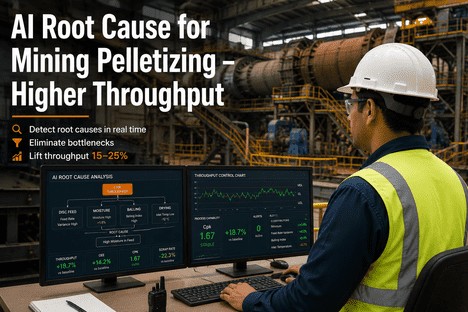
AI Root Cause for Mining Pelletizing – Higher Throughput

By Grace on June 11, 2026

ai-root-cause-detection-mining-pelletizing-supervisors-throughput-increase

Your pelletizing line just dropped 12% below target throughput. The disc speed is logged. Moisture is within range. Binder rate looks stable. But somewhere in the web of 100+ interacting process variables — particle size distribution, slurry density, disc angle, ore blend ratio, induration zone temperatures — something shifted, and you have no fast way to know what or when. By the time the root cause is identified through manual investigation, the production loss is already written into the shift report. This is the throughput problem that AI root cause detection for mining pelletizing was built to solve — and in 2026, the supervisors using it are pulling 15–25% more throughput from the same equipment.

Multivariate ML · Real-Time RCA · Adaptive SPC · Continuous Cpk
AI Root Cause Detection for Mining Pelletizing: The Supervisor's Guide to 15–25% Throughput Increase
iFactory's AI root cause detection platform correlates 100+ pelletizing process variables in real time — pinpointing the exact cause of throughput loss before the shift report is written, so supervisors act on intelligence, not guesswork.
15–25%
Throughput increase achievable when AI root cause detection eliminates recurring unresolved process deviations in pelletizing operations
100+
Process variables correlated simultaneously by multivariate ML — balling, induration, screening, and input quality all connected
<60s
Time from deviation onset to ranked root cause alert on the supervisor dashboard — versus 20–40 minutes with manual investigation
3x
Faster root cause resolution compared to conventional SPC and manual control chart review in high-variable pellet plant environments

Why Traditional Root Cause Analysis Fails Pelletizing Supervisors

Pelletizing is one of the most variable-dense processes in mineral production. The quality and throughput of the finished pellet is determined not by one or two parameters but by the simultaneous interaction of ore blend composition, concentrate moisture, binder type and dosage, disc speed and angle, disc loading, green pellet moisture, drying zone temperature profiles, induration firing curves, and cooling rates — all of which vary continuously across a shift, and all of which interact with each other in ways that simple univariate control charts cannot detect.

The standard approach to root cause analysis in pelletizing — reviewing individual control charts parameter by parameter after a deviation has been confirmed — has two fundamental problems. First, it is retrospective. By the time the supervisor reviews the charts, the deviation has already produced its throughput or quality consequence. Second, it is non-causal. A univariate chart tells you that moisture was high, but it cannot tell you whether moisture was the cause of the oversize rate increase, a correlated symptom of a disc loading problem, or simply noise during a period when the actual driver was ore blend particle size distribution. Acting on the wrong cause — or acting on the right cause too late — is where throughput is lost, shift after shift.

The Throughput Gap: Where Pelletizing Production Is Actually Lost
Problem 1
Late Detection
Deviations are confirmed at the screen or the quality lab — 15 to 40 minutes after the process has already moved off-target. The scrap recycle and the throughput loss are already locked in before any corrective action begins.
Problem 2
Wrong Cause, Wrong Fix
Without multivariate correlation, supervisors adjust the most visible parameter — often moisture — when the true driver was ore particle size, binder batch quality, or disc angle drift. The wrong fix leaves the root cause unaddressed and the deviation recurring every shift.
Problem 3
No Shift-to-Shift Memory
Each shift investigates deviations from scratch. The same root cause can go unresolved for weeks because no system connects the deviation on Tuesday night to the same pattern on the previous Thursday morning, across different operators running different recipes.

How AI Root Cause Detection Works in a Pelletizing Environment

AI root cause detection in pelletizing is not a smarter alarm system. It is a fundamentally different analytical architecture — one that treats the pelletizing process as a connected system of interacting variables rather than a collection of independent parameters each with their own upper and lower control limits.

The iFactory multivariate ML engine ingests live process data from every monitored point in the pelletizing circuit — balling disc sensors, moisture probes, binder dosing signals, furnace zone thermocouples, and screen output measurements — and builds a continuous model of the normal operating relationships between those variables under the current recipe, ore blend, and production rate. When a deviation begins, the model does not simply flag the variable that crossed a limit. It identifies which variable moved first, which variables moved in response, and which causal pathway best explains the pattern — then surfaces a ranked root cause to the supervisor dashboard before the downstream quality or throughput consequence is confirmed.

How the AI Root Cause Engine Reaches a Ranked Diagnosis — in Real Time
Ingest
100+ live process signals collected every few seconds across the full circuit
Model
Multivariate ML builds normal operating relationships for current recipe and ore blend
Detect
Deviation from the multivariate normal pattern triggers investigation — not individual limit breach
Correlate
Causal inference identifies which variable moved first and which moved in response
Alert
Ranked root cause and specific corrective action delivered to supervisor in under 60 seconds

The Five Root Causes That Steal the Most Throughput in Pelletizing — and How AI Finds Them

Throughput loss in pelletizing is not random. In the majority of operations, five recurring root cause patterns account for the bulk of unplanned production loss across shifts. AI root cause detection identifies all five faster than any manual review process — and more importantly, it distinguishes between them when they present with overlapping surface symptoms.

Root Cause A
Ore Blend Particle Size Shift
Throughput impact: High

A shift in concentrate particle size distribution — caused by mill wear, feed blend changes, or upstream process variation — changes the optimal moisture and binder parameters for pellet formation at the disc. When particle size distribution shifts without corresponding adjustment to balling parameters, the disc produces a higher proportion of undersized and joint pellets, screen recycle increases, and effective throughput drops. Because moisture and binder readings remain within their individual specification bands, conventional control charts do not fire. The AI model detects the characteristic multivariate pattern — disc load stable, moisture stable, binder stable, but joint pellet rate and size distribution variance rising together — and identifies particle size as the primary driver rather than any of the surface parameters that appear normal.

Multivariate detection
Invisible to univariate SPC
Recycle reduction
Root Cause B
Binder Batch Quality Variation
Throughput impact: High

Binder performance varies between batches — moisture content, particle size, and chemical activity all affect the effective binding strength delivered per unit of binder dosed. When a new binder batch with lower-than-typical activity enters the system, the disc produces weaker green pellets that break up under disc action, increasing fines recycle and reducing net pellet output. The supervisor maintains the nominal binder dose rate because the dosing signal reads correctly — but the effective binding rate has changed. The AI model correlates the binder batch change timestamp with the subsequent shift in green pellet drop strength indicators and disc performance metrics, identifies the batch transition as the root cause, and recommends a specific binder dose increase to compensate for the lower-activity batch.

Batch change correlation
Dose compensation alert
Fines reduction
Root Cause C
Induration Zone Temperature Drift
Throughput impact: Very High

Induration furnace temperature zone drift — caused by burner wear, gas pressure variation, or refractory degradation — produces pellets outside the optimal sintering range. Under-fired pellets fail crush strength specifications and must be reworked or downgraded. Over-fired pellets incur unnecessary energy cost and can generate surface cracking that compromises tumble index. In both cases, the pellets reach the mechanical test station before the deviation is confirmed — typically 60 to 90 minutes after the furnace temperature began drifting. AI root cause detection correlates the early thermal signature from zone thermocouples with pellet surface colour and texture data from post-induration vision inspection, generating a causal alert within minutes of zone drift onset — well inside the window for furnace parameter correction before product quality is committed.

Thermal-vision correlation
Pre-test crush alert
Energy waste reduction
Root Cause D
Disc Wear and Mechanical Drift
Throughput impact: Medium–High

Gradual disc wear changes the effective pelletizing geometry over time — altering the rolling bed depth, residence time, and size distribution profile in ways that accumulate across shifts until a step-change in performance becomes visible. Because the drift is gradual, it is rarely captured by periodic inspection and is frequently attributed to material variation rather than mechanical wear. The AI model builds a long-run baseline of disc performance metrics under equivalent process conditions and identifies the characteristic signature of progressive mechanical drift — a slow shift in the relationship between disc speed, loading, and size distribution output — flagging it for maintenance review weeks before it would present as a production problem requiring unplanned intervention.

Long-run drift detection
Planned vs unplanned maintenance
OEE protection
Root Cause E
Moisture Measurement Lag and Probe Drift
Throughput impact: Medium

Moisture probes in pelletizing circuits are subject to fouling, calibration drift, and measurement lag. When the probe reading diverges from actual concentrate moisture — either overreporting or underreporting — supervisors make binder and water addition decisions against inaccurate data. The resulting balling instability presents as unexplained quality variation that does not respond predictably to standard corrective adjustments. The AI root cause engine detects the characteristic signature of measurement lag — a delayed response pattern between moisture probe readings and pellet performance outcomes that is inconsistent with actual process dynamics — and flags the discrepancy as a sensor calibration issue rather than a process instability, directing the supervisor's action to the right intervention: probe recalibration, not parameter adjustment.

Sensor reliability detection
Calibration alert
Mis-diagnosis prevention
AI Root Cause · 100+ Variables · Real-Time Diagnosis · Shift-Floor Clarity
Every Throughput Problem Has a Root Cause. iFactory Finds It Before the Shift Report Is Written.
Stop adjusting the wrong parameter. Get the ranked root cause, the confidence score, and the specific corrective action — on your dashboard, in under 60 seconds, on any shift.

Continuous Cpk Monitoring: The Throughput Metric Your SPC System Is Not Tracking

Process capability (Cpk) is the single metric that connects process stability to throughput efficiency. A Cpk of 1.33 across your pellet diameter specification means the process is producing on-spec product reliably, recycle rate is low, and throughput is close to maximum attainable. A Cpk of 0.9 means the process is operating partially outside specification — producing scrap, loading the recycle system, and consuming production capacity that should be converting to saleable tonnes. The problem is that most pelletizing operations calculate Cpk periodically, from lab samples, at a frequency that masks the within-shift variation that actually drives throughput loss.

iFactory calculates Cpk continuously — across every quality characteristic monitored by the vision system and SPC model, updated every few minutes, displayed on the supervisor dashboard as a live process health signal. When Cpk for any characteristic begins to fall, the root cause engine correlates the capability decline with the process variable pattern driving it and fires an alert before the Cpk breach is confirmed by a lab result. The supervisor sees the process moving away from target capability while there is still time to act, not after the batch has been produced and tested.

Reactive Mode
How Most Pelletizing Operations Run Today
Screen oversize rate climbs. Supervisor reviews individual control charts to find the deviation.
Moisture looks high — supervisor reduces water addition. Oversize rate does not respond. Root cause was actually particle size.
30–40 minutes of investigation and incorrect adjustment. Recycle load builds. Throughput lost for the shift.
Cpk calculated from end-of-shift lab sample. Problem was already over by the time the number appeared.
AI Root Cause Mode
How iFactory Supervisors Run the Same Shift
Vision model detects rising joint pellet rate. Multivariate engine correlates with particle size distribution shift at disc inlet.
Alert fires: "Primary cause: particle size D50 shift +8%. Adjust moisture down 0.2 L/min and increase disc speed 2 RPM." Confidence: 87%.
Supervisor executes the specific action. Size distribution returns to target within 8 minutes. Screen oversize rate never breaches threshold.
Cpk monitored live throughout. Root cause, action, and resolution recorded automatically in the shift audit trail.

Adaptive SPC That Understands Your Process — Not Just Your Limits

One of the most consistent sources of missed root causes in pelletizing operations is the use of static SPC limits that were set during commissioning and never updated to reflect changes in ore blend, recipe evolution, or seasonal moisture variation. Static limits generate false alarms during normal process transitions — training operators to acknowledge and dismiss alerts — and miss genuine deviations when the process drifts within the static band because the band was set too wide to be sensitive.

iFactory's adaptive SPC model recalibrates control limits continuously using a rolling data window anchored to the current process regime. When a recipe change or ore blend transition is logged, the limits update automatically to reflect the expected normal variation under the new operating conditions — so the alert that fires on the new recipe is calibrated to that recipe's performance profile, not to a historical average that no longer applies. The result is a control chart system that generates fewer false alarms, responds faster to genuine deviations, and provides the root cause engine with higher-quality input signals to work from.

"

We had been running with the same SPC limits for four years. Every recipe change produced a wave of alerts that our operators had learned to ignore because they always resolved themselves. With adaptive limits, the alerts that fire now mean something. The first month after deployment we found three recurring root causes we had been misdiagnosing for over a year — one of them was adding roughly 180 tonnes of recycle load per week that we had attributed to ore variability. It was disc angle drift the whole time.

— Production Manager, Iron Ore Pelletizing Operation — 4.5 Mtpa, Straight Grate Induration

Shift Handover Intelligence: What the Incoming Supervisor Needs to Know in 60 Seconds

Root cause detection is only as valuable as the speed at which its findings can be transferred between supervisors. In a three-shift pelletizing operation, a root cause identified on the night shift that is not effectively communicated to the morning shift supervisor is a root cause that will recur. The quality and completeness of shift handover is one of the largest controllable variables in throughput performance — and it is almost entirely dependent on how well the outgoing supervisor has documented the shift.

iFactory generates a live shift intelligence summary that updates continuously throughout the shift and is available to the incoming supervisor before the handover meeting begins. The summary presents the active process state, every root cause alert that fired during the shift with its resolution status, any open deviations that did not fully resolve before shift end, the current Cpk for all monitored quality characteristics, and the recipe and ore blend context for the current production run. The incoming supervisor arrives at the shift floor with a complete picture of where the process is and why — enabling immediate effective oversight rather than a 20-minute orientation period during which the process is effectively unsupervised at the strategic level.

Process State
Live parameter snapshot at handover

All monitored process variables at current values, colour-coded against adaptive limits, with trending direction shown. The incoming supervisor sees immediately which parameters are stable, which are drifting, and which have recently been adjusted.

Alert History
Full root cause record for the shift

Every alert fired during the shift, the root cause identified, the action taken, and whether the deviation resolved — so the incoming supervisor knows which issues are closed and which may recur, and has the root cause context to act immediately if they do.

Live Cpk
Process capability at shift transition

Current Cpk for all monitored quality characteristics, with trend direction and the parameter most correlated with any capability decline highlighted. The incoming supervisor knows the quality health of the process before they take the first walk of the floor.

From Root Cause to Throughput Gain: What the Numbers Look Like

The throughput improvement from AI root cause detection is not a single step-change event. It accumulates across shifts as recurring root causes are identified, correctly addressed, and prevented from repeating. The typical improvement trajectory in pelletizing operations deploying multivariate AI root cause detection follows a three-stage pattern that supervisors can track directly against their shift production logs.

Weeks 1–4
Root Cause Discovery Phase

The AI model establishes baseline correlations for the current process. The first high-confidence root cause alerts fire, often identifying deviations that had been recurring undetected for months. Recycle rate typically drops 8–12% as the most common misdiagnosed root causes are correctly addressed for the first time.

Weeks 5–12
Systematic Elimination Phase

Supervisors build response protocols for the most common confirmed root cause patterns. Alert-to-action time decreases as the team becomes familiar with the ranked root cause format. Disc uptime and effective throughput begin trending upward as the process runs in a tighter, better-understood operating envelope.

Month 3+
Sustained Throughput Gain

The most common root causes have been addressed at the system level, not just corrected shift by shift. Throughput gains of 15–25% over pre-deployment baseline are sustainable because the process is now running in a continuously monitored, rapidly corrected operating state — not a reactive cycle of deviation, investigation, and correction.

Conclusion

The throughput gap in most pelletizing operations is not a gap in equipment capability or raw material quality. It is a gap in the speed and accuracy with which root causes are identified and correctly addressed. Every shift that investigates a throughput deviation manually — working through individual control charts, adjusting the most visible parameter, waiting for the screen or the lab to confirm whether the adjustment worked — is a shift that is accepting a structural disadvantage against the process knowledge available in its own sensor data.

AI root cause detection for mining pelletizing changes that dynamic fundamentally. By correlating 100+ process variables in real time, identifying causal patterns before their consequences are confirmed, and delivering specific actionable diagnoses rather than limit-breach alarms, iFactory gives pelletizing supervisors the analytical capability that was previously available only to process engineers doing post-hoc investigation — but delivers it on the shift floor, in the moment when it can change the outcome. The supervisors implementing this technology today are the ones who will be setting the throughput benchmark for the rest of the sector by the end of the decade. The gap between those operations and the ones still running static SPC and manual investigation is already widening, shift by shift.

iFactory's platform is purpose-built for pelletizing operations — multivariate ML root cause detection, adaptive SPC with recipe-aware limits, continuous Cpk monitoring, AI vision inspection, and automatic shift documentation. Book a Demo to see it configured for your circuit, or talk to an expert about what root cause detection can deliver for your specific operation.


Frequently Asked Questions

The key distinction is that the iFactory adaptive SPC model recalibrates its normal operating envelope when a recipe or ore blend change is registered in the system. During a transition, the model applies a transition-aware baseline that reflects the expected variation during the shift from one operating regime to another — dampening the sensitivity of alerts to variation that is consistent with a normal transition pattern, while remaining sensitive to deviations that are anomalous even given the expected transition behaviour. This architecture eliminates the alert fatigue that static-limit SPC systems generate during every blend or recipe change, and ensures that alerts fired during transitions represent genuine anomalies rather than expected process adjustment. Talk to an expert about transition management configuration for your specific blend change frequency.

iFactory integrates with existing plant DCS and historian infrastructure — OPC-UA, OPC-DA, REST API, and MQTT protocols are all supported, covering the most common configurations across ABB, Siemens, Rockwell, and Wonderware environments. The minimum viable deployment requires live process data from the key balling, induration, and screening measurement points already instrumented in most modern pelletizing operations. For operations where specific measurement gaps exist — particle size distribution at the disc inlet being the most common — iFactory's pre-deployment assessment identifies those gaps and recommends instrumentation additions that deliver the highest improvement in root cause detection confidence. Vision inspection cameras for pellet stream classification are part of the full platform deployment and are installed during the integration phase. Book a Demo to discuss integration scope with your control systems team.

The iFactory model is pre-trained on pelletizing process physics and deployed with a starting configuration based on equipment type, induration method, and ore class. This means the system generates useful root cause diagnostics from the first days of deployment rather than requiring weeks of data collection before it can contribute value. As the model accumulates live operational data from the specific plant, confidence scores improve and the detection of subtler, plant-specific patterns improves alongside them. The typical trajectory is high-confidence alerts for the most common root cause patterns within the first two weeks, with the full multivariate sensitivity profile established across a rolling 30-day operating window. Operations with longer historian archives available for pre-deployment ingestion can accelerate this timeline further. Talk to an expert about the deployment and model maturation timeline for your plant.

Yes — induration furnace monitoring is one of the highest-value applications of the root cause detection engine because the lag between furnace parameter deviation and confirmed quality failure is so long. The dwell time from pellet entry to mechanical test can be 60 to 90 minutes in a travelling grate system. The AI model monitors the multivariate pattern of zone temperatures, gas flows, draught control, and loading density continuously, and correlates early deviations from the normal operating relationship between those variables against historical patterns that preceded quality failures. When the model detects a pattern consistent with under-firing or temperature excursion, it fires a predictive alert to the supervisor dashboard with the estimated quality impact and the recommended furnace adjustment — typically 30 to 50 minutes before the affected pellets would reach the mechanical test station. That is a correctable window rather than a confirmed loss. Book a Demo to see the furnace monitoring configuration for your induration type.

Simultaneous multi-variable deviation — common in pelletizing during ore blend transitions and equipment state changes — is where multivariate causal inference delivers the most significant advantage over univariate SPC. The iFactory root cause engine uses temporal ordering analysis to establish which variable moved first, correlation structure analysis to identify which subsequent movements are consistent with being caused by the initial deviation versus being independent concurrent events, and confidence-scored ranking to present the most probable primary cause and contributing factors separately. The supervisor alert shows a ranked list: "Primary cause (confidence 84%): particle size D50 shift. Contributing factor (confidence 61%): moisture probe lag. Independent concurrent event: disc speed oscillation within normal limits." This ranked structure prevents the supervisor from acting on a secondary symptom while the primary cause remains active. Talk to an expert about multi-variable event handling for your process complexity.

Your Next Throughput Gain Is Already in Your Process Data. AI Root Cause Detection Finds It — Shift by Shift.
iFactory's multivariate AI root cause detection platform for pelletizing supervisors — 100+ variable correlation, adaptive SPC, continuous Cpk, and automatic shift intelligence. See it running on your process data.

Share This Story, Choose Your Platform!